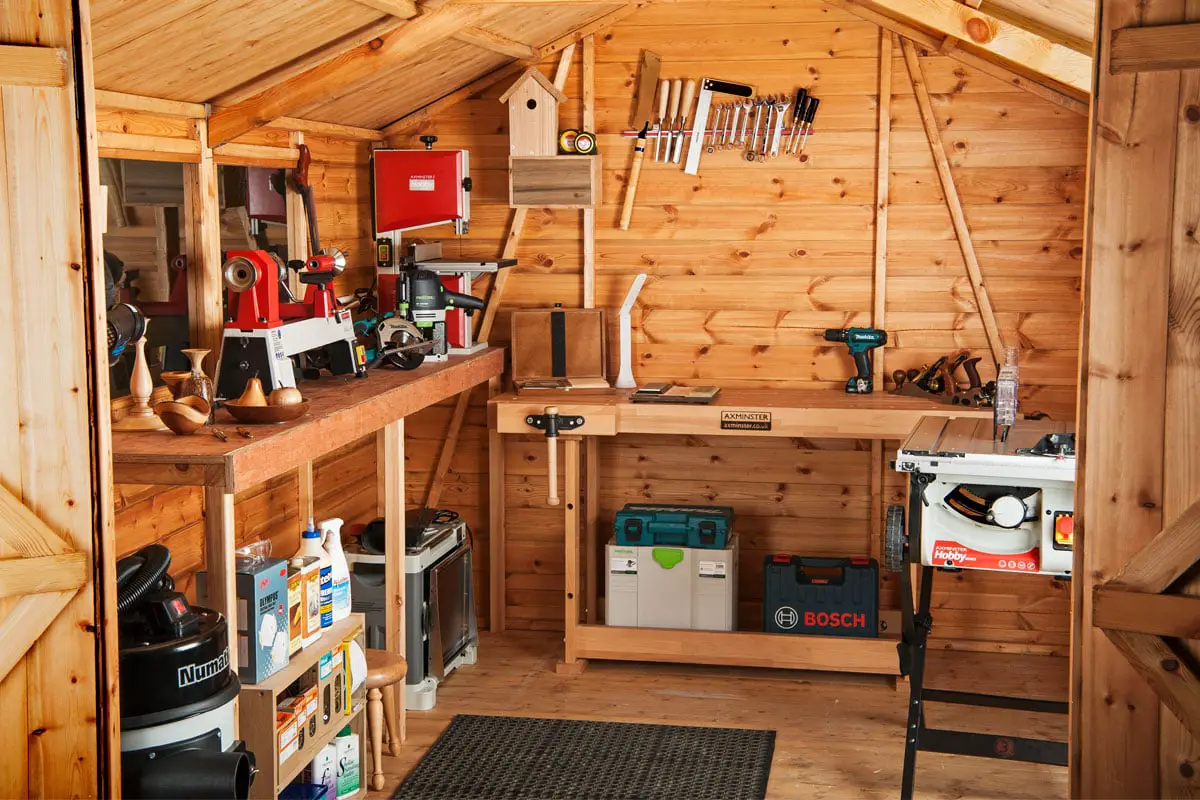
The air in my workshop was thick with the smell of freshly cut oak and something else. Desperation. It wasn’t mine. It was rolling off my family in waves.
My father Richard stood in the center of the room, his expensive suit looking completely out of place against the backdrop of my lathes and saws. His face, usually set in a mask of stern disappointment when he looked at me, was etched with a raw, ugly panic. My brother Marcus, the financial genius of the family, was slumped in a chair I had built with my own hands. He couldn’t even look at me. He just stared at the sawdust on the floor as if it held the answers to the universe. His wife Sophia stood behind him, arms crossed, her perfectly manicured nails tapping a frantic rhythm against her silk blouse. My mother Helen was positioned at my father’s side, eyes red-rimmed, darting between the two of us like a cornered animal.
Then there was me and my wife Eleanor. We stood together near the large workbench that was the heart of the studio.
My father slid a thick manila folder onto the workbench. The sound cut through the silence like a gunshot.
“Charles,” he said, his voice strained, trying to sound authoritative and failing. “We don’t have time for games. This is everything your brother needs. You just have to sign.”
I didn’t touch the folder. I knew what was inside. A contract to sell this workshop, this land, the only place I had ever felt truly myself. The land that had been in my mother’s family for generations, gifted to me because I was the only one who ever cared about it.
“I already gave you my answer,” I said, my voice low and steady.
“Your answer is unacceptable,” my father boomed, his composure finally cracking. “Family is everything, Charles. Don’t you understand that? Marcus made a mistake. A big one. But he’s your brother. You have a duty.”
A duty. The word hung in the air, heavy and suffocating.
My entire life had been measured against Marcus. His stellar grades, his Ivy League degree, his high-paying job on Wall Street. And then my life. My passion for woodworking was seen as a hobby. My choice to live simply was a constant source of embarrassment to them.
“Family doesn’t treat each other the way you’ve treated us,” I said, looking from my father’s furious face to my brother’s pathetic one.
My father’s jaw tightened. He realized that yelling was not going to work. He turned his attention onto the one person he believed was the weak link.
“Eleanor,” he said, his voice dripping with condescending paternalism. “Talk some sense into your husband. You’re a smart girl. You must understand the gravity of this situation.”
Eleanor, who had been silent the entire time, took a single step forward. She was calm, her hands clasped loosely in front of her. She looked my father directly in the eye. A small, almost imperceptible smile touched her lips as she spoke.
“I think there’s been a major misunderstanding here, Richard.”
Everything stopped.
The way she said his name without the respectful Mr. Blair or even Dad sent a ripple of shock through the room. My father stared at her, utterly speechless.
To understand that moment, you need to know how we got there.
It started five years ago, at our wedding.
Eleanor and I got married right here on this land, under the shade of a massive ancient oak tree whose branches felt like they were holding the sky up just for us. We didn’t want a stuffy, expensive affair. We wanted something that felt real. We had hay bales for seats, wildflowers in mason jars, and a barbecue pit sending delicious smells through the air. Our friends were there, laughing and dancing and celebrating. It was everything I had ever dreamed of.
And then it was time for the best man’s speech.
My brother Marcus stood up, tapping a champagne flute with a spoon, a smug smile already playing on his lips. He was in his element, center of attention, looking handsome in his tailored suit, a stark contrast to my simple linen shirt.
“To Charles and Eleanor,” he began, raising his glass.
The crowd cheered.
“I have to admit, when my little brother told me he was getting married, I was surprised. I always thought his one true love was a block of wood.”
A few scattered, uncomfortable laughs rippled through his side of the family. My friends stayed silent.
“But then I met Eleanor, and I understood. She’s earthy.”
He said the word like it was something you’d find on the bottom of your shoe.
I felt Eleanor’s hand tighten in mine. She gave me a small, reassuring smile, but I could see the hurt in her eyes. She was a brilliant environmental scientist, a woman who could name every tree and bird on this property, who felt more at home in nature than anywhere else. To Marcus, that just meant she was unsophisticated.
He wasn’t done.
“I remember when we were kids, Charles was always building things. Little forts, lopsided tree houses. I was busy building a stock portfolio with my allowance.” He paused for laughter. “But hey, to each his own. I guess some of us are destined to build empires and others are destined to build birdhouses.”
The humiliation was a physical thing. I looked over at my parents. My mother was smiling weakly, pretending this was all good-natured ribbing. My father had a look on his face I knew all too well. A mixture of disappointment and resignation. The look that said: this is the son I have to put up with.
When my father stood for his toast, it was even worse. He cleared his throat and avoided my gaze.
“Charles has always been unique,” he started. “He’s chosen a simpler path. We wish him and Eleanor all the best in their endeavors.”
It sounded more like a eulogy for my ambitions than a wedding toast.
Later that night, as Eleanor and I danced under the string lights, she rested her head on my shoulder.
“Don’t let them get to you,” she murmured.
“It’s not me I’m worried about,” I said, holding her tighter. “I’m sorry, Ellie. I’m so sorry.”
She pulled back and looked me in the eyes, her gaze fierce.
“Don’t you ever apologize for them or for us. What we have is real. It’s solid. It’s oak.” She tapped my chest. “They’re just particle board.”
I laughed, a real genuine laugh that broke through the tension. She was right.
But I made a silent toast of my own that night. To family, I thought, with a bitterness that surprised me, and to learning who really has your back when it matters.
I had no idea how much it was about to matter.
Three years passed. Marcus and his wife Sophia were hosting a summer party at their massive mansion in the Hamptons. We were expected to attend, and refusing would have started a family war I was too tired to fight.
I spent a week crafting the perfect housewarming gift: a small coffee table made from a gorgeous piece of reclaimed cherry wood, intricate dovetail joints, a finish so smooth it felt like silk. I was proud of it. It was a piece of my soul.
Sophia greeted us at the door.
“Charles. Eleanor. So glad you could make it.” Her smile didn’t reach her eyes. She glanced at the table in my hands. “Oh, how rustic.” She took it from me like it was contaminated, handing it off to a member of the catering staff. “Just put this somewhere in the back. Maybe near the patio.”
I watched the caterer tuck it away in a corner next to a trash can.
The evening was a masterclass in condescension. Marcus paraded me around to his finance friends like a court jester.
“This is my little brother Charles,” he’d say with a theatrical sigh. “He’s the artist in the family. Works with his hands. Can you imagine?”
Eleanor tried her best to make conversation, but her stories about a soil regeneration project she was working on were met with blank stares and polite, dismissive nods. They didn’t care about the earth. They only cared about what could be extracted from it for profit.
The low point came when Marcus was holding court in the living room, bragging about a recent investment.
“It’s all about foresight,” he declared, puffing out his chest. “You have to know which companies are dinosaurs ready to fail and which are the future.”
He turned his gaze directly on me. “Speaking of dinosaurs, how’s the whittling business, little brother? Still playing in the dirt?”
The room went quiet. My face burned. For a second I had nothing.
But then Eleanor’s voice cut through the silence, cool and clear.
“At least we sleep well at night, Marcus,” she said, taking a calm sip of her water, “without worrying about whose retirement fund we just gambled away.”
You could have heard a pin drop.
Marcus’s face went from smug to thunderous. Sophia gasped dramatically. My mother shot Eleanor a look that could curdle milk.
It was the first time anyone had ever pushed back. The first shot fired in a war I didn’t even know we were fighting.
As we left that evening, my younger sister Laura pulled me aside.
“That was intense,” she whispered. “But she’s not wrong to be worried. I hear things. Be careful, Charles. I think Marcus is in deeper than he lets on.”
Her warning was vague, but it planted a seed of unease.
As we drove away from that soulless mansion, leaving my handcrafted table behind in the dark, I couldn’t shake the feeling that my brother wasn’t building an empire. He was building a house of cards. And the wind was starting to pick up.
Another year crawled by. The distance between my family and me grew wider. We stopped getting invited to the fancy parties, which was a relief. The only communication was stilted holiday calls and occasional passive-aggressive texts from my mother asking why we never visited.
Life at the workshop, however, was better than ever. I was getting commissions from architects and designers who appreciated the work. Eleanor was deeply involved in her research, spending long hours in her small lab at the back of our property, a place no one in my family even knew existed. They assumed she was a simple gardener.
We were building a quiet, solid life based on things that mattered to us.
Then one rainy Tuesday afternoon, my phone rang. It was Laura. Her voice was trembling.
“Charles, are you alone?”
“Yeah, I’m in the workshop. What’s wrong?”
“It’s Marcus. It’s bad. Really bad.” She took a shaky breath. “I was at Mom and Dad’s last night. They thought I was asleep, but I heard them talking. Marcus lost everything. Not just his own money. His clients’ money. Dad was talking about legal liability. Marcus made a huge leveraged bet against some new tech company, and it blew up.”
My mind flashed back to the arrogant speech at the party. You have to know which companies are dinosaurs ready to fail.
“Why are you telling me this, Laura?”
“Because they’re going to come to you,” she whispered frantically. “Dad said you were the only one with a real asset. He was talking about the land, Charles. He said you owed it to the family.”
The sheer audacity of it left me breathless. For years they had mocked this land, mocked my life. And now that their golden boy had failed, they saw it as their salvation. Something they were entitled to.
“He can’t be serious,” I muttered.
“He is,” she insisted. Then I heard her mother’s voice in the background. Laura stammered a goodbye and the line went dead.
I stood there in the silence of my workshop, rain drumming on the tin roof. The seed of unease Laura had planted a year ago had just sprouted into something monstrous, wrapping itself around my throat. They were coming. After years of neglect and ridicule, they were coming to demand I sacrifice my world to save theirs.
And I had no idea that the truth of the situation was a hundred times more complicated and a thousand times more satisfying than I could have imagined.
That little tech company he had bet against. I still had no idea what it was. But I was about to find out.
The summons came two days later. A call from my mother, her voice artificially bright.
“Charles, darling, we’re having a family meeting on Sunday. Brunch. It’s very important that you and Eleanor are both here.”
It wasn’t a request. It was a royal decree.
We went. If I didn’t face them then, they would just show up at our home. And I needed to end this on terms I controlled.
Sunday arrived gray and overcast.
My parents’ house felt alien and hostile. Marcus and Sophia were already there, looking like they had aged ten years in a few weeks. My father was pacing in front of the fireplace. My mother was wringing her hands on the sofa. There was no brunch.
My father didn’t build up to it. He dropped the bomb.
“Marcus is facing financial ruin,” he announced. “Through a series of unfortunate, unforeseen market events, he has found himself in a precarious position.”
“Unforeseen?” I scoffed. “Or just incredibly stupid.”
His eyes flashed. “This is not the time for childish resentment. Marcus’ clients, good friends of mine, have lost their entire retirement savings. There is the very real threat of lawsuits. He could lose his license. He could even face prison.”
My mother started crying softly into a tissue.
Then my father turned to me, his gaze pinning me to my chair.
“There is a solution,” he said, his voice dropping to a conspiratorial tone. “The land your grandmother left you has been appraised. In this market, it’s worth a small fortune. Enough to cover Marcus’ losses and make his clients whole again.”
I stared at him. He said it so easily, so casually, as if my home and my business and my entire life were just a line item on his personal balance sheet, ready to be liquidated.
“No,” I said.
The word was quiet, but it echoed in the room.
“What did you say?” my father asked, disbelief coloring his features.
“I said no.” I stood up. “Absolutely not. You spent my entire life making me feel worthless because I chose this path. And now you want to burn it all down to fix his mess. The empire builder.”
“This is not about your feelings,” my father roared. “This is about the family name. This is about your brother’s future. Think of his children.”
“He should have thought of that before he gambled with other people’s money,” I shot back.
My mother stood up, eyes pleading. “Charles, please. He’s your brother. It’s just a piece of dirt with a shed on it. What you do is a hobby. This is his life. His actual career.”
A hobby.
After all these years. All my hard work, my artistry, my sweat and sacrifice. A hobby.
A switch flipped inside me. The part of me that had always craved their approval, that had always felt the sting of their disappointment, simply died.
“We’re leaving,” I said.
As we walked to the door, my father’s voice followed us.
“You have until the end of the week to come to your senses. Don’t you dare turn your back on this family.”
I didn’t look back. I just closed the door behind me.
The drive home was silent. I gripped the steering wheel so tightly my knuckles went white. Eleanor didn’t press me to talk. She just rested her hand on my knee. A simple grounding gesture that said everything I needed to hear.
When we finally pulled up to our house, I sat staring at my workshop through the windshield.
“They really don’t see me, do they?” I said, my voice raspy. “After all this time, they look at me and see nothing of value.”
“They don’t see you because they’ve never tried to look,” Eleanor said softly. “They see you as a reflection of themselves. And because you’re not a mirror image of what they value, money, status, power, they think you’re flawed. But that’s their blindness, Charles. Not your flaw.”
She was right. I knew she was right.
“What are you afraid of?” she asked.
I thought about it for a long moment. “I’m afraid that if I cut them off, if I say no for good, I’ll be completely alone. That they’ll finally have proof that I’m the selfish, worthless son they always thought I was.”
Eleanor reached out and cupped my face in her hands.
“You will never be alone. You have me. You have a life you built with your own two hands. And you are not selfish for protecting it. You are not selfish for refusing to be set on fire to keep them warm. They made their choices. Marcus made his. Now you have to make yours.”
Her words cleared the fog of guilt and obligation from my mind.
That evening I called my father. He picked up on the first ring.
“My answer is no,” I said, my voice steady as the oak tree outside my window. “I will not be selling my home or my business. This is the last time I will say it.”
There was a moment of stunned silence. Then a low guttural sound of pure rage.
“You will regret this,” he hissed. “You are no son of mine.”
He slammed the phone down. It hurt. It hurt more than I expected. But beneath the pain there was something else. A foundation. Solid and unshakable. For the first time in my life, I hadn’t bent to their will.
The days that followed were eerily quiet. A cold war had begun.
I was sanding a piece of maple, trying to lose myself in the rhythm of the work, when Eleanor came into the workshop holding two mugs of coffee. She had a look on her face I had never seen before.
“I think it’s time you knew the whole story,” she said, handing me a mug.
“The whole story about what?”
“About me. About my work. About what I actually do in that lab of mine all day.”
I had always respected Eleanor’s privacy. I knew she was a scientist, that she published papers in journals I couldn’t understand. I just thought of it as her passion, the way woodworking was mine.
She pulled out her laptop and sat beside me.
“You know my field is material science with a focus on sustainable polymers,” she began. “For the past six years, I’ve been working on something. A new way to treat wood. Not just a surface finish, but a cellular-level infusion. It makes any type of wood incredibly strong, fire-resistant, and weatherproof, while being completely non-toxic and biodegradable.”
She showed me charts, graphs, three-dimensional models. It was way over my head, but I could grasp the essence. It was revolutionary.
“Two years ago,” she continued, her voice steady, “I secured seed funding from a venture capital firm specializing in green technology. I founded a company. It’s called TimberForge Innovations.”
The name sounded vaguely familiar. I was sure I had seen it mentioned somewhere.
“The company has been operating in stealth mode, which is why I’ve been quiet about it. We’ve been perfecting the formula and filing patents. We now have seventeen patents, domestic and international. Our latest valuation from six months ago was $50 million.”
I just stared at her, the coffee mug frozen halfway to my lips.
Fifty million dollars.
My brilliant, humble, down-to-earth wife was the founder of a fifty-million-dollar company.
“Why didn’t you tell me?” The question came out as a whisper.
“Because I didn’t want this.” She gestured vaguely at the world outside our peaceful bubble. “I didn’t want money to change us. I didn’t want your family to suddenly treat you differently because of my success. I wanted what we have to be about us, about the life we built, not the money we have.” She looked at me, her eyes searching mine. “But now they’ve pushed us. They’ve crossed a line.”
She paused.
“They think they’re coming for a simple woodworker. They have no idea they’re picking a fight with TimberForge. And they have no idea who actually owns this land.”
The next day, we met with a lawyer named Leonard Miller. Small-town, sharp mind, no-nonsense. We sat in his modest office smelling of old books and coffee and laid out the entire story, from the wedding speech to the threatening legal letter. We told him about TimberForge Innovations.
When we got to the part about Eleanor’s company, a slow smile spread across his face.
“So let me get this straight,” he said. “They think this is just a piece of family land that you, the humble carpenter, are selfishly hoarding. And in reality, the land is not owned by you personally, but was legally transferred two years ago as a capital asset to a multi-million-dollar corporation of which your wife is the founder and majority shareholder.”
“Correct,” Eleanor confirmed.
Miller leaned back in his chair, tapping a pen against his desk. “This is a classic case of what we in the legal profession call finding out.”
He explained that their threats were completely empty. The land was a corporate asset. I had no legal authority to sell it even if I wanted to. Any attempt to force a sale would be thrown out of court so fast it would make their heads spin.
“So what do we do?” I asked. “Do we write them a letter back?”
Miller shook his head. “We do nothing. We let them make the next move. They’ve given you a deadline. When that deadline passes, they won’t file a lawsuit. They’ll escalate in a more personal way. They’ll show up.” He looked at me steadily. “And when they do, call me. I’d like to be there.”
Leaving his office, I felt a weight lift from my shoulders. The dread was replaced by a cold, hard certainty. The storm was coming. But for the first time, I felt like I was the one holding the lightning.
The deadline came and went on a Friday. Nothing happened. The weekend was silent. I almost allowed myself to hope they had given up.
But on Monday morning, I saw three cars turning down our long gravel driveway. My father’s Mercedes. My brother’s now-downgraded Lexus. And a third car I didn’t recognize.
They were here.
I shut off my table saw, walked to the house, and found Eleanor by the window watching them pull up. She was holding her phone.
“It’s time,” she said.
She pressed a button. “Leonard. They’re here.”
They didn’t knock.
My father pushed the workshop door open with a shove, as if he already owned the place. He strode in, followed by my tear-streaked mother, a pale and trembling Marcus, and a stern-looking man in a pinstriped suit carrying a briefcase. Their lawyer.
My father slid the manila folder onto the workbench and told me we were done talking. Their lawyer stepped forward with professional coldness and explained that a developer was eager to acquire the parcel, that funds would be transferred to escrow to handle my brother’s obligations, that it was a clean solution to a messy problem.
“It’s not a solution. It’s theft,” I said. “And I already told you no.”
My father launched into it then, everything he had been holding back. After everything we’ve done for you. Family crisis. Family name. Your brother’s future.
“You have until the end of the week to come to your senses,” he repeated.
I told him what he’d actually done for me. Belittled me, undermined me, made me feel like a failure my entire life. I told him what he had taught Marcus, and what that teaching had produced.
Then he turned to Eleanor.
“Talk some sense into your husband. You’re a smart girl.”
And Eleanor stepped forward.
“I think there’s been a major misunderstanding here, Richard.”
The room went dead silent.
She walked slowly to the workbench and placed her hands flat on the smooth wood.
“This folder is completely useless. The premise of your entire plan is flawed. You’ve made a very common mistake. You’ve judged a book by its cover.” She looked from my father to Marcus. “You looked at us and saw a simple carpenter and his quiet wife. You assumed we were poor, powerless, and easy to intimidate. You are wrong on all counts.”
She turned to their lawyer.
“I’m sure you’re a competent attorney, so you must understand the basics of property law. You can’t sell what you don’t own. And Charles does not own this land. Not anymore.”
Their lawyer frowned. “The deed is in his name from an inheritance.”
“The deed was in his name,” Eleanor corrected him smoothly. “Two years ago, as part of the initial capitalization of my company, Charles transferred this property to TimberForge Innovations LLC as a capital asset in exchange for a minority stake. I am the founder and majority shareholder of that company. Therefore, legally, I control this land, and I can assure you I am not selling.”
The color drained from my father’s face. Marcus looked like he had been punched in the gut. Their lawyer’s jaw went slack.
“TimberForge,” he stammered. “The material science startup. I’ve read about them. They’re significant.”
“We are,” Eleanor said with a nod. “And that brings me to the second and far more ironic part of this misunderstanding.”
She fixed her gaze on Marcus, and her voice became ice.
“You see, Marcus, a cornerstone of your investment strategy is to bet against companies you believe will fail. Shorting the stock. You look for what you perceive as weakness and try to profit from its collapse. My lawyers did some digging. They were very interested to learn that the single largest, most catastrophic loss in your portfolio, the one that wiped you and your clients out, was a massive leveraged short position against an emerging green tech company you were convinced was all hype.”
She let the silence stretch.
“You bet the farm on the failure of TimberForge Innovations. My company. You tried to profit from destroying my life’s work, and in doing so, you destroyed yourself.”
The confession was written all over my brother’s ashen face. He had, in his arrogance and blindness, become the author of his own demise. My father looked at Marcus, then at Eleanor, his mind struggling to process the sheer poetic justice of it all. My mother just covered her mouth with her hand.
Then, before anyone could speak, a sleek black town car pulled up the driveway.
A man in an impeccably tailored suit got out and walked into the workshop, his eyes scanning the scene before landing on Eleanor.
“Dr. Stone,” he said, his voice carrying an easy authority. “Julian Croft. A pleasure to finally meet you in person.”
He extended his hand. Eleanor shook it warmly.
“Mr. Croft. Welcome to our humble headquarters.”
“Humble, perhaps, but the source of genius,” he replied with a smile. He glanced at my stunned family, then back at Eleanor. “Is this a bad time? I’m eager to sign the final papers for our partnership. A $15 million deal to make TimberForge the exclusive supplier for our new line of sustainable architecture isn’t something I wanted to leave to my assistants.”
Fifteen million dollars.
The number hung in the air, a final definitive nail in the coffin of my family’s arrogance. The look on their faces was something I will never forget. It wasn’t just shock. It was the complete soul-crushing obliteration of their entire worldview. Their notions of success, of power, of who held the cards, all of it evaporated in an instant.
The lowly carpenter and his country girl wife were not on the bottom rung of the ladder.
They were the ladder.
Julian Croft, blissfully unaware of the family drama he had walked into, was all business. Eleanor led him to a clean table in the corner. They began going over documents, their voices a calm murmur of contractual terms and delivery schedules.
My father stood frozen, his face a mask of gray disbelief. He looked at me and for the first time in my life I saw no anger, no disappointment, no judgment in his eyes. Just nothing. The hollow gaze of a man whose foundations had been turned to dust.
Marcus finally broke. He staggered back and collapsed into the chair, burying his head in his hands. A dry, racking sob escaped his lips. Their lawyer packed his briefcase quietly, gave my father a slight apologetic nod, and slipped out without a word.
My mother went to Marcus and put a trembling hand on his shoulder. She looked up at me, her eyes swimming with a desperate, pathetic plea.
“Charles,” she whispered. “Even so, he’s still your brother. You could still help him. Loan—”
“No,” I said, my voice cutting through her whispers. “This was never about money, Mom. This was about respect. And you have shown us none. You came into my home not to ask for help, but to demand a sacrifice. You saw my life’s work as nothing more than a cash machine to fix his failures.”
I walked over to them and looked down at my broken brother.
“You didn’t just bet against a company, Marcus. You bet against me. You’ve been betting against me my whole life. You finally lost.”
I turned to my father, who still hadn’t moved.
“And you taught him how. You taught him that what I do has no value. You taught him that I was less than him. This is your failure as much as it is his.”
I took a step back.
“Get out. Get out of my workshop. Get out of my life. The next time you hear from me will be through my lawyer, to discuss the formal dissolution of any and all family ties.”
My father flinched as if I had struck him. My mother let out a small gasp. Marcus continued to sob.
Slowly, painfully, they gathered themselves. My mother helped Marcus to his feet and they shuffled out of the workshop like ghosts, moving past the corner where a multi-million dollar deal was being signed as if they could not bear to look at it.
My father was the last to leave. He paused at the door, turning back to look at me. His mouth opened as if to say something, but no words came. He just shook his head, a broken man, and closed the door behind him.
The silence that fell was profound. The silence of a battlefield after the war is over.
Julian Croft and Eleanor finished their business a few minutes later. He shook my hand firmly.
“You have a remarkable wife, Mr. Stone, and a beautiful workshop. I hope we’ll be seeing more of your work in our projects.”
“I hope so too,” I managed.
After he left, Eleanor came and stood beside me. She didn’t say anything. She just slipped her hand into mine.
The storm had passed. The wreckage was immense. But we were still standing.
The six months that followed were a blur of activity and a strange, quiet peace. The absence of my family’s drama was like the end of a constant low-grade headache I didn’t realize I had until it was gone.
TimberForge Innovations exploded out of stealth mode. The partnership with Julian Croft put them on the map. Articles were written, awards were won. My brilliant wife, Dr. Eleanor Stone, became a sought-after speaker at technology and environmental conferences around the world.
My own life changed dramatically but in a way that felt authentic. My workshop became the official research and development hub for TimberForge. I became head of artisanal prototyping, a title Eleanor and I laughed about as we made it up. But it was real. I was no longer just a carpenter. I was an artist and an innovator working with a material that was changing an industry. Architects and designers were now commissioning pieces with our proprietary wood. My work was finally being seen, valued, and celebrated.
We heard snippets about my family through the grapevine. Marcus had declared bankruptcy. He was facing multiple lawsuits from former clients and an investigation by the SEC. They had to sell the mansion in the Hamptons. My parents sold my childhood home to cover legal fees. They were living in a small rented condo somewhere.
I felt a distant sadness. Not for them exactly, but for the family we could have been. I felt no guilt.
One crisp autumn afternoon, I was sketching a new chair design when a small unfamiliar car pulled up the driveway. It was my sister Laura. She looked nervous, clutching her purse like a shield.
I walked out to meet her.
“Can we talk?” she asked, her eyes welling up.
I led her to the porch swing I had built, the one my mother had once called a waste of good lumber.
“I’m so sorry,” she began. “I was a coward. I knew what they were doing was wrong, but I was scared of Dad’s anger, of Mom’s disappointment. I stood by and let it happen.”
I looked at my little sister, really looked at her, and I didn’t see an enemy. I saw someone who had been trapped in the same toxic system I had been. She just hadn’t found her way out yet.
“I know,” I said quietly.
We talked for over an hour. She told me about the fallout, the screaming matches, the blame, the sheer misery of their new lives. Marcus and Sophia were in the middle of a nasty divorce. The family was completely shattered.
Then she looked at me with an expression that said she was about to share one final ugly secret.
“There’s something else you should know,” she whispered. “The reason Dad was so completely over the edge. It wasn’t just about protecting Marcus or the family name. Marcus had convinced him to make one last big investment to try and cover the initial losses. Dad took out a second mortgage on the house and gave Marcus almost his entire retirement fund. Thirty years of savings. The money that was supposed to be their inheritance to us someday. It was all in that same TimberForge bet. So when Marcus went down, he took Dad down with him completely.”
The final piece clicked into place. It hadn’t just been pride. It had been pure animal panic. My father wasn’t just trying to save his favorite son. He was trying to save himself.
It didn’t excuse his actions. Not by a long shot. But for the first time, I understood them.
When Laura left, she gave me a fierce hug.
“I’d like to still be your sister,” she said. “If you’ll have me.”
“I’d like that too,” I told her, and I meant it.
It has been a year since that day in the workshop.
The late afternoon sun is casting long shadows across the fields as Eleanor and I walk hand in hand down the path toward the old oak tree where we were married. The air is cool and smells of damp earth and possibility.
TimberForge is thriving beyond our wildest dreams. But that is not what I think about in these quiet moments. I think about how different my life is. Not because of the money, but because of the peace. The quiet confidence that comes from living a life that is truly your own.
My workshop is still my sanctuary, but it is no longer a fortress I hide in. It is a place of creation, of joy. My relationship with Laura is slowly rebuilding, one honest conversation at a time.
As for the rest of my family, there is only silence. I don’t know if I’ll ever speak to them again. Maybe someday, if they ever truly understand the damage they caused. But I have stopped looking for that day. I have stopped looking for their approval, because I finally found my own.
I look at Eleanor, her face bathed in the golden light of the setting sun, and my heart feels full.
“Thank you,” I say, my voice thick with emotion. “For believing in me, even when I didn’t believe in myself.”
She stops and turns to face me, her eyes smiling.
“I didn’t believe in you, Charles,” she says softly. “I knew you. There’s a difference.”
And in that moment, I understand.
True value isn’t something that’s given to you by others. It’s not measured in dollars or job titles or the approval of your parents. It’s something you build within yourself, joint by joint, day by day. It’s about knowing who you are and having someone by your side who sees you, truly sees you, and loves you for it.
My family thought I was building birdhouses.
But all along, with Eleanor by my side, we were building an empire. A real one. An empire of integrity, of love, and of peace.
That’s a fortune no market can crash.
Specialty: Emotional Turning Points
Rachel Monroe writes character-driven stories about betrayal, second chances, and unexpected resilience. Her work highlights the emotional side of family conflict — the silences, the misunderstandings, and the moments when someone quietly decides they’ve had enough.