My grandmother’s handwriting was small and careful, the cursive of a woman who had learned penmanship in an era when it was considered a form of character. I know this because I have spent the past year reading everything she ever wrote, every grocery list left on the counter, every birthday card that arrived without fail, every note tucked into the things she left behind for me to find. The handwriting never varied. It was the same at eighty-one as it had been at forty, unhurried and precise, the script of someone who understood that how you put words on a page is itself a kind of statement about who you are.
My name is Leah Sanderson. I am thirty-one years old. My grandmother’s name was Ruth, and she was the quietest person I have ever known, and she was also the most deliberate, and it took me the better part of a year after her death to understand that these two qualities were not separate things but the same thing expressed differently depending on the situation.
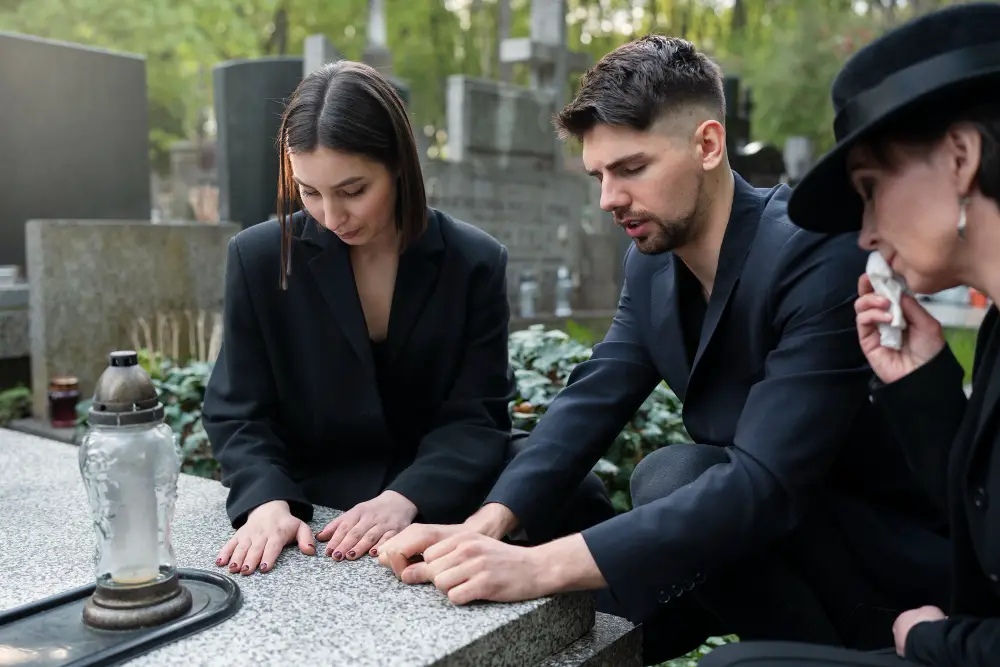
Let me start at the grave, because the grave is where everything that had been building for years became visible at once.
The funeral was held at Grace Lutheran, the small stone church on Main Street in Millfield, Ohio, where my grandmother had attended services every Sunday for four decades. About sixty people came, which in a town of four thousand is essentially everyone. My father, Gerald Sanderson, delivered the eulogy in a dark suit I had never seen before, his voice catching carefully on certain words, his posture the posture of a man who understands that he is being watched and wants to be seen doing this correctly. He said his mother had lived a simple life and that she hadn’t had much but she had love and that was what mattered. Several women behind me whispered that he was a devoted son. Donna, his wife, dabbed at her eyes in the front pew with the practiced grief of someone who has understood that the performance is part of the occasion. My father’s stepson Kyle stood in the parking lot afterward and took a selfie beside his car.
At a funeral.
I noticed, in the back row, a man I had not expected to see. Gray-haired, quiet suit, the particular stillness of someone who is present for a specific purpose and is waiting for the right moment to fulfill it. His name was Warren Holt. He was an attorney. He caught my eye once and nodded, a single small motion that I did not yet understand.
At the cemetery, when they had lowered the casket and the October wind was pulling at everyone’s coat hems and scattering dried leaves across the fresh earth, Warren Holt stepped forward. He approached me, not my father, and extended a manila envelope.
My father’s hand shot out and took it before I could.
He tore it open. Inside was a savings book, brown cover, yellowed pages, my grandmother’s name on the first line. He flipped it open and read the balance and laughed. Not a small, private laugh but the kind that carries, the kind that wants an audience. He threw the book. It landed on the casket, bounced once, and slid into the mound of loose dark earth beside the grave.
“It’s useless,” he said. “Four thousand dollars. Let it stay buried with her. That’s all she ever had.”
Donna’s hand went to her mouth but I could see the smile behind her fingers. Kyle had his phone out and was recording. He laughed about how four thousand was what he spent in a month.
Sixty people. The quiet of a held breath. Nobody spoke.
I stood very still for a moment. Then I stepped to the edge of the grave, knelt down, and picked the savings book up from the dirt. I brushed it off carefully, with both hands, the way you handle something that deserves to be handled with care. I put it in the inside pocket of my coat, over my heart.
My father watched me.
“You want that junk? Fine. That’s your inheritance. Don’t come asking me for anything else.”
I did not say anything. I did not need to say anything yet.
What he did not know, and what I had been careful not to reveal in the hour since Warren Holt had appeared in the back pew, was that I already had another copy of the savings book. I had found it two days earlier, in the top drawer of my grandmother’s writing desk, tucked alongside a slip of paper in her handwriting that said: Bring this to the bank. Ask for Janet. The book opens the door. Grandma.
She had left me two copies. One for Warren Holt to hand over at the cemetery, knowing exactly what my father would do with it, and one hidden where she knew I would find it, locked in the desk she had always kept locked, the lock now broken because my father had been through the house before her body was cold. He had searched for an hour, opening drawers and shoeboxes and folders, while she was still in the bedroom. He had found nothing.
He had been looking for the wrong kind of document.
Before I tell you what was in that trust, I need to explain what it was like to grow up in Gerald Sanderson’s house, because the trust was not just a financial instrument. It was an answer to a question about character, and to understand the answer you need to understand what prompted it.
My mother died when I was ten. Car accident on a Tuesday morning. My father tried for a while, genuinely tried, and then he stopped. He sent me to live with Grandma Ruth for three years while he got back on his feet. When he married Donna, he brought me home, not because he missed me but because Donna said it would look bad if his daughter lived with his mother.
Donna’s son Kyle got the large bedroom. I got the room beside the garage, one window and a heater that worked inconsistently. Kyle got a truck at sixteen. I bought a twelve-year-old Civic with waitressing money. Donna told neighbors they treated all their children the same and told my father, behind closed doors, that his daughter ate there and slept there and contributed nothing. I paid the electric bill every month starting at nineteen. My father never mentioned that.
When I got my nursing degree at twenty-three and started working as a community health nurse, my father told people I was doing fine now, that he had always known I would figure it out eventually. When Grandma Ruth was diagnosed with congestive heart failure in the fall of 2022 and I cut my clinical hours to take care of her, my father told people he was supporting his adult daughter because she couldn’t manage on her own. He visited three times in two years. I drove to her house every Sunday without fail for three years and stayed four days a week during the illness, bathing her, cooking meals she could swallow, driving her to the cardiologist forty minutes away, sorting her medications into the little plastic organizers with the days of the week printed on the lids.
He never mentioned any of that either.
Every few months, my father would call Grandma Ruth and say he wanted to help manage her finances. Every time she said no. Once, after she hung up, I watched her hands shake and she said, without looking at me, that he meant well. She said it in the tone of a woman reciting something she had decided to believe rather than something she actually believed.
In March of 2023, I was sorting her mail at the kitchen counter and saw a bank statement, already open, with a withdrawal of fifteen thousand dollars. I asked about it. She said she had made a mistake and not to worry about it. I let it go. I should not have let it go, but I believed her because she was my grandmother and I had been trained by long habit to take her at her word.
A week later, passing her bedroom, I heard her on the phone. Her voice was low and careful, the voice she used when she was being precise about something that mattered. Make sure it’s airtight, Warren, she said. He’ll try. She hung up before I rounded the corner, and that night she held my hand at the kitchen table and said: When I die, take the book in the drawer. Don’t let your father have it. Promise me.
I promised.
She died on a Sunday morning in early October. I drove to her house the same way I always did, radio off, windows down because the air smelled like wood smoke and dry leaves, and I found the front door unlocked and the coffee pot cold and my grandmother in her bed with her hands folded over her old Bible, the room too still, the oxygen machine silent. I sat on the edge of the bed and held her hand. It was already cool.
I called 911. Then I called my father. He arrived two hours later and his first words were: did she have a will.
That evening, after the service, after the grave, I drove to my father’s house and found my clothes in black trash bags on the hallway floor. Three bags, plus a cardboard box with my nursing textbooks stacked on top of my mother’s old quilt. Donna answered the door and told me Kyle needed the room for his home office. My father appeared behind her and said I was thirty-one and it was time to figure it out. I had eighteen hundred dollars in my checking account.
I did not argue. I loaded the bags into my Civic and sat in the driveway for ten minutes. The porch light went off. I called Peggy Callaway, my grandmother’s oldest friend, seventy-four years old and five feet tall with the backbone of someone who had spent thirty years running the county library and had not softened with retirement. She told me to come and asked no questions and said Ruth would have wanted that.
At Peggy’s kitchen table that night, I opened the savings book from the grave, the one with the cemetery dirt still in the spine, and found the slip of paper identical to the one I had already found in the desk. The book opens the door. Go to the bank. Ask for Janet.
I did not sleep.
The next morning I walked into First Commonwealth Bank at nine in the morning in yesterday’s black dress, eyes swollen, hair unbrushed, and asked for Janet. The teller made a phone call and Janet Rios came out within two minutes, mid-forties, reading glasses on a chain, firm handshake, the manner of someone who has worked in banking long enough to have seen most things and learned to respond to all of them with measured care. She led me to a glass-walled office at the back.
I put the savings book on her desk.
She typed the account number, paused, typed it again, looked at her screen, looked at me, looked at her screen. She excused herself and stepped out and through the glass I watched her make a phone call with her hand pressed flat against the wall. When she came back she told me the savings account was linked to a trust. An irrevocable trust. I was listed as the sole beneficiary.
She said she needed to call the compliance department. Then she said she needed to contact the police and asked me not to leave the building.
I asked how much was in the trust.
She turned her monitor so I could see the screen. She pointed at a number near the top.
Two million, three hundred and seventeen thousand dollars.
I read it three times. Then a fourth time because my hands were shaking and I thought I was miscounting zeros.
Janet explained it in the patient, careful voice of someone who understands they are delivering information that will take time to process. The trust had been funded over decades. My grandmother had worked as a bookkeeper at Colton Manufacturing for thirty-one years and contributed steadily to a pension. When my grandfather died in 2005, she received approximately three hundred and fifty thousand dollars in life insurance proceeds. In 2010, she sold eighty acres of family farmland west of town. Midwestern agricultural land had appreciated significantly in the years since her family acquired it; the sale netted just over a million dollars. The remainder was accumulated interest and dividends, carefully managed by the bank as corporate trustee since 2017.
She had lived in an eight-hundred-square-foot house with peeling paint and a creaking porch step.
By choice, Janet said. Not by necessity.
My grandmother had grown up during rationing. She clipped coupons every Thursday. She wore the same three cardigans in rotation and grew tomatoes and canned them every August. She did these things not because she had to but because she had lived through a time when having nothing was a real and present possibility, and she had never let herself forget what that felt like, and she had built, in the space between what she spent and what she had, something that her son had told everyone did not exist.
He had believed what he said. He had never bothered to look deeper. He had looked at the peeling paint and the coupons and the practical cardigans and concluded poverty, and he had been so certain he was right that he had not asked any questions that might have produced a different answer.
The trust was structured, Warren Holt would explain to me two days later in his oak-paneled office on Maple Street, to be as close to unbreakable as the law permits. She had come to him in 2017, sat in the chair where I was now sitting, and said she needed it to be airtight because her son would try. He had designed the trust with a corporate trustee so there was no individual Gerald could pressure or influence, with an irrevocability clause that foreclosed contestation on ordinary grounds, and with a physical activation mechanism that required the beneficiary to present the savings book in person with valid identification. The book was the key because she had calculated, correctly, that Gerald would see four thousand dollars in a decades-old passbook and dismiss it as worthless without a second thought.
He had thrown it onto her casket.
She had bet everything on the probability that I would pick it up.
The police who arrived at the bank that morning were a uniformed officer and a detective from the county fraud division. Janet Rios laid it out for them with the same measured precision she had used with me. In 2023, three withdrawals had been made from a linked checking account using a durable power of attorney in the name of Gerald Sanderson. Fifteen thousand in March, twelve thousand in June, thirteen thousand in September. Total of forty thousand dollars. The power of attorney had been revoked by Ruth Sanderson on January 9th, 2023. Every transaction after that date was unauthorized.
The March withdrawal was the one I had seen on the bank statement at her kitchen counter. The one she had told me was a mistake.
She had known it was not a mistake. She had known her son was stealing from her while she was dying, using a legal instrument she had already revoked, and she had not told me because she did not want me to carry that knowledge while I was still caring for her. Or perhaps because she had already set in motion something that would produce consequences beyond anything a conversation with me could achieve. She had called Warren. She had instructed the bank’s compliance division not to act further for the moment. She had told Warren, in her exact words: let him dig his own grave. The truth will come out when it needs to.
In Millfield, news does not travel. It detonates.
By the following afternoon, half the town had some version of the story. Ruth Sanderson, quiet cardigan-wearing Ruth who clipped coupons and grew petunias, had left her granddaughter a fortune, and her son, the devoted son who had delivered that eulogy with the practiced crack in his voice, had not received a single dollar. My phone began ringing with relatives calling to advise me about fairness and family and the importance of not letting money destroy relationships, which is the language people use when they want you to surrender something you are legally and morally entitled to while framing the request as wisdom.
Gerald hired a lawyer, a man named Dennis Pratt who handled family law and DUIs from a strip mall on Oak Street. Pratt apparently told him the truth about irrevocable trusts and Gerald apparently told Pratt to try anyway. Then came Donna’s campaign, the calls from cousins and aunts and uncles, the suggested fifty-fifty split that various relatives endorsed with the confident fairness of people who had not been present for a single Sunday visit in three years. Gerald organized what Donna called a family meeting, ten relatives at their house, at which Gerald reportedly cried and asked what he had done wrong for his mother to skip him, and Donna proposed a solution that several heads reportedly nodded at.
Then Peggy Callaway drove her small blue sedan to the house, walked to the front door, and spoke six words loud enough for everyone inside to hear. I didn’t learn until the next morning what they were.
I know why Ruth did this.
And then, when Gerald tried to explain that his mother had been losing her mind, she gave him one more sentence. Her mind was sharper than yours ever was, Gerald.
The calls from relatives slowed after that. Not all at once, but noticeably. Aunt Carol, Gerald’s younger sister, told me she was starting to think there was more to the situation than her brother was letting on. The town had a way of doing the math on its own when enough pieces were visible.
The detective called Gerald on a Thursday. Gerald called me fourteen minutes later.
His voice was different from any version I had heard before. The bravado was gone, stripped out of it, leaving something thinner and more afraid.
“Call off the investigation,” he said. “I’m your father. Don’t do this to me.”
“I didn’t start it,” I said. “The bank flagged it when I brought in the savings book. I can’t call off anything even if I wanted to.”
“If I go down for this, it’ll destroy the family. Is that what you want?”
I closed my eyes.
“You destroyed it a long time ago,” I said. “You just didn’t notice.”
Silence. Then the line went dead.
Donna called twenty minutes after that. No more church-fundraiser warmth, no more sweet concern. She told me that if I didn’t drop it they would make sure everyone in Millfield knew I had manipulated a sick old woman to steal from my own father. I told her the truth was on my side and she said truth doesn’t always matter in a town like this, people believe what they want to believe. I said I supposed we would find out.
Gerald filed a petition to contest the trust on grounds of undue influence, claiming I had manipulated my grandmother during her cognitive decline. Warren Holt smiled when he told me about it, the particular smile of a man who has spent forty years in the law and has seen this specific variety of bad decision many times.
He slid three documents across his desk.
The first was a cognitive capacity evaluation performed by my grandmother’s physician in April 2017, the same month the trust was executed. She had scored in the ninety-third percentile. Clear mind, clear intent, documented and signed and dated.
The second was the bank record of the unauthorized POA transactions, establishing that Gerald’s motivation for contesting the trust was financial rather than grief. His own behavior was the most effective argument against his claim.
The third was a video. Kyle’s video, filmed at the cemetery, posted to Facebook with the caption Grandma’s Big Inheritance, LOL. You could see Gerald clearly in it, reading the balance, laughing, throwing the book onto the casket. His voice was unmistakable: It’s useless. Let it stay buried.
“Kyle posted this to mock you,” Warren said. “He handed us the strongest piece of evidence in the case. No judge looking at this video will see a grieving son.”
There was a night when I nearly gave in. It was eleven o’clock at Peggy’s house, the guest room dark, the savings book on the nightstand with the grave dirt dry and cracked in its spine, and I was lying on my back looking at the ceiling thinking about my father before all of this. The one who had put me on his shoulders at the county fair when I was five. The one who had made pancakes on Saturday mornings before my mother died. The one who had sat on the kitchen floor and cried after the phone call, the kind of crying where your whole body shakes.
That man was still in there somewhere. He was just buried under two decades of choices that had accumulated into a person I no longer recognized.
I had my phone in my hand. I was about to call him and say take it, take all of it, I don’t want this anymore.
Peggy appeared in the doorway.
She set chamomile on the nightstand and sat on the edge of the bed.
“Ruth told me something once,” she said. “She said if Leah gives in, Gerald will spend every cent in two years. And then he’ll blame her for not having anything left.”
I put the phone down.
“You’re not fighting him, Leah. You’re honoring her. There’s a difference.”
I looked at the savings book. The dirt was dry now but I could still see a faint fingerprint impression on the cover. My grandmother’s, worn smooth from the thousands of times she had held it over the years she was building what she intended to leave me.
She had not left me money. She had left me a choice. And she had built the architecture around that choice with such care and such patience and such precise knowledge of the people involved that I understood, finally, that the quiet I had always associated with her was not passivity but a form of mastery. She had simply understood that in certain situations, the most powerful thing you can do is wait, and document, and build something unbreakable, and then let the other person’s character do the rest of the work.
Thanksgiving arrived.
An invitation came to the extended family from Donna, group text, all family welcome, time to come together. I was not on the group text. Aunt Carol forwarded it to me with a single line: you should come, family is family.
I knew what it was. Gerald wanted an audience for his version of reconciliation, which meant: pressure delivered in front of relatives, Leah framed as the villain if she said no, the word family deployed as a financial instrument.
I called Warren. He said I did not owe them anything, but if I went, to go prepared. He gave me a summary of the trust’s legal standing, the list of unauthorized transactions with dates and amounts, the revocation document. Not weapons, he said. Facts, in case someone asks questions. And if they don’t ask, then eat turkey and leave. But he’d met my father, and my father had never been able to resist a room.
Peggy ironed my blouse the night before. I made corn casserole from my grandmother’s recipe, the one with Ritz crackers on top. Peggy had always been very specific about the crackers.
The house had fifteen people, a table with a white cloth that looked recently purchased, candles, a turkey slightly overdone on one side. Donna had me seated at the far end of the table against the wall. I did not protest. We got through the salad without incident. Then my father tapped his water glass with a butter knife and the room quieted and he began with the standard material, thanks and family and gratitude, and then the turn that Warren had correctly predicted, because Gerald Sanderson had never met a room he did not want to use.
“As many of you know,” he said, “there’s been some confusion about my mother’s estate.”
He looked at his plate. Looked up. His voice had the practiced quality of a man who has rehearsed this.
“My mother was a simple woman. She lived simply, and if she made certain decisions near the end of her life, it was because she was influenced by someone she trusted too much.”
He looked at me.
Fifteen heads turned.
Donna said they just wanted what was fair. Kyle said, mouth full of bread, for me to do the right thing.
Fifteen people, candles, the room waiting for me to fold.
I had spent thirty-one years being the quiet one at the end of the table.
I set down my fork.
I placed my napkin beside my plate.
I stood up.
“You want to talk about what Grandma Ruth wanted,” I said. “Let’s talk.”
I told them about the Sundays. The cardiology appointments. The medications in their little organizers, the sheets changed, the meals she could swallow. I told them my father had visited three times in two years. I said it without anger, just as information, the way you state a documented fact.
I reached into the folder I had brought in with the casserole dish and placed a single sheet of paper on the table where everyone could see it.
“In 2023, someone used a power of attorney to withdraw forty thousand dollars from my grandmother’s bank account. Fifteen thousand in March, twelve in June, thirteen in September. The power of attorney had been revoked on January 9th. Every withdrawal after that date was unauthorized.”
Silence. A fork hit a plate somewhere down the table.
“The police are investigating. The name on the power of attorney is Gerald Sanderson.”
My father’s chair scraped back.
“That’s a lie. She gave me permission.”
“She revoked the permission on January 9th. Every withdrawal after that is fraud. Elder financial abuse under Ohio law. That’s a felony.”
Nobody moved. Nobody reached for the mashed potatoes or refilled a glass. The turkey sat in the center of the table, going cold.
Gerald looked at the faces around him. Every one of them looking back with the slow, uncomfortable expression of people who are recalibrating what they have been defending and finding the recalibration painful.
Donna shot to her feet.
“This is ridiculous. Leah is twisting everything.”
The room did not move.
Aunt Carol spoke, quietly. “Gerald, is it true? Did you forge that power of attorney?”
He stared at the table. His jaw worked. No words came.
That silence was louder than anything he had ever said from a stage.
Donna turned on me with her finger raised and started a sentence she did not finish, because a voice came from the kitchen doorway behind me.
“I wouldn’t finish that sentence, Donna.”
Peggy Callaway stepped into the dining room.
She held a small cassette recorder, old-fashioned, the kind with a mini tape.
“Ruth kept records of everything. Including the voicemail where you told Gerald to clean out the old woman’s account before she changes her mind. January 15th, 2023. Gerald’s voicemail box. Ruth heard it when she was visiting his house. She called me that night. She played it for me over the phone. And she recorded it.”
Donna’s face collapsed.
Aunt Carol turned to Kyle.
“Wasn’t that your video? The one from the cemetery. Gerald throwing the savings book on the casket. You posted it online.”
Kyle’s thumbs were already moving on his phone. Deleting. But screenshots live forever in a small town, and several people in that room had already seen it.
The candles burned. The turkey went cold. Nobody was eating.
I picked up the sheet of paper and folded it.
“I’m not here to humiliate anyone. The facts are on the table. Dad, I’m not giving up what Grandma Ruth left me. Not half. Not a dollar. Because she didn’t leave it to me as a gift. She left it to me as a boundary.”
Gerald’s eyes were wet. Whether from shame or self-pity I could not tell. Perhaps both.
“She knew you wouldn’t take care of her. She knew Donna would push you to take everything. She knew Kyle would laugh. And she still loved you, Dad. She just didn’t trust you.”
I put on my coat.
“I won’t be coming back to this house. You have my number if you want an honest conversation. But I won’t hold my breath.”
I walked out. Peggy followed.
Behind me, the silence of a room full of people recalculating everything.
Gerald was formally charged in the weeks that followed, elder financial exploitation, a third-degree felony under Ohio Revised Code. He withdrew the petition to contest the trust on advice of his criminal defense attorney, who explained in writing that pursuing the civil case while facing criminal charges for the same underlying conduct was legally catastrophic. He took a plea deal in February. Three years’ probation, full restitution of forty thousand dollars to be paid in installments, two hundred hours of community service. It went on his record.
In Millfield, a record follows you to the grocery store.
The plumbing clients began canceling. One by one the phone stopped ringing. Donna’s friends at Grace Lutheran stopped saving her a seat at Wednesday Bible study. Kyle moved to Columbus and did not leave a forwarding address.
I did not report my father. The bank did. I did not leak the story. The town talked. I did not campaign against him. I simply stopped covering for him, and everything else he had built himself.
The trust was officially confirmed in the first week of December. When I left Warren Holt’s office, I drove to Peggy’s house. She was at the kitchen table with two cups of tea, and in front of her was a sealed envelope. Cream-colored. My name in blue ink on the front, my grandmother’s careful cursive, the same small precise hand I had been reading all year.
Peggy said she had promised to wait until it was settled.
I opened it with hands that were not steady.
Three pages of yellow legal paper. Blue pen. The date at the top was six months before she died.
Dear Leah, she had written. If you’re reading this, then I’m gone. And you did what I asked. You kept the book. I knew you would. I knew because you’re the only one who ever kept showing up.
I had to stop.
I kept reading.
I’m sorry I couldn’t give this to you while I was alive. If Gerald knew, he would have found a way to take it. He’s my son, and I love him. But I see who he is. I’ve seen it for a long time. This money isn’t a reward, sweetheart. It’s a head start. Use it to build the life you deserve. The one your mother would have given you if she’d had more time. Don’t hate your father. He’s lost. But don’t sacrifice yourself for his mistakes either. You are allowed to choose yourself.
Love, Grandma Ruth.
P.S. I hope you still make my chicken soup on Sundays.
I folded the letter and pressed it against my chest and cried. The kind where your whole body shakes.
Peggy put her hand on mine and did not say anything. She let me fall apart at her kitchen table, which was what I needed, and when I was done she said there was one more thing. Not in the letter. In the house.
She drove me to my grandmother’s house on Birch Lane. The petunias were dead from the frost. The porch steps creaked the same way they always had. Inside, the air still smelled faintly of lavender and old paper.
Peggy led me to the basement, past the furnace, past the shelf of canned tomatoes from the previous August, to a corner behind the water heater where a small wooden box sat on an old towel. Dark walnut. Carved into the lid in letters smoothed by time and repeated touching was a single name: Emily.
My mother’s name.
I knelt on the concrete floor.
Inside was a journal in my mother’s handwriting, entries from her pregnancy with me. The baby kicked today, one of them read. Right side, just below my ribs. I think she’s going to be stubborn. Beneath the journal, photographs. My parents on their wedding day, my mother laughing, my father looking at her the way young men look at people they are certain are the whole world. My mother holding me as a newborn, still in her hospital gown. A silver bracelet, thin chain. My mother had worn it every day.
At the very bottom, a birthday card. Handwritten. Unfinished.
Happy 11th birthday, my little—
She died six weeks before I turned eleven. She never finished the card.
My father had thrown this box away when he cleared the house for Donna’s arrival. My grandmother had found it in the trash. She had kept it for twenty years, waiting.
I sat on the basement floor in a house that smelled like lavender and canned tomatoes and held my mother’s bracelet against my wrist and understood something that I had not fully understood until that moment. My grandmother had not only protected my future. She had protected my past. The inheritance was not primarily financial. It was the full, documented, carefully preserved evidence that I had been seen and loved and planned for, that someone had believed I was worth protecting even during the years when the people who should have believed this most had been busy believing otherwise.
I used a portion of the trust to buy a house. Nothing grand, a two-bedroom cottage on Birch Lane, six minutes from where my grandmother had lived. White siding. A front porch with room for two chairs. I planted petunias along the walkway in the same variety she grew, because this felt like both tribute and continuity, the right way to occupy a new space.
I went back to work full-time at the clinic. I hired a financial advisor Warren recommended and put together a conservative, long-term plan, the kind my grandmother would have approved of, designed for stability and growth rather than spectacle. I am not rich. I am secure. She taught me the distinction.
Aunt Carol calls every other Sunday now. We are building something slowly, without pretense, which makes it feel real.
My father’s number is not blocked. The door is not locked. But I am not opening it, not yet, and perhaps not ever, and I have made my peace with that uncertainty.
Every Sunday morning I drive to Millfield Memorial Cemetery. I bring fresh flowers, petunias in summer, mums in fall, holly in December. I sit on the bench near her headstone and talk to her. I tell her about my patients, about the house, about the petunias along the walkway. I tell her about the soup.
My kitchen window faces east and the early light comes in long warm stripes across the counter on Sunday mornings when I am standing at the stove. I make the chicken soup with carrots cut thick, not thin, because she was very specific about this. Whole chicken, not parts. She always said parts were for people in a hurry and we were not in a hurry.
On the wall above the stove there is a small frame. Inside it is the faded brown savings book, clean now, the grave dirt gone. Next to it hangs a photograph of my grandmother on her porch, squinting in the sun, wearing clip-on earrings and one of her three cardigans. And next to that, a photograph of my mother, young, laughing, the silver bracelet catching the light on her wrist.
My father threw that book onto a grave and called it useless.
She had spent seven years making sure it was the most important piece of paper I would ever hold.
Not because of the number on the page. Because of what the number represented: thirty-one years of a woman getting up early and staying late and choosing the store brand and growing tomatoes and canning them every August, building something in the patient, incremental way of someone who has decided that the future deserves to be prepared for, even if you will not be there to see what it becomes.
She planned for me when no one else did.
She kept the record.
She left me the key.
And she trusted, absolutely, that when the moment came, I would be the one to pick it up.

Adrian Hawthorne is a celebrated author and dedicated archivist who finds inspiration in the hidden stories of the past. Educated at Oxford, he now works at the National Archives, where preserving history fuels his evocative writing. Balancing archival precision with creative storytelling, Adrian founded the Hawthorne Institute of Literary Arts to mentor emerging writers and honor the timeless art of narrative.