Something Better Than a Husband
There is a particular skill I developed early in my life, and I became so practiced at it that it stopped feeling like a skill and started feeling like a personality trait. The skill was this: managing the space between what was happening and what I needed other people to believe was happening. I learned it at my mother’s kitchen table, watching her explain to visiting relatives why she was crying, and I learned it in the car on the way home from family gatherings, rehearsing with her what we would tell my father’s sister about why we had left early. I learned it so thoroughly that by the time I was an adult, I could apply it to myself without even noticing. I could smooth over a bruise with concealer and a steady voice and convince the people around me, most of the time, that I had no bruises at all.
My mother’s name is Diane, and she is the kind of woman who chairs charity events and writes handwritten thank-you notes and is described by the people who know her socially as gracious, elegant, and poised. These are all accurate words. She is elegant in the way that a city that floods regularly is still beautiful from the right angle. The flooding is not incidental to the city. It is part of its structure. For as long as I can remember, my mother’s cruelty and my mother’s graciousness have been the same thing, deployed toward the same purpose, which is the maintenance of a specific version of reality in which she is always right and anyone who challenges her is hysterical, ungrateful, or simply confused about what happened.
My father understood this. He was a quiet man who loved her and managed her carefully and died of a heart attack when I was twenty-six, which left me as the primary object of the management that he had been providing, because the management was necessary for reasons I did not fully understand until I was older. What I understood as a child was that certain things made my mother’s mood shift in specific, dangerous ways, and that the best strategy was to anticipate those things and prevent them or, when prevention failed, to absorb the consequences and not make them worse by crying or arguing or telling anyone outside the house what had happened. Look what you made me do was a sentence I heard so many times growing up that I could tell you what tone she used for each specific variety of it. The regretful tone. The irritated tone. The one that meant she was embarrassed and needed me to help her reframe the moment before it became a story she had told in the wrong direction.
I moved out at twenty-two, which she framed to her friends as my decision to pursue independence, which was true in the specific and narrow sense that I had decided the only way to survive was to live somewhere she did not have immediate physical access to. I called her twice a week, visited on holidays, attended her charity events, and listened to her opinions about my apartment, my job, my clothes, and my relationships with the careful patience of someone who has learned that patience is cheaper than the alternative. This arrangement worked until Ethan.
I met Ethan when I was twenty-eight, at a fundraiser for a nonprofit where I worked in grant administration. He was a corporate attorney, calm and organized, the kind of person who made every space feel more manageable by virtue of being in it. What attracted me to him in the beginning was exactly that quality. He did not react to things the way I had been trained to expect people to react. He was level. He was rational. He listened to things I told him about my mother and said calm, reasonable things in response, and he did not flinch at the details that had made previous partners uncomfortable, and I mistook his steadiness for safety in the way that people who have grown up inside a certain kind of chaos sometimes mistake the absence of noise for the presence of peace.
We dated for two years and got engaged in the spring. I was happy in the way I had always been happy, which is to say with a significant portion of my attention always directed at managing the variables around me. In this case the main variable was my mother, who had opinions about the engagement and the wedding that she expressed with the confident authority of someone who considers her opinions to be a form of gift. The venue was acceptable but not her first choice. The flowers were lovely but the arrangement at the altar was slightly off. The caterer was adequate. The seating chart was a constant source of revision. I spent the six months between the engagement and the wedding performing the same calibration I had performed my whole life, trying to keep Diane’s involvement in a range that felt manageable while also planning an event that I actually wanted to exist at.
What I told myself, during those six months, was that Ethan was handling it well. He sat through dinners with my mother and said the right things and did not visibly bristle at the way she spoke about my choices. He told me I was doing a good job managing her. He suggested, occasionally, that if I just explained things to her more clearly she would understand, or that if I were more patient with her concerns she would feel heard and stop pushing. These suggestions made me feel, at the time, that he was trying to help. The feeling was real. The interpretation was wrong.
The night before the wedding, my mother arrived at my apartment without calling. This was not unusual. She had a key I had given her three years ago for emergencies and had since redefined the concept of emergency to include most situations in which she wanted access to my space. I was at the kitchen table with a glass of wine and Rachel, my best friend and maid of honor, going over the final timeline for the next day when the door opened and my mother came in carrying her reading glasses and a printed copy of the seating chart that she had clearly been studying with a highlighter.
She wanted my late father’s sister Carol moved to the back. She wanted her country club friends at the second table from the front. She wanted Ethan’s mother, a kind and unassuming woman named Margaret who had been nothing but warm to me since the day we met, placed as far from the head table as the room would allow. I did not know, at the time, why she wanted Margaret away from the front. I would understand it later.
I said no. I said it calmly and directly and without the usual softening. I was tired. I wanted the seating chart to stay as it was. Rachel watched from the other side of the table with the expression she always wore when my mother was in the room, the careful stillness of someone who has been asked not to intervene.
What happened next took about four seconds. My mother grabbed my arm across the table. I pulled back. Her ring struck the outer edge of my left eye. I put my hand to my face. She stood very still for a moment in the specific way she went still after something like this, waiting to see what shape the next few minutes would take. Then she said, with the measured sadness that always followed, that I had caused this by being difficult, that she was simply trying to help, and that I needed to pull myself together because tomorrow was an important day.
Rachel drove her out of the apartment. I sat alone at the kitchen table with a bag of frozen peas against my face and my phone in my hand, trying to decide whether to call Ethan. I called him. He picked up immediately and I told him what had happened and he was quiet in the way he was sometimes quiet, the way I had always read as him thinking carefully about what to say. He told me to put ice on it and try to sleep and he promised we would deal with everything together after the ceremony. There would be time to address it properly, he said, once the wedding was done and we were past the immediate pressure of the day. He said it so reasonably that I believed him. I needed to believe him. I packed the ice against my eye and went to sleep in the apartment that still smelled of my mother’s perfume and told myself it would be all right.
Rachel came back at seven in the morning and found me in the bathroom with the concealer, doing what I had always done. She stood in the doorway and watched for a moment without speaking. Then she said my name, and her voice had the quality it sometimes had when she was choosing her words very carefully. She asked if I wanted to call the wedding off. I said no. She asked again, differently. I said I needed to see how the morning went.
Before I left for the venue, Rachel took photographs. She did this quietly, without making it into a thing, because she is the kind of friend who has been watching from the second table long enough to know how to be useful in a moment without making the moment more complicated. She photographed my face with timestamp enabled on her phone. She photographed the screenshots I showed her of messages from my mother from the previous evening, including one that said cover your face and stop being dramatic, sent thirty minutes after she had left my apartment. She put the photographs in a small envelope that she tucked into my bouquet. I did not ask her to do this. She simply understood that it might be necessary.
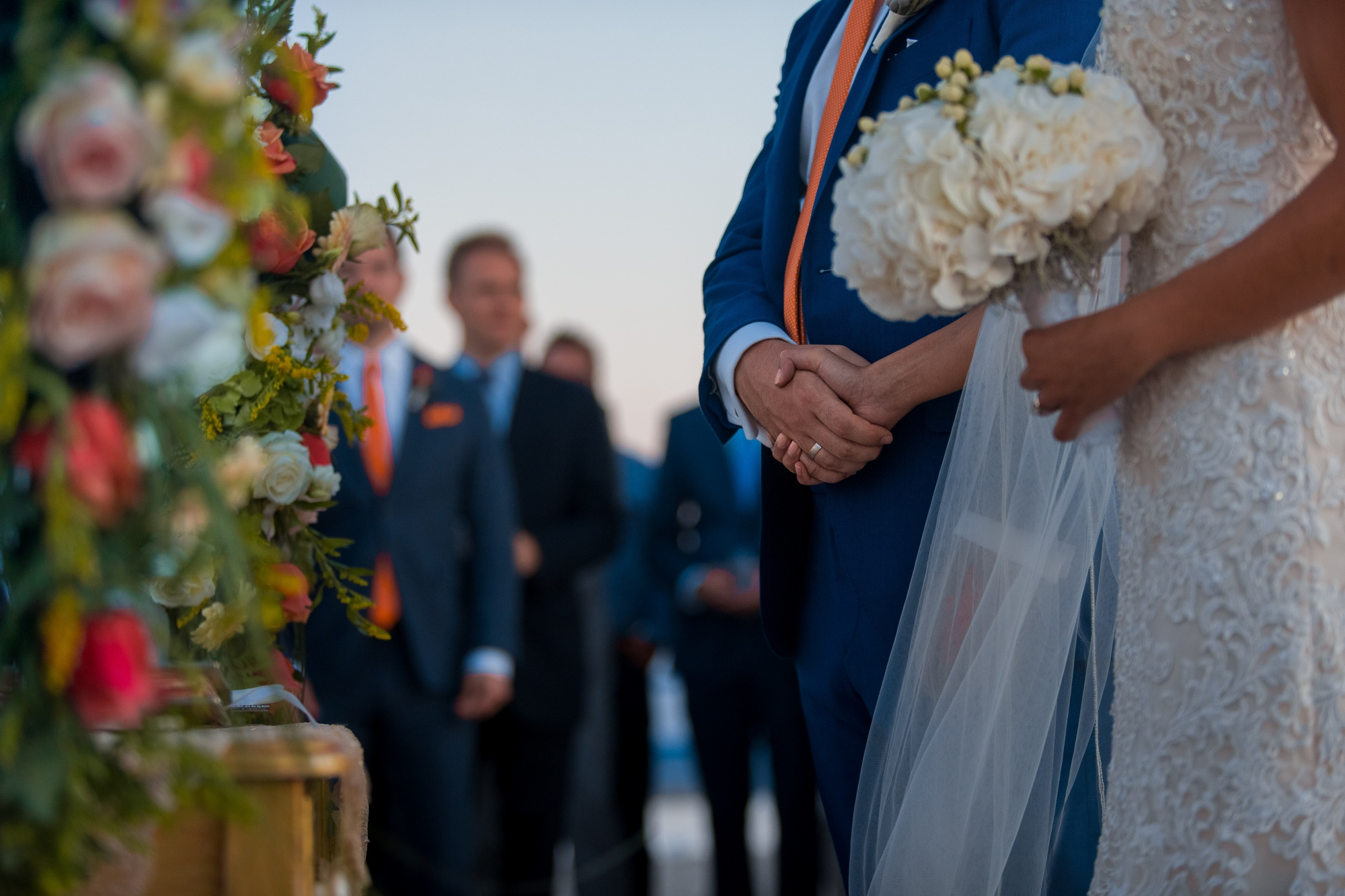
The ceremony hall was everything I had spent months making it. Soft lights, white chairs, floral arches in cream and pale green that had taken me longer to choose than any other element of the planning, because flowers are the kind of detail that feel important in a way that is hard to explain to anyone who has not spent six months building an event around a day you are hoping will be the beginning of something stable. Nearly a hundred people sat in the rows when I arrived. Colleagues from work. Cousins I had grown up with. Neighbors from my parents’ old street who had known me since I was a child. College friends who had flown in from Seattle and Denver. Aunt Carol, my father’s sister, in the third row on the right where I had put her without consulting my mother, because she had earned her place near the front by being present in my life for thirty years without conditions attached.
I saw the murmuring before I understood it. Conversations softened when I moved through the room. My cousins’ eyes went to my face and then away. My mother arrived in pale blue with pearls at her throat, looking composed in the way she always looked composed, the specific composure of a woman who has had many years of practice arranging her expression around difficult circumstances. She looked at my face when she saw me and did not flinch. This was information. I registered it without quite knowing yet what category to put it in.
Ethan was at the front when I walked in. I had been looking forward to this specific moment for months, the moment of arriving at the place where he would be standing, and seeing in his face the steady look that had always made me feel that the world was navigable. Instead, when he turned toward me, his eyes moved past me and settled on my mother, who was finding her seat nearby. A small, satisfied smile spread across his face. I had not seen that expression on him before, or rather, I had not recognized it when I saw it, because it had not yet been given its context. I would give it context in approximately thirty seconds.
He said it clearly, not as a whisper but as a statement, at a volume that carried to the nearest rows and then moved from person to person through the room in the way that any extraordinary sentence moves through a room, carried by expression and posture even to the people who didn’t quite hear the words themselves.
It’s so she learns.
The room went still for a moment, the particular stillness of people who have just heard something that their brains are trying to process before they decide how to respond. Then came the laughter. Not all of it was genuine amusement. Some of it was the reflexive social laughter people produce when they are uncomfortable and unsure whether the appropriate response is to laugh or not, and they choose laughter because it is the option that requires the least explanation. But enough of it was real. Enough that I felt it the way you feel something physical, a change in temperature, a shift in pressure. My skin went cold.
My mother pressed her lips together with the particular expression she used in public when she wanted to appear to disapprove of something she had privately sanctioned. Something satisfied moved behind her eyes.
Rachel, standing just behind me, said my name very quietly.
I looked at Ethan.
“What did you just say?”
The smile faded into irritation. The irritation was familiar. I had seen it before in smaller moments, over smaller things, but I had always named it something else. I had called it stress. I had called it his way of processing difficulty. I had called it a bad day. I understood now that I had been calling it the wrong name.
“Don’t start,” he said, lowering his voice. “We’re in the middle of the ceremony.”
“Tell them what you meant,” I said. I was louder now. I was not managing anymore.
The officiant stepped back. Ethan’s parents shifted in their seats. The room rearranged itself around the question that was now hanging in the space between us.
He leaned closer. “Your mom told me what happened last night. She said you were being hysterical. That you wouldn’t listen. She said sometimes consequences are the only thing that gets through to you.” He said it with the measured delivery of a man presenting evidence for a position he genuinely held. “She knows how to handle you.”
Handle me.
I stood at the altar in my wedding dress with a bruise under my eye that concealer had not fully covered, and I thought about the past year with the specific clarity that sometimes arrives when a situation finally shows you its entire shape at once. Ethan laughing when my mother mocked the nonprofit where I worked, a laugh I had told myself was just polite. Ethan telling me after family dinners that I was too sensitive, that if I just explained myself more clearly things would go better. Ethan suggesting, consistently, that I should apologize first, always first, always regardless of what had happened, because keeping the peace was more important than keeping accurate score. I had read his consistency as support. I had read his steadiness as safety. I had been reading the wrong thing.
He had not been my steady point in a difficult situation. He had been part of the situation.
“You talked to her about me,” I said.
“She reached out,” he said. “She was worried about you. She said you were struggling with the pressure of the wedding and that sometimes you needed firm handling.” He said this as if it were reasonable. As if my mother calling my fiancé to discuss how to manage me were a normal expression of maternal concern. “She’s not wrong that you get difficult when you’re stressed.”
Behind me, Rachel inhaled sharply. My chest felt hollow and my mind had never been clearer. These two things can coexist. I have since learned that clarity does not always feel like strength. Sometimes it feels like the opposite, like something has been removed rather than added, like the floor has dropped away and you are standing in the air above where the floor used to be. But the air holds.
I looked at the room. Nearly a hundred people in white chairs under soft lights and floral arches. College friends who had flown across the country. Neighbors who had watched me grow up. Aunt Carol in the third row, who had stayed quiet through so many of my mother’s years of displeasure toward her simply to avoid making my life harder. I saw their faces, the confusion, the embarrassment, the careful expressions of people who have just witnessed something and are waiting to understand what category to put it in.
“My mother hit me last night,” I said.
The room froze in the way that rooms freeze when something has been said that cannot be unsaid, that crosses whatever line separates social discomfort from genuine reckoning. Even the people who had laughed thirty seconds ago were not laughing now.
I touched the bruise beneath my eye.
“And apparently my fiancé thinks that was a useful lesson.”
My mother stood so quickly her chair scraped across the floor with a sound like a punctuation mark. “Olivia,” she said, in the voice she used when I had made a public error. “That is enough.”
“It’s actually years too late,” I said. “But we’re here now.”
She looked around the room, and I could see her preparing to speak, preparing to do what she had always done when I said something inconvenient in front of people, which was to turn the inconvenience into a story about my instability, my tendency to dramatize, my difficulty in managing my emotions. She had done it so many times that I knew the shape of it before it arrived. I did not let it arrive.
I reached into my bouquet and pulled out the small envelope Rachel had tucked there. Inside were the photographs she had taken that morning, timestamps clear. The screenshots of my mother’s messages from the night before, cover your face and stop being dramatic, thirty minutes after she had left my apartment. I handed the envelope to the officiant, who took it with the expression of a person who has been asked to do something in a ceremony that was not part of their preparation.
Then I turned back to Ethan. I slid the engagement ring from my finger. It had been on my hand for nine months. I had looked at it in quiet moments and felt the particular feeling that rings are designed to produce, the feeling of being chosen. I understood now that I had been chosen, but not in the way I had believed. I had been chosen the way certain problems are chosen, because someone thought they could manage them.
I placed the ring in his open palm.
“You don’t get to stand beside me after siding with the person who hurt me,” I said. “This wedding is over.”
No one laughed after that.
The silence was very large. Ethan looked at the ring in his hand with an expression of genuine shock, as though the ring’s return were the surprising element of the past five minutes, as though everything that had preceded it were simply context. His mother had begun crying quietly, which I registered without being able to fully attend to, because there was too much else to hold. My mother had gone from her poised disapproval expression to something angrier, and her anger always meant she had calculated that other strategies had failed and was moving to a different approach.
“You are humiliating this family,” she said.
For most of my life, that sentence would have folded me. I know exactly what it felt like, the specific collapse of something in my chest when she said it, the instinct to apologize, to moderate, to find the version of events in which I was partially wrong and she was partially right and we could all go back to the familiar arrangement. I had felt that collapse hundreds of times. I did not feel it now.
“I’m telling the truth,” I said. “If that humiliates you, that belongs to you, not to me.”
Rachel reached my side. Then Aunt Carol stood from the third row and walked toward me, not quickly, but with the deliberate movement of someone who has made a decision they have been postponing for a long time. She was my father’s sister. She had spent years maintaining a careful silence around my mother to avoid making my life harder. She placed her hand on my shoulder and said: “You’re coming with us.”
That small gesture, her hand on my shoulder, the word us, undid something in me more completely than all the chaos had. I felt my throat close in the way it closes before tears, but the tears did not come yet. They would come later, in a private room, with Rachel and Carol and a piece of wedding cake, but not yet. There was still something to finish.
Ethan found words, finally. They were the wrong ones. “Olivia, don’t throw away our whole future over one misunderstanding.”
He said it with the calm certainty of a man who believes the situation is still negotiable, who believes that if he finds the correct combination of practical language and measured tone I will step back into the event I had planned and continue the script. He looked at me the way someone looks at a problem they expect to solve with the right approach. I looked at him and saw it completely, the whole shape of it, the way it had been arranged around me for a year while I named it something else.
“This wasn’t a misunderstanding,” I said. “It was a warning. I’m finally listening.”
Then I turned to the room. I had not planned what I was about to say. It arrived the way some things arrive, not from planning but from the place where clarity lives when it has burned through everything else.
“Thank you all for coming,” I said. “The reception hall has already been paid for and the food is ready and you are welcome to stay. I hope you will. Not to celebrate a marriage, but because you flew across the country and you deserve a good meal and good company. This ended the way it needed to end, and I’m glad you were here for it.”
I don’t know exactly when the clapping started. It began with one person, someone near the back, and then it grew, not loud or jubilant but genuine, the sound of people responding to something real after a great deal of performance. The sound of recognition. Aunt Carol kept her hand on my shoulder. Rachel was on my other side. My mother had gone to whatever she goes to when she loses control of a room, and I was no longer attending to her location.
That evening, still in my wedding dress, I sat in a private room at the venue with Rachel and Carol and ate a generous piece of wedding cake. The room was small and the lights were not flattering and my mascara was destroyed and there was a bruise under my left eye that the makeup had given up trying to cover. I was also laughing at something Carol said, a memory of my father trying to learn to make my grandmother’s bread recipe and making something that she described as artisanal concrete. We laughed until there were tears in it, the way laughter sometimes curls around grief and becomes something more complicated and more honest than either of them alone.
Later, after Carol went home and Rachel fell asleep in the car on the way back to my apartment, I sat at my kitchen table with a glass of water and the quiet. Not the quiet my mother had always restored after difficult moments, which was the quiet of things being suppressed back into their proper positions. This was different. This was the quiet of something having actually stopped.
In the weeks that followed, I filed a police report. I began therapy with a woman named Dr. Farris who had a very still face and asked questions that arrived slowly and stayed. I changed my locks. I blocked my mother and Ethan on my phone and email and every platform where I had not already removed them out of some habit of connection that no longer applied. These things were not easy. They were not clean. Grief is not clean, and what I was grieving was not simple: a mother I had been trying to reach my whole life, a future I had planned carefully and believed in, a version of love that turned out to have been something else under the right light.
People asked me, afterward, how I found the courage to walk away at the altar. I understood why the question felt urgent to them, why the image of a woman in a wedding dress in a room full of guests doing something unexpected captured their attention. The honest answer is that I did not feel courageous at the time. I felt clear. Clarity and courage are not the same thing. Courage is a quality that exists before you act. Clarity is what sometimes arrives in a single moment and removes the available alternatives until only one remains. Ethan’s words removed the alternatives. The laughter that followed them removed whatever was left. I did not walk away because I was brave. I walked away because staying had finally become more costly than I was willing to pay, and for the first time in my life I believed that the cost was real and was mine to refuse.
I spent a lot of time in therapy that first year understanding the specific way that growing up with my mother had shaped what I was willing to accept, and what I had named acceptable because the alternative, naming it accurately, felt more dangerous than the thing itself. I learned the word coercive. I learned the phrase intermittent reinforcement, which is the mechanism by which charm and cruelty in alternating cycles produce a kind of attachment that is very hard to break, because the cruelty makes you seek the charm and the charm convinces you the cruelty was an exception. I learned to apply these words to my childhood, and eventually I learned to apply them to my relationship with Ethan, and eventually I stopped being surprised to discover that the patterns had rhymed.
What I did not expect was what I found on the other side of all of that work, which was not some revised and improved version of the life I had been trying to build, but something I had not known I was looking for: an ordinary Thursday afternoon, by myself, making dinner in my apartment with music on, and the complete absence of the low-level vigilance that I had carried since childhood, the constant monitoring for shifts in emotional weather, the management of the space between what was happening and what I needed others to believe was happening. The absence of that was extraordinary. I had not known what silence felt like when it was not the silence of things being suppressed.
My aunt Carol and I talk most weeks now. She tells me about my father’s childhood, stories I had not heard because my mother had managed most of the communication between my father’s side of the family and our household, and some of what she tells me is painful for reasons I am still working through, and some of it is funny, and all of it is mine in the way that things become yours when you are finally permitted to hold them without managing someone else’s reaction to the holding.
Rachel was the maid of honor at a wedding that ended differently than anyone planned, and I am grateful for that in a way that does not require the wedding to have gone differently. She did the most important thing anyone can do for a person in a difficult situation, which is to believe them, completely and without qualification, and to be ready in the moment when readiness is required without making the moment about herself. She still has the envelope of photographs, which she sent to the police report along with her own statement. The case resulted in a civil protective order. My mother’s attorney asked that the photographs not be entered into public record. The request was denied.
I sometimes think about the wedding as a piece of architecture, all the months of choosing and arranging and planning, the flowers and the lights and the chairs and the food and the hours spent on a seating chart that someone else had tried to revise three times and I had refused to let her touch. I think about building something that carefully and having it collapse into something completely different, and I think about the fact that what it collapsed into was more honest than what I had been building. I had been building an event around a relationship that was performing health while being organized around control. When the performance stopped, what was underneath had nowhere to hide.
The day I arrived at my own wedding with a bruise I could not fully conceal, I did not know I was about to leave. I had told myself I was going because I had spent too many years learning to smile through humiliation to walk away before I understood how deep it went. That was true, but there was something else underneath it: the last thin hope that I was wrong, that Ethan’s steadiness was real, that the morning would present itself differently than the night before had. When he stood at the altar and told the room that what my mother had done was a lesson I needed to learn, he answered the question I had not known I was asking. The hope was not wrong for existing. It was simply answered.
I walked away with something better than a husband. I walked away with the knowledge of what I was worth without anyone else’s management applied to the question. I walked away with Aunt Carol’s hand on my shoulder. I walked away with Rachel on my other side, and wedding cake, and the genuine laughter of a woman who had just had the most honest moment of her adult life in front of a hundred people in a room she had decorated with flowers she had spent months choosing.
The flowers were beautiful, incidentally. I have since learned to let that be true without it being sad.

Ethan Blake is a skilled Creative Content Specialist with a talent for crafting engaging and thought-provoking narratives. With a strong background in storytelling and digital content creation, Ethan brings a unique perspective to his role at TheArchivists, where he curates and produces captivating content for a global audience.
Ethan holds a degree in Communications from Zurich University, where he developed his expertise in storytelling, media strategy, and audience engagement. Known for his ability to blend creativity with analytical precision, he excels at creating content that not only entertains but also connects deeply with readers.
At TheArchivists, Ethan specializes in uncovering compelling stories that reflect a wide range of human experiences. His work is celebrated for its authenticity, creativity, and ability to spark meaningful conversations, earning him recognition among peers and readers alike.
Passionate about the art of storytelling, Ethan enjoys exploring themes of culture, history, and personal growth, aiming to inspire and inform with every piece he creates. Dedicated to making a lasting impact, Ethan continues to push boundaries in the ever-evolving world of digital content.