My daughter was only eight months old when it started, and like most things that nearly break you, it began small.
A cough. Just a cough.
Dry and rattling, the kind that sounds like something is loose inside a tiny chest. She coughed through the day and through the night, and I would lie awake in the dark listening to her breathe, counting the seconds between each shallow rise and fall, telling myself it was nothing, just a cold, just the season changing, just one of those things babies get.
But the weeks passed and the cough didn’t leave. It deepened.
I brought her to the pediatrician. Then again. Then a third time. The doctor listened to her lungs carefully each visit, asked thorough questions, watched her breathe. Eventually, she said the word that settled over me like a fog: asthma. Infant asthma. She prescribed an inhaler and medication and sent us home with instructions I followed exactly, down to the minute and the dose.
Nothing improved.
If anything, it got worse. My daughter stopped eating well. She became lethargic in a way that babies shouldn’t be, heavy and still when she used to be curious and squirming. She woke up at night not the normal way babies wake up, fussing and hungry, but gasping, struggling, her little body working too hard just to breathe. I would get to her crib in seconds and stand over her in the dark, one hand on her back, feeling her ribs move under my palm, and the fear that lived inside those moments was the kind that doesn’t go away even after the moment passes. It follows you into the next day and the next, quiet but constant, like something watching you from just outside your line of sight.
I was running on no sleep and raw fear and the particular desperation of a parent who is doing everything right and watching it fail anyway.
The pediatrician had been kind throughout all of it. She never made me feel like I was overreacting. She adjusted the medication, suggested we try a humidifier, asked about dust and pets and whether we’d recently changed detergents. We had not. We checked everything she mentioned. We washed all the soft furnishings in the nursery. We replaced the air filters throughout the house. We vacuumed the carpet twice a week instead of once.
Nothing changed.
On one of those sleepless nights, sitting in the rocking chair in the nursery with my daughter on my chest, I remember looking around the room and trying to understand what I was missing. The nursery was clean. It was warm. The walls were freshly painted the soft green we had chosen before she was born because someone had told us neutral colors were calming for infants. The crib was tucked into the coziest corner of the room, against the wall, away from the window draft.
Everything looked right.
Everything was wrong.
And then there was Daisy.
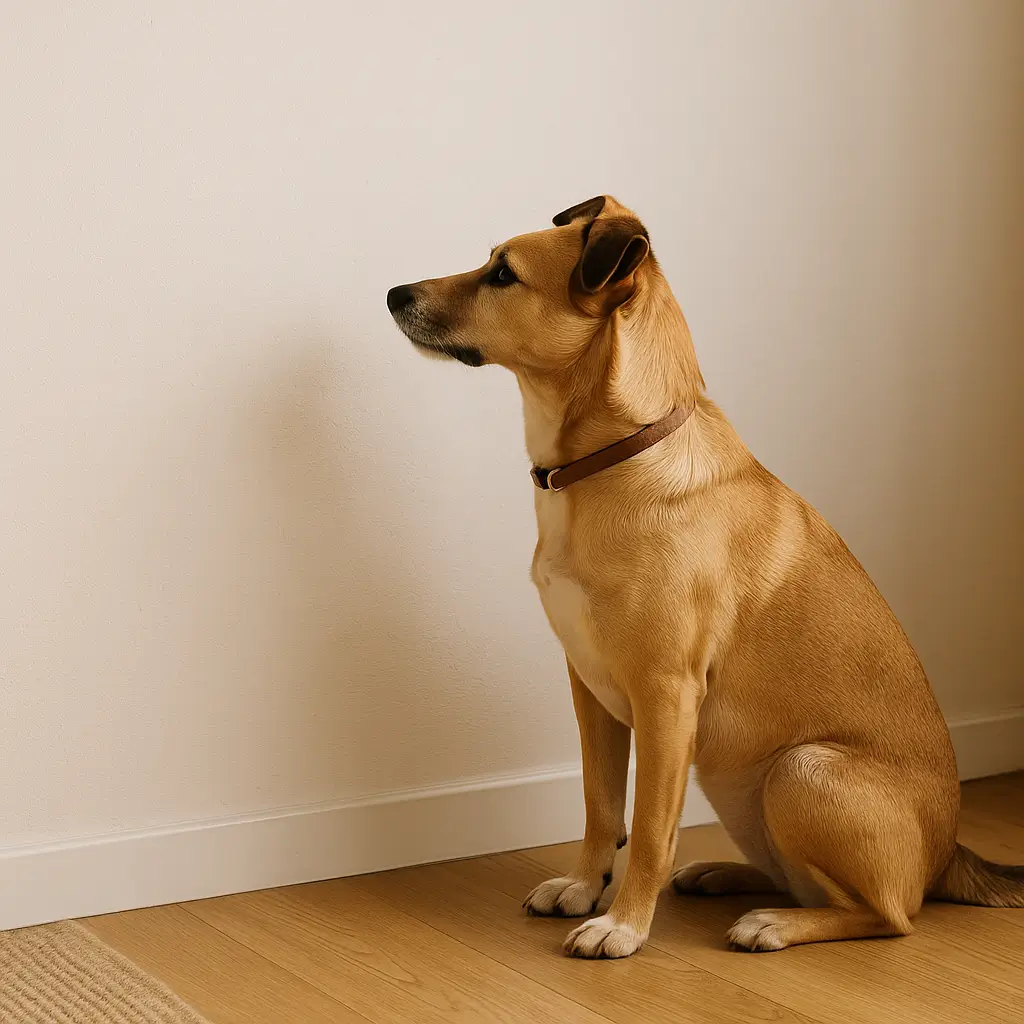
Daisy is our golden retriever. She had always been the gentlest dog, the kind that would settle beside the crib for hours without being asked, her chin resting on her front paws, her eyes tracking the baby with a steady, patient devotion. From the day we brought our daughter home from the hospital, Daisy had positioned herself as the unofficial guardian of that room. She took the responsibility seriously. She would follow us in when we went to check on the baby and follow us back out only reluctantly, as if leaving felt like a dereliction of duty.
So when she started scratching the wall, I didn’t understand it at first.
I would leave the nursery for a few minutes and hear it from the hallway. A frantic, rhythmic scraping. I would rush back in and find Daisy at the wall directly behind the crib, her paws working against the drywall with a kind of focused urgency that was completely foreign to her usual temperament. She tore at the wallpaper. She dug at the seams where the wall met the baseboard. She threw her full weight against the scratching, leaning into it, as if whatever was on the other side of that wall was something she was determined to reach no matter how long it took.
I pulled her away the first time, confused. The second time, I raised my voice. I told myself she was bored, or jealous, or reacting to some disruption in the household routine that dogs sense before people do. I started closing the nursery door to keep her out when I wasn’t in the room.
She knocked it open.
I installed a baby gate across the doorway, the heavy plastic kind with the double latch that’s supposed to be difficult even for adults to manage quickly.
She knocked it down.
Every single time, she went back to the exact same spot. Not to a different section of the wall, not to the corner or the window or the door. The same stretch of drywall, directly behind the crib, maybe three feet up from the baseboard. She would press her nose against it first, inhaling in deep, concentrated pulls, and then she would begin clawing again. Methodical. Relentless. Completely unlike the calm, unhurried animal I had known for years.
I noticed the blood on her paws a few days later.
The skin had worn through on the inside of her front pads. Small cracks, red at the edges, the kind of injury that comes from repeating the same abrasive motion too many times over too many days. She was hurting herself and not stopping. She would come to me to be petted and I would hold her paws and look at them with a sinking mixture of concern and frustration, and then she would pull away and go back to the wall.
By this point, I was running on weeks of broken sleep and a kind of exhaustion that colors everything gray. The baby wasn’t getting better. The dog had seemingly lost her mind. The house felt like a place where I was constantly failing at something I couldn’t identify. I had no patience left for trying to figure out what Daisy’s problem was. I moved her food and water bowl to a different room. I kept the nursery door shut and braced. I told my husband that something was wrong with her brain and that we needed to call the vet when we had a moment to breathe.
We didn’t have a moment to breathe.
Last night, I walked into the nursery and stopped in the doorway.
Daisy had broken through.
The drywall was cracked and cratered at the baseboard level, right behind the crib, a ragged hole that she had worked open over days of scratching. Chunks of plaster and grey dust were scattered across the carpet in a wide radius. She was still at it when I came in, her paws working at the broken edges of the hole, her nose pushed into the darkness on the other side, her whole body tense with the urgency of an animal that had been trying to communicate something important for weeks and had finally managed to make herself understood in the only language available to her.
I grabbed her collar. My voice was sharp. All I could think in that moment was the repair cost, the damaged wall in a room we had freshly painted, the mess on the carpet, the inconvenience layered on top of all the other inconveniences of the past several weeks. My hands were shaking from tiredness and frustration and I was not thinking clearly.
I pulled her back and leaned down to look at what she had done.
The smell hit me before the light did.
Heavy and thick and wrong in a way that my body understood before my mind caught up. Musty and dark and organic, the kind of smell that belongs in a forgotten basement or a building that has been shut up for years, not in a freshly painted nursery where a baby sleeps. I fumbled my phone out of my pocket and switched on the flashlight and pushed the beam through the hole in the wall.
The light moved across wooden beams. Across insulation.
And then it stopped on what was covering them.
Black mold. Thick, dense, spreading across almost every surface visible inside that wall cavity. Not a spot of it. Not a patch. A colony that had been establishing itself for a long time, growing outward from some wet central point, covering the framing and the insulation in a dark, fuzzy layer that looked alive because it was. The beam of my flashlight played across it and I felt the floor shift under me even though nothing had moved.
I traced the light along the pipe that ran through the wall from the neighboring bathroom. There it was. A slow leak, barely visible, just a thin trail of moisture along the outside of the pipe. The kind of leak that would never make itself known through the paint or the plaster. The kind that just seeps quietly into the wall cavity, day after day, week after week, month after month, keeping everything inside permanently damp, permanently hospitable to exactly what I was looking at.
The leak had probably been there for a year. Maybe longer.
The mold had been growing almost as long.
And the wall it was growing behind was the wall my daughter had been sleeping against, her crib pressed up to it, her face just inches from the surface, her lungs working through every night breathing the air that filtered through from that dark interior space.
I sat back on the floor of the nursery. I couldn’t stand up. My hands were shaking in a different way now, not from frustration but from something closer to the feeling you get when you understand how close something came to going very differently.
She didn’t have asthma.
She never had asthma.
She had been breathing toxic mold spores every night for weeks, her small lungs trying to process air that was quietly poisoning her, her body doing everything it could to fight something we were unknowingly flooding back in with every breath she took in that room. The inhaler hadn’t helped because the problem had never been inside her. It had been inside the wall. We had been treating the symptom while the cause was three inches behind the headboard of her crib.
I thought about all the nights I had stood over that crib with my hand on her back, feeling her breathe too hard, telling myself we just needed to find the right medication. I thought about all the pediatrician visits where we went over the checklist and nothing jumped out. I thought about the air filters we had changed and the detergents we had switched and all the meticulous, careful, completely misdirected effort we had put into solving a problem we could not see.
And then I looked at Daisy, sitting a few feet away, watching me with the steady, patient eyes she always used when she was waiting for me to figure something out.
She had known from the beginning.
Dogs can smell mold through walls. Through drywall and paint and insulation, through surfaces that are completely invisible and impenetrable to us. Their noses detect organic compounds that we cannot sense at all, including the specific volatile compounds that black mold produces as it grows. Daisy had been smelling what was behind that wall from the first day it became strong enough to reach her, and she had understood in whatever way dogs understand such things that it was connected to the baby she watched over, that the air coming from that wall was the same air her charge was breathing every night.
She had done the only thing available to her.
She had tried to get through.
She had scratched and clawed and knocked down every barrier I put between her and that wall. She had worn her paw pads bloody and kept going. She had communicated in the most direct and physical way a dog can communicate, which is not words but persistent, focused, impossible-to-ignore action directed at a specific place. She had been telling me for weeks exactly where to look.
I had scolded her every time.
I had closed the door on her and called her crazy and assumed the problem was something inside her rather than something she was trying to show me. I had been so consumed by the visible, manageable emergencies of a sick baby and a damaged wall that I had never stopped to ask why a dog who had been nothing but gentle and calm for years was suddenly driving herself to physical injury trying to get my attention.
There is a particular quality to the regret I felt sitting on that nursery floor. It was not the sharp kind that comes from a mistake you made quickly, without thinking. It was the slower kind, the kind that comes from realizing how long something has been true that you refused to see.
We moved our daughter out of that room the same night. She slept between us in our bed, and something shifted in her breathing before morning. I cannot say whether it was the distance from the mold or the warmth of sleeping between her parents or some combination of the two, but the quality of her breathing changed. It was still not right. But it was different. It was better.
The next morning I called a mold remediation company and a plumber before I called anyone else. The remediation team arrived that afternoon. They confirmed what the flashlight had already shown me: extensive toxic black mold growth throughout the wall cavity, feeding on moisture from a pipe that had been slowly leaking for well over a year. They said the spore concentration in the air of that nursery was significant. They said it was consistent with the respiratory symptoms we had been seeing. They said we had found it in time.
In time.
I keep returning to those words. We found it in time. Not because of anything we did, nothing we checked or noticed or thought to look for. We found it because a golden retriever wore her paws to bloody cracks trying to show us where to look, and eventually she made a hole big enough that I couldn’t avoid looking through it.
The plumber repaired the pipe. The remediation company stripped the wall and treated the framing and the surrounding area and sealed everything before it was rebuilt. We repainted the nursery a different color, partly for practical reasons and partly because I needed the room to look different. The crib is on the opposite wall now, far from where it used to sit.
Our daughter has a follow-up appointment with the pediatrician this week. Her breathing has been noticeably better since we moved her out of the nursery. The doctor, when I called to explain what we had found, went quiet for a moment and then said it made complete sense. She said she wanted to see her again. She said that children that age, with healthy lungs otherwise, typically recover well once the exposure is removed. She said we caught it.
Daisy has a vet appointment for her paws. The cracks are healing. She seems calmer now, the low persistent anxiety of the past several weeks gone from her posture and her eyes. She sleeps more easily. She follows me around the house with the same unhurried devotion she always has.
And every night, she positions herself beside the crib in the redecorated nursery, her chin on her paws, her eyes moving slowly between the baby and the door and the newly sealed wall. Watching. Steady. Present in the way she has always been, in the way I failed to appreciate fully enough until the night I leaned down and looked through a hole she had spent weeks trying to make.
I am writing this because I want other parents to have this information. Not only about mold, though black mold inside a wall near where a child sleeps is a serious health risk that is worth knowing about and watching for. But about the animals we share our homes with, the ones who pay a different kind of attention than we do, the ones who notice things our senses cannot reach.
When a pet you know well begins behaving in a way that is entirely out of character, especially if that behavior is repetitive and focused and directed at a specific place in your home, it is worth pausing before you decide they have simply lost their minds. It is worth asking what they might know that you don’t. It is worth getting down on the floor and looking where they are looking.
Daisy did not lose her mind.
She did her job better than anyone.
She protected my daughter the only way she could, with persistence and physical sacrifice and a refusal to be redirected or silenced or shut behind a door. She asked me to look for weeks before I finally did.
I will spend a long time being grateful for that dog.
And I will spend a long time wishing I had listened sooner.

Specialty: Emotional Turning Points
Rachel Monroe writes character-driven stories about betrayal, second chances, and unexpected resilience. Her work highlights the emotional side of family conflict — the silences, the misunderstandings, and the moments when someone quietly decides they’ve had enough.