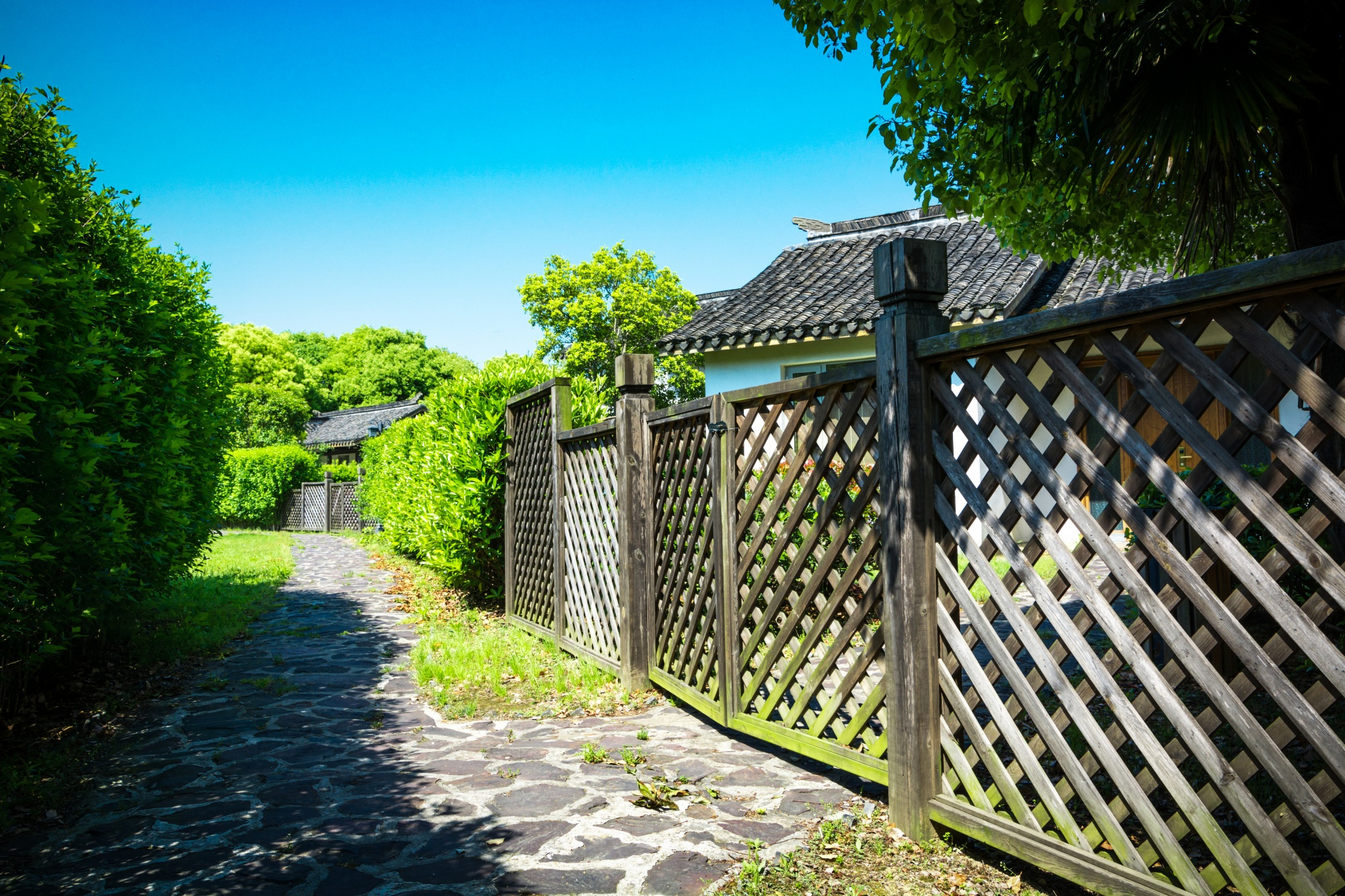
The Fence Cap
The morning I finally decided to do something about it, I was standing in my backyard with a cup of coffee, watching a stranger’s bed sheet billow in the breeze.
Not my sheet. Not a sheet I had hung there. A sheet that belonged to my neighbors, the family behind me, and which had been clipped to the top of my fence sometime before I woke up, stretched between two fence panels like a sail, catching the October light, blocking part of my view of the yard I mow every Saturday and pay taxes on every year.
I stood there long enough to finish most of my coffee. Then I went inside, refilled the cup, and came back out. The sheet was still there. Of course it was. Sheets don’t move on their own.
I want to be clear that I am not an unreasonable person. I don’t have strong opinions about most things. I don’t mediate neighborhood disputes or leave notes about parking or track which houses have their garbage cans out past the allowed time. I have lived in the same place just outside Columbus for going on six years, and in that time I have had exactly two meaningful interactions with any neighbor: once to return a package that was delivered to my address by mistake, and once to ask if a dog that kept appearing in my yard was theirs. It was. They apologized. We moved on. This is, I think, the ideal form of neighbor relationship: cordial, minimal, low-maintenance.
I’m also not someone who turns small annoyances into large grievances. My general approach to life is that if something isn’t actively hurting me or anyone else, it’s probably not worth expending significant energy on. I’ve watched people spend months in a state of barely contained fury over genuinely tiny things, and I’ve always thought that looked exhausting.
But something about that bed sheet, the deliberateness of it, the way it was clipped firmly and spread evenly like someone had stood back to assess the geometry, got under my skin in a way I couldn’t quite name or shake.
Let me back up.
I’ve lived in this house long enough to understand the particular intimacy of close-built neighborhoods. The houses in my area are set near enough together that you develop an unconscious awareness of your neighbors’ rhythms without ever really meaning to. I know roughly when the family on my left leaves for work because I hear their car backing out of the driveway and I’ve synchronized my coffee timing to it without intending to. I know the family across the street eats dinner early because their kitchen light comes on at five and goes off by six-thirty. Not because I’m watching, but because proximity makes it unavoidable.
When I bought the house, one of the things I liked about it was the fenced backyard. Fences in a neighborhood like this don’t really isolate you from your neighbors, they can’t, the lots are too small for that, but they do define something. They say here is where my space begins and there is where yours ends, and there is value in that clarity even when you never have cause to assert it. For six years, my fence had been nothing more than a structural fact of the property, invisible the way ordinary things are invisible until someone draws your attention to them.
My backyard shares a fence line with the yard behind me. The fence runs down the middle of the shared property edge, wood on my side, wood on their side, the top rail sitting at about shoulder height. I had never thought much about it.
The family behind me, Daniel and his wife and their three kids, had moved in about two years before the sheet incident. I knew their names the way you know names when you’ve been introduced briefly and then confirmed them later via the mail that occasionally drops in the wrong box. Daniel was friendly in that specifically neighborly way: a wave when he spotted me outside, a nod when our schedules overlapped at the fence line, occasional comments about the weather or a passing sports result, nothing that suggested we were about to become close friends, nothing that suggested we needed to be. The kids were cheerful and loud in the way of children who have room to run, and I had long since adjusted my Saturday morning timing around their backyard playing without thinking of it as an adjustment.
It was, in other words, a perfectly ordinary neighborly situation, and it had been for two years before any of this started.
The first time a piece of their laundry appeared on my fence, I genuinely thought it was the wind. A gray t-shirt, just the one, hanging over the top rail with one sleeve drooping down on my side. I remember looking at it for a moment, deciding it had blown over, and tossing it back without much thought. That’s what happened in a neighborhood like this. Things moved. Wind was unpredictable. No reason to make anything of it.
Two days later, a towel appeared. And this time I stood there longer. Because wind moves things, but it doesn’t place them. Wind doesn’t lay a towel flat across a fence rail and smooth it into a neat rectangle. Wind doesn’t care about symmetry.
I stared at it for probably longer than was strictly reasonable, turning the question over, wondering if I was reading too much into it. Then I told myself I was, tossed the towel back, and went inside.
But then it kept happening. Socks. A pair of jeans. A t-shirt in a different color from the last one. Then another shirt. A pillowcase. All in the same approximate spot, all arranged with the same even, deliberate placement that wind does not produce. And I began to understand what was actually going on.
There was a slow, accumulating quality to the realization. It wasn’t a single moment where everything clicked. It was more like a fog clearing by degrees, each new item on the fence making the pattern a little more visible, until one afternoon I was standing there looking at the fence and the question of whether this was accidental had simply stopped being available.
Daniel’s yard is smaller than mine. Their clothesline runs from one end of it to the other, and I had noticed that it was always full, always straining under the weight of what a family of five generates in laundry. My fence, meanwhile, sits slightly higher than theirs, catches more direct sun in the afternoon, and sits in the path of a reasonably reliable mid-afternoon breeze. Objectively good drying conditions. I understood the appeal. I understood the logic. I even understood that this probably didn’t feel like a big deal from their side of the fence.
But from my side, it felt different. It felt like the slow, quiet renegotiation of a boundary. Not an angry renegotiation, not an intentionally hostile one, but a renegotiation nonetheless. My space, extended by degrees into someone else’s use, without ever being asked.
My friend Mark came over for a cookout one afternoon and gestured at a pair of socks hanging over the fence with his bottle.
“When did you get into the laundry business?”
I laughed. But later, after he left, I sat with how much that small comment had bothered me, not because it was harsh but because it acknowledged something I had been pretending wasn’t happening. The fence that separated my yard from the outside world had become someone else’s clothesline, and I had been letting it happen by not addressing it.
I finally said something to Daniel on a Saturday when I caught him in his yard with a laundry basket, three kids orbiting him with the boundless kinetic energy of children who have not yet learned to stay still.
I kept it casual. Light. I told him I had been noticing clothes showing up on my side and just wanted to check in about it.
He looked at me for a moment in the way people look at you when they’re deciding how seriously you want them to take the thing you’ve said. Then he smiled and waved a hand.
“Oh, yeah. Sometimes things spill over when we’re drying.”
I nodded. I smiled back. I said yeah, that made sense, even though it didn’t, because spilling over doesn’t clip itself neatly to a fence rail.
Walking back inside, I told myself the conversation had accomplished something. That the awareness had been raised, that things would change. And for a few days, they did. The fence was clear. My yard was mine again. I trimmed some overgrown branches along the fence line and noticed how good it looked with nothing on it: just wood, sunlight, space.
Then it started again. Only this time, something was different.
When I walked out one morning and found three items hanging across the fence in neat intervals. The first thing I noticed was the clothespins. Bright blue. Not draped loosely over the fence. Clipped. Clipped firmly onto the top edge of the fence rail on my side. The outside of my fence.
I set my coffee down on the porch railing and walked over and crouched slightly to look at them. They were good quality clothespins, the kind with a strong spring. Someone had gripped each one, reached across the fence line, pressed the jaws open, and attached them firmly to wood that belonged to me. This was not a casual act. You cannot do this accidentally or absentmindedly. You have to deliberately extend your reach across a boundary and attach your things to someone else’s property.
I unclipped each pin. I folded the clothes neatly. I set everything on top of the fence rail on their side, careful and deliberate. Then I went inside and stood at the kitchen window with my coffee and thought about what it meant that this was the new escalation.
I stood there with my coffee and looked at those clothespins for a long time.
It is one thing for fabric to drift over a fence. It is another thing for someone to reach over the boundary of your property, physically extend themselves into your space, and clip their belongings onto your structure. The first can be argued as accidental or thoughtless. The second requires intention. Someone had to reach across the top rail, apply pressure, attach the clip. It’s not a large act, but it is a deliberate one.
I unclipped each pin slowly, folded the clothes neatly, set them on top of the fence rail on their side. Not thrown. Not aggressive. Just returned.
But I went inside feeling something I hadn’t felt before in this situation: not annoyance, exactly, but something more specific. The feeling that my silence had been understood as agreement. That by not pushing back harder the first time, I had communicated something I hadn’t meant to.
The laundry continued appearing with what I can only describe as increasing confidence. A towel one day. A pillowcase the next. One morning, a small superhero shirt that had to belong to one of Daniel’s kids, clipped right at eye level, facing my yard like a small declaration of territorial rights. Each time I would take it down. Each time I would return it. Each time the pause before I acted got a little longer.
I called my sister in Denver one evening and told her the whole sequence. She found it funny, in the way people find things funny when they’re not the ones living inside them. Then she said what seemed like the obvious answer: just say something. Be direct. Make it clear you’re not going to keep accommodating this.
She wasn’t wrong. She was, in the abstract sense, entirely right.
But my sister lives in a house with a large lot and no shared fence lines and no neighbor she is likely to see every day for the foreseeable future, and I think there is something specific about close-neighbor situations that is genuinely hard to explain to someone who hasn’t been in one. The calculation isn’t just: will this solve the problem. The calculation is: what kind of relationship will exist afterward, and is that relationship preferable to the current one.
I had seen this go wrong in my neighborhood. The family two houses down had had a parking dispute with their neighbor three years earlier that had been entirely legitimate on their part, by all accounts, they were right and their neighbor was wrong, and they had said so clearly and directly, and the result was that neither family’s children were allowed to play together anymore and both adults had adopted a policy of conspicuous avoidance that everyone on the street could feel. The original problem had been solved. The residue of how it was solved had been sitting there ever since.
I didn’t want that. I wanted to be able to walk into my backyard on a Saturday morning without it feeling like a contested territory. I wanted to wave at Daniel without there being a subtext behind the wave.
So I tried a middle path.
I went to the hardware store down the road, the kind of place that still smells like actual wood and actual dust and where the man behind the counter has clearly been doing this long enough to know what you actually need when you describe a problem. I bought a small outdoor sign. Simple black letters on white background. Please do not hang items on fence. Nothing aggressive, nothing pointed. Just a clear statement in permanent weather-resistant text.
I spent a little time thinking about where exactly to mount it. I wanted it to be visible without being confrontational, present without being accusatory. I found the spot where the laundry had been appearing most consistently and put it there, at a height and angle that would be unmistakable to anyone approaching the fence from the other side. Then I stepped back and looked at it and felt the specific satisfaction of having done the adult, measured, responsible thing.
It worked for about a week.
Not quite a week, actually. Maybe six days.
Which, if you are keeping track, is slightly shorter than my first casual conversation about the subject had bought me, and considerably less permanent than I had hoped. But I came home one afternoon to find a light blue bed sheet stretched across two panels of my fence, tight enough to catch the wind, the sign clearly visible eight inches to the left of it, and I stood there for a moment trying to decide what exactly I was supposed to take from that.
Then I came home from work one afternoon still loosening my tie and there was a light blue bed sheet clipped across two panels of my fence, taut and full, catching the late-day sun. The sign was right there. Unambiguous. Apparently unconvincing.
I stood at the fence and ran my fingers along the top rail, feeling the flat edge, thinking. And I noticed something that had been in front of me the whole time but that I had been too busy framing this as a social problem to see: the fence itself was what made this possible. The flat top rail was grippy, the right height, the right surface. It was, objectively, excellent for hanging things on. As long as it stayed that way, this was going to keep happening. Not necessarily out of spite or disrespect, though I had considered both, but because it solved a real problem for them and my discomfort was invisible from their side of the boards.
I had been trying to change behavior through signs and conversations and quiet returns of neatly folded laundry. But behavior doesn’t always change because you communicate clearly about it. Sometimes it changes because the environment stops supporting it.
I was back at the hardware store the following Saturday. The same man was behind the counter, and I told him I was looking to protect the top of a wooden fence. Water runoff, general maintenance, keeping the wood in good shape.
He nodded and walked me down a narrow aisle toward a section I had never had reason to visit before. Fence toppers. Vinyl, mostly, designed to sit over the top rail and cap it. He pulled one down and tapped it with a finger. Smooth on top, rounded, curved down on either side. Helps water run off, he said. Keeps the rail from soaking through. Protects the grain.
I turned it over in my hands. No flat surface. Nothing to grip. The curve was gentle but continuous, nothing for a clothespin to catch on, no ledge for anything to rest against. It was essentially a surface that declined to cooperate with any attempt to use it as a horizontal platform.
Yeah, I said, mostly to myself. That’ll work.
I bought enough to cover the shared fence line.
Installing it took most of a Saturday morning. I worked methodically along the run of fence, fitting the toppers into place, securing them, making sure the line was even. When I stepped back to look at the finished result, it was genuinely better looking than before. Cleaner. More finished. Like the fence had always been missing this piece and had finally received it. Anyone looking at it from either side would see a well-maintained fence that had been properly capped to handle weather.
Anyone who tried to hang something on it would find that the surface no longer cooperated.
That evening I sat on my back porch with a beer, looking at the fence line in the last of the afternoon light, and felt something I hadn’t felt in weeks. Not quite relief and not quite satisfaction. Something more like the specific calm of a person who has found the right tool for a problem and used it correctly. Quiet. Settled. Done.
The next morning was quiet. The fence was clean. I went through my whole routine without once looking over and seeing something that wasn’t mine.
The attempt came that afternoon.
I heard Daniel’s voice in the yard, the kids running, the usual Saturday sounds from their side of the fence. I was on my porch reading, not watching, just present in the general way of a Saturday afternoon at home.
I heard footsteps approach the fence. Then a pause. Then the soft rattle of a clothespin being applied.
I looked up from my book.
A shirt had been lifted over the fence from their side, and I watched a hand reach toward the fence cap and press the jaws of a clothespin against the curve.
The pin slid off immediately. The shirt, still attached to it, sagged sideways and slid back down to their side of the fence like a slow, gentle collapse.
I watched without saying anything.
The hand came up again. Different spot this time, slightly different angle, a bit more pressure behind it. The same result: the pin skimmed across the curve, found nothing to grip, and released. The fabric fell.
A pause. Longer this time. I could almost feel the recalibration happening on the other side of the fence, the moment of working out what had changed and why the fence was no longer doing what it used to do.
The hand withdrew.
I went back to my book.
There was something genuinely satisfying about those two minutes, but I want to be precise about what the satisfaction was. It wasn’t vindictive. It wasn’t the satisfaction of having won something or gotten back at someone. It was quieter and more specific than that: the satisfaction of a problem solved by the right mechanism. No raised voices, no awkward conversation, no buildup of resentment on either side. Just a physical reality that had been adjusted, doing what it was now designed to do. The laundry slipped. The physics worked. The fence held the line without me having to say a word.
Over the following few days it happened two more times. A towel once. A pair of jeans another time. Each attempt a little more tentative than the last, like someone checking whether a door that used to open might have changed its mind. It hadn’t. Every time, same result. Slip, fall, gone.
And then it just stopped.
No more fabric stretching across my morning view. No more clothespins on my side of the fence. No more pausing over my coffee with that low-level irritation simmering in the background. Just my yard, clean and quiet and mine the way it had been before all of this started.
I ran into Daniel about a week after the last attempt. We were both out back at the same time, the way you sometimes are, and he nodded toward the fence.
“Hey,” he said. “You do something to that thing? Our stuff keeps slipping off lately.”
I looked at the topper, considered my options for a moment, and kept it simple.
“Yeah. Added a cap along the top. Helps protect the wood from weather.”
Which was entirely accurate. Just not the complete picture.
He nodded like it made sense. Scratched the back of his neck. “Ah. Yeah, we’ll probably need to put up another line or something.”
And that was it. No awkwardness. No tension. No moment where either of us had to decide how honest to be about what we both understood had just happened. Just two neighbors talking about fence maintenance on a quiet afternoon.
Within a couple of weeks, I noticed a second clothesline going up in their yard. A bit higher, strung a little tighter, clearly meant to handle more volume. The kids still ran around. The laundry still got done. Life on their side of the fence continued as it had before, just reconfigured to work within their own space. And life on my side quietly returned to normal.
I’ve thought about this a lot since, in the way you revisit small situations when you’re not quite sure you handled them right, when the outcome is good but the process still sits a little crooked in your memory.
Here’s what I keep turning over: I never told Daniel directly how much it bothered me. I made one casual comment that gave him an easy out, put up a sign that he ignored, and then solved the problem by changing the physical environment rather than by having the harder conversation. And it worked. The result was exactly what I wanted. My fence is mine again. There’s no lingering tension between us. The kids wave when they see me over the fence. Daniel and I exchange the same easy neighborly conversation we always did.
But I also notice that the resolution worked because it made the behavior physically impossible, not because Daniel ever had to reckon with the fact that it was wrong. He never had to sit with the acknowledgment that he had kept doing something after being asked to stop. He got to experience the fence as simply having become less useful for his purposes, rather than as a boundary that had been there all along and that he had been crossing.
But I’m not entirely comfortable calling it a clean resolution, because something was left unaddressed.
The sign he ignored was not subtle. He knew I didn’t want the fence used that way. And yet the behavior continued until the environment made it impossible. That tells you something about how the situation was being evaluated on his side, and I never made him account for it in any direct way. He got to walk away from all of it without ever having to acknowledge that he had kept doing something he knew I had asked him to stop.
There’s a version of this story where I say something clearer earlier, where I have a real conversation rather than a polite mention, where I say something like: I’ve asked you about this, put up a sign about this, and it keeps happening, and I need you to understand that it’s not okay. That conversation would have been uncomfortable. It might have made things weird between us for a while. It would have required something from both of us that the vinyl fence topper never did.
But it also might have produced something the fence topper can’t produce: an actual understanding. Not just an adjusted behavior, but a genuine reckoning with where the line was and why it mattered.
I didn’t do that. I took the quieter path, the one that involved less confrontation and more problem-solving. And I’m still not sure whether that was wisdom or avoidance dressed up as wisdom. There’s a real difference between those two things, and I’m not sure I can honestly say which one this was.
What I can say is this: the problem is solved. The fence is clear. Daniel and I still wave at each other when we’re both outside, still exchange the occasional passing remark about weather or the Buckeyes or whatever the kids are doing, with exactly the cordial, low-maintenance warmth that characterizes a good neighbor relationship. Nothing feels broken. Nothing feels pretended.
My friend Mark came over again recently and sat on the porch and at one point nodded toward the clean fence line.
“Whatever happened to the laundry situation?”
“Took care of it,” I said.
“How?”
“Changed the fence.”
He nodded like that was a perfectly sensible answer. Maybe it was.
I still don’t fully know whether I did the right thing or the easy thing. Maybe those were the same thing in this case. Maybe they weren’t. Maybe the difference only matters if you believe that every conflict requires a reckoning, that you owe each other the harder truth even when the quieter solution works just as well.
I tend to believe that the way you resolve something shapes the kind of relationship that exists afterward. And the relationship that exists between Daniel and me now is easy and unencumbered and probably better for what I chose not to say than it would have been for what I could have said. There are no hard feelings that I’m aware of. There is no shadow over the fence line. There is just, as far as I can tell, two people living next to each other in reasonable peace.
Maybe that’s the best outcome you can realistically hope for. Maybe holding out for something more complete would have cost more than it was worth. Maybe the fence topper was, all things considered, the right tool for the job.
I drink my coffee in the backyard most mornings and I look at the fence and I think about none of this because there is nothing on my fence to look at.
That part, at least, is unambiguously good.

Specialty: Legal & Financial Drama
Michael Carter covers stories where money, power, and personal history collide. His writing often explores courtroom battles, business conflicts, and the subtle strategies people use when pushed into a corner. He focuses on grounded, realistic storytelling with attention to detail and believable motivations.