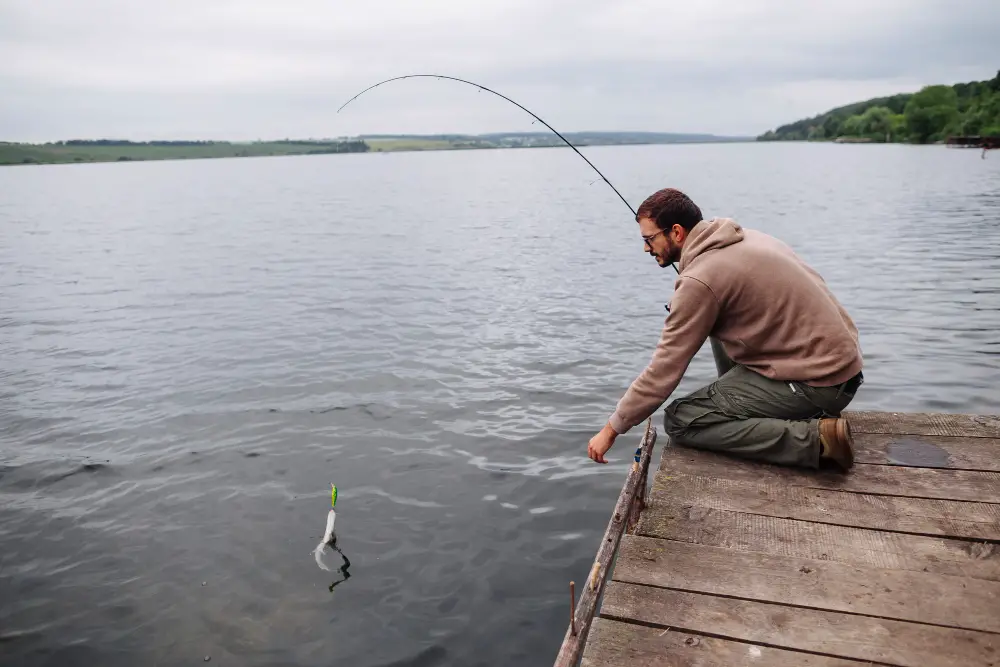
The morning had come in slowly, the way mornings do on old water, light arriving before warmth, mist sitting low over the surface of the lake like something that had nowhere else to be. Viktor Sorokov had driven out before dawn, before the town stirred, before the bakery on the corner of Lenina Street put its first loaves in, before the dogs started their rounds. He had done this for thirty-seven years, and the rhythm of it was so deep in him now that he woke without an alarm at quarter past four and was dressed and out the door before the kettle finished boiling, a thermos of tea tucked under his arm and the folding chair and the rod case already in the back of the old Niva that his son had offered to replace twice and that Viktor had declined to replace because the Niva started in cold weather without complaint and asked for nothing except oil and occasional conversation, which Viktor provided.
The pier was his by habit rather than right, which amounted to the same thing. He had been coming here since before the birches along the eastern bank had grown taller than a man. The planks had been replaced twice, the posts once, and still the pier had a particular creak on the fourth board from the shore that Viktor knew well enough to step over without thinking. He set up his chair with his back to the treeline and his face toward the open water and baited his hook with the patient attention of someone performing a small ceremony, which was exactly what it was, and settled in.
The float was a red and white thing, a little weathered, that his wife Masha had given him on his fiftieth birthday as a joke because she said he spent more time watching floats than watching her. He had laughed and told her she was never as still as a float, which she had considered for a moment before agreeing. That had been fourteen years ago. He watched the float now with the same quality of attention he had once given to much larger and more dangerous things, and found that the practice transferred well. Attention was attention. The object of it mattered less than the quality of the act.
He had already brought two fish to the bucket, a reasonable start for this hour, when he heard them.
The sound arrived before they did. Young men carried their voices differently than older ones, with a forward projection that announced itself around corners and across water, a sound that said we are here and we expect the world to rearrange itself accordingly. Viktor heard the footsteps on the pier boards, heard the creak of the fourth plank that he always stepped over, heard it twice more in quick succession, and noted all of this without moving his eyes from the float. He also heard the particular quality of their silence at the end, the silence of young men looking at an old one and deciding something.
“Hey, grandfather. You’re not from around here, are you?”
Viktor did not answer immediately. He reeled in the line slowly, checked the bait, lowered it back with care, and only then half-turned his head, enough to look at them without fully facing them.
There were three. The one who had spoken was in front, perhaps twenty-two, wearing a jacket with a collar turned up against the cold, the kind of posture that wanted to be read as casual authority. Behind him stood two others of similar age and similar expression, which was the expression of people who have grown accustomed to a specific social order and mistake that familiarity for intelligence.
“This is our lake,” the second one said. “You want to fish here, you pay.”
Viktor looked at them for a moment. He had looked at many men in his life under many different circumstances and at various levels of mutual danger, and he had developed over those years the capacity to read a situation fully and accurately in the time it took most people to begin forming an opinion. What he read now was this: three young men, not dangerous in themselves, made temporarily dangerous by the specific combination of idleness, entitlement, and an audience of one another. The lake was not theirs. The demand for payment was a performance, not a transaction. What they wanted was not money but the pleasure of the compliance, the visible shrinkage of someone older and alone, which would confirm for them a story they were already telling themselves about their place in the world.
“The lake belongs to everyone,” Viktor said, in a voice that was neither loud nor especially quiet. “It’s public water. I have the right to fish here.”
They laughed.
“He’s explaining our rights to us,” the first one said, addressing the others rather than Viktor, which was in itself a kind of answer. When a man addresses his audience instead of his opponent, he has already revealed which one he needs more.
“Pay up or leave,” the first one said again, harder this time, the performance requiring escalation since the first iteration had not produced the expected result.
Viktor turned back to the water.
This was the thing that undid them, the simple refusal of his attention. A man who argues can be argued with. A man who protests can be mocked. A man who trembles can be enjoyed. But a man who simply looks at the water as if you are not there is doing something that has no obvious counter, because the counter would require acknowledging that you have been dismissed, and that acknowledgment is its own defeat.
They shouted. Viktor watched the float. One of them used the word deaf, which Viktor registered as interesting, because a man who accuses you of not hearing him has already admitted that his words are not producing their intended effect. The float moved slightly in a small current and settled again.
Then the bucket went.
One of them stepped forward and kicked it with the full force of a man who has decided that destruction will accomplish what speech could not. The metal rang with a hollow sound that crossed the water and came back changed, and the bucket went sideways off the pier into the lake, and the two fish went with it, and the ripples spread outward in widening rings that reached the far edge of the mist and kept going into the invisible distance.
Viktor watched the ripples.
He did not flinch. He did not speak. He adjusted his grip on the rod with the small, automatic movement of a man whose hands have maintained their own separate intelligence for decades, and he watched the water.
This was worse, to them, than any response would have been. Viktor understood this too. He had learned it thirty years ago in contexts that these young men could not imagine, the profound and disorienting power of a person who simply refuses to perform fear. Fear was the product they were here to collect, and Viktor was not producing it, and the absence of it was creating in them something they did not have a name for, which was a kind of vertigo.
“Last chance,” the closest one said, and his voice had changed. The performance was still there but something raw had crept in under it, something that was not quite anger and not quite shame and was in fact the particular emotion of a person who has gone too far to go back but not far enough to finish. He stepped forward and raised his fist.
Viktor stood.
He had not planned the timing. The body did its own calculation. Thirty years of training do not retire when the uniform does. They settle deeper, migrate from the conscious to the automatic, and wait there with the patience of old tools in a shed, still sharp, still ready, uninterested in the passage of time.
The wrist went first. Viktor caught it at the top of the swing, before the fist had committed its direction, and applied a rotation that the elbow and shoulder were not designed to resist, a simple mechanical fact about the human arm that Viktor had applied to human arms on hundreds of separate occasions across a career that had included three cities, two regional crisis units, and one extended deployment to a situation he was not permitted to describe in detail to people who had not been there. The young man went down onto the planking with a sound that was partly the boards and partly the breath leaving his body.
The second moved in from the left. Viktor did not step toward him. He redirected, using the momentum of the first resolution as his starting point, and the blow was short and placed with the kind of precision that comes not from strength but from knowing exactly where to put something and why. The young man folded at the middle and sat down on the pier, his hands on his abdomen, trying to relocate his breath.
The third was already moving backward when the edge of the pier caught the back of his legs, and he went into the water with a sound of genuine surprise that was different in quality from the sounds the other two had made, which were the sounds of consequence, whereas his was the sound of simple accident. The water was cold enough in October to make the surprise last a while.
Viktor stood straight.
He looked at the young man on the boards, who was beginning to try to sit up. He looked at the other young man, still folded, still reclaiming air. He looked at the surface of the water where the third was thrashing his way upright in the shallows.
“You still don’t know who you’ve dealt with,” he said.
His voice was very quiet. It carried the particular authority of a voice that does not need to raise itself, because it has spent thirty years being heard in very loud places.
The one on the boards made it to his knees, one hand on the planking, grimacing. He looked up at Viktor with an expression Viktor recognized well because he had put it on many faces over the years, the expression of a man in the process of dramatically revising his understanding of a situation.
“I served in OMON for thirty years,” Viktor said. “I have stood in front of men who were considerably more committed to this kind of thing than you are. None of them enjoyed how those encounters concluded.”
He took one step forward, which was enough. He did not need to take another.
The one in the water had made it to the bank and was standing there dripping in the cold, his bravado entirely dissolved by the October water, which cared nothing about what he thought of himself. He looked at his friends on the pier. No one said anything.
“Take your time getting up,” Viktor said. “And then go.”
They did not take their time. The one on the boards got to his feet with the careful movements of a man cataloging damage, and he helped the second one up, and the two of them walked back along the pier toward the bank with the specific posture of people trying not to look like they are moving as fast as they actually are. The third came up from the bank to meet them. None of them looked back.
Viktor watched them until they were among the trees and then until the sounds of them were gone, and then he turned back to the water.
He sat down in the folding chair. He picked up the rod. He found the thermos and poured what was left of the morning’s tea into the cap and drank it, looking at the place where the bucket had gone in, where the ripples had long since finished their business with the surface and left it smooth again.
He thought about the fish. Two decent ones, gone back to the water by accident, which was perhaps not the worst thing that could happen to a fish. He baited the hook again and lowered the line and settled the rod in his hand and watched the float come to rest on the still surface of the lake.
The mist was beginning to lift. Across the water the far shore was becoming visible in outline, the dark mass of the far treeline separating itself from the gray sky. In an hour the light would be full and the lake would be the color of old pewter, and the fish would go deeper, and it would be time to pack up and drive back along the road that ran through the birch forest and into the town where the bakery would have bread in the window and the Niva would start without complaint.
He had not thought about the encounter in dramatic terms while it was happening, and he did not think about it that way now. This was a habit of mind he had cultivated over many years in a profession that required the clear separation of what was actually happening from the story one told oneself about what was happening. The story, he had learned, was frequently dangerous. It introduced delay, misreading, hesitation, or its opposite, excessive force born from a narrative that had gotten ahead of the situation. The discipline was to stay in the situation as it actually was, which that morning had been three young men who understood force as the primary language of social relations and who had not yet encountered anyone who spoke it back to them without either aggression or fear.
He had not been angry with them. He had been precise, which was a different thing entirely.
What he felt now, sitting in the early quiet with the float steady on the water, was something that might have been satisfaction but was more accurately described as the particular peace of a thing resolved. He had not come to the lake looking for conflict. He had come, as he always came, looking for the specific quality of attention that fishing required and that he had discovered, late in his career and early in his retirement, was the closest civilian equivalent to the quality of attention his training had demanded of him in situations of genuine danger. Both required the complete suspension of past and future. Both required you to be exactly where you were, with no part of your mind somewhere else.
There was a fish moving near the float. He could tell by the slight tension in the line, barely perceptible, the kind of signal that announced itself to a person who was paying the right kind of attention and was invisible to anyone who was not.
He waited.
He thought, briefly, about his wife, who would ask when he came home whether he had caught anything, and would listen to his answer with the same patient attention she had given every fishing report for thirty-seven years. Masha had told him once, during his last year of service, that the best thing about his fishing was not the fish. He had asked what it was. She had looked at him with the expression she reserved for observations she considered obvious and said: you come home looking like yourself. He had thought about that for a long time. He still thought about it.
The float dipped.
He set the hook with a clean, economical motion, and the rod bent, and the line ran tight, and beneath the surface of the cold lake something pulled back with its own kind of argument.
Viktor held his ground and let it tire itself out.
He had all morning.
The road back through the birch forest was empty at this hour, the trunks white and straight on both sides, the light coming through at an angle that turned everything slightly gold for fifteen minutes before the sun got high enough to make the light ordinary. Viktor drove slowly, not because the Niva required it but because this was one of the better fifteen minutes of any morning and he had learned to stay inside it rather than drive through it on the way to whatever came next.
The bucket, he had replaced from a spare in the car. He had brought home four fish in total: the two caught before the trouble, and two more caught after, and the morning had balanced itself out in the way that mornings sometimes did when you were patient enough to let them.
In the town he stopped at the bakery and bought bread and a small cake with honey that Masha liked, and the woman behind the counter, who had been selling bread since before Viktor moved to the district, asked how the fishing was, and he told her it was good, and she said she was glad, and that was the whole conversation, and it was sufficient.
At home Masha was in the kitchen with her tea, reading something on the tablet their daughter had set up for her the previous Christmas. She looked up when he came in and at the bucket and at his face, and she said: “Good morning?”
“Good morning,” he said.
She looked at him more carefully in the way she had of looking at him when she suspected the morning had been more eventful than the fishing report would suggest. He had never been able to determine whether this was intuition or the accumulation of thirty-seven years of observation. He suspected it was both, which amounted to the same thing.
“Anything interesting?” she asked.
Viktor set the bucket on the counter and began unpacking the fish with the methodical attention he gave to any task worth doing properly. “Three young men. Wanted me to pay to use the lake.”
Masha put her tea down.
He told her the story in the sparse, factual way he told stories, without embellishment or dramatization, the way a report was written. She listened without interrupting, which was also her way, and when he finished she was quiet for a moment.
“The bucket?” she said finally.
“In the lake.”
“Did you get it back?”
“No. I had the spare.”
She nodded once. “And the young men.”
“They left.”
She looked at him across the kitchen with the expression he associated with her assessment of situations that she had privately already assessed before he finished describing them, which was most situations. Then she picked up her tea and took a sip.
“Well,” she said, “I hope the fish were worth the early start.”
“Four,” he said. “Two before and two after.”
“That’s acceptable,” she said, which was her highest form of praise, and turned back to her tablet.
Viktor washed his hands at the sink. Through the kitchen window he could see the small garden, still holding its late-autumn color, the last of the asters going brown at the edges, the apple tree stripped of fruit, the fence along the back that he had repaired in September and intended to paint in the spring. It was a good fence. It would last.
He dried his hands and took down the second cup from the cabinet and poured himself tea and sat across from Masha at the kitchen table. She was reading something that required her full attention. He drank his tea and looked at the garden and did not think about the young men, who were in all likelihood somewhere in the town, damp and sore and in the middle of revising the story of the morning into something they could live with, which was the kind of work that took time and would not be finished today.
He thought about the float on the still water. He thought about the way the mist had lifted by the time he packed up, revealing the far shore in full detail, the individual trees visible, the specific topography of the far bank that in early morning had been only an impression.
The bucket was at the bottom of the lake. The fish he had caught in it were somewhere in the cold dark water, going about their business, already past the morning’s interruption with the indifference of creatures for whom the interruption had resolved in their favor. He found this satisfying in a way he could not have explained precisely, the particular equilibrium of a morning that had contained trouble and contained it, that had ended with fish in a clean bucket and tea in a clean cup and Masha reading at the kitchen table in the October light.
He had worked thirty years in a job that required him to place himself between violence and its intended targets. He had done it in cold corridors and hot streets and in situations where the outcome was not guaranteed and the variables were not controllable and the margin between a thing going right and going wrong was very thin. He had done it without the pleasure of revenge and without the comfort of certainty and without the satisfaction, available in simpler stories, of the clean conclusion. The work was not like that. The work was ongoing. The work was the daily placement of a trained and disciplined self between what was happening and what was worse.
Retirement was not the end of that. It was the continuation of it by different means. He came to the lake not to escape the world’s difficulty but to practice the quality of attention that difficulty required, in a context where the stakes were low enough to allow for pleasure. The float on the water. The line in the cold lake. The patience that waited inside the patience.
This morning had asked more of him than most mornings at the lake. He had given what was asked and no more, which was the discipline, which was always the discipline: proportionate, precise, complete, and then finished. Not carried into the next hour. Not narrated into heroism. Not used as evidence of anything except that it had happened and was now over and the water was still and the fish were in the bucket and the tea was warm.
Masha turned a page.
The garden held its quiet colors in the October light.
Viktor drank his tea.

Lila Hart is a dedicated Digital Archivist and Research Specialist with a keen eye for preserving and curating meaningful content. At TheArchivists, she specializes in organizing and managing digital archives, ensuring that valuable stories and historical moments are accessible for generations to come.
Lila earned her degree in History and Archival Studies from the University of Edinburgh, where she cultivated her passion for documenting the past and preserving cultural heritage. Her expertise lies in combining traditional archival techniques with modern digital tools, allowing her to create comprehensive and engaging collections that resonate with audiences worldwide.
At TheArchivists, Lila is known for her meticulous attention to detail and her ability to uncover hidden gems within extensive archives. Her work is praised for its depth, authenticity, and contribution to the preservation of knowledge in the digital age.
Driven by a commitment to preserving stories that matter, Lila is passionate about exploring the intersection of history and technology. Her goal is to ensure that every piece of content she handles reflects the richness of human experiences and remains a source of inspiration for years to come.