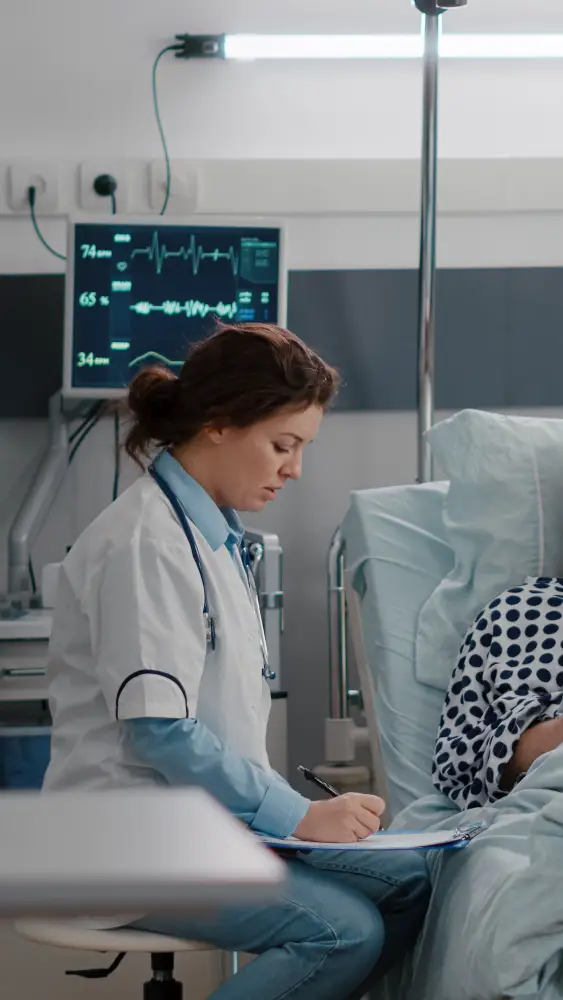
The footsteps in the hallway were the only sound for a long moment, and then my mother was in the doorway.
She looked smaller than I remembered. Not physically diminished, exactly, but stripped of the particular authority she carried in family spaces, the way she occupied a room with the certainty of someone who has never had reason to question whether she belonged at its center. That certainty was gone now. In its place was something I had never once seen on her face in thirty-four years.
She was afraid.
Her eyes moved the way eyes move when a person is trying to absorb several things at once: the monitors, the brace supporting my back, the cane against the chair, the bruising still visible along my collarbone, and then my face, which I kept very still. She had aged in ways I had not noticed because I had not been looking at her closely for years. The lines around her mouth had deepened. Her hands, when she finally stepped into the room and let them fall to her sides, trembled slightly.
“Sarah,” she said, and my name came out broken in the middle, the way words break when they meet grief they were not prepared for.
“Hi, Mom.”
Two ordinary words from me. One shattered one from her. And in the space between them, every visit she had not made and every call she had not placed came flooding in until the room felt crowded with absence.
She came forward slowly, the way people approach things they are uncertain of, and I watched her looking at me with the same expression she might have worn if she had discovered, very suddenly and very late, that she had left something precious in a burning building and only understood what it was after the smoke cleared. I recognized the progression. Confusion ceding to guilt. Guilt ceding to realization. Realization ceding to shame, the particular shame of a person confronting not just what they did, but why they were only now confronting it.
I had given her enough credit to know she was not entirely without conscience. But I had also known her long enough to know the exact sequence of what she would say next.
“How long have you been here?” she asked.
“Eleven weeks,” I said.
She pressed one hand over her mouth.
“Nobody told us it was this serious. We thought it was a minor accident. Kevin said he heard it was just a few injuries.”
“Kevin knew I was in the ICU,” I said. Not angrily. Not even bitterly. Just factually, in the way you state weather or mileage, because I had spent enough time in this hospital to reach a place on the other side of certain emotions, the place where the truth becomes less a wound and more simply the truth. “He spoke to my assistant, Julie, three days after the crash. She told him I was in a medically induced coma. He said he would let you know.”
My mother’s face went white.
I watched her do the math, the specific and punishing arithmetic of realizing that she had not been protected from difficult news by someone else’s failure to communicate. She had been protected from difficult news by her own son’s willingness to withhold it, and, if she was honest, by her own willingness not to ask too many questions about a daughter who had always been more convenient at a distance.
She sat down in the chair beside my bed without being invited, which was the right thing to do because her legs were visibly unsteady. For a while neither of us spoke. The machines made their small steady sounds. Outside the window, the healing garden held the late afternoon light in the particular way of October, all amber and long shadow.
“The wing,” she said finally. “The nurse said you donated twenty million dollars.”
“Last year,” I said. “Yes.”
“And before that?”
“The free clinic on Beaumont. The research annex at Children’s Hospital. The scholarship program at the university. The mobile health unit the county uses now.” I paused. “There are others.”
She was quiet for a long time.
“I didn’t know,” she said.
“No,” I agreed. “You didn’t.”
What I did not say, because it was implicit in everything and did not need saying, was that not knowing had been a choice, slow and accumulated, made across years of asking Kevin about his promotions and Amanda about her kitchen remodel and never quite getting around to asking me about my work in any way that implied the answer actually mattered to her. Curiosity requires investment, and my mother had always invested her curiosity unevenly.
She started to cry then. Not the theatrical crying of manipulation, not the performance I had been braced for, but the raw, undirected weeping of someone who has arrived somewhere painful and has no script for it. I handed her a tissue from the box on the bedside table, which felt absurd given the circumstances, but my hands needed something to do.
“I’m so sorry,” she said. “About the visiting. About not coming sooner. About—”
“Mom.”
She looked up.
“I know you’re sorry,” I said. “And I believe you mean it. But I need you to understand something, and I need you to sit with it rather than immediately trying to fix it.”
She pressed the tissue to her eyes and nodded.
“The name on that wing,” I said, “the reason that name is there, is not because I wanted recognition. I kept my name off everything for years because I thought recognition was beside the point. The work mattered. The children mattered. I funded a pediatric recovery ward because I believed that families with sick children deserved a space that felt less frightening than a hospital usually does.” I let that sit for a moment. “I built that for strangers. And I nearly died in it without one person from my own family walking through the front door.”
My mother made a sound that was less a word than a collapse of sound.
“I don’t say that to punish you,” I continued. “I say it because I want you to understand the actual shape of what happened. Not the version where you didn’t know, not the version where there was a miscommunication. The version where I have spent a decade building something real and significant and you never once asked me to explain it to you. The version where Kevin knew and chose not to tell you and that didn’t particularly surprise me. The version where I lay in intensive care for six weeks and the people who showed up were my business partner, my assistant, and a nurse named Jennifer.”
The light in the room shifted slightly as a cloud moved. My mother sat with her hands in her lap and her face completely open, every defense dissolved. I had never seen her look like that. She was sixty-one years old and she was looking at me the way people look when they have been wrong in a way that cannot be minimized or reframed.
“What did you think I did?” I asked. “For work. For the last ten years.”
She hesitated, and in the hesitation was the answer.
“I knew you ran a foundation,” she said slowly. “After you sold the software company. I knew it was something with healthcare or children, I think.”
“Did you ever ask me about it specifically? Ask me what it did, what we had accomplished, what I was building toward?”
She didn’t answer, which was an answer.
“Kevin has a financial strategy,” I said. “You can recite his clients and his firm’s ranking and the square footage of his office. Amanda renovated her kitchen and you know the countertop material and the cabinet brand and how it photographs. I funded a pediatric wing and you found out when you read it on a plaque because you happened to have a gallbladder appointment.”
“That’s not fair,” she said, very quietly.
“No,” I agreed. “It isn’t.”
We sat in the recognition of that for a while.
The hard thing about grief that has been deferred for years is that it does not arrive clean. It arrives tangled with everything that came before it, every small dismissal that felt survivable at the time, every family gathering where I translated my work into the briefest possible summary because experience had taught me that longer summaries produced glazed eyes and redirected conversations. Every holiday where my mother asked Kevin three follow-up questions for every one she asked me. Every time Amanda said I needed to live a more balanced life, by which she meant I needed to have a husband and a kitchen worth photographing, and my mother nodded in the thoughtful way of someone who privately agreed.
None of those things were catastrophic in isolation. They were ordinary and human and something that families do when they have decided, without quite deciding it, who among them will hold the important stories.
The catastrophic part was that it had taken eleven weeks in intensive care and a name on a building for my mother to sit in this room.
“I want to understand,” she said. “I want you to tell me about what you’ve built.”
“You want to understand it now,” I said.
She flinched.
“I know how that sounds.”
“Do you?”
She looked down at her hands. “It sounds like I’m only curious because I found out it was impressive.”
“Are you?”
The question hung in the air between us, clean and honest and a little cruel in the way that honest questions sometimes are. She did not answer quickly, which was the right thing. She thought about it in a way that suggested she was trying to be truthful rather than comforting.
“Maybe,” she said. “Maybe partly. But also—” She stopped. Started again. “Also because you almost died and I didn’t know. Because I’ve been sitting here trying to understand how I didn’t know. And the answer is that I didn’t ask. Not because I didn’t love you. Because I assumed you were fine.”
“I am usually fine,” I said. “That was always the problem. You and Kevin and Amanda could rely on my being fine, which meant nobody had to worry about me, which meant nobody had to be curious about me, which meant I became the family member you could skip.”
My mother pressed her lips together and did not argue with this.
It was the most honest exchange we had ever had, and it was happening in a hospital room because I had nearly died and she had seen my name on a building. The absurdity of it was not lost on me. I had built the wing partly because I believed in the work and partly because this city was my home and its children were worth protecting. I had not built it for my family to discover. I had never imagined it would serve as the opening move in a conversation we should have had a decade ago.
“What do you want from me?” she asked. Her voice was subdued, stripped of its usual certainty.
“I don’t want anything immediately,” I said. “I want you to understand that what happened while I was in here is not something an apology resolves. You can apologize, and I believe you mean it, but the work of what comes next is not a feeling. It’s a practice.”
“What does that mean?”
“It means that if you want a different relationship with me, that requires you to be genuinely curious about my life on a Tuesday when nothing dramatic has happened. Not just when you find my name somewhere unexpected. It requires you to ask questions and listen to the full answer and not redirect to Kevin’s earnings report or Amanda’s countertops.” I looked at her. “I built a twenty-million-dollar pediatric wing and you learned about it from a plaque. That’s a decade of conversations that didn’t happen. I’m not interested in fixing that in one afternoon.”
She absorbed this without protest.
“Can I come back?” she asked. “While you’re still here?”
“Yes,” I said. “Bring coffee. Jennifer will tell you what I actually like.”
She almost smiled at that, a small, watery thing, but real.
“I’ll call Kevin,” she said, standing slowly. “When I leave here. I’ll tell him what I think of what he did.”
“That’s between you and Kevin,” I said. “Don’t do it on my behalf. Do it because you think it’s right.”
She stood in the doorway for a moment before she left, the way people stand in doorways when they want to say one more thing but haven’t found it yet.
“The wing,” she said. “The children who recover in there. Do you know how many?”
“We’re tracking sixty-four admissions since the wing opened,” I said. “Eleven of them were children who required care that wasn’t available at any other facility within two hundred miles. The wing made it possible for them to stay near their families during treatment instead of being transferred to a hospital four hours away.”
My mother stood in that doorway and looked at me with an expression I had never quite seen from her before, something that was not pride exactly, because pride implies credit, and she had no claim on what I had built. It was something closer to recognition. As if she were seeing, for the first time and with full clarity, the person who had been standing in front of her all along.
She left without saying anything else, which was the right choice. There was nothing that would have improved on the silence.
Jennifer came back twenty minutes later and took my blood pressure and asked, with her customary professional calm, whether I was all right.
“I think so,” I said.
“She stayed for about forty minutes,” Jennifer said. “She walked through the wing before she left. I saw her stop at one of the playrooms.” A pause. “She sat down in one of the chairs in there for a while. Just sat.”
I looked at the ceiling.
“Good,” I said.
The physical recovery continued its patient, incremental work across the following weeks. The body is a remarkably earnest instrument once you stop asking it to perform for an audience, once you give it the simple instruction of heal and then do the work of letting it do so. I walked the length of the corridor in the mornings, and Jennifer marked the improvement with the same quiet satisfaction she brought to everything. Dr. Martinez was cautiously optimistic about my mobility timeline, which in medical language meant he was pleased but reserved the right not to be, and I had spent enough time in the medical world to understand that as good news.
Marcus came every other day and managed to be useful without being hovering, which is a skill that most people lack and which I had never fully appreciated until I needed it. He updated me on the foundation work, confirmed that the December event was proceeding, and reminded me, gently but persistently, that the organization would not actually collapse if I was unavailable for another six weeks. I did not fully believe him, but I appreciated the attempt.
My mother came back the next day with coffee, and the day after that, and three days after that. She did not immediately transform. I want to be honest about that because the truth of it matters more than a cleaner version would. She still sometimes started sentences about Kevin and had to visibly redirect herself. She still occasionally framed my work in terms of its scale and its numbers rather than its meaning, because that was the language she knew, and relearning language is slow work. But she asked questions. She asked what it had been like to sell the software company at twenty-six and then decide to use that money the way I did. She asked why the pediatric wing specifically. She listened to the answers without the glazed, waiting-for-my-turn quality I had spent years recognizing and accommodating.
She told me, on one of those visits, that she had not spoken to Kevin since her call to him after leaving my room the first day. She did not elaborate and I did not ask.
Amanda sent flowers. A large arrangement, clearly expensive, delivered with a card that said thinking of you which was technically true in the minimal sense that she had been aware of my existence enough to order the arrangement. I put the flowers in the window where they caught the light and thought about what Marcus had said months ago: that the people who showed up in hard moments were telling you something about themselves, not about their feelings toward you.
The foundation event in December was held without me, which turned out to be fine, because Marcus had helped build an organization that could function without any single person at its center, including me, which was precisely how I had always wanted it to function.
I was discharged from the hospital on a December afternoon when the air outside was sharp enough to be bracing without being cruel. Jennifer walked me to the car, which was more ceremony than strictly necessary, but I was grateful for it. She had been present for more of my recovery than anyone outside the medical team, and there is a particular kind of relationship that forms between a nurse and a long-term patient, not friendship exactly, but something in the vicinity of it, something built on the specific intimacy of being seen at your most reduced and treated with consistent dignity regardless.
“The playroom,” I said, before I got in the car. “Tell me what they’re using it for.”
“Art therapy on Tuesdays,” she said. “A volunteer reading program on Thursday afternoons. The kids call it the yellow room because of the light.” She smiled. “They love the yellow room.”
I thought about that on the drive home. The yellow room. Children calling a space by the quality of its light, by what it felt like to be inside it, by nothing more complicated than the fact that it was warm and bright and theirs. That was why I had built it. Not for recognition. Not for my name on a plaque. Not even to be noticed by my family, though that had happened anyway, in the sideways and unintended manner of most significant things.
I had built it because I believed that the world, tended carefully and over time, could become less frightening for the people most in need of that. And because I had money and skill and the specific kind of determination that forms in people who spent their childhoods being overlooked and decided, at some point, that this was not a reason to become small but a reason to become useful.
The relationship with my mother rebuilt itself slowly, over months, through phone calls and occasional dinners and the imperfect but genuine work of two people trying to learn a new vocabulary for each other. She asked, at one dinner in February, if she could come to a foundation event. I said yes. She attended and was quiet through most of it, listening to the program staff talk about outcomes and plans, and on the drive home she said nothing for a long time and then said that she had not understood, really understood, what the word legacy meant until that evening.
“You’ve already built yours,” she said.
“I’m still building it,” I said.
“Yes,” she said. “I know. That’s what I mean.”
It was not a perfect reconciliation. Those exist only in versions of events that have been simplified for the comfort of people who were not inside them. What it was, was real, and slow, and sometimes difficult, and occasionally very good in the way that things are good when they have been earned. My mother learned to ask questions. I learned to answer them without the armor I had spent decades constructing. We practiced being in each other’s lives with our actual selves rather than the performances we had both, in different ways, been maintaining.
Kevin sent an email in March that began with an apology and became, by the third paragraph, a defense of his actions. I did not respond to it. That was its own kind of answer.
I returned to full-time work in April, which my body protested for about two weeks and then accepted with the pragmatic adaptability of something that has survived worse. I walked with a cane through the summer, which I had been told might be permanent and might not be, and which I found I minded less than I expected. The cane was an honest instrument. It said something true about where I had been and what the path back had cost.
In September, almost exactly eighteen months after the accident, I was back in the hospital for a routine follow-up with Dr. Martinez. While I was waiting in the corridor, I watched a family come through the pediatric wing. A small girl, maybe five, holding her father’s hand, her head wrapped in a soft bandage. She was walking toward the yellow room. At the door she stopped and looked back at her parents the way children look back before they cross a threshold, not for permission but for the simple reassurance that the people they love are still there.
Her father nodded. Her mother smiled.
The girl went through the door.
I sat with that for a moment in the corridor, the particular quietness of having built something that now existed entirely beyond your own involvement in it, something that simply was, that simply served, that needed nothing further from you.
Jennifer appeared around the corner on her way somewhere and stopped when she saw me.
“How’s the follow-up going?”
“Just waiting,” I said. “Good, overall.”
She looked at the playroom door, then at me, with the expression of someone who understands the full picture without needing it explained.
“Yellow room just got a new reading corner,” she said. “Donated anonymously. Again.”
“Imagine that,” I said.
She shook her head, smiling, and walked on.
I waited in the corridor and listened to the sounds of children inside the room they had named for its light, and thought about what it meant to love something enough to build it carefully and then let it go entirely, let it become a place where strangers’ children called it by what it felt like rather than who had paid for it.
That, I thought, was the whole point.
That had always been the whole point.

Specialty: Quiet Comebacks & Personal Justice
David Reynolds focuses on stories where underestimated individuals regain control of their lives. His writing centers on measured decisions rather than dramatic outbursts — emphasizing preparation, patience, and the long game. His characters don’t shout; they act.
Very good sequel!