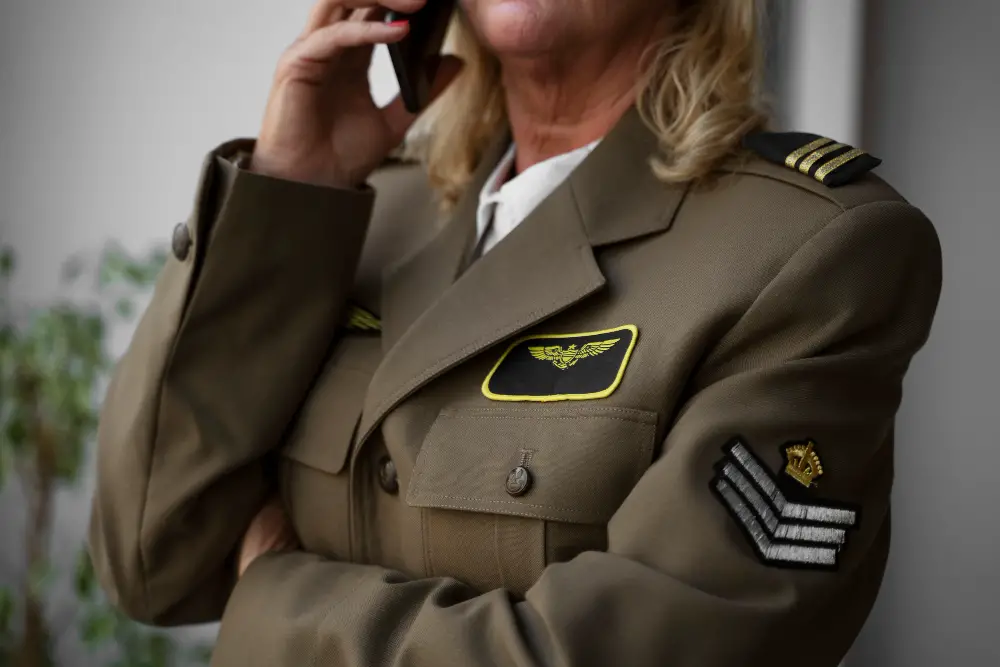
The ring had been on her finger for eleven days when General Victor Kain grabbed her wrist.
She had just crossed the stage to receive her commendation, the Arlington reception hall bright with afternoon light and the polished brass of the highest-ranking uniforms in the country. Everything was proceeding exactly as ceremony required. She extended her hand to the general. He took it. Then his eyes dropped to her index finger, and whatever polished performance he had been maintaining dissolved so completely and so fast that the two men of his security detail each shifted their weight simultaneously, their hands moving to their sides before they had consciously decided to move them.
“Take that off,” Kain said. His voice was a harsh whisper that did not carry to the surrounding guests, but his grip on her wrist did not match the volume. It matched the expression on his face. “Right now. You should not be wearing that here.”
Lieutenant Ava Cross had been trained to keep her posture and her face neutral in situations of pressure, and she kept them both now, though her heart had accelerated with the sudden alarm of a person who has not yet understood what she has done wrong but can see clearly in someone else’s eyes that it is serious.
“Sir,” she said, her voice barely audible over the reception noise.
He did not explain. He pulled her away from the crowd with the purposeful speed of a man doing triage, through a heavy oak door at the far end of the hall, into a small antechamber where the sounds of celebration became a muffled irrelevance and the two of them stood alone under a single window that looked out at nothing significant.
He let go of her wrist and ran both hands over his face. She watched him do it and understood, in the way that trained people understand things through behavior rather than words, that he was not angry. He was frightened.
“Where did you get that ring?” he asked.
“My grandfather,” she said. “Arthur Cross.”
Kain looked at her the way people look at things that should not exist.
She had not expected it to mean anything. She had found it in a hidden compartment beneath a loose floorboard under his bed, wrapped in oiled canvas inside a small wooden box, when she drove down to Blackidge alone to clear out the house after the police called her at three forty-two in the morning to tell her he was dead. The ring was made of some dark, unpolished metal that did not catch the light in the way of decorative jewelry. When she examined the inner band she found an insignia she could not identify, and she had spent years of her career learning to identify military insignias. It belonged to nothing in any system she had studied.
She put it on out of defiance and grief. Her parents had not come to clean out the house. Her father had told her over the phone to let the state handle it and had hung up before she could respond. Her brother thought the whole thing was a sad joke. Her mother had referred to the old man’s death with the same mild annoyance she brought to all inconveniences that did not fall within the category of things she had personally organized. They had spent decades treating her grandfather as though his existence were an administrative error, a persistent, embarrassing footnote in an otherwise tidy family record, and when he died they could not summon the basic human effort of presence.
So she had driven to West Virginia alone and scrubbed his floors and found the ring and put it on her hand where they could not ignore it. She thought she was making a private statement about her family’s cruelty.
She had not understood what she was actually putting on.
Kain pointed at the ring and she removed it and held it in her palm, where it felt heavier than it had before, as though the weight of what it signified was adding itself to the physical fact of it.
“Arthur Cross was not a paranoid old man living in the woods,” Kain said, his voice controlled now but thin with the effort of controlling it. “He was a founding member of a military unit so classified that presidential briefings on its operations required a separate authorization level. We called it Echelon Black. It was officially erased from every institutional record. The men and women who served in it ceased to exist in any documented form. They had no service IDs, no Social Security numbers, no family they could safely acknowledge. They were handed the work that the government desperately needed done and would never be able to admit to, and when that work was finished, when the people in charge decided that Echelon Black knew too much to be allowed to continue existing, they did not retire the unit. They hunted it.”
The room held the particular silence of a space that has been removed from the normal flow of events.
“They were purged,” Kain continued. “And Arthur was their primary target, because Arthur was the Phantom Handler. His specific role within the unit was the removal of compromised assets from operational exposure. When a deep-cover spy was blown, when an intelligence source was burned and could not be safely extracted through official channels, Arthur Cross was the man they sent. He gave dead people new lives. He created identities that no government database could flag, relocated assets to coordinates that appeared in no official record, and when saving someone proved genuinely impossible, he ensured they left nothing behind for the enemy to recover.”
Ava looked at the ring in her palm.
She was thinking about the years she had driven out to Blackidge on weekend passes, about sitting on his porch in the long summer evenings watching the tree line at the edge of the property, about the way he had checked his locks and his windows with a routine so ingrained it appeared automatic. She had thought it was age-related anxiety. She had never stopped to compute what it would mean for a man to check his locks that way every night for thirty years with genuine purpose.
“When the order came to burn Echelon Black,” Kain said, “Arthur was the most dangerous man alive. He knew the identities of every asset he had ever relocated. He knew the coordinates of every safe house, every dead drop, every piece of black infrastructure the unit had ever operated. He was a living archive of the most catastrophic secrets in the intelligence community. The people who ordered the purge understood that if Arthur Cross ever spoke, careers would end, institutions would fracture, and the men who had authorized domestic operations on American soil would face consequences that had no comfortable resolution.”
“He survived because he was the best at what he did,” Kain said, and there was something close to reverence in the phrase, involuntary and immediately controlled. “He erased himself. He became the pathetic, ignored old man that your family despised, and the disgust your parents had for him was the most effective cover he could have built. Nobody examines a man who has been publicly abandoned by his own children. Nobody looks twice at someone that prosperous, successful people are embarrassed to acknowledge. He survived thirty years because he made himself into exactly the thing that comfortable people avert their eyes from.”
Ava stood with the ring in her palm and felt something reorganize itself inside her chest, a long, slow rearrangement of weight.
Her father had called him a nuisance. Her mother had complained about his medical bills, the phone calls, the mere fact of his continued existence as a demand on her attention. Her brother had mocked the way he lived. And all of it, the irritation, the contempt, the long years of deliberate neglect, had been the architecture of his survival.
He had absorbed their cruelty because their cruelty was useful. He had let them hate him because their hatred kept them safe.
Kain pointed at the ring. “That is a unit marker. The original founding members of Echelon Black carried them as physical identification in field conditions when all other communication had gone dark. It is also a physical key. Arthur would not have preserved it unless it opened something he needed preserved. And the people who tossed his house after he died found a property they could search but not a key they could operate, which means whatever he left behind, they have not found it yet.”
“And they know I have the ring,” Ava said.
“The moment you walked into this room wearing it, in front of a hundred senior officers and their staff, yes.” Kain’s voice was flat and precise. “Hide it. Do not wear it. Do not show it to anyone. If they realize Arthur passed a key to someone they need to account for, your life as you currently know it is finished.”
He did not say it as a threat. He said it as meteorology, the way a forecaster describes a weather system already in motion. He opened the oak door, replaced the social expression he had been wearing when he received her commendation, and walked back into the reception hall without another word.
She stood in the antechamber for ten minutes before she left the building.
She had not gone back to the field house. She had not stayed for the ceremony’s conclusion. She had walked out into the Arlington afternoon, put the ring on a chain around her neck where it rested against her sternum like a cold coal, and driven home to an apartment that she would later understand had already been entered and searched with a precision that left no evidence except the kind she had been trained to read.
The chair by her desk moved one inch. The closet door not quite flush. Her laptop angled a fraction of a degree from its exact usual position. Nothing taken. Nothing broken. A professional communication delivered in the vocabulary of professional surveillance: we have been here. We can come back. The ring is what we want.
She had gone back to Blackidge three days later.
The house was exactly as the search team had left it. Floorboards pried up, cushions sliced, walls drilled and probed. They had been thorough in the way of people with access to excellent equipment and no time constraint, which meant they had searched every place a professional would think to look. What they had not done, because they were searchers and he had been a builder, was understand the difference between finding a hiding place and recognizing a structural anomaly.
She stood in the wreckage of his living room and tried to think like him.
He had been a phantom handler. His profession had been the concealment of people, the engineering of disappearances so complete that the intelligence apparatus of a superpower could not reverse-engineer them. A man with that training did not hide things in loose floorboards or hollowed books. Those were the first places a professional sweep found because they were the first places a professional sweep looked. He would have hidden his insurance policy in a way that required not searching skills but architectural knowledge, the specific knowledge of a person who had personally built the thing that concealed it.
She remembered helping him replace the doorframe of the bedroom hallway when she was sixteen. She remembered complaining about the weight of the oak. He had told her a strong frame was what kept the whole house from falling, and she had rolled her eyes at the time in the way of teenagers for whom the observation of an old man sounds like commentary on nothing.
She got down on her knees in front of the baseboard beside the doorframe and looked at the grain of the wood.
The seam was there if you knew to look for it.
She used her tactical knife. The latch released with a clean mechanical click, the sound of something engineered to function long after its maker was gone. The rectangular section of wall came free, and inside the hollow space she found a steel lockbox coated in dust, too heavy to lift casually, its lid fitted with a circular indentation that was not a combination dial or a keyhole but the exact negative impression of the ring hanging against her chest.
She carried the box to the kitchen table. She fit the ring into the indentation and turned it clockwise. The mechanism released.
Inside, nested in protective foam, was a leather-bound notebook. Old leather, worn smooth at the edges in the way of things handled often over many years. His handwriting in dense, precise rows. Names and dates and coordinates and the operational records of a career spent erasing human traces and building new ones in the erasure. She recognized some of the names from intelligence history briefings, people officially declared killed in action or disappeared, whose cases had been closed with the administrative finality that is its own kind of message. They were not dead. They were relocated. He had given them the second lives that their original lives had made necessary.
The red-stamped pages were at the back. Domestic operations. American soil. The kind of work that did not appear in any historical record because its appearance would constitute not merely embarrassment but criminal liability reaching into the current structures of the Pentagon. She read one entry and then set the notebook down and looked at the window for a moment before reading the next.
He had been the most dangerous man alive not because of what he could do with his hands but because of what he had written in this book.
The envelope was in the back cover, hidden in a false seam of the leather binding. Her name on the front. His handwriting, neat and deliberate, addressed to her specifically across the gap between a date three months before his death and this moment in his ruined kitchen.
She opened it and read it twice before the tears came.
He apologized for the weight. He apologized for the years. He told her that every visit she had made to Blackidge, every bag of groceries and fixed pipe and quiet afternoon on the porch, had been the thing that kept him capable of carrying what he carried. He told her that her family’s cruelty had been his survival strategy and that the hardest part of executing it had been watching her absorb their framework for his worthlessness without being able to tell her the truth. He told her that her mother’s contempt had been a kind of armor. He told her that he had been a man who had learned to use other people’s worst impulses as tools for his own preservation and that watching her refuse to adopt those impulses, watching her continue to see him despite every structural incentive not to, had been the one thing he had not been able to make himself give up.
He gave her a choice in clear, unornamented language. She could take the ledger and disappear, living the way he had lived, in the careful paranoid quiet of a person managing an enormous secret alone. Or she could find the people he had saved and use their collective existence and the leverage of the ledger to dismantle the mechanism that had hunted him and that was now hunting her.
He told her he was proud of her. He told her to trust no uniform that arrived claiming help. He told her to give them hell.
She folded the letter and put it in her uniform pocket next to the ring.
She found them through the dead-drop protocols hidden in the notebook’s final pages, old-school communication relays that a deep-cover operative would recognize and a signals analyst would spend weeks deciphering. She identified herself using the insignia as a digital signature and stated in eight words what had happened and what she needed.
The response came within hours. Coordinates for a private estate in the mountains of upstate New York, and a message that contained exactly four words: We are waiting. Period.
She drove through the night.
The gates of the estate were opened by two men who looked at the ring on her finger and stepped aside without speaking. She walked through the main doors of the house and stopped.
It was nothing like the funeral in Blackidge, which had been attended by a tired priest, two neighbors, and the ambient sound of people who wanted to be elsewhere. This room was full. Men and women of different ages and different appearances, the variety of people who are living different lives because someone engineered their differences for them. A mechanic with rough hands. A woman who looked like she ran a school somewhere quiet. An elderly man with a scar running the length of his neck who stood in the center of the room with the posture of someone who had been military once and never fully stopped.
They were the people Arthur Cross had saved. The ghosts he had given second lives. Dozens of them, gathered in this room because a dead man’s granddaughter had used his ring to call them home.
The older woman from the cemetery in Blackidge came forward first. She put her hand on Ava’s shoulder and looked at her with the expression of a person who has been waiting a long time to be able to say something directly.
Then, one by one, they spoke.
The man from East Berlin described a door being kicked in and a gun already loaded and Arthur coming through the window with the unhurried competence of someone who had done this before, who gave him a name and a history and a daughter he had raised in a country that did not know his original one. A woman who looked like a suburban mother described being left bleeding in an alley in Chicago after her own command structure ordered her death, and Arthur arriving with a van and driving her across three state lines through the night without once making her feel like a liability.
They spoke only about him. Not the wars, not the politics, not the institutional machinery that had made their situations necessary. They spoke about what he had done with his hands and his knowledge and his willingness to put himself in the space between a compromised asset and the mechanism that would have destroyed them.
Ava stood in the center of that room and held all of it.
Her family had looked at Arthur Cross and seen a burden. They had seen a bill, an embarrassment, an eccentric old man too irrational to be taken seriously. They had seen what he had designed for them to see, because the design had been necessary, because the alternative would have put them in the path of the people who were now hunting her. He had taken their contempt and worn it like a costume and kept wearing it for thirty years because the costume worked, and because he loved them in the specific, complicated way of a person who must choose between being loved and keeping the people they love safe.
She understood, standing in that room, that this was the second memorial. The real one. The one that counted.
The tall man from East Berlin looked at her across the circle of faces.
“He protected us when no one else would or could,” he said. “If the people who killed him are coming after you, they will need to go through every single person in this room first.”
She looked around at them.
He had not left her a ring and a ledger. He had left her an army of sixty-three people who owed him their continued existence and who had spent decades maintaining the skills that had made that existence possible. The people hunting her thought they were pursuing a frightened junior officer with a piece of evidence she did not fully understand. They had not calculated the architecture of what Arthur Cross had actually built.
They spent the night working.
The estate became a command center assembled from the accumulated resources of several decades and many countries. The ledger was photographed, digitized, encrypted, and distributed to servers in locations that no single organization could simultaneously identify and access. A dead-man protocol was established: if Ava’s vital signs went silent, or if any of the operatives in that room disappeared without triggering their own regular check-in sequences, the decryption keys would deploy automatically. Unredacted files to every major international news organization. Complete documentation of every domestic operation, every assassination disguised as accident, every black-fund transfer, every name with operational authority over events that had been officially denied.
They were not building a weapon. They were building a guarantee.
She drove back to Washington alone in the morning and turned her phone on and used her credit card at a downtown coffee shop. She waited forty-five minutes.
The black sedan pulled to the curb exactly as she had expected.
The man in the gray suit in the back seat had the cold, executive stillness of someone who has operated for a long career in the comfortable certainty that his institutional position made him unreachable. He did not introduce himself. She did not ask. She took the folded photocopy from her jacket and handed it to him.
She watched him read it. She watched the executive stillness fail.
She told him what she had built and what it would do if activated. She told him the terms: close the file on Arthur Cross, recall the surveillance apparatus, forget that she or anyone Arthur had saved had ever existed. She told him that if a single black sedan appeared in her mirrors again, or if any of the people in that network developed unexplained accidents, she would pull the trigger on a detonation that would end careers, destroy institutions, and send him specifically to a federal prison that would not be comfortable.
He had spent his career hunting people in the dark. He recognized when the dark had been taken from him.
He nodded once. She opened the door and stepped out onto the sidewalk and did not look back.
The sedan pulled into traffic and was gone.
In the weeks that followed, her life returned to its surface routines. She reported for duty. She reviewed briefs and filed reports and attended briefings where the people across the table from her did not know what she carried on the chain around her neck or what she had built in the mountains of upstate New York. Her parents had taken her advice in the way of people who have been frightened badly enough to override their usual resistance to inconvenience. They had sold the colonial house at a significant loss and relocated to somewhere in southern Europe, living now in the paranoid quiet that had been her grandfather’s entire existence, understanding for the first time what it cost to inhabit that condition. She found she could not produce uncomplicated satisfaction at this. It was not justice, exactly. It was consequence, which was related but not identical.
She had stood before the choice he had described in the letter. She could have exposed the ledger, burned the corrupt architecture to the ground, cleared his name in every official record that had ever erased it. The man in the gray suit would have ended his career in a federal courtroom. The history would have been corrected in the public record where corrections are made.
But the ledger contained the locations of sixty-three people living lives they had built from the second chances Arthur had engineered for them. Exposure would not have ended at the corrupt officials. It would have followed the thread of every documented identity back to every protected person, and the work Arthur Cross had spent his entire life doing, the patient, invisible labor of keeping the innocent breathing, would have been undone.
She chose the silence.
She understood, making that choice, something about her grandfather that she had not understood before. He had not been silent because silence was easy. He had not been silent because the truth was not worth saying. He had been silent because silence was the tool his situation required, and he had been a man who chose his tools according to the work rather than his preferences, and that capacity for choosing correctly even when the choice was costly was, she thought, the central fact of who he was.
She kept the ring. She wore it openly now, on her finger where anyone could see it, where General Kain had seen it and gone pale and dragged her out of a reception hall. She wore it as a mark, not a target. An acknowledgment of lineage. A quiet declaration of what she had chosen to become.
She walked across the base in the morning light and looked at the insignia catching the sun, and thought about the sixty-three people living their ordinary lives in the safety of his careful architecture, and thought about the letter folded in her uniform pocket, and thought about all the long quiet evenings on the porch in Blackidge that had meant more to him than she had known they did.
He had not taught her how to be a hero.
He had taught her how to choose correctly even when no one was watching, and to keep choosing correctly even when the cost was borne alone, and to understand that some of the most essential work a person can do in the world produces no record, claims no recognition, and leaves nothing behind except the unaware continuation of the lives it protected.
She looked at the ring.
She went back to work.

Lila Hart is a dedicated Digital Archivist and Research Specialist with a keen eye for preserving and curating meaningful content. At TheArchivists, she specializes in organizing and managing digital archives, ensuring that valuable stories and historical moments are accessible for generations to come.
Lila earned her degree in History and Archival Studies from the University of Edinburgh, where she cultivated her passion for documenting the past and preserving cultural heritage. Her expertise lies in combining traditional archival techniques with modern digital tools, allowing her to create comprehensive and engaging collections that resonate with audiences worldwide.
At TheArchivists, Lila is known for her meticulous attention to detail and her ability to uncover hidden gems within extensive archives. Her work is praised for its depth, authenticity, and contribution to the preservation of knowledge in the digital age.
Driven by a commitment to preserving stories that matter, Lila is passionate about exploring the intersection of history and technology. Her goal is to ensure that every piece of content she handles reflects the richness of human experiences and remains a source of inspiration for years to come.