I used to think that if you raised your children well, really well, the ending of your life would feel softer than the middle of it. Not grand. Not dramatic. Just gentler. A casserole dropped off when winter set in. A Sunday call that was not rushed. Somebody noticing when your porch light stayed off too long.
Instead, mine drove out to my house in Spokane Valley on a wet Tuesday in March, parked in a neat row along South Pines Road, and sat in my living room telling me it was time to talk about next steps.
I remember the smell of rain on wool and the sound of my son’s truck keys tapping against his knee. I remember my oldest daughter still in her navy courthouse suit, her reading glasses pushed up on her head like she had come from somewhere important and would be returning there shortly. I remember my youngest, Claire, smiling the whole time, that bright fixed smile people wear when they have decided that staying cheerful is the same as being kind.
My name is Margaret Ellison. I am seventy-four years old. I raised three children in the same ranch house on a corner lot in Spokane Valley, in the same house Richard and I bought in 1979 when the wallpaper in the kitchen was the color of mustard and we thought that was charming. I taught second grade for thirty-one years. I made lunches and drove carpools and sat in the pediatrician’s office and the school auditorium and the bleachers at every game any of them ever played in, through the years when parenting is just showing up and the years when it is something harder and more invisible.
I thought I knew what I was building toward.
The conversation that Tuesday was the careful kind, all softened edges and reasonable language. They had been worried, they said. My eyesight. The house was a lot for one person. There was a place they had found, very nice, with activities, with staff who were trained for this. They had already made some calls.
My oldest, Katherine, did most of the talking. David nodded at the right moments. Claire kept saying things like “We just want you to be safe, Mom” in the tone people use when they have already decided what safe means and are not asking.
By the weekend, my blue Pyrex dishes were boxed up, my late husband’s recliner had a donation tag hanging from one arm, and I was standing in the driveway of the home where I had lived for forty-four years with two suitcases and a cardigan folded over my arm.
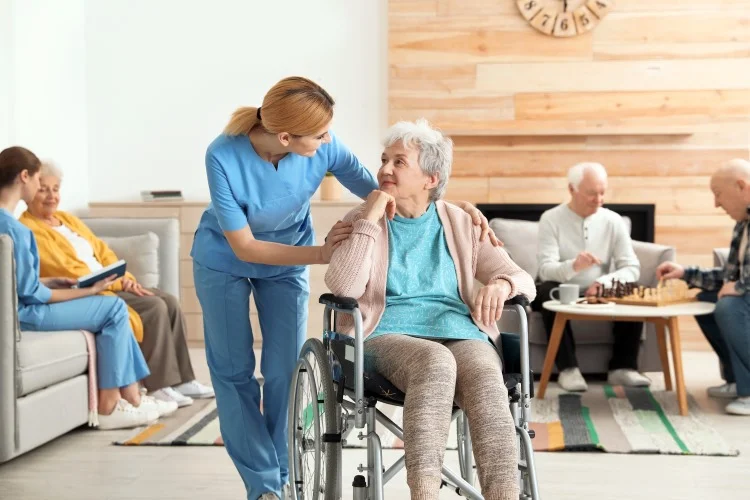
The place they chose was called Sunny Meadows, a nursing facility just off East Valleyway Avenue. It was not unkind. The lobby had warm lighting and a piano nobody played and a jigsaw puzzle in the day room that had been half-assembled for so long the pieces were slightly warped at the edges. The staff were polite and competent and relentlessly cheerful in the way that people become when their job requires them to be upbeat around grief all day. The food was served at regular intervals and tasted like things that had once been vegetables.
My room had one window and two drawers and a closet about the width of a doorway.
My children promised they would visit constantly.
If you have lived long enough, you learn that some promises are made out of love and some are made because silence would have made a person look bad.
The first week, nobody came.
The second week, my son David stopped by with grocery-store carnations on a Thursday afternoon, stayed forty minutes, and left before they had time to open. He talked about his renovation project. He mentioned the kids’ soccer schedules. He patted my hand when he left and said he would be back soon, and we both understood that soon was doing a great deal of work in that sentence.
My youngest mailed a card with a looping signature and a stamped message about thinking of you. No real message underneath. Just her name, written large the way people write when they want to fill space.
My oldest came in on a Saturday wearing the same kind of focused, efficient energy she brought to difficult meetings. She told me I was adjusting so well. She checked her phone while I was still answering her question about my week. She kissed my cheek when she left and mentioned that things were very busy at the office.
Adjusting so well.
The phrase stayed with me the way certain phrases do when they reveal more than the speaker intended. As if a life can be folded into two drawers and a plastic cup on a tray table and whatever remains is simply the matter of attitude.
What my children did not know was that two months before they had their conversation in my living room, my sister Dorothy had died in Seattle.
Dorothy was the kind of woman who had always occupied more space than the room expected. She had worked in finance for forty years, had never married, had never particularly cared what people thought of her choices, and had spent the second half of her life accumulating not just money but the quiet satisfaction of watching people underestimate her. She left me seven million dollars and one final piece of advice, delivered through a letter that her attorney handed me along with the estate documents.
The letter was two paragraphs. The first paragraph explained the money. The second paragraph said: Margaret, you have spent your whole life making yourself smaller so other people would feel comfortable. Stop it. You are seventy-four, not dead.
I folded the letter and put it in my cardigan pocket and sat with it for several days.
At Sunny Meadows, I watched. That was what I did in those first weeks. I watched the lobby. I watched which residents had visitors and which ones kept their eyes on the front doors until a staff member gently redirected them toward dinner or a television program. I watched the aides run thin by noon, managing too many people with too little time and too little pay. I watched the families who came in once a week or once a month and stayed twenty minutes and left looking relieved, as if the visit were a box checked rather than a relationship maintained.
I watched my children’s visits shrink in length and frequency until they had settled into a predictable rhythm that had less to do with me and more to do with their own schedules and, I suspected, their own discomfort with what they had done.
I was not angry, exactly. I want to be honest about that. I understood how it happened. People get busy. People convince themselves that convenience is the same as care. People look at an elderly woman in a cheerful facility and decide that she is fine, she is managing, she is adjusting so well, and then they go home to their kitchen islands and their neighborhood text threads.
But understanding how a thing happens is different from accepting it.
Six weeks after I arrived at Sunny Meadows, I took a car service into downtown Spokane on a Wednesday morning. I had not told anyone. I wore my good coat and my pearl earrings and I walked three blocks from the Spokane County Courthouse to the office of a real estate attorney named Gerald Park, whose name I had found in the bar association directory.
Gerald Park was in his fifties, careful, the kind of attorney who listened more than he spoke. I sat across from his desk and told him what I was looking for. He was quiet for a moment after I finished. Then he asked several precise questions, made notes on a legal pad, and told me he would do some research.
I thanked him and asked him to be thorough.
Sunny Meadows was a private facility. The owner was a man named Robert Hatch, who had operated several care facilities across eastern Washington through a holding company. Gerald Park discovered, after several weeks of quiet inquiry, that Mr. Hatch had been considering selling for some time. The facility was profitable but aging. The renovations it needed were substantial. Mr. Hatch was sixty-seven years old and had mentioned to his accountant, apparently more than once, that he was thinking about retiring to somewhere warmer.
Gerald Park called me with this information on a Thursday afternoon while I was eating institutional chicken in the Sunny Meadows dining room. I set down my fork and listened carefully.
The process took three months.
During those three months, I continued to live in my room on the second floor. I continued to eat the overcooked vegetables and do the gentle chair yoga on Tuesday mornings and sit by my window in the afternoons. I did not tell anyone what I was doing. Not the staff. Not the other residents. Not my children.
There were things I had learned that I wanted to address when the facility became mine. The staffing ratios. The quality of the food, which could be improved substantially without a great deal of additional cost. The common areas, which were functional but joyless. The visiting policies, which had always been loosely enforced, varying depending on who was at the front desk and what mood they were in.
I had thoughts about visiting policies.
The sale closed on a Friday.
On Monday morning, Gerald Park’s office sent letters of notification to the facility management, the staff, and the families of all current residents. New ownership. New administrative structure. Updated policies effective immediately, with a thirty-day transition period for operational changes and a sixty-day timeline for the physical improvements already under contract.
Among the policy updates was a new visitor registration system. All regular visitors would need to be registered with the facility. Visits outside of posted hours would require advance scheduling. Unregistered visitors would be asked to wait in the lobby while staff contacted the resident. Certain individuals could be designated by the resident as requiring administrative approval before access.
I sat with Gerald Park in the facility’s small conference room that Monday morning while the letters went out, and we went through the administrative details, and I thought about my children driving up to that lobby on Sunday the way they always did, between errands, flowers in hand, already mentally somewhere else.
That Sunday came with the particular flat light of an April morning in eastern Washington, white sky and cold air and the smell of damp concrete.
I was in the small room just off the lobby that had been redesignated as the administrative office, the glass wall giving me a clear view of the front entrance. I had told the receptionist, a young woman named Patricia who had been at Sunny Meadows for three years and whom I had come to like considerably, that I would be observing.
Patricia did not ask many questions. She was the kind of person who recognized when a situation was going to be interesting and chose to position herself accordingly.
At eleven-fourteen, the sliding glass doors opened and my three children walked in.
David had flowers in one hand and the distracted expression of a man who had already been somewhere else that morning. Katherine was slightly ahead of the others, the way she always positioned herself, and she was already looking past the lobby toward the hallway that led to my room, calculating the route, calculating the time. Claire was scrolling her phone as she crossed the threshold, the light from the screen reflected briefly on her face.
They approached the reception desk in the loose formation of people who have done something many times and expect to keep doing it without interruption.
Patricia looked up from her computer. She said something I could not hear through the glass. I watched David’s expression shift first, a small confused narrowing. Katherine tilted her head slightly. Claire looked up from her phone.
Patricia said something further, consulting the screen. She was calm, professional, and completely pleasant. She had been given no instruction to be unkind. She had simply been given an accurate list.
My children’s names were not on the pre-approved access list. They were on a secondary list that required them to wait in the lobby while a staff member contacted the resident in question to confirm the visit.
Which meant contacting me.
Which meant I had to decide.
I watched Katherine’s posture change first. She straightened in the way she straightened before difficult conversations, shoulders back, chin slightly up, the posture that had served her well in courtrooms and conference rooms and that had no particular power here. She leaned forward and said something to Patricia with the tone of someone clarifying a misunderstanding.
Patricia, to her credit, remained perfectly pleasant while explaining that the new policy applied to all visitors without exception.
David set the flowers down on the reception desk. He looked around the lobby as if the room might offer some explanation. Claire had put her phone away.
After a few minutes, Patricia picked up the phone at the desk and made the call to my room.
I watched her do it. Then I looked at my children standing in the lobby, uncertain for the first time in a long time about what would happen next, about whether the door would open, about what I would decide.
I thought about the wet Tuesday in March and the neat row of cars on South Pines Road.
I thought about the donation tag on Richard’s recliner and the two suitcases and the cardigan folded over my arm.
I thought about the word adjusting, and about what adjusting actually cost, and about all the rooms I had made smaller to fit inside.
Then I told Patricia to bring them back.
Not because what they had done was acceptable. It was not. Not because a single Sunday visit repaired anything. It didn’t. But because I was seventy-four years old and I had spent enough years making myself smaller, and what I wanted now was not punishment for its own sake. What I wanted was the conversation we should have had in my living room before the boxes and the donation tags and the two suitcases.
What I wanted was to be sitting at the head of the table when they arrived.
So when they came down the hallway and found me in the conference room at the small table with Gerald Park’s folder open in front of me and a cup of tea I had made myself from the good kettle I had brought from home, I watched them see the room clearly for the first time.
The administrative signage. The letterhead on the folder. My name on the letter at the top of the stack.
Katherine sat down slowly. David stood for a moment before sitting. Claire held the back of a chair without pulling it out.
“Mom,” Katherine said. Her voice was careful, the way voices get when the floor has shifted and a person is not yet sure how solid the new surface is.
“Sit down,” I said. “All of you.”
They sat.
“I want to talk,” I said, “about next steps.”
The silence that followed had a different quality than the silence in my living room in March. That silence had been full of decisions already made, conversations already rehearsed, logistics already arranged. This silence was something else. This was the silence of three people encountering a version of their mother that they had not calculated for.
I picked up my tea.
“I have been thinking,” I said, “about what adjusting so well actually means.”
Katherine opened her mouth. I held up one hand, and she closed it. Thirty-one years of second grade had given me, among other things, a very effective way of indicating that it was not yet someone else’s turn to speak.
“It means,” I continued, “that I made myself comfortable in a situation I did not choose. It means I did not make scenes. It means I ate my meals and attended my chair yoga and watched the lobby doors and tried not to be difficult. Because you raised me to believe that being difficult was the worst thing a person could be.”
I paused.
“You did not raise me,” I said. “I raised you. And somewhere along the way, I let you learn that my needs were the kind that could be managed. Scheduled. Outsourced.”
David looked at his hands. Claire’s eyes had gone bright. Katherine was very still.
“I am not angry,” I said, which was partly true. “I am clear. There is a difference.”
I told them then, plainly and without performance, what I needed. Not what would be convenient for their schedules or comfortable for their consciences. What I actually needed. Visits that were real visits, not obligations. Phone calls where they stayed on the line long enough to hear my answers. Presence that was not borrowed from somewhere else and pointed at me for twenty minutes.
I told them that I had bought this facility not as revenge, though I understood how it might look, but because I had seen how these places ran when nobody with real investment was paying attention, and because Dorothy’s money and Dorothy’s letter had finally given me permission to stop arranging myself around what other people needed from me.
“You can visit,” I said. “I want you to visit. But you are going to have to call ahead. And when you come, you are going to have to stay long enough to actually be here.”
There was a long quiet.
Then David said, in the voice he used when something had cut through whatever he had armored himself with, “Mom, I’m sorry.”
It came out plainly, without the careful softening, without the qualifications. Just those three words in his regular voice.
Katherine had her hands flat on the table. She looked at them and then at me. “We convinced ourselves it was the right thing,” she said. “I convinced myself.” A pause. “I think I knew it wasn’t.”
Claire was crying quietly. She didn’t try to stop or apologize for it, which was the most honest thing I had seen from her in a long time.
I looked at my three children at the table, older than I always pictured them in my mind, tired in the way that people get when they have been running too fast for too long, all of them sitting with something that was going to take more than one conversation to work through.
But they were here. And they were not looking at their phones.
“Good,” I said. “Then we’ll start there.”
In the months that followed, Sunny Meadows changed.
The staffing ratios improved. The food improved dramatically once I brought in a consultant and told the kitchen what I was willing to spend. The common areas were repainted in colors that belonged to the living world rather than the institutional one, warm yellows and greens rather than the particular shade of beige that says nobody is really paying attention here. The jigsaw puzzles were replaced with new ones. A piano teacher came on Wednesday afternoons. The visiting hours became structured and meaningful, clearly posted, consistently enforced, with real consequences for the families who treated the facility like a storage unit they stopped by when it was convenient.
The staff noticed. The residents noticed. There is a particular quality that a place acquires when someone with actual stake in it starts paying attention, and the people who live inside a place can feel it even when they cannot name it.
My children started calling on Tuesday evenings and sometimes on Sunday mornings. The calls were longer. Katherine sometimes called twice in a week, which I suspected surprised her as much as it surprised me. David drove up on a Saturday in June and we sat on the back patio in the afternoon sun for three hours and talked about his father in a way we never had, the way grief sometimes needs a long quiet time before it becomes conversation.
Claire drove up alone one afternoon in September. No particular occasion. She brought good coffee and a box of the almond pastries I had always liked, and we sat at the small table in my room and she told me things about her marriage that she had been carrying alone for a long time. I listened. I did not rush her or tell her what to do. I just listened, the way I should have been given the chance to do for years.
I still lived at Sunny Meadows. My room was still one window and a closet about the width of a doorway. But the window looked onto the garden now, which had been replanted with dahlias and Russian sage, and in the late afternoons the light came through at an angle that reminded me of the light in the kitchen on South Pines Road when the sun was going down.
I thought often about what Dorothy had written in her letter. Stop letting people rearrange your life and call it help.
Simple advice, the kind that sounds obvious and isn’t.
What I had learned, at seventy-four, was this: the ending of your life does not soften by itself. It softens when you insist on being present in it, when you refuse the version of yourself that has been decided for you, when you understand that love is not the same as management and that the people who love you are sometimes capable of more than they have been asked to give.
You have to ask.
Sometimes you have to do more than ask. Sometimes you have to buy the building.
My name is on the letterhead now. My name is on the door of the administrative office. My name is on the registration list, not as a resident, not as someone being managed, but as the person who runs this place, who knows every aide’s name, who attends every staff meeting, who reads every family questionnaire, who has made it her business to understand what it means when a person’s porch light stays off too long.
I turned the television in the day room off and bought a record player. I framed photographs of residents in the lobby, real photographs taken by a local photographer, not stock images of happy elderly people doing organized activities. I put fresh flowers in the dining room every Monday.
Small things. But small things are how a place tells you whether someone is paying attention.
Last Tuesday, one of the aides, a young woman named Rosario who worked the morning shift, stopped me in the hallway to say that her grandmother had recently lost her husband and that she was worried about what would happen to her, that her family did not know what the right thing was, that everybody was arguing about it.
I asked her to sit down.
I told her that the right thing was not always the obvious thing, and that the obvious thing was not always done for the right reasons, and that her grandmother should know, clearly and specifically, what she needed, and should ask for it directly, and should not make herself smaller to make the conversation easier for anyone else.
Rosario listened. Then she said, “How do you know all this?”
I thought about the wet Tuesday in March and the neat row of cars and the words adjusting so well.
“Experience,” I said.
She nodded.
I went back to my office and poured myself a cup of tea from the good kettle and sat by the window and watched the dahlias in the garden move in the afternoon wind, and through the glass I could see the lobby where Patricia was at the desk and the front doors were open and the light was coming in gold and level across the floor.
It looked, from where I was sitting, like a place where someone was paying attention.
That was enough.
That was, in fact, everything.

Sophia Rivers is an experienced News Content Editor with a sharp eye for detail and a passion for delivering accurate and engaging news stories. At TheArchivists, she specializes in curating, editing, and presenting news content that informs and resonates with a global audience.
Sophia holds a degree in Journalism from the University of Toronto, where she developed her skills in news reporting, media ethics, and digital journalism. Her expertise lies in identifying key stories, crafting compelling narratives, and ensuring journalistic integrity in every piece she edits.
Known for her precision and dedication to the truth, Sophia thrives in the fast-paced world of news editing. At TheArchivists, she focuses on producing high-quality news content that keeps readers informed while maintaining a balanced and insightful perspective.
With a commitment to delivering impactful journalism, Sophia is passionate about bringing clarity to complex issues and amplifying voices that matter. Her work reflects her belief in the power of news to shape conversations and inspire change.