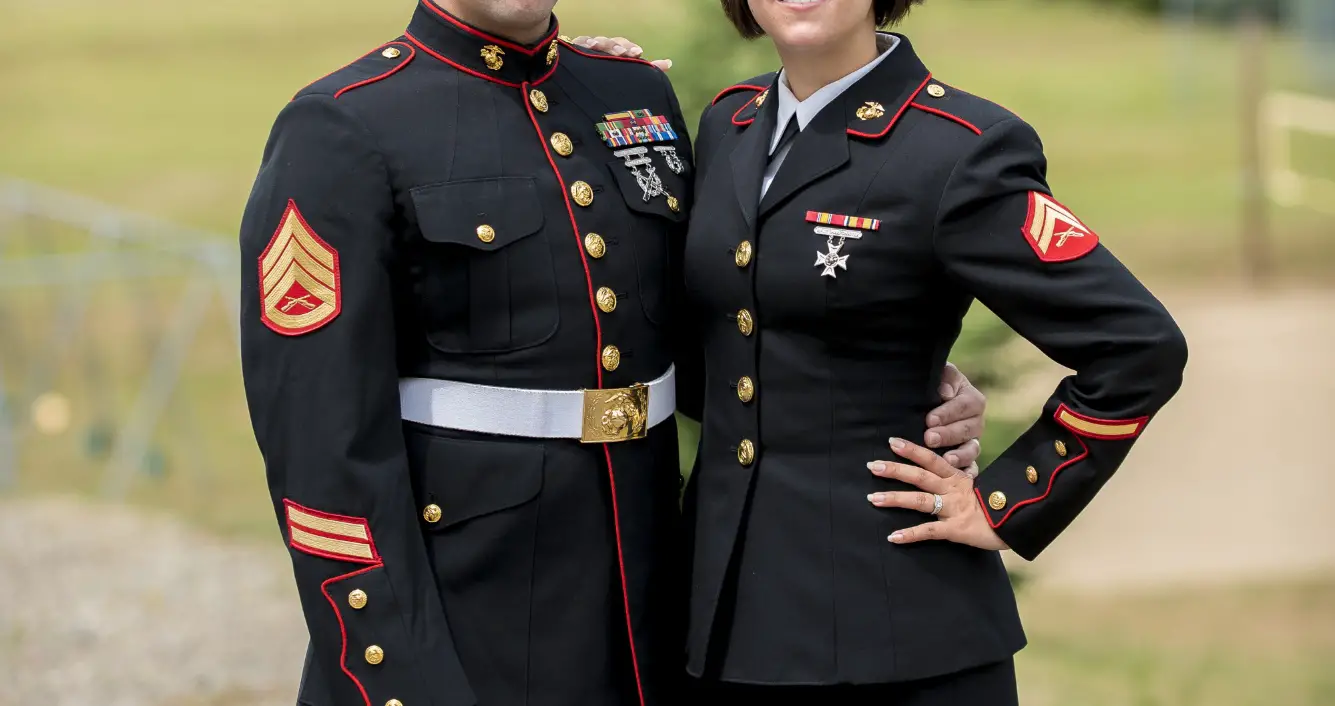
The first thing my father said after the lawyer finished reading was, “Well, I guess the old man surprised us all.” He was jingling the Tesla key card in his hand when he said it, and he was smiling.
We were standing on the sidewalk outside Callahan and Burke’s offices in downtown Norfolk, in the particular flat gray light of a winter afternoon, and I was still in the uniform I had driven home in from Quantico the previous morning. I had not slept. I had eaten a gas station sandwich somewhere near Fredericksburg and called it dinner. My grandfather’s funeral had been that morning at Arlington, and I was still carrying the specific physical weight of grief that settles in the chest after you watch a flag folded.
By sundown, I was standing in the parlor of the mansion with my cover in my hand, looking at the two people who had raised me, or at least who had been present during my childhood, and my mother was telling me I needed to pack tonight. She said it would make things easier for everyone. My father added, almost as an afterthought, that I was essentially homeless now.
I want to tell you about my grandfather first, because none of what happened afterward makes any sense without him.
Admiral Thomas Whitaker was ninety-two years old when he died, and until the last year of his life he still carried himself like a man accustomed to command. He had served in Korea as a young officer and in Vietnam after that, and he spent the remaining decades of his career rising through the naval hierarchy with the kind of unhurried discipline that men of his generation wore like a second uniform. In public he was formal, precise, capable of silencing a room without raising his voice. People who met him at official functions remembered the straight back and the clipped sentences and the way he seemed to be perpetually assessing the horizon for weather.
At home with me, he was different.
He taught me to tie a square knot before I could ride a bicycle. He taught me how to check the oil in a car, how to shake hands correctly, how to look people in the eye when they were speaking rather than glancing away when the exchange became difficult. On Saturday mornings he made pancakes in a cast-iron skillet and let me pour as much syrup as I wanted while he drank black coffee and read the paper in a specific focused silence that I came to understand was not coldness but concentration. He was a man who gave his attention fully or not at all.
When I was ten and came home crying because some girls at school had decided I was too serious and too awkward to include, he sat me down at the breakfast table and said, “Character often looks lonely before it looks admirable.” I wrote it in the front cover of my school planner and kept it there until the planner fell apart.
My parents, by contrast, moved through life with the specific quality of people waiting for a service they had ordered but not yet received. My father had worked in real estate with mixed and eventually minimal results, and he spoke about large opportunities the way people speak about acquaintances they expect to run into again, always just around the corner, always slightly delayed. My mother sat on charity boards mostly for the luncheons and the photographs, and she had a gift for performing warmth in rooms full of people she did not particularly care about. They liked the admiral’s name and his status and the invitations that came with being his son and daughter-in-law. What they did not like was the moral expectation that came attached to him, the quiet insistence that a person’s worth was measured by how they treated the people who could do nothing for them.
Throughout my childhood they left me at the mansion for weeks at a time, explaining that Granddad enjoyed the company. The actual explanation was simpler. He raised me more than they ever did, not because they were absent but because he was present in the particular way that shapes a person. That was why I joined the Marines. People assumed it was tradition, duty, the straightforward inheritance of a military family. For me it was less complicated than that. Service was the only honest language I had grown up around, and I wanted to speak it fluently.
My grandfather never pushed me toward uniform. When I told him I wanted to apply to Officer Candidate School, he was quiet for a moment and then asked whether I wanted it enough to suffer for it. I said yes. He said, “Then earn it.” That was the whole conversation.
I earned it. By the time he died I had two deployments behind me and a body that woke up stiff on cold mornings and a set of experiences I could not have acquired any other way. I had missed birthdays and Christmases and more ordinary Tuesdays than I could count, and Granddad understood that kind of absence the way only people who have themselves been absent for long periods can understand it. He wrote short letters in his neat block hand during my deployments, always ending with the same two words: stand steady. He never explained them. He did not need to.
When his health finally failed that winter, I took leave and came home to Virginia. The mansion sat on the water outside Norfolk, old brick and white columns, the kind of house that people slowed down to look at from the road without being quite sure why. Inside it smelled like lemon polish and old books and the particular salt-and-wood smell of a house that has been open to the bay for fifty years. Even in hospice care, Granddad insisted on being wheeled to the library each afternoon. That room was his actual home within the home: naval histories and framed maps and ship models and windows that looked out over gray-blue water as far as you could see.
Two days before he died, he asked me to sit with him there.
“You came back,” he said.
“Of course I did.”
He studied me for a long moment. His face had gone thin but his eyes were sharp in the way they had always been sharp, the eyes of someone still paying attention. “People show themselves clearly when the anchor line snaps,” he said.
I smiled. “That sounds like one of your lessons.”
“It is.”
He rested his hand over mine. “Read everything carefully, Amelia. Especially when grief is making everyone else careless.”
I thought he meant life in general. The way he always wove advice into conversation, making it sound like observation rather than instruction. I filed it away with the other things he had told me over the years, the square knots and the handshakes and the line about character looking lonely before it looked admirable.
Those were nearly the last coherent words he said to me.
At the funeral, my parents performed grief with the practiced competence of people who understood that public occasions had expectations. My father stood with an expression of dignified sorrow that didn’t quite fit his face. My mother wore black silk and accepted condolences with the graciousness of someone who had learned the precise vocabulary of loss without needing to feel it. People approached me throughout the morning: old officers and their wives, neighbors who had known the admiral for decades, a retired Marine colonel who had served with him in Washington and who told me, with genuine warmth, that my grandfather had spoken about me constantly and had said I had the strongest spine in the family. I was grateful for that. I was also exhausted in the specific way that grief exhausts you, the weight behind the ribs, the feeling of simple tasks requiring more effort than they should.
The will reading took place the following afternoon at Callahan and Burke, a quiet old office with paneled walls and brass lamps and framed certificates yellowed with age. Harold Callahan had handled my grandfather’s affairs for almost thirty years. He was in his seventies, silver-haired, methodical, not prone to drama. He offered coffee none of us touched, opened the folder, and read.
My parents received the mansion. They received the Tesla. They received substantial investment accounts and art holdings. The numbers moved through the room with the slightly unreal quality of large figures spoken in a quiet space. When Callahan reached my name, there was a brief pause, and then a provision so short it barely occupied a sentence. A personal bequest. Letters from Granddad, a Navy shadow box, his watch. That was all.
My mother exhaled softly, the exhale of someone who had been holding their breath and found the result satisfactory. My father leaned back in his chair with the particular ease of a man whose expectations have been confirmed. I felt something rise in my face that was not quite anger, not quite disbelief, but a third thing that contained elements of both. I knew my grandfather. I knew him the way people know weather in their bones, the way you know someone when you have been raised by them. He had not confused inheritance with love, but he also would not have left me exposed to the specific mercy of these two people. Something about the reading felt incomplete.
On the sidewalk afterward, my father jingled the key card. By sundown I was standing in the parlor hearing the words that split the day in half. Pack tonight. Now you’re homeless.
The strange thing about shock is how quiet it is. I had expected anger to arrive immediately, some sharp righteous protest. Nothing like that happened. Instead, everything inside me went oddly still, the way the air does before a weather system moves in off the Atlantic. I stood in the room where Navy secretaries and decorated officers had once shaken my grandfather’s hand, looking up at his portrait above the mantel, the uniform immaculate, rows of ribbons across his chest, his expression carrying the particular composed authority of a man who had seen enough to know that most crises were temporary and most people, when tested adequately, revealed themselves clearly.
I went upstairs and packed slowly. Uniforms first, then civilian clothes, then books. In my desk drawer I found the small brass compass my grandfather had given me the morning I left for OCS. The engraving on the back read the same two words as all his letters. I closed my hand around it and carried it downstairs and put it in my coat pocket.
My father walked me to the door with the specific performance of a man being magnanimous. He carried one of my bags and set it on the driveway. The second one followed. He went back inside. My mother appeared in the doorway long enough to mention that they were changing the security codes that evening, and then the door closed.
I stood on the driveway in the October dark and looked back at the house for a while. The dock lights reflected on the water beyond the lawn. A boat horn sounded somewhere out on the bay. I loaded my bags into the trunk of my car and drove.
I did not have a specific destination. That night I found a roadside motel outside Chesapeake and lay awake on a thin mattress listening to highway traffic and running my thumb across the engraving on the compass. The second night I stayed in the spare room of a retired Marine friend outside Quantico who asked no questions and made good coffee. I was thirty-two years old, a Marine captain with two deployments, and I was sleeping in borrowed rooms because my parents had found a way to make me feel like a child who had nowhere to go.
On the third morning, sitting in a diner booth outside the base with my second cup of coffee and a view of a wet November highway, my phone rang. The screen read Callahan and Burke Law Offices.
I answered immediately.
“Captain Whitaker,” came Harold Callahan’s careful voice. He sounded calm, but there was something in his tone I could not quite identify, something almost measured in its restraint. “I hope I’m not interrupting.”
“Not at all,” I said.
“I wanted to ask you something specific.” A brief pause. “Did your parents read the entire will?”
The question landed in a way I had not expected. “I assumed they did,” I said.
There was a sound on the other end that might have been a short laugh. “Well,” he said, “that explains quite a bit.”
I sat up straighter in the booth. “I’m not sure I follow you.”
“Let me ask you something else. After the reading, did anything unusual happen?”
“They kicked me out of the house,” I said. “Changed the security codes. Told me I was homeless.”
Silence on the other end. Then, quietly and with complete control: “I see. And how quickly did this happen?”
“Same evening.”
Another pause. “Captain Whitaker,” he said, “I think you need to come to the office. Today if you can manage it.”
“I can leave now.”
“Good.” Another small pause. “I’ll tell you something in advance, so the drive isn’t entirely spent with uncertainty.” He chose the next words with the precision of someone who has been waiting several days to say them. “Your grandfather was a very deliberate man. He rarely left things to chance. And I believe he expected certain people to behave exactly the way they did.”
I was very still in the booth. The waitress moved past and refilled my coffee without asking. Outside, a truck moved slowly through the wet intersection, its lights smearing on the wet pavement.
“You might want to hear the rest of that will,” he said.
The drive took three hours in light traffic, the Virginia countryside going by in varying shades of gray and brown and wet November, and I spent most of it thinking about the things my grandfather had said in that library two days before he died. Read everything carefully. Especially when grief is making everyone else careless. I had filed those words under general wisdom and moved on. Now they sat differently, with the specific weight of instructions rather than observations.
Callahan and Burke looked exactly as it had three days earlier: polished wood, brass lamp, the quiet of a room where serious business gets conducted at a measured pace. Callahan stood when I entered, shook my hand, and offered coffee, which this time I accepted. He waited until I had it before opening the thick folder on his desk.
“Admiral Whitaker’s full estate directive,” he said. “All of it.”
He turned several pages slowly.
“The section we read at the formal reading was the primary inheritance structure,” he said. “Assets to your parents, personal bequests to you. That part was complete.” He tapped a section of the document. “But the document has a second half.”
He slid a page toward me across the desk. At the top, in the clear formal type of a legal document, read the heading: Conditional Inheritance Clause.
“Your parents did inherit the mansion,” he said. “And the Tesla and the investment accounts. That was genuine. But the inheritance carried specific conditions attached to it.”
I began reading.
The first condition stated that the beneficiaries were required to allow Captain Amelia Whitaker permanent residence within the family home for as long as she wished.
The second gave me shared authority regarding the management and preservation of the estate property.
The third required my parents to maintain and actively support the Admiral Thomas Whitaker Veterans Outreach Foundation, a project my grandfather had been developing for years and that my parents had treated with the polite inattention they gave to most things that required effort without immediate reward.
And then the enforcement clause, at the bottom of the page, in the same formal type as everything else, making it no more or less dramatic than what preceded it: if any of the conditions were violated, full ownership of the Norfolk estate and associated assets would immediately transfer to Captain Amelia Whitaker.
I read the clause twice. Then I set the page down.
“They violated the first condition the same day as the reading,” I said.
“Within hours,” Callahan confirmed.
“They violated the second by telling me I had no say in anything.”
“Yes.”
“And the foundation.”
“They made no inquiries about it whatsoever.”
I looked at the lawyer. “You knew this would happen.”
“I suspected it,” he said carefully. “And your grandfather instructed me to wait forty-eight hours before contacting you, to allow events to develop. He also asked me to prepare the transfer documentation in advance, in the event it became necessary.” He paused. “It has become necessary.”
The room was very still. Outside, November wind moved through the trees lining the street, and I could hear it faintly even through the old glass of the office windows.
“He built the whole thing,” I said, quietly. Not quite to Callahan, but to myself, or to the room, or to the portrait of the man I was only now beginning to fully understand. “He predicted exactly what would happen and built a structure around it.”
“He understood people,” Callahan said. “Very well.”
He removed a sealed envelope from the folder and placed it on the desk between us. My name was written across the front in the careful block handwriting I knew from forty years of letters.
I picked it up and held it for a moment before opening it. Inside was a single folded sheet in the same hand.
Amelia, it began, if you are reading this, events have likely unfolded the way I suspected they would. Do not be angry. People reveal their character when comfort replaces discipline.
I stopped for a moment. Then continued.
Your parents were not cruel people by nature. Very few are. Selfishness grows slowly, watered by comfort, resentment, and the habit of believing someone else will always cover the cost. I watched that happen to them over the years. I tried to correct it, sometimes too gently. In the end, I chose a different method.
The will was not designed to punish them. It was designed to reveal them. If they welcomed you and cared for this house and supported the foundation, they would have proven themselves worthy of what they received. If they did otherwise, they would prove the opposite. Either way, the truth would be known.
My vision was slightly blurred by the time I reached the last paragraph.
Now I must tell you something important. You will face your own test in this. Power arrives sometimes wearing the mask of justice, and it whispers that because you have been wronged, you are entitled to wound in return. Do not listen too quickly. You have every right to remove them from that house if you believe it is necessary. But before you act, ask yourself one question: what course leaves your character intact? Revenge can satisfy a hurt for a moment. Character is what keeps a person company for the rest of her life.
Take care of the Veterans Foundation. Take care of the house if you keep it. And if your parents one day find the honesty to repent, leave the door open just wide enough for them to walk through themselves.
Stand steady.
I folded the letter and placed it back in the envelope and held it in my hands for a long moment.
He was still teaching me. That was the thing about my grandfather. Even now, he was still teaching me.
“I could put them out tonight,” I said eventually.
Callahan was quiet.
“But that’s not what he wants,” I said.
“No,” he said. “I don’t believe it is.”
I stood and picked up the folder of documents. “Then I know what I’m going to do.”
Two days later I drove back to the mansion. The Virginia sky was clear and pale after days of rain, and the Chesapeake was bright in the morning light, moving with that specific late-autumn quality that makes water look like hammered metal. The same road I had driven hundreds of times looked slightly different now, not because anything about it had changed but because my relationship to what waited at the end of it had.
I parked in the driveway behind the Tesla, which my father had moved to a prominent position near the front entrance. The house looked exactly as it always had: white columns and old brick and tall windows catching the morning light. I stood beside my car for a moment and looked at it. Buildings remember things, my grandfather used to say. If that was true, these walls had held more history than most.
I knocked.
My mother answered. She was in a pale blue dress with a glass of white wine in her hand at eleven in the morning, which told me they had been entertaining again, or planning to. When she saw me, the social warmth left her face instantly.
“What are you doing here?”
“I came home,” I said.
She started to say something else. I stepped inside before she could finish the sentence.
The entry hall was the same as it had always been: the grandfather clock by the stairs, the naval landscapes on the walls, the Persian runner that had been there since before I was born. My father appeared in the hallway from the direction of the dining room, stopped when he saw me, and told me in a sharp voice that this was not the time.
“Actually,” I said, “it’s exactly the time.”
I opened the leather folder Callahan had prepared and removed the top document and handed it to my father. He took it with the irritated certainty of someone who expects to be handing it back within seconds. Then he started reading it. The certainty left his face somewhere around the third line.
“What is this?” he said.
“Ownership transfer. Certified by the county two days ago.”
My mother looked over his shoulder. She read faster than he did, and her face changed faster too. She looked up at me with an expression I had not seen on her before, something that had lost the careful management she usually applied to her reactions. “That’s not possible,” she said.
“It’s exactly possible,” I replied. “He wrote a conditional clause into the will. You violated it within twenty-four hours.”
“We didn’t know about any conditional clause,” my father said.
“I know,” I said. “You didn’t read to the end.”
That landed differently than the other things I had said. Because it was not an accusation of malice but of carelessness, and they both understood the distinction. They had not been foiled by something they saw coming. They had been foiled by something they did not bother to look for, which was a different and more specifically embarrassing kind of defeat.
My father set the document down on the hall table. He looked at it for a moment, then at the house around him, then at me. “So the house is yours now,” he said.
“Yes.”
He gave a short sound that was not quite a laugh. “And you could tell us to leave.”
“I could.”
We stood in the hallway of my grandfather’s house with the clock ticking behind us and the winter light coming through the tall windows, and for a long moment nobody said anything. Then I took the letter from my coat pocket, the one in the careful block hand, and I held it without unfolding it.
“He left me instructions,” I said. “Not about the house. About this moment.”
My mother’s eyes moved to the envelope. She was quiet.
“He knew you’d do exactly what you did,” I said. “He built it into the document on purpose. Not to punish you, which is what I would have done if I had been the one designing it. He built it to reveal you. To show both of you who you became when the expectation of consequence was removed.” I paused. “And then he told me what to do with what I found.”
My father looked at the envelope. “What does it say?”
“That revenge satisfies a hurt for a moment. That character keeps a person company for the rest of her life.” I put the letter back in my pocket. “That I should give you consequences without becoming cruel.”
I brought out the second set of documents from the folder.
The mansion would stay in my name. That was not changing. But my parents were not being evicted. The east wing guest cottages, which had been used for overflow storage and occasional visitors, were being converted into permanent housing for aging veterans and their spouses, people who had spent their lives in service to the country and who had no particular family infrastructure to fall back on in retirement. The main house would become the operational headquarters of the Admiral Thomas Whitaker Veterans Outreach Foundation, with meeting rooms and counseling spaces and the kind of community infrastructure my grandfather had been quietly planning for the last years of his life. My parents could stay in the small cottage near the garden, which was comfortable and private and entirely adequate for two people, and which was available to them as long as they contributed to the foundation’s work rather than existing around it.
My father studied the plans in silence. My mother sat down in one of the hall chairs, which was the first time I had seen her sit without performing composure.
“You’re turning the mansion into a veterans center,” my father said.
“That was his plan. I’m finishing it.”
He was quiet for a long time. Then he said something I had not expected. “He would have liked that.”
“I know,” I said. “I know he would.”
The conversion took several months. Volunteers arrived. Construction crews worked on the cottages. Veterans started appearing in small numbers, referred through the foundation’s network, retired sailors and former Marines and widows of servicemen who had served for decades and then found themselves at the far edge of old age with fewer resources than they had anticipated. Many of them were in their seventies and eighties, people who had spent their best years belonging to an institution that gave structure and purpose and community, and who had arrived at retirement to discover that those things do not automatically transfer to civilian life.
The library remained exactly as my grandfather left it. His portrait above the fireplace. His reading glasses on the closed biography of Chester Nimitz. The green-shaded lamp on the side table. I did not move a single item in that room, not because I was preserving it as a memorial, but because it was already exactly right. He had spent fifty years getting that room exactly right and there was nothing in it that needed improvement.
My parents adjusted. Not quickly, not gracefully at first, but they adjusted. My father began maintaining the docks, which required early mornings and physical work and the specific kind of attention to small problems before they become large ones that he had spent his adult life avoiding. He was surprisingly good at it. My mother started organizing community dinners twice a week for the veterans and their families, the kind of event at which her social competence was actually an asset rather than a performance for its own sake. She was, it turned out, genuinely good at making rooms feel welcoming. She had simply never had a reason to deploy that ability toward something that did not directly benefit her.
One afternoon in the early spring, about six months after the transfer, my father found me on the porch overlooking the water. He leaned on the railing beside me in the way of a man who has something to say and is still deciding the exact shape of it.
“I’ve been thinking about your grandfather,” he said.
“I think about him every day.”
“He was right about something,” my father said.
I waited.
“He was right that we didn’t pay attention. Not to the document, not to the foundation, not to you.” He looked out at the water for a moment. “I’ve been trying to understand why we were so quick to act the way we did, so fast to turn around and push you out. I don’t have a satisfying answer. I think we saw the numbers and stopped seeing anything else.”
I did not say anything, because he was not finished and he did not need encouragement.
“What your grandfather built here,” he said, nodding toward the house and the docks and the cottage where two retired Navy couples were currently having coffee on a small porch, “this is what he was talking about his whole life. This is what he meant by service. Not the rank. Not the awards. The actual doing of something useful for people who need it.” He paused. “I should have understood that decades ago.”
“Yes,” I said. “You should have.”
He nodded. “I know.”
We stood there for a while longer. A destroyer was moving slowly across the horizon, heading toward open water, its superstructure gray against the bright spring sky. My grandfather used to stand at this railing and watch the ships, and I had stood beside him and watched too, not understanding what I was seeing until I was old enough to understand that the ships themselves were almost incidental to what he was actually looking at, which was the fact of people organized around a common purpose moving in a common direction, which was the thing he considered most worth preserving in human life.
Later that evening I went into the library and sat in his chair and read, the way I had been doing most evenings since the conversion was complete. The bay outside the windows was going dark, the water turning from silver to blue to black in the way it does when the light leaves. The lamp made the room warm and close. On the desk beside me sat the letter, back in its envelope, and the compass with its two-word engraving.
The greatest thing my grandfather left me was not the house, which was just brick and wood and old glass, however beautiful. It was not the Tesla, which I had given to the foundation’s transportation pool. It was not the money, though the money funded work that mattered. What he left me was this: a clear demonstration, executed with the patience and precision of a career spent making consequential decisions, that the people who shape us continue shaping us after they are gone. That the lessons do not stop when the teacher does. That a person who has paid genuine attention to the world can arrange a situation in which the truth becomes visible to everyone who needs to see it, without cruelty, without theater, with only the clean documentary clarity of a legal clause and forty-eight hours of waiting.
He had known exactly who my parents were. He had loved them anyway, in the specific way that you love people whose failures you understand without endorsing. He had also known who I was, which was the more important knowledge, and he had trusted me with the hardest part: not the discovery, not the legal victory, but the question of what to do with it once it was in my hands.
I had answered that question as best I could, which was all he had ever asked of me.
The compass was still on the desk. I picked it up and turned it in my fingers, feeling the familiar weight and warmth of the brass, the engraving worn slightly smoother on one side from thirty years of being held. Outside, the last Navy ship had disappeared over the dark horizon. The room was quiet in the way of rooms that have been filled with good work and good presence and know it.
I set the compass down on the desk in front of me and opened the book I had been reading and kept the lamp on late into the evening, in the room that still smelled like lemon polish and old leather and the particular salt-and-wood smell of a house that has been open to the bay for fifty years, and I was at home in the deepest and most accurate sense of that word, the sense that has nothing to do with ownership and everything to do with belonging.
Stand steady, I thought.
I was.

Specialty: Quiet Comebacks & Personal Justice
David Reynolds focuses on stories where underestimated individuals regain control of their lives. His writing centers on measured decisions rather than dramatic outbursts — emphasizing preparation, patience, and the long game. His characters don’t shout; they act.