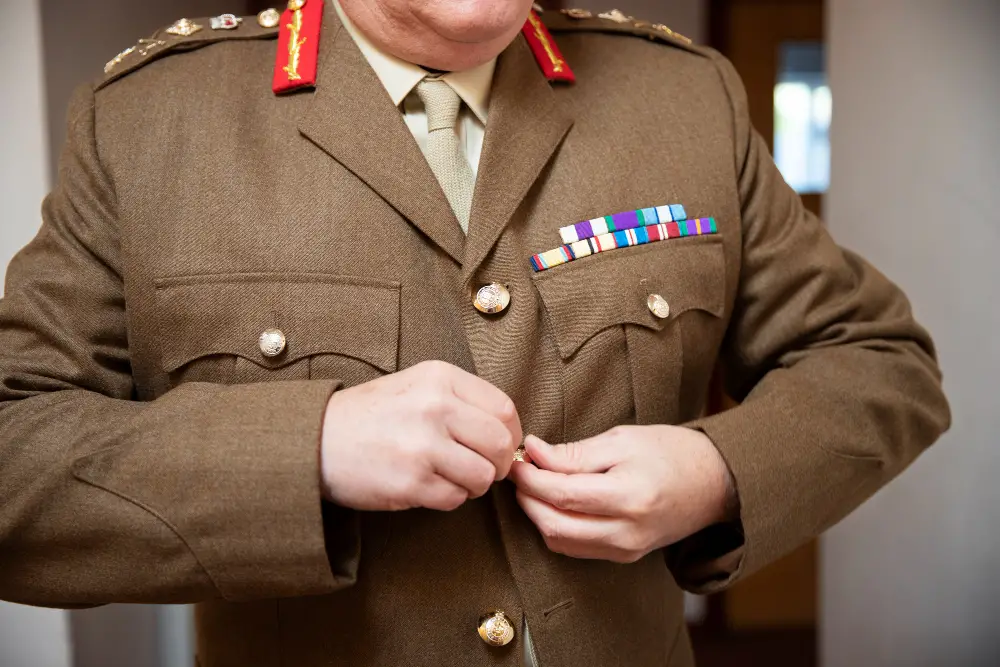
The general’s face drained of color so completely and so fast that the people on either side of him took small involuntary steps backward, responding to something they couldn’t name.
He was not looking at my face. He was not looking at my rank. He was looking at my hand, at the ring on my index finger, at a piece of worn silver metal that I had put on that morning without thinking about it because it had become the kind of habit that lives below conscious decision, the way you reach for a familiar jacket or touch something at your throat. His eyes were fixed on it with the specific attention of a man confronting an object that should not exist in the place where it exists.
“Where did you get this?” he asked.
His voice was low and controlled, but there was something underneath the control that I recognized from my own training, the particular quality of a person managing their external presentation while something internal has gone wrong. I had thought, for one irrational second, that he was joking. Generals didn’t react to cheap silver rings. But the man in front of me was not joking. He was, I understood in the next second, afraid.
“It was my grandfather’s,” I said. “He passed away last month.”
He swallowed.
“We need to talk,” he said. “Privately.”
My grandfather Thomas Hail was the quietest man I have ever known, and I knew him better than anyone in my family did, which was not saying as much as it should have been. He lived in a small, fading house on the edge of a town in Ohio that had been fading at roughly the same pace for forty years, cracked sidewalks and neighbor kids who rode bikes that needed fixing and a corner hardware store that was open three days a week. He drove a truck that was older than most of the Marines I served with. He had no medals on his walls, no photographs in uniform, no stories about anything that could be connected to a war or a mission or any chapter of official history.
If you asked him about his past, he would smile with the patient warmth of someone who has answered a question so many times that the answer has become a kind of furniture, comfortable and familiar and entirely unrevealing.
“That was a long time ago, sweetheart,” he would say.
My parents had a different description. To my father, Grandpa was difficult. To my mother, he was a burden, a persistent reminder of something she preferred not to think about. He had no money worth inheriting and no connections worth cultivating and no social capital that translated into the vocabulary my parents used to measure people. He lived the way he lived, they said, because he had chosen to, which was their way of saying that whatever had happened to him was his own fault, which was their way of saying that they did not want to be responsible for understanding it.
When he got sick they said he would be fine. When he got worse they said he was stubborn, that he had always been like this, that he didn’t want help, that some people were just like that. By the time a neighbor called me at my base two states away and told me he had collapsed in his kitchen and been taken to the county hospital with no family present, my parents had already constructed a complete and entirely satisfying explanation for why none of this was their responsibility.
I requested emergency leave that night and drove through the dark without stopping.
He was already fading when I arrived. The room had the particular smell of serious illness in institutional spaces, disinfectant and old coffee and the peculiar staleness of recycled air that has been breathed by people who are frightened. He smiled when he saw me, and it was the smile of someone who has been quietly expecting something and has had their expectation confirmed, not with pleasure exactly, but with a kind of recognition.
“Guess you’re the only one who remembered me,” he whispered.
I told him not to talk like that. I told him my parents would come soon.
He shook his head with the small, definitive movement of a man who has spent a long time being accurate about certain things.
“They won’t,” he said. “But that’s all right.”
He died two days later. No dramatic final statement, no confession, no summary of what his life had meant. Just a quiet breath and then the absence of breath, and I sat beside him for a long time before I reached for my phone.
My mother said at least he wasn’t suffering anymore.
No one offered to help with the funeral. No one asked what he would have wanted or where he should be buried or what words would be appropriate. So I arranged it myself, a simple wooden casket and a small service with five people, including me and the priest. A neighbor came, the woman who had called me from the hospital. An elderly man with a Navy cap appeared and said he had once served with my grandfather, though he didn’t say where or when, and left before I could ask him anything more.
My parents did not come. My brother sent a text that said sorry, busy week.
I stood at the grave and listened to the dirt and felt something settle into the space where my grief was, something that was not anger yet but was laying its foundation.
After the service I went back to his house to pack what remained of his life. Most of it was ordinary in the way that most lives are ordinary when reduced to their physical residue, old clothes and war movies on VHS and stacks of yellowed newspapers and a dusty toolbox in the garage that I recognized from childhood, the one he had used to fix my bike three times without ever making me feel like I owed him anything for it.
In his bedroom drawer, wrapped in a faded handkerchief, I found the ring.
It was not flashy. Solid metal, slightly worn, with a strange symbol etched inside the band. Not a name, not a date, just a small marking that I didn’t recognize, and I had spent years of my career learning to recognize military insignias, the marks that identified branches and units and special designations. This one belonged to nothing in any system I had ever studied.
I remembered him wearing it every day of my life, never removing it, not even when he was washing dishes, the ring going dark and bright in the water and coming out clean and unchanged. When I had asked about it as a teenager, during one of the long summer afternoons we spent on his porch while the rest of the family was inside doing things they considered more important, he had looked at it for a moment before answering.
“It reminds me who I am,” he said.
I had nodded as if I understood. I hadn’t.
I kept the ring because it was his and because no one else wanted it. My parents cleared out the house within three weeks. My father said he didn’t need it anymore, meaning Grandpa, meaning the house, meaning all of it, and I understood that this was the most honest thing my father had ever said about his relationship with his own father, though he had not meant it as honesty.
I went back to base. Back to the routines of service, the structure that held everything in place. But something about his quiet life kept pulling at me, some gap in the picture that I couldn’t stop trying to fill. I knew he had been a Navy SEAL. It said so on his discharge papers, tucked in a folder in the back of a cabinet, the only military documentation I had found in the entire house. But beyond that there was nothing. No photographs in uniform, no service records, no awards, no unit citations. It was as if his military career had been removed from the record by someone who understood what thorough removal looked like.
Weeks later I was invited to a formal military ceremony, an anniversary event for veterans, the kind of occasion that fills a hall with polished shoes and pressed uniforms and speeches about sacrifice that are true in their broad outlines and imprecise in their particulars. I wore my dress uniform and my medals properly aligned and Grandpa’s ring on my finger because by then it had become the kind of habit that operates below conscious thought.
I was standing in the middle of a conversation about something I can no longer remember when a general paused in his path through the room, and I felt his attention before I saw it, the way you feel certain kinds of attention before you understand their source. He was gray-haired and strongly built with the particular composed authority of someone who has spent decades being the person other people look to when they need to know what to do. His name was Robert Whitmore, though I didn’t know that yet.
He stepped closer. His eyes were on the ring.
“Excuse me,” he said, quietly.
He asked the question, and when I told him it had belonged to my grandfather, who had passed away the month before, something moved across his face that I did not have a name for in that moment. Not surprise exactly. Something more like the expression of a man who has been carrying a specific weight for a long time and has just been told that the weight is heavier than he had calculated.
He wrote down my name, my unit, my grandfather’s full name on a small card, said he would be in touch, and walked away.
I stood in the applause and the polite conversations feeling like I had stepped briefly into a different version of reality and been returned to the original without explanation.
I called my mother that night.
She said I was reading too much into things. She said Grandpa had liked pretending he was special.
That word. Pretending.
“He really was a Navy SEAL,” I said.
“Yes, yes,” she replied. “In some minor capacity, decades ago. It doesn’t matter now.”
“It mattered to him.”
“It shouldn’t matter to you,” she said. “Focus on your own career.”
My father was worse. He sighed when I brought it up, the loud sigh of a man who has been asked to revisit something he decided was settled long ago. He said Grandpa had been secretive, always acting like he knew things he couldn’t talk about, exhausting to be around.
“He saved lives,” I said.
“So do a lot of people,” my father said. “That doesn’t make him a hero.”
I wanted to say many things. I wanted to remind him that Grandpa had died in a hospital room alone while my father was somewhere comfortable and unreachable. But I understood, sitting at my father’s kitchen table, that he was not capable of receiving anything I had to say in the form I wanted to say it. He had built a structure for understanding his father’s life, and the structure required that his father’s life be small, because if it was large then my father’s absence had a cost he was not prepared to pay.
Some questions don’t get answered by asking the right person. They get answered by finding the right records.
I reached out to a retired Navy officer I had trained with, a man who had served long enough and broadly enough to have accumulated the kind of knowledge that lives in personal memory rather than institutional files. I described the ring. There was a silence on the phone that lasted long enough to mean something.
“I’ve seen something like that,” he said. “Once. It wasn’t supposed to exist.”
“What does it signify?”
He hesitated. “It’s not for public recognition,” he said. “It’s proof. Of things that never happened.”
The email from General Whitmore arrived a week later. No subject line. Just his name, a request to speak, and an address near a veteran center, modest building, small flag, receptionist who recognized my name before I said it.
The office held two chairs, a desk, and a faded photograph of young men in outdated uniforms on a wall otherwise bare of decoration. No medals, no citations, none of the institutional self-display that most offices of this rank contained. The general gestured for me to sit.
He told me about units that did not appear in public records. He told me about operational groups designed for missions requiring absolute deniability, missions where success meant nothing happened and failure meant the same thing. He told me my grandfather had been part of one of those groups for more than a decade.
“Then why isn’t there any record?” I asked.
“Because officially he never served there,” the general said. “He was a ghost by design.”
I sat with that for a moment. The quiet man who made burnt pancakes on Sunday mornings and fed birds in his backyard and repaired things other people would have thrown away had spent a decade being officially invisible by deliberate construction, had come home from that invisibility and built a small life in a fading Ohio town and lived it alone because the alternative would have required him to explain things that had been classified out of existence.
“The ring,” I said.
“A verification marker,” he replied. “Used internally to identify individuals cleared for operations that were never to be acknowledged. Most were destroyed when the unit was disbanded. The fact that yours survived means your grandfather kept it when he was supposed to surrender it.”
“He kept it because it reminded him he existed,” I said.
The general looked at me with an expression that told me I had said exactly the right thing.
“He told you that?”
“He told me it reminded him who he was. It’s the same thing.”
He nodded slowly. “Some men keep reminders even when they’re told to forget,” he said. “Especially when they’re told to forget.”
I thought about my family’s language for my grandfather. Difficult. Secretive. Irrelevant. I thought about the way his name came up at holiday tables, if it came up at all, with the tone of a problem that had been managed rather than a person who was loved.
“My family treated him like he had failed at living,” I said.
“That is often what happens to people who serve in silence,” the general replied. “They receive no parades. They receive no explanation they’re permitted to give. They come home and they carry the weight of what they did and they watch other people move through the world receiving credit for smaller things, and they say nothing because saying something would undo the very thing they gave their lives to protect.”
“And what did he protect?”
“People,” the general said simply. “Individuals who are alive today because your grandfather was willing to do work that could never be attributed to him.”
I drove back to base with the ring heavy on my finger and my grandfather’s words running on a loop in my mind. It reminds me who I am. He had spent thirty years after his service maintaining the discipline of invisibility in a context where invisibility was no longer required but had become the only way of being he knew how to inhabit. And my family had looked at that invisibility and seen failure, because they only knew how to read visibility.
In his bedroom closet, behind the old jackets I had already gone through, I found a small metal box taped to the wall at shoulder height, the kind of placement you walk past without noticing for years unless you are specifically looking for something hidden. Inside were three items: a folded American flag, a handwritten list of names, and a thin black notebook.
The notebook was filled with dates and numbers and short codes with no explanations, the kind of entries that looked like useless clutter to anyone who didn’t understand what they were, the kind of thing my father had apparently thrown away from a similar notebook without reading carefully enough to understand it was not clutter at all. In the margins, repeating throughout, was the same symbol as the one inside the ring.
I took photographs of everything.
The general asked me to bring the notebook to the veteran center. He had two other men with him when I arrived, both older, both in civilian clothes, both carrying themselves with the particular posture of people who have spent long periods of time in formal institutional hierarchies and retain the shape of it even after they are gone. They studied the notebook in silence for several minutes.
One of them exhaled.
“He kept better records than most,” the man said.
“What are these numbers?” I asked.
“Timelines,” the general replied. “Operational markers. Your grandfather documented events that were never officially to have occurred.”
“Can they be used for anything?” I asked.
“For understanding,” he said, “not for exposure. And not in a courtroom or a newspaper.”
I felt the frustration of that but also, somewhere below the frustration, something else. Something that recognized the shape of a logic I had seen in my own service, the understanding that some truths serve their purpose best by existing rather than by being broadcast. He had not lived quietly because he was ashamed. He had lived quietly because silence was the thing his work required, and the discipline that had made him effective in the field had followed him home and never left.
I went to my parents that night. Not with anger, though anger was available. With the evidence and the truth behind it and the letter I had found in his folder, which I had not shared with them before.
My father read the letter slowly. His hands shook by the end of it.
“This can’t be real,” he said.
“A general confirmed it,” I said. “Multiple retired officers recognized his work.”
My mother covered her mouth. My brother looked at the table.
“Why didn’t he tell us?” my mother asked.
“Because you never created space for it,” I said. “Because every time his name came up someone sighed or changed the subject or made a joke. Because the story you had already decided about him didn’t have room for the actual story.”
That landed more heavily than I had expected it to. I watched my father absorb it, watched the protective structure of his long-standing narrative about his own father begin to fail under the weight of documentation and direct statement.
“All those years,” my father said quietly. “I thought he was hiding from responsibility.”
“He was carrying it,” I said. “So you wouldn’t have to know what he was carrying.”
My brother looked up from the table. He said that Grandpa had asked him for help once, a few years before he died, and he had said he was too busy. He said it the way people say things they have been not saying for a long time, with the specific exhaustion of a confession that has been waiting for the right moment.
My mother said she thought he was exaggerating. She thought he wanted attention.
We sat at that table for a long time. I didn’t offer forgiveness, because forgiveness is not something you can offer in a single sitting after decades of a particular kind of failure. But something in the room shifted, the way a room shifts when everyone in it has finally agreed to look at the same thing.
“We didn’t deserve him,” my father said.
I didn’t argue. I just nodded.
My parents asked, a week later, whether we could hold a second service. A proper one, not because they had new information about his classified service but because they finally understood they had not said goodbye to him properly the first time, and the first time had been when he died, which they had not attended.
We held it on a Saturday in October when the trees along the cemetery road were going gold and red. The neighbors came, and the veterans from the center, and the elderly man with the Navy cap who had appeared at the first service and left before I could speak to him. General Whitmore stood quietly in the back in civilian clothes and did not identify himself to anyone.
There were no speeches about heroism. No recitation of classified service. Just stories: the man who fixed bikes without being asked, who brought soup to sick neighbors, who showed up with tools when someone needed something repaired and left before anyone could properly thank him. The man who sat at the edge of holiday gatherings and watched the people around him with an expression that might have looked like distance if you didn’t know what it actually was, which was the expression of a person who has learned to be deeply careful about what he allows himself to want.
My father stood at the grave with the folded flag in his hands and said the only honest thing I had ever heard him say about his father. He said he had spent his whole life measuring people by what they showed, and he had missed the best part of his own father because of it.
My mother cried. My brother placed the flag beside the headstone without being asked.
I held the ring in my palm and thought about the letter. If you’re reading this, then you’re the only one who cared enough to look. I thought about all the long summer afternoons on the porch, the burnt pancakes on Sunday mornings, the way he talked to birds in the backyard as if they were acquaintances he had known for years. I thought about the way he had looked at me in the hospital, that small smile of recognition that contained, I understood now, not just love but relief, the particular relief of a person who has been afraid for a long time of being alone with something unbearable and has finally been given a companion.
I placed the ring back on my finger.
The general retired not long after and sent me a letter with a note enclosed from someone who had served beside my grandfather decades ago. Most of the letters in the collection were from people my grandfather had helped escape from situations that would have killed them. One line appeared in a letter from a man who had gotten out of Eastern Europe in 1983 with a new identity and a new life and children who did not know his original name. You taught us that the hardest missions are the ones where no one ever knows you were there.
I drove alone to the cemetery a few weeks after the second service, on a quiet morning when the frost was still on the grass and my breath made small clouds in the cold. I knelt by the headstone, the proper one my parents had finally arranged, and I stayed there for a while without speaking. The wind moved through the trees. The traffic on the road a quarter mile away provided a low, indifferent background.
I finally understood what he had been doing in that small Ohio house for thirty years. He had not been hiding from life. He had not been failing at it. He had been living in the specific, demanding way of someone who has made a choice and kept it, who has understood that the cost of certain kinds of service is the inability to explain the service, who has accepted that the people who love you will sometimes misread your silence as absence rather than discipline.
He had kept the ring because the ring was the one thing that couldn’t be taken away, the one mark of an existence the institution had otherwise erased, the one object that said I was here and I did this and I knew who I was even when the record said otherwise.
I pressed it against the base of the headstone for a moment, just to let it rest there, then put it back on my finger where it had been since the day I found it in the faded handkerchief in his bedroom drawer.
My family is different now. Not repaired exactly, because some things don’t repair, but changed. My father visits the veteran center on his own and sits in the back room listening to old men tell stories that are mostly not about heroism. My mother lights a candle on my grandfather’s birthday, which she looked up from the discharge papers and has observed without comment every year since. My brother asks questions at family dinners now and waits for the answers instead of moving on before they come.
These are small things. But small things, sustained over time, become the actual texture of a life.
I am still a Marine Corps officer. I still believe in the values the service taught me, discipline and commitment and the willingness to carry weight that other people can’t or won’t carry. But my understanding of what those values mean has been altered by a quiet man in a fading Ohio house who spent the last years of his life alone because the people who should have known him never tried to see through the cover he had built to keep them safe.
There are people like him everywhere. People who carry things that don’t get named or recognized, who contribute in ways that produce no certificates, who live with the weight of what they have done and say nothing about it because saying something would cost too much or because no one has asked in a way that makes asking seem safe. They sit at the edges of rooms. They speak last in conversations or not at all. They get labeled difficult or secretive or strange. And sometimes they die in hospital rooms without the people who should have come.
Pay attention to the quiet ones. Ask them questions. Sit with them on the porch and be willing to not understand the full answer, to accept that some things will not be explained, that the person beside you has a life that extends far beyond what they have chosen to say. Let them know that you see them, not the version of them that is easiest to understand, but them.
It is the thing my grandfather needed most and received least until it was almost too late, and then only from the youngest and least powerful member of his family, a granddaughter who came because she wanted to and not because she was required to, who sat beside him in the silence and tried to be worth sitting beside.
I wear the ring every day.
It reminds me who he was.
It reminds me who I am trying to be.

Ethan Blake is a skilled Creative Content Specialist with a talent for crafting engaging and thought-provoking narratives. With a strong background in storytelling and digital content creation, Ethan brings a unique perspective to his role at TheArchivists, where he curates and produces captivating content for a global audience.
Ethan holds a degree in Communications from Zurich University, where he developed his expertise in storytelling, media strategy, and audience engagement. Known for his ability to blend creativity with analytical precision, he excels at creating content that not only entertains but also connects deeply with readers.
At TheArchivists, Ethan specializes in uncovering compelling stories that reflect a wide range of human experiences. His work is celebrated for its authenticity, creativity, and ability to spark meaningful conversations, earning him recognition among peers and readers alike.
Passionate about the art of storytelling, Ethan enjoys exploring themes of culture, history, and personal growth, aiming to inspire and inform with every piece he creates. Dedicated to making a lasting impact, Ethan continues to push boundaries in the ever-evolving world of digital content.