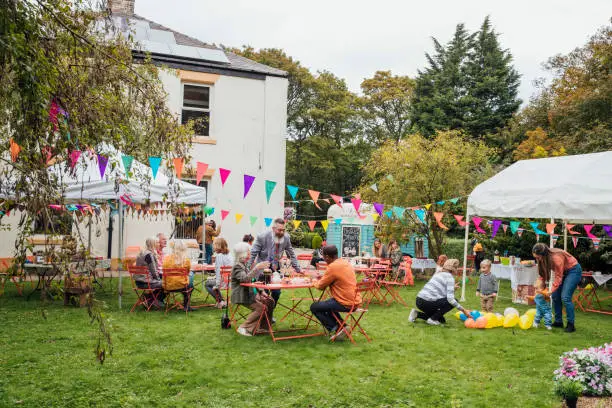
Hosting my husband’s 40th birthday party in our backyard had seemed like a great idea when I planned it. Standing in the middle of it, surrounded by loud music, thirty-odd guests, and what felt like an entire kindergarten class running loose between the tables, I was reconsidering that assessment.
Brad was near the far end of the yard talking to a group from his office, and even in the middle of everything I caught myself watching him the way I still did sometimes after eight years of marriage. Forty looked unfairly good on him. I thought, not for the first time, how lucky I was.
I was so naive.
There was no time to stand still anyway. Someone needed to know if the dip was dairy-free. One of the neighbor kids was crying over a toy truck near the fence. A small blur shot past my legs and I looked down just in time to see my four-year-old Will disappearing under the nearest table, a cake pop in his fist, looking extremely pleased with himself.
“Will, honey, we don’t throw cake pops.”
“I wasn’t,” he yelled back from somewhere under the tablecloth, which almost always meant he either had or was actively planning to.
I looked back toward Brad. He was laughing now at something Ellie had said.
Ellie. My best friend since second grade. She and I had sat at the same lunch table for years, shared a dorm room in college, been each other’s maids of honor, cried together through her mother’s illness and my miscarriage before Will. She was family in every way that mattered except the paperwork.
Someone was asking about the drinks.
I turned away and pointed them toward the side table and moved through the party with the particular focused energy of a person keeping twelve things running at once and not quite managing any of them.
Ellie appeared at my side at some point and said softly, “You’re doing too much.”
I laughed. “I always do. You know that.”
“I could’ve helped more before people got here.”
“You already did a lot.”
I let myself feel grateful she was there. Which was its own kind of irony I would understand only later.
Then from under the tables came a shriek and a peal of laughter, and I found Will crawling out from beneath a tablecloth with two other children, all three of them looking like they had been living outside with raccoons. His knees were grass-stained. Both hands were filthy in a way that suggested contact with multiple surfaces and possibly a garden bed.
I caught him by the wrist. “Come here.”
“But I’m playing.”
“You can play after. We are not cutting cake with those hands.”
I brought him inside and sat him on the chair by the kitchen sink and ran the water warm and started scrubbing. Will grinned at me with the specific delight of a child who knows he is in mild trouble and has decided to find it entertaining.
“What’s so funny?” I asked.
He looked up at me with bright eyes and pink cheeks from running in the afternoon heat. “Aunt Ellie has Dad.”
I stopped scrubbing.
“Aunt Ellie has what?”
“I saw it,” he said helpfully. “When I was playing.”
“Saw what, baby? What do you mean?”
He pulled his hands free of mine and jumped off the chair. “Come. I show you.”
Young children say things that sound ominous and turn out to be nothing. A misheard word. A dream they are still half inside. A connection their small brains have made that dissolves into something innocent the moment you see what they are actually pointing at.
I followed him back outside telling myself exactly that.
Will lifted his arm and pointed directly at Ellie, who was standing near the drink table talking to my sister-in-law.
“Mom,” he said loudly and with complete confidence. “Dad’s there.”
Ellie looked over at us and smiled and laughed the warm, easy laugh I had known since we were seven years old.
I laughed too. “Silly boy.”
But Will did not laugh. He kept his arm raised, his small face tight with the particular frustration of a child who knows what they know and is not being believed. He was pointing with the serious intent of someone delivering information, not playing.
I followed the exact line of his finger.
He was not pointing at her face.
He was pointing lower. Toward her midsection.
Ellie leaned forward at that moment to pick up her drink, and her shirt shifted, just slightly, just enough. I saw dark ink on pale skin. Fine lines. The curve of something. The suggestion of a face.
The smile stayed on my face by pure muscle memory while something cold moved through the center of me.
“Okay,” I said to Will, keeping my voice even. “Go sit at the table and wait for cake. You can play again after.”
He nodded and ran off, satisfied that he had conveyed his important information.
I walked toward Ellie.
“Ellie,” I said, with a lightness I did not feel, “can you come inside for a second? I need help with something.”
“Sure!” She set down her drink and followed me through the sliding door without question.
Inside, the noise from the party dropped to a muffled hum. I stood in my kitchen and looked at her and tried to think clearly. I needed to see the full tattoo. I needed to know if what I had glimpsed for half a second meant what Will’s words and my instincts were already telling me it meant.
“What’s up, Marla? You need help with the cake?”
I pointed to the shelf above the refrigerator. “Can you grab that box for me? I hurt my back a little getting ready for the party. I can’t reach it.”
“Oh no, when did you hurt yourself?” She was already moving toward the fridge, glancing over her shoulder with the genuine concern of someone who has been my friend for thirty years.
“Just this morning. It’s not bad, I just don’t want to make it worse.”
She stepped up on her toes and stretched her arms overhead.
Her shirt lifted.
I saw everything.
A fine-line black ink portrait, the kind of detailed realistic work that takes hours and costs real money. A man with a dimpled smile and almond-shaped eyes and a strong jaw. An aquiline nose I had touched a thousand times.
It was Brad. My husband’s face was tattooed on my best friend’s body like a private altar to something she had kept hidden while sitting at my table, holding my son, standing beside me at my wedding.
I don’t know how long I stood there staring before she turned around with the box. Long enough. Too long.
From outside, I heard cheering.
“We’re ready for cake!” someone called.
Brad’s voice carried through the glass, warm and easy. “Babe? You okay in there?”
I closed my eyes for one second.
I thought about every time I had noticed something small and strange and explained it away. Every time Brad was unreachable and I assumed work. Every time Ellie canceled on me and I assumed life. Every moment I had chosen the simpler story over the one that would have required me to look more carefully.
I had been protecting something that did not deserve protection. And the person who had finally told me the truth was my four-year-old, who had seen a face he recognized on his aunt’s skin and tried to tell me because he did not yet know that some things you are not supposed to say.
I opened my eyes.
Ellie was happy to carry Brad’s birthday cake outside. I walked a step behind her as she set it on the center table, watched her and Brad exchange a look across the crowd, a look I recognized now as a different kind of look than I had ever noticed before, and wondered how many times I had seen it and translated it into something else.
Everyone gathered around. Phones came out. People pressed in close.
“All right, all right,” Brad said, with the comfortable performance of a man at his own celebration. “No speeches, please.”
“Just one,” I said.
The crowd quieted.
Brad looked at me with the unsuspecting ease of someone who believes the situation is fully under his control. He smiled. “Who am I to tell my wife she can’t shower me with praise on my birthday?”
People laughed.
I looked at him. Then at Ellie. Then back at him.
“I’ve spent all day making sure this party was perfect for you,” I said. “The food, the guests, the decorations. Everything. So I think it’s fair to ask one favor before we cut the cake.”
Brad’s mother put a hand to her chest, reading this as sentimental.
“I turned to Ellie. “Ellie, do you want to show everyone your tattoo?”
The change in her face was immediate. Her hand flew to her side.
Brad frowned. “What’s this about?”
“Because it’s such an extraordinary likeness of you, Brad.”
His jaw dropped.
“Since she went to the effort of getting your face permanently marked on her body,” I said, “I figured she might want to show it off to everyone. Or is it just for you?”
A murmur moved through the crowd like a wave. I heard someone say what did she just say. I heard someone else repeat it to the person beside them. I watched Brad look at Ellie with the panicked, desperate look of a man looking for an exit that is not there.
That look was its own confirmation.
“My four-year-old saw it before I did,” I said to the guests, to all of them, to every person who had been at our table and in our home and part of what I had believed our life was. “He pointed at her and told me his dad was there. I wonder if that’s the only thing he’s seen that I missed.”
Brad’s voice went sharp. “How dare you. We never did anything in front of him.”
His mother’s mouth fell open.
I tilted my head. “But you did do something.”
He looked at Ellie the way people look at someone they are hoping will save them. She could not save him. She could not even look up.
I looked at both of them. “My best friend and my husband. The two people I trusted most.”
The yard was very quiet. Even the children had gone still, sensing the shape of something they did not have words for.
Ellie’s voice, when it came, was thin and unsteady. “Marla, I was going to tell you.”
“When? When you got pregnant? When he filed for divorce? What was the timeline on telling me you were having an affair with my husband?”
Brad snapped, “It’s not like that.”
“Then what is it like? Do explain.”
He said nothing. His lips moved and nothing came out. His eyes moved from me to Ellie to the assembled faces of people who had watched us build a marriage and a family over eight years.
I looked at him and saw everything I had chosen to see and everything I had chosen not to. The man who used to text me stupid jokes from work. The one who held my hand through fourteen hours of labor and cried when Will was born. The one who built blanket forts and forgot to call when he was running late. I saw all the cracks I had stepped around because I loved him and because we had a child together and because life is long and complicated and I had told myself that none of it was unfixable.
And I understood, with a clarity that felt like cold water, that he had counted on exactly that.
He lowered his voice. “Can we not do this here?”
“You mean at the party I planned for your 40th birthday? In the yard where our son is playing? In front of the people who spent years watching me love both of you?”
His father muttered something about lowering my voice, as though volume were the problem.
I turned to him. “No.”
Brad’s face hardened into something I recognized as his last defense. “You’re embarrassing yourself.”
Someone in the crowd gasped. My sister said something under her breath.
“No,” I said. “Your behavior is the only embarrassment here.”
I picked up the cake.
“The party’s over.”
Nobody argued. Nobody tried to explain or smooth it over or suggest we all take a breath. The crowd shifted and separated in the quiet, purposeful way people move when something true has been said and there is nothing left to arrange around it.
I looked at Brad. “You can figure out where you’re going tonight. But it won’t be here.”
Then I walked to the table where Will was sitting with his legs swinging under his chair, waiting for cake with the patience of a child who has been told it is coming and believes completely that it will.
He looked up at me and smiled. “Now cake?”
I looked at his face. His dirty knees. The damp curl of his hair at his temples. The complete, uncomplicated trust in his eyes, the trust of a child who had told me the truth that afternoon with no concept of what that truth would cost anyone, including himself.
I could not explain any of it to him. He was four years old and the world was still mostly good. I was not going to be the one to take that from him.
I tilted my head toward the house. “We’re going inside.”
He jumped off his chair and followed me, because that is what four-year-olds do when their mothers walk in a direction. Behind us, the voices erupted all at once, questions and denials and someone crying, someone saying Brad’s name over and over as though it would help.
I slid the door shut behind us.
I stood in my kitchen with my son and turned my back on all of it.
The rest could wait until tomorrow.
By morning, the story had moved through everyone who mattered. Brad did not come home that night, and he did not come back. The divorce was not dramatic, just final, two people in quiet rooms with lawyers making decisions about custody and calendars and who kept what, with Will at the center of every conversation.
Ellie texted once. I read it and did not reply. A week later I heard she had left town.
The house felt different after that. Quieter. Smaller in some ways and larger in others. But for the first time in a long time, when I walked through it, it felt like mine. Like something I actually owned rather than something I was only keeping.
Will never asked about the tattoo. He had done his job, delivered his information with the total confidence of someone who saw a face they recognized and thought their mother would want to know. He did not understand what it meant and he did not need to.
He had told me the truth.
The rest was mine to carry.
Specialty: Emotional Turning Points
Rachel Monroe writes character-driven stories about betrayal, second chances, and unexpected resilience. Her work highlights the emotional side of family conflict — the silences, the misunderstandings, and the moments when someone quietly decides they’ve had enough.