The silence lasted exactly three seconds. I know because I counted them the way I had learned to count everything in the air, precisely and without sentimentality, because in certain situations a second is the difference between a controlled outcome and an uncontrolled one.
Then Ground Control came back.
“Confirm voice identification. Eagle One is deceased.”
The captain was still looking at me. Not with hostility, not exactly. With the expression of a man who has been handed a variable he does not have a formula for and is deciding in real time whether to trust the math anyway.
“Eagle One is deceased,” Control repeated, as if the second iteration might resolve the discrepancy.
I keyed the mic.
“Eagle One is retired,” I said. “Which is not the same thing, and we can argue about it after Falcon Two lands this aircraft.”
Outside, the F-16 had stabilized enough to stop being immediately catastrophic, but I could still read the small shudders in the airframe, the micro-corrections of a pilot fighting fatigue and adrenaline and the specific psychological trap of being too aware of the aircraft beside him. Jake Mercer had always been afraid of the wrong things at the wrong times. It was the one quality I had never been able to fully train out of him, not because he lacked capability but because he was, underneath the discipline and the flight hours and the calm professional exterior, still the kid who had shown up to his first evaluation with his hands already shaking and his eyes already sharp, who had more raw instinct than anyone I had trained in five years and the unfortunate habit of letting his instinct outrun his technique when the pressure spiked.
“Falcon Two,” I said, “tell me your fuel state.”
A pause. Longer than it should have been.
“Below bingo,” he said.
The captain’s jaw tightened. Below bingo meant below the reserve threshold, meant the calculation for getting home had already changed, meant we were no longer discussing a formation problem and were now discussing something more fundamental.
“Nearest diverted field?” I asked the captain.
“Kelley Field is forty miles south,” the co-pilot said, without being asked, which told me he had already been running numbers. Good. A co-pilot who ran numbers without being told was a co-pilot who understood the shape of a problem before anyone named it.
“Falcon Three,” I said, “what is your fuel state?”
“Comfortable,” the second pilot said immediately. “I can follow him down.”
“Do not follow him down. Hold pattern above the diverted field at angels twelve. You are no use to him if you’re both low.”
A beat.
“Copy,” Falcon Three said. There was something in the word, not resentment exactly, but the particular tone of a pilot who is used to being the senior decision in the air and is recalibrating who that is.
Control came back, and this time the voice had changed. The earlier voice had been a controller following protocol. This voice was someone else, someone higher, with the clipped efficiency of a man who has been pulled from another conversation to manage something that has become above routine.
“Unidentified voice on escort frequency, you are transmitting on a restricted military channel. Identify yourself and your authorization.”
I had been waiting for this.
“My name is Riley Hart,” I said. “Former Army aviation test pilot, GS-14 equivalent, civilian contractor clearance expired five years ago. I am currently aboard the commercial flight your escort is orbiting. I am transmitting because the escort pilot is below bingo fuel, fighting trim, and overcorrecting into our wing. If you would like to terminate this transmission, I will sit down and you can manage the situation without me. But I would make that decision quickly.”
Silence on the command channel.
Beside me, the captain let out a breath.
Then a third voice entered the frequency, and this one I recognized the way you recognize a voice that has shaped years of your life in ways both good and difficult. Measured and unhurried, carrying the particular weight of someone who has spent decades being the person who made the call when nobody else wanted to.
“Let her work,” said Brigadier General Marcus Webb.
The channel went quiet.
The captain looked at me with the expression of a man who has stopped trying to categorize what is happening and has arrived, perhaps for the first time in his professional life, at the decision to simply let it happen.
“What do you need?” he asked.
“Nothing you have,” I said. “I need Jake Mercer to fly his aircraft.”
I keyed the mic again.
“Falcon Two. Look at your altimeter and tell me what you see.”
“Eleven thousand, four hundred,” he said. Steadier now. The steadiness of a man who has been given something specific to do and has redirected his nervous system toward the task.
“Good. Hold that. Do not look at us. Look at your instruments. The airliner is not your problem right now. Your aircraft is your problem. What is your trim reading?”
He told me.
“Adjust two degrees starboard. Not three. Two. Then leave it.”
I heard the click of adjustment in the way you hear it over open channel, not the mechanical sound itself but the half-second pause in the pilot’s breathing that always preceded a control input in a pilot who had been trained correctly.
“Better?” I asked.
“Yes, ma’am.”
“Stop saying ma’am. You’re flying. What’s your heading?”
He gave it.
“You’re six degrees off your assigned vector. Correct slowly. Do not chase the number.”
“Copy.”
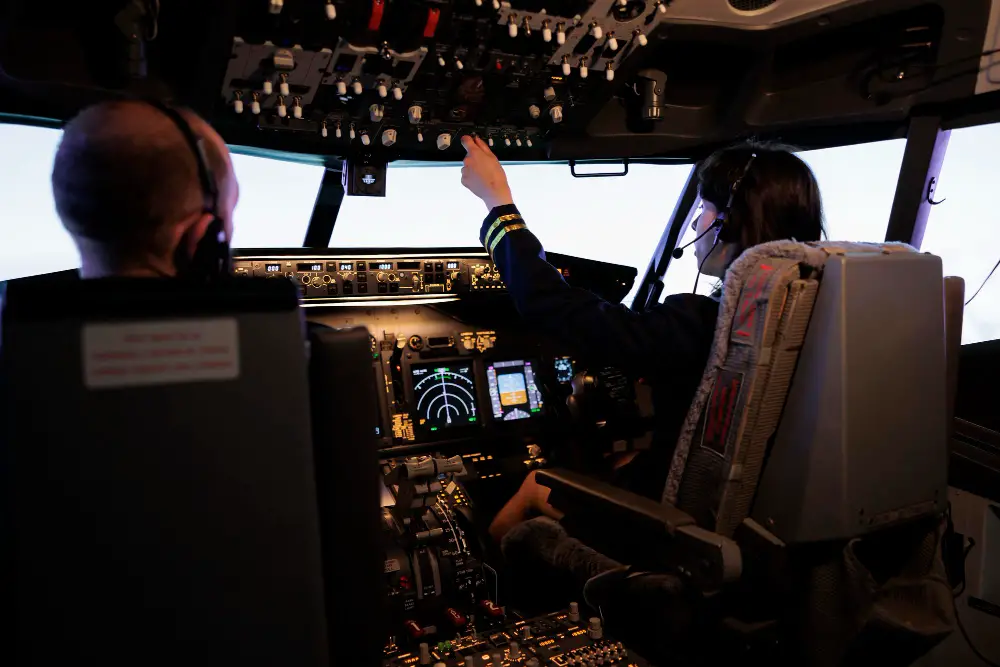
Through the windshield I watched the F-16 begin to settle into something that looked less like a controlled emergency and more like an aircraft being flown by a person who had remembered that he knew how to fly it. The nose stopped its cyclical dipping. The wings leveled. The micro-drift toward our wingtip that had been tightening my chest since I got to the cockpit began to ease as he achieved distance, not the dramatic lateral break of a pilot abandoning formation but the quiet, deliberate widening of a man who had stopped fighting the sky and started working with it.
“You’re doing well,” I said.
“I couldn’t see the horizon for a minute there,” he said. It came out unplanned, the kind of statement that slips through when adrenaline starts receding and the person underneath the pilot becomes briefly visible. “The glare off your fuselage, I couldn’t separate it from the reference line.”
“I know,” I said. “You shifted to visual reference instead of instruments. It’s what you always do when the visual information is stronger than the instrument data.”
A pause.
“You remember that?”
“I remember everything I taught you,” I said. “Which is why I knew before you did.”
The co-pilot made a sound that might have been a laugh under different circumstances. The captain had turned back to his own instruments but I could see in the set of his shoulders that he was monitoring the exchange with the concentrated attention of a man who has realized he is watching something he will spend years trying to explain to people who were not here.
Control came back.
“Falcon Two, Kelley Field has a clear runway. Emergency services are on standby. When ready, begin your descent.”
“I’m ready,” Jake said.
Something in the flatness of it, the absence of the earlier tension, the voice of a pilot who has landed a hundred times and is about to land again, settled into the cockpit like a change in pressure.
“Falcon Two,” I said, “one more thing.”
“Yes?”
“Don’t hold the stick so hard on final. You grip too tight when you’re tired. Let the aircraft give you information. You are not fighting it home.”
A longer pause this time.
“Copy, Eagle One.”
I took the headset off.
The captain was watching me. The co-pilot was watching me. Through the small portal window in the cockpit door I could sense the cabin beyond, the held-breath quality of three hundred passengers who did not know the specific details of what had happened but understood, with the animal accuracy of people in enclosed spaces, that something had shifted from bad toward better.
“You can sit down now,” the captain said. It was not unkind. It was the voice of a man who has been holding a very heavy thing and has just been allowed to set it down and is not sure yet how to speak normally.
“I’ll wait,” I said. “Until he’s down.”
The captain nodded and said nothing more.
We tracked Falcon Two on the secondary display the co-pilot pulled up, a terrain-referenced position overlay that showed the fighter as a small amber icon beginning its descent toward Kelley Field. Falcon Three orbited obediently above at angels twelve, a faithful second icon turning slow circles while his partner descended. I watched the amber icon and breathed steadily and did not let myself feel anything unnecessary until the moment the co-pilot said “gear down, locked” from the data feed and the amber icon touched the blue line that represented the runway threshold and stopped moving.
“He’s down,” the co-pilot said.
I exhaled.
The captain exhaled.
From behind the cockpit door came a sound I hadn’t expected. Not applause exactly, not the performative kind. The sound of a cabin full of people who have been holding their breath without knowing they were holding it, finally letting it go all at once. It moved through the door like weather.
The captain looked at me with the specific expression of a man who has just been reminded that his profession is about more than checklists and fuel calculations and weather avoidance.
“Riley Hart,” he said.
“Yes.”
“What happened to you? Why does Control think you’re dead?”
I had been waiting for that question too. It was the question that always came when someone found out I was still alive, and I had a version of the answer I had rehearsed and a version I had not, and I was tired of the rehearsed one.
“A classified test flight went wrong,” I said. “The aircraft was experimental. The outcome was bad. People above my pay grade decided that burying the program was cleaner than explaining it, and burying the program meant burying the names attached to it. My name was one of them.”
“And you let them?”
I considered that.
“It wasn’t entirely a choice,” I said. “But I was also exhausted. And I thought, maybe, that someone who needed to disappear could disappear and live quietly and stop being the kind of person who sat in cockpits when things went wrong.” I looked through the windshield at the clear morning sky, emptied now of F-16s. “I was apparently wrong about that last part.”
The captain was quiet for a moment.
“You saved his life,” he said. “That pilot.”
“He was well-trained,” I said. “He saved his own life. I just reminded him that he knew how.”
I retrieved my wings from where I had been holding them through the entire exchange and put them back in my hoodie pocket. The captain watched me do it.
“You should go sit down,” he said. “But not because you have to.”
I understood the distinction. I nodded.
When I pushed the cockpit door open and turned back into the cabin, I was not prepared for what happened. Not the attention, I had expected that, the hundred faces turned toward me as I made my way back up the aisle. What I was not prepared for was the stillness of it. No one spoke. No one moved. The teenager with the camera had his phone down. The businessman in row nine had his laptop closed. The mother near row eleven had her daughter on her lap and was watching me with an expression that had nothing performative in it.
The young man who had been sitting beside me in 8A had moved to let me have the window seat. I sat down. I looked out at the empty sky where the F-16s had been. My coffee was still in the seat-back holder, long cold.
The man beside me said nothing for a long moment.
Then he said, quietly, “Are they okay? The pilots?”
“One of them is on the ground,” I said. “The other is on his way home.”
He nodded like this was enough, and it was.
We flew the rest of the route in the particular silence that descends on a cabin after something has passed, not comfortable exactly but real, the way it is real when people have briefly been in genuine proximity to danger and have come through it and are still sitting in the same seats they were in before, slightly different.
I did not sleep. I looked at the sky and thought about Jake Mercer, who had been twenty-three years old when he first sat across a table from me in a briefing room in New Mexico and told me with quiet, earnest conviction that he intended to be the best combat pilot of his generation. I had told him that intention was insufficient and that I would tell him when he was good enough to stop being impressed with himself. He had taken that well, which was the first indication that he might actually become what he was trying to become.
I thought about the last time I had spoken to him before today, which had been in a hospital room, my hospital room, five years ago, three weeks after the accident that took the program and my name and the version of my life that had been organized around those things. He had sat in the chair beside my bed with his hands between his knees and said he was sorry, which was not his fault and which he did not need to be, and I had told him so. He had said he would find a way to clear my name. I had told him not to try.
I wondered now if he had recognized my voice immediately or if there had been a moment of doubt, a moment of his rational mind telling him that the voice was similar but impossible because the person it belonged to was dead, before his gut overrode the calculation. I suspected it had been immediate. Gut recognition almost always was.
We landed without incident ninety minutes later. The gate was the ordinary chaos of a commercial arrival, passengers gathering bags and jackets and the distracted momentum of people who have somewhere else to be. But something was different at our gate. I noticed it before the jetway door opened. There were more people than usual on the other side of the glass.
Not passengers.
Uniforms.
The flight attendant who had stopped me in the aisle came to find me before we deplaned.
“There are some people waiting,” she said.
“I know,” I said.
“Should I be worried?”
I looked at her. She had been good today, the way the best people in her profession were good, present and managing and not showing what she felt until it was appropriate to show it. I had noticed.
“No,” I said. “But thank you for asking.”
The jetway smelled the way jetways always smelled, a combination of recycled air and industrial cleaner and the particular staleness of a space that exists only between two places. I walked it the way I walked everything now, without hurrying, without performing the calm, just maintaining it the way you maintained trim in an aircraft, through small constant adjustments rather than dramatic corrections.
At the end of the jetway stood General Marcus Webb.
He was older than the last time I had seen him, which should not have surprised me but did. He had never looked his age to me, had always been the same version of himself from the moment I met him, which was the version of a man carved from something that did not change easily. But time had found him in the five years since the accident, had laid itself across his face in the specific way it laid itself across people who had been carrying things they could not put down. He was in civilian clothes, which meant nothing except that he had chosen to be in civilian clothes, which with Webb always meant something.
Three people stood behind him, two of whom I did not recognize and one of whom I did.
Jake Mercer.
He was in flight suit, still, which meant they had brought him directly from Kelley Field, which meant someone had moved very quickly. He looked exactly the way I had expected him to look after all of it: slightly pale beneath his natural coloring, square-shouldered in the way of people who have been trained to present composure when they do not feel it, and visibly fighting the impulse to say something before he knew what the right thing to say was.
I stopped in front of Webb.
“Marcus,” I said.
“Riley,” he said.
Then he did something I had not expected, which was that he put both hands on my shoulders the way a person does when they are checking that something is actually present and not a projection, and he looked at me for a moment without speaking.
“You’re going to have to come in,” he said.
“I know.”
“The program is being reopened. There are people who want to ask questions about what happened.”
“There have always been people who wanted to ask questions about what happened,” I said. “The difference is that now someone will answer them.”
He studied me.
“Are you ready for that?”
I thought about the five years of quiet. The gray hoodie and the ordinary flights and the backpack under seat 8A and the careful labor of becoming someone the world did not know, which was easier than people imagined and lonelier than it had any right to be. I thought about the feeling in my chest when the radio crackled and the F-16 started drifting and the old part of me woke up before I had given it permission.
“I’ve been ready,” I said. “I was just waiting for the right moment to be useful.”
Webb almost smiled. It moved across his face quickly, the way light moves across water when something breaks the surface, and then it was gone and he was himself again.
“The inquiry starts Monday,” he said. “There will be lawyers, and senior officers, and several people who would prefer the program stayed buried.”
“I’m sure.”
“You’ll need to be prepared.”
“Marcus,” I said, “I trained combat pilots for eleven years. I survived a classified crash that took two other people and a program and my own name. I spent five years being dead while being alive. I am very difficult to prepare.”
He made a sound that was not quite a laugh.
Then Jake Mercer stepped forward.
He was twenty-eight now. He had been twenty-three the first time I had told him he gripped the stick too hard when he was tired, and here he was at twenty-eight, having just been told the same thing over a restricted military channel by a voice he had been told belonged to someone who did not exist. He stood in front of me with his hands at his sides and his jaw set in the particular way of people who are holding something in until they decide whether it is appropriate to let it out.
“You were on that plane,” he said.
“Yes.”
“You’ve been alive,” he said. “This whole time.”
“Yes.”
He absorbed this.
“You could have reached out,” he said. Not accusatory. Just accurate.
“I couldn’t,” I said. “And then later I could have, and I didn’t, because I had become someone who didn’t reach out. That was a choice and I made it and I’m not certain it was the right one.”
He looked at me for a long moment with the eyes of someone calculating something he isn’t going to say yet.
“You told me to let the aircraft give me information,” he said.
“You already knew that.”
“I forgot it.”
“You were scared,” I said. “Fear does that. It narrows the cognitive field until you’re only seeing the thing you’re afraid of, which in formation flying is never the thing you should be looking at.”
“I know that,” he said.
“Yes,” I said. “You do. That’s why you corrected when I told you to.”
He was quiet for a moment.
“I thought about you,” he said. “After. I thought, if she could hear this transmission, she would tell me to stop fighting the stick. And then it was you.”
“I heard you,” I said. “Old habit.”
The two people behind Webb had been quiet through this exchange, which told me they were either very senior or very patient or both. One of them stepped forward now, a woman in her forties with the specific posture of someone who operates at the intersection of military and legal authority and is comfortable in neither and at home in both.
“Ms. Hart,” she said. “I’m Deputy Inspector General Carla Reyes. We’ve been building a case for the program inquiry for three years. We’d like to speak with you at length.”
“How long have you known I was alive?” I asked.
She paused.
“Eight months,” she said. “We found you through financial records. Civilian contractor payments that should have stopped but didn’t, routed through three intermediaries.”
I looked at Webb.
He looked at the ceiling with the expression of a man who has not technically done anything he was not authorized to do.
“Someone kept paying me,” I said.
“Someone felt responsible,” Webb said, without looking down.
I thought about the deposits that had appeared in an account I had not opened, each one modest enough to ignore and regular enough to rely on, which I had assumed were some administrative residue of the program’s dissolution and had never investigated because investigating would have required acknowledging that I had a past that was still generating paperwork.
“Marcus,” I said.
“The inquiry needs you,” he said, still looking at the ceiling. “It needed you functioning. That required resources.”
“That required honesty,” I said.
He finally looked at me.
“I know,” he said. “I’ll answer for it.”
It was the most direct acknowledgment of a failure I had ever heard from him, and from Webb, who managed his admissions the way a careful pilot managed fuel, precisely and only when absolutely necessary, it was the equivalent of a full confession.
I let it stand.
“What happens after the inquiry?” I asked Reyes.
“That depends on what the inquiry finds,” she said.
“And if it finds what I expect it to find?”
“Then several people who made decisions about the program’s termination will face significant consequences,” she said. “And the public record will be corrected.”
“My name,” I said.
“Your name,” she confirmed.
I looked at the wings in my pocket. The worn edges. The faded engraving on the back that said things I had stopped reading because I had been trying to be someone who didn’t need to read them anymore. I had spent five years insisting to myself that I was fine without the name and the record and the formal acknowledgment of the eleven years I had given to something that had taken them back without asking. I had told myself that it didn’t matter because I was alive and the two people who had been in that aircraft with me were not, and the comparative accounting of that fact was supposed to make everything else feel small.
It hadn’t worked. I had just gotten quiet about it.
“Monday,” I said to Reyes. “I’ll be there.”
She nodded, professional and efficient.
Reyes and the other official moved off with the particular momentum of people who have secured what they came for and have other things waiting. Webb lingered, which was characteristic. Webb always lingered when there was something left to say.
“Are you angry with me?” he asked.
“Yes,” I said. “A little.”
“That’s fair.”
“You could have told me,” I said. “That you knew. That there was going to be an inquiry. That they had been building a case. You let me be dead for three years longer than I needed to be.”
“You were safe,” he said. “You were functional. And you were not ready.”
“You decided that.”
“Someone had to,” he said. “You had stopped deciding things.”
I wanted to argue that and couldn’t, because he was right, and the fact that he was right was its own irritation. I had stopped deciding things. I had handed myself over to the quiet life with the relief of someone who has been fighting for a long time and has finally been given permission to stop, and the problem with relief of that kind is that it looks from the outside very similar to surrender.
“How did you know I’d be ready now?” I asked.
He nodded at Jake.
“Because of him,” Webb said. “When I found out Falcon Two was going to be your escort, I changed your seat assignment.”
I stared at him.
“You put me on that flight deliberately.”
“I put you near a window deliberately,” he said. “Everything else was yours.”
I looked at Jake, who had been listening to this with the expression of someone who is learning several things simultaneously and is not sure which of them to address first.
“He could have been hurt,” I said.
“He could have,” Webb said. “He wasn’t.”
“That’s a significant gamble, Marcus.”
“I have considerable confidence in both of you,” he said. “As it turns out, not misplaced.”
I thought about saying more. I had several more things. But Webb had always been difficult to argue with productively because he was usually, infuriatingly, approximately correct, and the five-year-old anger I had carried about the program and the accident and my own erasure was real and valid and also not the most useful thing I had to offer right now.
“Monday,” I said.
“Monday,” he agreed. “Get some rest this weekend.”
He turned and walked toward the terminal exit with the unhurried stride of a man who has accomplished what he came to accomplish and is already thinking about the next thing. I watched him go.
Jake was still standing in front of me.
“I’m glad you’re not dead,” he said.
“So am I,” I said. “Most days.”
He almost smiled.
“Are you going to train pilots again?” he asked.
I thought about that. About the feeling in the cockpit when the static cleared and the channel opened and I heard his voice, young and tight and breathing too fast, and my hands had known what to do before my mind had finished giving permission. About the five years of practiced distance from all of it, and how the distance had not actually put anything away but had only removed the occasions that required it to be present, and how this morning had demonstrated in fairly unambiguous terms that the thing I had spent five years trying to quietly retire was not actually retirable.
“Probably,” I said.
He nodded like this was the answer he had expected.
“You’re still the best I ever had,” he said. “And I’ve had good ones since.”
“Don’t tell them that,” I said. “It’s bad for morale.”
He did smile this time, and it was the same smile he had given me on the day he passed his final evaluation, when I had told him that he was ready and watched the relief and the pride and the determination rearrange themselves across his twenty-three-year-old face. He was twenty-eight now and had just landed a damaged aircraft below bingo fuel after a formation emergency, and the smile was older but it was the same smile, which meant he was still the same person underneath the experience he had accumulated, which was the most you could hope for in anyone.
“Thank you,” he said. “For today.”
“Fly better,” I said.
He laughed, which was what it was meant to produce, and then he nodded once with the formal respect of a pilot to someone he considers his superior and turned and walked away.
I stood in the terminal for a moment. Around me, the ordinary machinery of commercial travel resumed its function. People pulling luggage, checking phones, navigating the specific directed chaos of an airport that doesn’t know or care that the past hour has been anything other than ordinary. A child ran toward her father at the arrival gate across the concourse. A man argued quietly into his phone about something that mattered very much to him. A coffee cart attendant arranged cups in the particular way of someone performing a task they have performed a thousand times and have stopped consciously thinking about.
I reached into my hoodie pocket and took out the wings.
I held them in my palm the way I had held them in the cockpit, the worn metal warm from contact, the engraving softened from years of being touched and hidden and touched again. They were not a symbol of anything I had lost. They were a record of something that had happened, that was still happening, that had apparently not finished happening despite my best efforts to arrange for it to be finished.
I put them back in my pocket and picked up my backpack from where I had set it down and walked toward the exit.
Monday was three days away.
I had, apparently, things to say to people who were ready to hear them. A name to reclaim. A record to correct. And somewhere beneath all of that, the quiet, stubborn, poorly buried conviction that the work I was good at had always been the work of making sure other people came home.
Jake Mercer had come home this morning.
That was enough for today.
I walked out through the automatic doors into the ordinary daylight, and the city opened around me in all its indifferent, ordinary enormity, and I breathed the outside air, and I thought about what it meant to stop being dead.
It meant starting again.
That was, in the end, the only thing it meant.
And I had never, not once in my life, been afraid of a beginning.

Lila Hart is a dedicated Digital Archivist and Research Specialist with a keen eye for preserving and curating meaningful content. At TheArchivists, she specializes in organizing and managing digital archives, ensuring that valuable stories and historical moments are accessible for generations to come.
Lila earned her degree in History and Archival Studies from the University of Edinburgh, where she cultivated her passion for documenting the past and preserving cultural heritage. Her expertise lies in combining traditional archival techniques with modern digital tools, allowing her to create comprehensive and engaging collections that resonate with audiences worldwide.
At TheArchivists, Lila is known for her meticulous attention to detail and her ability to uncover hidden gems within extensive archives. Her work is praised for its depth, authenticity, and contribution to the preservation of knowledge in the digital age.
Driven by a commitment to preserving stories that matter, Lila is passionate about exploring the intersection of history and technology. Her goal is to ensure that every piece of content she handles reflects the richness of human experiences and remains a source of inspiration for years to come.