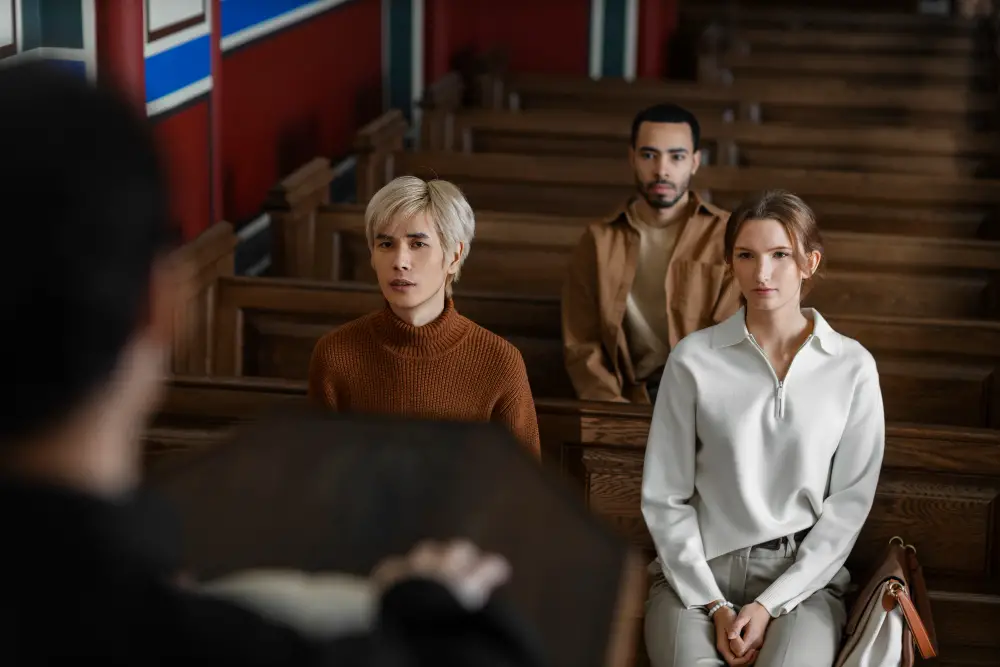
My stepmother said it without blinking, looking directly at the judge while she dabbed her eyes with a tissue she had pre-crumpled in her purse for effect.
“She doesn’t even know what day it is, Your Honor. She can barely dress herself.”
I kept my hands folded in my lap. I counted silently to fourteen, which was the number of days she had left before she lost everything she had ever stolen from my family, and I let the words hang in the air of courtroom 4B of the Harris County Probate Court in Houston, Texas, where I was surrounded by people who shared my last name and not one of them was on my side.
My stepmother Diane had been in my life since I was eleven years old. She arrived eight months after my mother died of pancreatic cancer, moving into the space my mother left behind with the efficiency of someone who had been watching for the vacancy. She had blonde highlights and a real estate license she never used and a smile that could charm the skin off a snake, and my father, who was a genuinely good man drowning in the particular grief that comes from losing the person who made sense of everything, grabbed the rope she threw him without noticing it was a leash.
Seventeen years she managed him. Seventeen years of careful, patient work: isolating him from his brother, from his college friends, from anyone who might have said the quiet thing out loud. She turned him toward her and away from everything else, and he was too grateful to examine why she needed his world to be that small. My father loved her. I am certain of that. What he never fully understood was that she did not love him back in the same currency. She loved the four-bedroom house in River Oaks. She loved the lake house in Conroe. She loved the quarterly dividends from the commercial real estate trust my grandfather had built from nothing in 1974, the trust that represented forty years of work and sacrifice and the particular American faith that what you build can be passed to the people who come after you.
My father had a stroke and died in the ICU at Houston Methodist at six forty-seven on a Tuesday morning. I was holding his hand. Diane was in the waiting room on her phone calling his financial adviser.
In the week after the funeral, I learned three things.
First: my father had updated his will eighteen months before he died. He left the house to Diane, which was generous and probably foolish in retrospect, but that was who he was. The trust, roughly four-point-two million dollars in commercial property and investment accounts that my grandfather had assembled across five decades, he left entirely to me.
Second: Diane had known about this change for exactly four months, because she had gone through his desk while he was at a cardiology appointment and found the draft document. She had known since before his final hospitalization that the money was going to me, and she had spent those four months doing the rational thing, which is to say the criminal thing.
Third: she had been systematically moving money out of the trust’s operating account. Not in large dramatic withdrawals that would trigger automatic alerts, but in careful, patient increments. Five thousand here. Eight thousand there. Forty-seven individual transfers over eleven months, each one sized to stay below the thresholds she understood from watching my father’s finances for nearly two decades. By the time he died, she had moved just over three hundred and ten thousand dollars into accounts I could not immediately see.
Most people, when they discover something like this, react. That is the entirely human and entirely understandable response. You scream. You call a lawyer. You post about it and contact every family member in your phone. You let your outrage speak because your outrage is legitimate and you are in genuine pain and you want the people around you to understand what has been done.
Diane was counting on that.
She hadn’t just stolen money. She had a second phase to the operation, because a theft this size required a second phase. If I reacted emotionally, if I made accusations, if I came apart in front of the extended family, she would point to my behavior and say: look, she’s unstable. She’s paranoid. She’s not capable of managing a multimillion-dollar trust. And without my credibility, the story of the stolen money becomes the ravings of a grieving, unhinged daughter.
First you take the money. Then you take the credibility. It’s a move straight from the narcissist’s operational manual. They don’t just hurt you. They arrange things so that when you try to tell someone what happened, you sound insane.
So I didn’t react.
I moved out of the apartment my father had been helping me pay for and into an eight-hundred-dollar-a-month studio in Montrose. I drove my ten-year-old Civic. I wore jeans and T-shirts to family dinners. I smiled at Diane across the table and let her pat my hand and say that my father would have wanted us to stay close, sweetheart. I let her believe the performance was working.
And every night after everyone went home, I sat at my kitchen table with a laptop and a cup of black coffee, and I traced every dollar she had touched.
Here is what Diane did not know about me: she thought I was a mid-level analyst at an accounting firm, which was technically accurate but deeply incomplete. What she had never asked about, because she had never been particularly interested in who I was as opposed to what I might do to her plan, was that I had spent six years working forensic audits for a firm that specialized in fraud detection. I had helped the IRS build cases against people considerably more sophisticated than Diane. My entire professional life had been about following money through dark hallways until I found the room where it was hiding.
She wasn’t stealing from a grieving daughter. She was stealing from someone who did this for a living.
But I needed more than evidence. Evidence can be disputed. Evidence can be dismissed as fabrication by a paranoid woman with a motive to lie. What I needed was for Diane to commit, publicly and irrevocably, to a version of events that the documentation would destroy. I needed her to make her move in a venue where the consequences of being caught were specific and severe and entirely of her own making.
So I let her keep stealing. I watched the transfers in real time and documented each one with timestamps, IP addresses, and device identifiers. I cross-referenced the destination accounts with corporate filings in Nevada, Wyoming, and Delaware, and I found what I expected to find. Three shell companies, the standard architecture of someone who had attended the wrong kind of financial seminar. One was called Bluebird Properties LLC. Another was Golf Horizon Consulting. The third, and this was the one that almost made me laugh in the quiet of my studio apartment at one in the morning, was called Legacy Asset Management.
She named her theft vehicle Legacy. The irony was operatic.
For five months I watched and compiled and built a binder that a federal prosecutor would find emotionally satisfying. And then Diane made her move.
She filed a petition for emergency conservatorship, claiming I was mentally incapacitated and unable to manage the trust. She brought supporting documentation in the form of a psychological evaluation submitted by a man named Dr. Edwin Marsh, who turned out to be her boyfriend’s golf buddy and who had written a clinical diagnosis of severe dissociative disorder and cognitive decline based entirely on what Diane had told him during a phone call. He had never met me. He had never tested me. He had produced a formal clinical assessment of a woman he had never seen, in support of a petition filed by the woman who was robbing her.
And that is how I ended up in courtroom 4B on a Wednesday morning in January, listening to my stepmother describe me as though I were a broken appliance that needed to be unplugged.
The gallery behind her was full. My father’s sister, Aunt Colette, was there with her daughters. A woman I didn’t recognize who I later learned was Diane’s hairdresser, brought in purely to fill a seat and nod along. Diane had spent months preparing her audience, building the narrative through phone calls and tearful lunches and carefully worded voicemails about how worried she was, how much she missed Robert, how frightened she was for his daughter. She had turned my extended family into a Greek chorus, and now she was giving them the performance she had rehearsed.
Her lawyer, a man named Curtis Hamley in a suit that was one size too tight, addressed the bench with the practiced confidence of someone who had been told the outcome was already arranged. He requested the immediate appointment of Diane Callaway as temporary conservator over the Callaway Family Trust, citing the respondent’s inability to manage her own affairs and the resulting financial deterioration of the estate.
Three hundred and ten thousand dollars, missing from the trust’s operating account. No oversight, no filings, transfers to unknown entities. If that wasn’t evidence of incapacity, Curtis told the judge, he didn’t know what was.
Judge Alderman was in his early sixties, silver-haired, with the face of a man who had been watching people lie to him for decades and had developed a specific kind of patience for it, the patience of someone waiting for the moment the lie becomes undeniable. He looked at me over his reading glasses.
“Miss Callaway. These are serious allegations. How do you respond?”
The room held its breath. Diane leaned forward slightly. Curtis clicked his pen. Aunt Colette’s hands were folded in her lap. They were all waiting for the breakdown, for the tears or the outburst or the confused fumbling that would confirm the story they had been told.
I stood up slowly. I buttoned my blazer. I looked directly at Diane, not at the judge, not at the gallery, at her. I held her gaze for three full seconds without blinking or looking away, and I watched the first flicker of something that was not quite fear but was the precursor to it move across her face.
Then I turned to the judge.
“I’m listening, Your Honor. I just want to make sure my stepmother is finished. I wouldn’t want to interrupt her while she’s still under oath.”
Diane’s lip moved, a fraction of a second, quickly controlled. She felt the ground shift beneath her without yet understanding why.
Curtis recovered and pressed forward. He handed a folder to the bailiff containing the transfer records he had presumably been given by Diane, and spoke about the pattern of neglect and mismanagement these documents demonstrated. Three hundred and ten thousand dollars, transfers to unknown entities, no oversight. What kind of person loses that much money without noticing?
The gallery murmured. Aunt Colette whispered to her daughter. They were closing ranks around the narrative, settling into the version of events they had been prepared to accept.
I let the silence sit for exactly five seconds. Long enough for the room to settle into its assumptions. Long enough for Diane to feel, just for a moment, that she had won.
Then I said, “Your Honor, may I approach the bench?”
He nodded.
I picked up a black binder from the table. Two hundred pages, tabbed with colored flags. Red for financial records. Blue for digital forensics. Green for corporate filings. Yellow for the perjury.
I placed it in front of him.
“I didn’t lose track of three hundred and ten thousand dollars,” I said. “I watched every dollar leave. I know exactly where it went, when it went, and who sent it.”
Behind me, I heard Diane’s hands grip the table edge. I did not turn around.
“These are the wire transfer confirmations from the trust’s operating account,” I said, opening to the first red tab. “Forty-seven individual transfers over eleven months, made to three separate LLCs: Bluebird Properties, Golf Horizon Consulting, and Legacy Asset Management. All three companies were incorporated in Wyoming using a registered agent service. The beneficial owner of all three shell companies is Diane Marie Callaway. The woman sitting right there, asking Your Honor to give her control of the money she has already been stealing.”
The courtroom erupted. Aunt Colette made a sound. Someone in the gallery was whispering. Curtis was on his feet with an objection, but nobody was listening to Curtis right now.
“She fabricated that,” Diane said, her voice sharp, the performance dropping for the first time into something rawer and less rehearsed. “She’s delusional. This is exactly what I’ve been telling you. She makes things up.”
Judge Alderman raised one hand. The room went silent.
He looked at me with an expression I will carry with me for the rest of my life. Not anger. Not shock. The expression of a man who has just understood that he has been brought into a room under false pretenses and is now recalibrating everything accordingly.
“Continue, Miss Callaway.”
I opened the blue tab.
“These are the IP logs from every transfer. Every single one originated from the same device, a laptop registered to the home network at 1847 Willow Creek Lane. My stepmother’s address. The house my father left her.”
I moved to the green tab.
“These are the bank statements for the three shell companies. The pattern is consistent across all forty-seven transfers. Money flows in from the trust, sits for thirty to sixty days, and then transfers again to a personal brokerage account at Charles Schwab, held jointly by Diane Callaway and a man named Trevor Fisk.”
I looked at Diane. Her mouth had opened and then closed. She looked, for the first time since I had known her, like someone who did not know what came next.
“Trevor Fisk is a real estate agent based in Galveston. He and my stepmother have been in a relationship for approximately three years, beginning while my father was still alive and recovering from his first cardiac episode. I have hotel receipts, text message records obtained through legal discovery, and a lease agreement for a beachfront condo in Galveston, co-signed by both of them. A condo purchased with money transferred from my father’s trust.”
The gallery was a different kind of silent now. Not the held-breath silence of people waiting for a breakdown. The silence of people rapidly revising everything they believed they understood about the last year of their lives. I could hear Aunt Colette’s breathing change from across the room.
Judge Alderman closed the binder. He removed his glasses and rubbed his eyes, which was the gesture of a man who had seen enough and was now deciding what to do with what he had seen.
Then I told him about the letter.
My stepmother had submitted a document as part of her petition, page fourteen of the original filing, a letter supposedly written by my father three months before his death, granting Diane broad authority over the trust. It bore his signature and carried the formal weight of a document from beyond the grave.
I had the letter analyzed by a certified forensic document examiner. The report was in the yellow tab. The signature was not authentic. It had been digitally lifted from a property tax filing dated 2023 and pasted onto the letter using image editing software. The metadata embedded in the letter’s PDF showed a creation date four days after my father’s death, on a computer registered to the law office of Curtis Hamley.
Curtis slammed his hand on the table.
I kept speaking.
The letter was a forgery, submitted under oath to a probate court as part of a fraudulent conservatorship petition. Under Texas Penal Code, aggravated perjury. And under the statute governing secured execution of a document by deception involving value over three hundred thousand dollars, a first-degree felony.
Judge Alderman looked at Curtis for a long time. The silence between them had a specific quality, the silence of a man who has just been caught understanding that the silence contains him.
“Mr. Hamley,” the judge said quietly, “did you prepare that document?”
Curtis was sweating visibly through his shirt. He did not answer.
Diane turned on him with the speed of someone who has been prepared for this eventuality and has no loyalty available for the deployment of mercy.
“He told me it would hold up,” she said, pointing. “He said no one would check. This was his idea.”
Curtis flinched as though she had struck him.
The alliance collapsed in real time. Two people in a sinking boat, each one trying to reach the other’s life jacket before the water came up. Watching it happen, I felt something I had not expected to feel. Not triumph, exactly. Something quieter. The specific satisfaction of a thing that was always going to happen finally happening.
Diane turned to the gallery, trying to reconstruct a performance that had come apart at its seams.
“I didn’t want this,” she said, her voice cracking in the register she used for sympathy. “Robert was going to leave me with nothing. After everything I did for him. Seventeen years I gave that man. I raised his daughter. I kept his house—”
“You kept his money,” I said. “That’s what you kept.”
Judge Alderman raised his hand one final time.
He spoke in the deliberate, unhurried tone of a man who has already made his decision and is now simply stating it for the record.
The court found no evidence of mental incapacity on the part of the respondent. The conservatorship petition was denied with prejudice. The matter of the forged document and the fraudulent petition was being referred to the Harris County District Attorney’s Office for criminal investigation. Given the interstate nature of the transfers, the shell companies in Wyoming, the brokerage in Texas, the condo in Galveston financed through interstate wire transfers, a referral to the United States Attorney for the Southern District of Texas was also being made.
“Mrs. Callaway,” he said, addressing Diane directly, “I strongly suggest you retain separate criminal counsel. Mr. Hamley will not be in a position to represent you, as he appears to be a subject of the same investigation.”
Diane’s face went completely blank. Not frightened. Not angry. Blank with the specific blankness of someone whose entire constructed reality has just been taken from them, and who has not yet developed a plan for what exists on the other side of it.
I sat down. My hands were not shaking. My pulse was steady. I felt the way you feel at the end of something that required everything you had to complete, emptied out but clear, every decision made, every step taken, nothing left uncertain or undone.
In the hallway afterward, Aunt Colette approached me crying. She said she hadn’t known, that Diane had told them, that she had believed. I understood. I was not angry with Colette. Narcissists do not confine their manipulation to their primary target. They build an alternative reality comprehensive enough to trap the people around them, good people who trust what they are told and have no particular reason to doubt the person doing the telling.
She asked why I hadn’t come to her. Why I hadn’t told anyone what was happening.
“Because I needed you to believe her,” I said. “If any of you had doubted her story, she would have changed her approach. She needed a full audience in that courtroom, people who had been nodding along for months. She needed that confidence, because that confidence was the only thing that would make her go through with the petition. And the petition was the only way to get the forgery into the court record under oath, where it becomes a felony instead of a private dispute I have to prove in civil court.”
Colette stared at me.
“You planned all of this?”
“I planned for the possibility,” I said. “There’s a difference.”
I walked out into the January sun. Houston in winter is its own particular weather, cold enough to feel the season without cold enough to settle into it, and I stood on the courthouse steps and took the first fully released breath I had taken in fourteen months.
The case moved through the system over the following weeks with the bureaucratic momentum of something that has sufficient documentation to not require argument. Diane was indicted on six counts: theft from an estate, forgery, aggravated perjury, securing execution of a document by deception, money laundering, and one federal count of wire fraud. Curtis Hamley was indicted separately on three counts including conspiracy and tampering with a government record. Trevor Fisk, the boyfriend, cooperated with federal investigators in exchange for eighteen months of home confinement, which meant, given that the Galveston condo had been seized as proceeds of fraud, that he served his confinement in his mother’s guest bedroom in Beaumont. There is a poetry in consequences that arranges itself this precisely that no writer could have invented.
The shell companies were dissolved. The brokerage account was frozen. Every dollar in Legacy Asset Management and Bluebird Properties and Golf Horizon Consulting was clawed back into the trust, and then some, because the civil recovery included interest and legal fees and the specific arithmetic of money that has been made to work hard for its return.
Diane called me once from a number I didn’t recognize. Her voice was flat and stripped of performance, which was, I realized, the first time I had ever heard her actual voice.
“You ruined my life,” she said.
“No, Diane,” I said. “You built a house on someone else’s land. I just showed up with the deed.”
She hung up. I blocked the number, and three more numbers she tried over the following week, because narcissists do not stop when they lose. They recalibrate and try again and again from new angles until you make the infrastructure of your life impervious to their entry. I made mine impervious.
She took a plea deal eleven months later to avoid trial. Six years in state custody, two years of unsupervised probation. Curtis received three years and was disbarred. The day of her sentencing, I did not go to the courthouse. I did not need to witness the formal conclusion of something that had already, for me, concluded in courtroom 4B when I put that binder on the bench.
Instead, I went to my mother’s grave.
It is in a small cemetery on the south side of Houston, under a live oak that drops acorns every fall. I sat on the grass and told her everything, all of it in sequence, the discovery and the months of surveillance and the studio apartment and the dinners with Diane where I smiled and said the appropriate things and felt, underneath the surface calm, a steady frequency of terror that I did not allow myself to fully acknowledge until it was over.
Because here is the thing I had not told anyone, not my lawyer, not Aunt Colette, not the therapist I started seeing six months into the process. For all five months of building that case, I was frightened. Every morning I woke at three in the morning with my heart running fast, wondering if I was making a mistake, wondering if Diane had already discovered the surveillance, wondering if the family would believe me even with documentation, wondering if I was the one who was wrong about all of it. The self-doubt that Diane had spent seventeen years carefully cultivating in me did not disappear simply because I had found the evidence. It stayed. It showed up every night in the dark and asked me if I was sure.
I did it anyway.
Not because I had conquered the fear. Not because I was operating from some place of calm, settled certainty. I did it because I decided that being afraid was not sufficient justification for letting someone take what my father had built and what my grandfather had built before him, the thing that represented not just money but forty years of a man who believed that what you create can be left to the people who come after you.
I did it because patience is the one weapon that people like Diane never see coming. She was fast and loud and performed her way through rooms. She played to audiences and built crowds and counted on spectacle. I was slow and quiet and played to the evidence, and when the curtain finally came down, everyone in the room discovered they had been watching the wrong person the entire time.
I restructured the trust after the recovery. I fired the financial adviser who had been too friendly with Diane and hired a fiduciary who reported only to me. I sold the lake house in Conroe, which had been a place my father loved and which I could not enter without feeling the specific weight of a grief that needed time and distance to become bearable rather than simply loud.
With part of the proceeds, I established a scholarship in my mother’s name at Prairie View A&M, her alma mater. She had been a first-generation college student, the first person in her family to leave home for an education, and the idea that her name would now open that same door for other women felt like the most fitting possible use of money that had been used for a very long time for the wrong purposes.
I adopted a dog, a three-legged rescue mutt I named Verdict, because my therapist said humor was a healthy coping mechanism and I thought it was funny, and because he was the right amount of company for a person who had been running alone for a long time and was learning to slow down.
Aunt Colette and I had lunch once a month. She started volunteering at a legal aid clinic that helps elderly fraud victims, which was her way of converting the guilt she carried about believing Diane into something that moved forward rather than backward. She was good at it. She had the specific gift of sitting with people who had been betrayed by someone they trusted, perhaps because she now understood that experience from the inside.
I think about my father still. I think about who he was before Diane, the man who had been generous and present and capable of the specific kind of love that makes room for the people it contains. I think about him drowning in grief and grabbing the rope she offered, and I do not blame him for not seeing the leash inside it, because grief changes the physics of judgment and people in pain accept lifelines without always examining what is attached to the other end.
I think about what it means to honor someone’s life after they are gone. My grandfather believed that what you build can be passed down, that the work of one life can fund the possibility of the next. My father believed this too, believed it enough to update his will eighteen months before he died and make sure that what he had was going where he wanted it to go. They were right about that, and in the end the thing held, not because it was easy to protect but because I was willing to do the unglamorous, exhausting, frightening work of sitting alone at a kitchen table every night until the picture was complete.
There is a woman somewhere right now sitting at a kitchen table at two in the morning, staring at bank statements that do not add up, wondering if she is imagining things, wondering if the person she trusted is actually doing what the numbers suggest. I know that woman. I was that woman for five months before I allowed myself to believe what I was seeing.
You are not imagining things. You are not paranoid. The numbers mean what numbers mean.
Document everything. Tell no one until the time is right. And when the time comes, walk into the room with your binder and your steady hands and your heart running fast underneath the blazer you have buttoned with care, and show them precisely who they chose to underestimate.
Peace is not something you wait to be handed. It is something you build one page at a time, in the dark, when no one is watching, until the morning when you put it down in front of someone who has the authority to make it permanent.
That is what my mother’s daughter did.
That is what I intend to keep being.

Ethan Blake is a skilled Creative Content Specialist with a talent for crafting engaging and thought-provoking narratives. With a strong background in storytelling and digital content creation, Ethan brings a unique perspective to his role at TheArchivists, where he curates and produces captivating content for a global audience.
Ethan holds a degree in Communications from Zurich University, where he developed his expertise in storytelling, media strategy, and audience engagement. Known for his ability to blend creativity with analytical precision, he excels at creating content that not only entertains but also connects deeply with readers.
At TheArchivists, Ethan specializes in uncovering compelling stories that reflect a wide range of human experiences. His work is celebrated for its authenticity, creativity, and ability to spark meaningful conversations, earning him recognition among peers and readers alike.
Passionate about the art of storytelling, Ethan enjoys exploring themes of culture, history, and personal growth, aiming to inspire and inform with every piece he creates. Dedicated to making a lasting impact, Ethan continues to push boundaries in the ever-evolving world of digital content.