I said it out loud, sitting in my truck with the engine still running, like hearing the words might somehow make them make sense.
They didn’t.
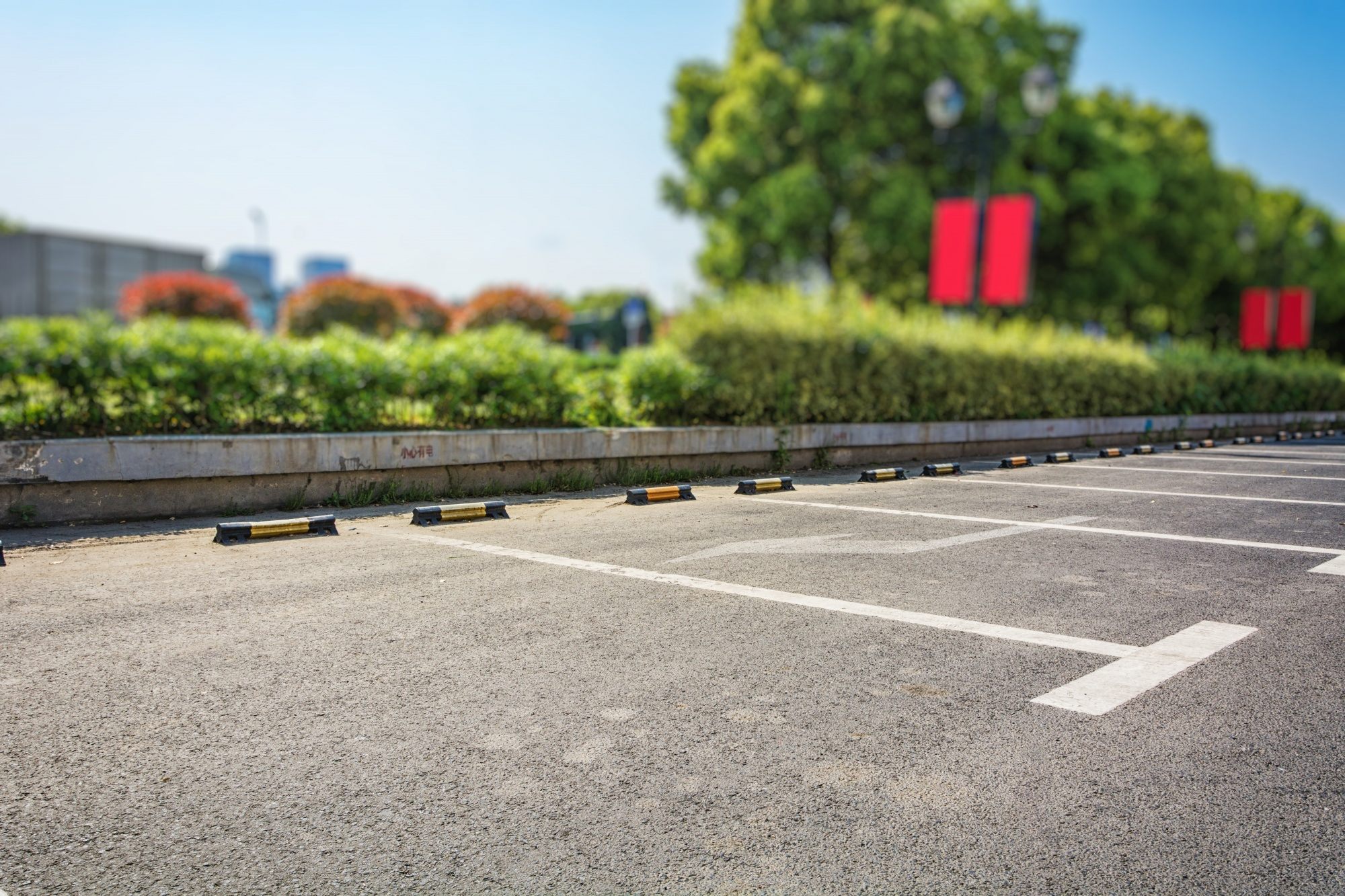
My headlights stretched across the concrete, and there it was. Bright yellow paint, still fresh, still catching the light like it had just dried an hour ago. Not a stray mark or a careless line. Full parking stalls. Clean, deliberate boxes with numbers painted neatly in white at the top of each one.
Seven. Eight. Nine.
On my driveway.
And like that wasn’t enough, three cars were already parked inside those boxes, sitting there comfortably like they belonged, like someone had handed out permission slips while I was at work.
I didn’t move for a long time. My hands were still wrapped around the steering wheel, gripping tighter than I realized, and I remember blinking slowly into the glare of my own headlights, trying to shake the feeling that I was looking at something physically impossible. Like I had turned into the wrong driveway. Like the address on my mailbox had changed overnight.
Because this wasn’t just wrong. It was genuinely insane.
My name is Caleb Turner. I live on the edge of Cedar Ridge, Ohio, the kind of place where the roads are quiet and the neighbors tend to mind their business and people fix things instead of replacing them. Fifteen years ago, my father helped me build my house here, and that alone tells you something about the kind of place it is and the kind of people who live in it. The house isn’t big or impressive by any stretch. It’s square and solid and practical, with a detached garage and a metal shop out back where I spend most of my evenings working on small engines and custom woodworking. Honest work. The kind that keeps your hands busy and your head clear.
The driveway runs along the side of the property, wide concrete that my father and I poured ourselves, stretching from the main road all the way back to the shop. It fits a truck with a trailer attached without any trouble. Over the years I’ve pulled everything down that driveway, from engine hoists to lumber loads to a friend’s broken-down boat that needed a full weekend of attention. It’s a working driveway on working land.
It is not shared. It is not a public easement. It is not community property or a right-of-way or anything other than exactly what it has always been, which is mine. I pay property taxes on that strip of land every single year and complain about the bill like anyone would, and I have the deed, the survey, and the county records to back it up. There’s even a survey pin set into the ground near the edge, placed in 2008 when everything was officially measured and recorded. I know exactly where my land begins and exactly where it ends.
For years, none of that mattered in any practical sense because nobody questioned it. The property line was just a fact, like the angle of the roof or the depth of the well. It existed quietly and nobody felt the need to test it.
Then, about five years back, the empty lot next door got sold.
I didn’t think much of it at first. People buy land. Developers develop. I watched the construction crews show up and figured it would be a few months of noise and then something would be built and life would go on. What went up was fast, though. Faster than I expected. Within a few months, twelve townhouses were standing where there had been weeds and scrub brush. Beige siding, gray trim, every unit pressed tight against the next like they’d been produced on an assembly line. Each unit came with a garage that looked like it could hold one average-sized car and maybe a bicycle if you were careful about the handlebars.
The people who moved in seemed decent enough. Young couples, a few families, some single folks working from home. They waved when they saw me. I waved back. Normal enough.
The HOA formed almost immediately. That didn’t surprise me either. New developments like that always form HOAs. They write up bylaws and elect officers and hold meetings in someone’s living room and argue about landscaping standards. I paid no attention to any of it because none of it applied to me. My property was older, separate, and entirely outside their jurisdiction. The plat map made that clear to anyone who cared to look. Whatever problems they had, whatever rules they made, none of it crossed the property line.
Or so I believed.
The parking situation started showing cracks within the first year. Twelve townhouses with garages sized for one car each meant that any household with two vehicles was immediately running out of space. Guests made it worse. The internal street through the development had limited parking on both sides, and on weekends it looked like someone had set up an outdoor market without the vendors. Cars angled halfway onto curbs. Trucks parked so close together that getting out required a ten-point turn. On trash days the whole thing looked like a dealership overflow lot. You could hear people arguing about it sometimes when I was out in the yard. The conversations drifted over the fence in pieces.
“Where exactly am I supposed to put my car?”
“This is not what I agreed to when I bought here.”
“The board needs to do something about this immediately.”
I heard all of it. I felt genuine sympathy for the inconvenience, the way you feel sorry for anyone dealing with a frustrating situation. But I also knew it had nothing to do with me. Their parking shortage was a consequence of how the development had been designed and sold. That was between them and the builder, or between them and each other. I had a large concrete driveway that ran along the edge of my property, and I understood even then that it probably looked tempting to people who were desperate for space. But looking tempting and being available are two entirely different things.
I told myself it would work itself out. People find solutions. They adjust. They figure it out.
I was wrong about how they would figure it out.
That Friday evening, I finally killed the engine and stepped out of my truck into the night air. The smell hit me before I had taken three steps. Fresh paint. Sharp and chemical and completely out of place on a quiet residential evening. I walked slowly down the driveway, my boots loud against the concrete, passing the parked cars one by one and reading the numbers painted above each stall. Seven, eight, nine. I crouched near the far edge where the concrete met the grass and brushed some loose dirt aside with my fingertips until I felt the metal of the survey pin, right where it had always been, right where the records said it should be.
Still mine.
“Hey, Caleb!”
I stood and turned. Trent Hollis was leaning on his porch railing next door, casual as anything, like the situation was perfectly ordinary.
“Looks good, right?” he called over. “Finally some order around here.”
I stared at him for a moment. “Looks good?”
“Yeah,” he said, shifting his weight. “The parking situation has been a real mess.”
I walked a few steps closer to the fence. “Trent. This is my driveway.”
He gave me the look people use when they want to seem reasonable while also not backing down. “Well, the board said it was basically functioning as an extension of the shared access corridor. Runs along the whole block, so.”
“Runs along it,” I said slowly. “Not belongs to it.”
He raised both hands in that gesture people make when they want to signal innocence. “Hey, I’m not the guy to talk to. Take it up with Marcus.”
Marcus Dayne. HOA president. Mid-forties, always in polo shirts, always talking about bylaws and community standards with the kind of confidence that comes from never having been told no. I knew exactly who Marcus was.
I didn’t go knocking on doors that night. I didn’t call anyone or send any emails. I went inside, poured a glass of water, and sat at my kitchen table looking out the window at my own property while strangers parked their cars on it. Every time a new set of headlights turned in off the main road and pulled into one of those numbered boxes, I felt something tighten in my chest. Not just anger. Something more precise than that. It was the feeling of watching an assumption being treated as a fact. The feeling of watching people act as though the question of who owned that land had already been settled in their favor, without my knowledge, without my consent, and without any legal basis whatsoever.
I didn’t sleep much.
The next morning I came outside with my coffee to find a silver sedan parked sideways across the entire entrance to the driveway. Not in one of the painted stalls. Sideways. Blocking everything. There was no way in and no way out.
I stood there holding my mug and looking at that car, and something in my thinking shifted. Up to that point I had been turning the situation over, considering approaches, weighing options, telling myself that maybe a calm conversation with the HOA would be enough. Seeing that sedan killed that line of thinking entirely. The painted stalls had been presumptuous and illegal. This was something else. This was a declaration. Whoever had parked that car had decided that my driveway was not mine, and had acted accordingly with complete indifference to what I might think or need.
I walked to the nearest townhouse and knocked. A woman answered in slippers, phone in hand, and before I had finished explaining the situation she told me flatly that the driveway was no longer considered private property and that the HOA had designated it as shared overflow parking. I asked her to repeat that, because I genuinely wasn’t sure I had heard her correctly. She repeated it without apology or hesitation. I told her the driveway was on my property, documented and surveyed. She told me to take it up with the board and closed the door.
I tried the next house. A younger guy, college-aged, who glanced out at the situation, shrugged, said it was probably fine, and suggested I talk to the board. I got the same answer at the next door and decided I had heard enough.
Walking back across the grass, I felt a quietness come over me that was different from calm. It was clarity. The kind that comes when you finally understand that you are not dealing with a misunderstanding or a mistake. You are dealing with a decision that was made deliberately by people who assumed you wouldn’t do anything about it.
I went inside and pulled my deed and survey out of the drawer where I kept them. I spread them on the kitchen table and looked at them again even though I already knew every detail. My name. The property description. The boundary measurements. The recorded survey. Everything perfectly clear, perfectly unambiguous, perfectly mine.
Then I picked up my phone and called Ridgeway Towing.
The man on the line was professional and direct. He asked if I was the property owner and I said yes. He asked for the address and I gave it. He said they would send two trucks and asked if I needed them sooner rather than later. I said sooner would be appreciated.
After I hung up I drove to the hardware store and bought two metal no-parking signs with the full legal language about unauthorized vehicles being towed at the owner’s expense. When I got back I installed them at the entrance of the driveway using post anchors, positioned so that anyone approaching from the road would see them immediately and clearly before making any decision about where to put their car.
I was finishing the second post when the first tow truck pulled in. The driver introduced himself as Hank, a big quiet man with a methodical way of moving that told you immediately he had done this work for a long time. I handed him the deed and the survey and he took several minutes looking them over carefully, walking the length of the driveway edge, finding the survey pin and crouching to examine it the same way I had the night before. Then he straightened up, handed the documents back to me, and said that it was clearly my property.
He went to work without ceremony.
The first car went up fast, the tow truck positioning itself and the equipment moving with practiced efficiency. The moment the car left the ground the alarm started going off, that urgent electronic shriek that cuts right through ambient noise and travels. It carried across the entire neighborhood in seconds, and the effect was immediate. Curtains moved. Doors opened. People appeared on their porches and looked around trying to locate the source of the sound.
Trent came out first, phone already raised, recording. He asked what I was doing and I told him I was clearing my private property. He said I couldn’t tow residents’ cars and I told him that residents couldn’t park on my land. He didn’t have a follow-up for that.
The second truck arrived while the first was still working and the crowd kept growing. People stood in small clusters on the sidewalk, whispering, pointing, filming on their phones. Then Marcus pulled up, driving quickly, and walked straight toward me with the expression of someone who had decided in advance that he was going to control the situation.
He said the whole thing was completely unnecessary.
I told him that painting my driveway without my permission was what was unnecessary.
He said they had been trying to solve a serious parking shortage and that they needed to work together as a community.
I said that a community solves its problems within its own property lines and doesn’t take from people who never agreed to give.
He shifted tactics and said it was about cooperation, about neighbors working together.
I looked at the tow trucks, at the cars being removed from my land, at the fresh paint still visible on my concrete, and I told him that cooperation generally starts with asking.
He watched the second car come up and tried one more angle, telling me this was going to be discussed at the next HOA meeting and that I should come and present my position.
I told him to bring my deed when he did. He was welcome to read it aloud to the whole group if he wanted.
After that he stood back and watched, because there was nothing else to do. One by one the cars were removed, and the painted stalls that had been meant to project permanence started to look smaller and more absurd with each empty space they left behind. Just yellow boxes on concrete that had never been theirs to mark.
When the trucks finished and drove away, the crowd dispersed slowly and quietly. The noise left with them, and the evening settled back into something like ordinary. I stood at the end of my driveway and looked at it for a long moment, empty and clear, exactly as it should be.
The Monday morning inbox was, as I expected, full. Emails from residents, emails from Marcus, subject lines using words like “hostile” and “overreaction” and “unnecessary escalation.” A few were angrier than that. The general theme was that I had caused inconvenience and embarrassment and that a more cooperative approach would have served everyone better.
I read each one and replied to all of them the same way, with photos of the painted lines, copies of the deed, the survey showing the property boundary clearly marked, and a brief factual statement explaining that the vehicles had been towed from private property on which they had been parked without permission. No emotional language. No accusations. No demands. Just documentation.
Whatever conversations happened after that on the HOA side, I wasn’t part of them. But two days later a contractor van appeared near my driveway. I recognized the same crew that had painted the lines. They looked uncomfortable now, moving without the confidence they had carried before, and they unloaded grinding equipment and spent the better part of a day removing the paint from my concrete. The work wasn’t perfectly clean. In certain light, at certain angles, you could still see faint traces of yellow on the surface, ghostly outlines of the stalls that had been there. But the lines themselves were gone, and so was the claim they had represented.
An email went out to HOA residents that afternoon. Marcus had written it carefully, the language chosen to walk back a position without explicitly admitting fault. The painted lines had been “unauthorized” and would not be recognized going forward. It was the kind of statement that sounds like an explanation while actually being a retreat, but the message was clear enough. Whatever plan had been put in motion had failed.
For a while after that the neighborhood was simply quiet. No one parked on the driveway. The boundary was observed. The signs stayed up at the entrance and nobody pretended not to see them. I went back to my normal routine, working in the shop in the evenings, coming and going without interference, and the whole episode started to feel like something that had happened a long time ago even though it had been recent.
A few weeks later, on a Tuesday afternoon, I was inside the shop working on a small engine when I heard knocking on the metal door. I opened it and found Marcus standing outside. He looked different without the polo-shirt confidence, hands in his pockets, no prepared speech ready. Just a person standing at someone’s door.
He said he shouldn’t have handled it the way he did. That was the entire statement. No elaboration, no qualifications, no list of extenuating circumstances. He looked me in the eye when he said it, which counted for something.
I nodded. I didn’t push for more and he didn’t offer any. He left a few minutes later, and I stood in the doorway watching him walk back to the development and thought about how sometimes a simple acknowledgment is genuinely all you’re going to get from another person, and how that can be enough.
Life settled back into its rhythm. The parking problem inside the development didn’t disappear because it was structural, built into the design from the beginning. But it stayed on their side of the property line, which was all that had ever needed to happen. Cars filled their internal street, crowded and sometimes messy, but none of it crossed onto my driveway anymore. When a new family moved in a few weeks later and their moving truck paused at the entrance to my driveway, clearly considering using it to turn around, one of the residents walked over and pointed at the signs and said something brief. The driver nodded, backed up, and found another way to manage. No argument, no confusion. Just recognition.
That moment told me something important about how these situations actually resolve. Not through dramatic confrontation or legal proceedings or community meetings where everyone sits in a circle and agrees to respect each other. They resolve through clarity, made undeniable and maintained consistently. Once the boundary was understood to be real and enforced, it stopped being tested in any serious way. The occasional tire edging over the concrete line, the occasional car pulled in halfway while someone ran inside quickly. Those happened and I handled them the same way each time, with a brief and matter-of-fact reminder, no raised voice, no drama, just a clear statement of where things stood. People adjusted fast once they understood the boundary wasn’t negotiable.
I kept the signs up. I kept the security camera running, the one I had installed the week after the towing. Not out of hostility or suspicion toward any particular person, but because I understood something now that I hadn’t fully absorbed before. Situations like the one I had experienced don’t usually start with malice. They start with convenience, with someone seeing a solution to their problem and reaching for it without stopping to ask whether they had the right. And then they accumulate. Each small act that goes unchallenged makes the next act easier and more natural-feeling. The survey pin in the ground had never moved, but people’s willingness to act as though it didn’t exist had grown steadily and silently until someone was painting numbered stalls on my concrete.
Standing at the edge of the driveway one evening a few months after everything had settled, I looked down at the survey pin and thought about that process. How ordinary it was. How it didn’t require anyone to be a bad person. Most of the people who had parked on my property probably hadn’t thought carefully about whether they were allowed to. They had seen spaces with numbers and parked. The HOA board had seen a problem and looked for the nearest available land without asking who owned it. Trent had called it order. Marcus had called it community. None of them had called it what it was, which was taking something that didn’t belong to them.
I don’t think I handled everything perfectly. There are probably people who would say I should have written a formal letter first, or attended a board meeting, or given the process more time before calling the tow trucks. Those people aren’t wrong that those approaches exist. But I had watched how quickly the situation had moved in the wrong direction. The paint had gone down fast. The cars had followed immediately. The woman in the slippers had spoken about my driveway in the past tense, as though the question of ownership had already been settled without me. If I had waited for a meeting, I would have been walking into a room where the argument was already framed around compromise rather than correction. I would have been asked to negotiate over something that was never open for negotiation in the first place.
There is a difference between conflict and correction. Creating conflict means introducing a problem that wasn’t there. Correction means addressing a problem that someone else introduced. The conflict in this situation existed from the moment the first yellow line was painted on my property. I didn’t create it by calling the tow trucks. I responded to it. And I responded in a way that was clear, legal, documented, and proportionate.
That distinction matters to me because I have thought about it often since then. People sometimes speak about standing your ground as though it were inherently aggressive, as though the person who refuses to be taken from is the one creating trouble. But boundaries don’t work that way. A line on a survey map doesn’t defend itself. A deed doesn’t knock on doors. They are just records of what is true. Whether that truth is respected depends entirely on whether someone is willing to stand behind it.
I am. I know that now in a way I perhaps understood intellectually before but had never actually tested.
My driveway is the same as it has always been. Same concrete, same width, same distance from the road to the shop in the back. On certain evenings, when the light is low and at the right angle, you can still see the faint impression of those yellow lines in the surface, shadows of where the paint once was before it was ground away. I notice them sometimes and I don’t mind them. They’re a reminder without being a wound.
The boundary had never moved. Only people’s respect for it had shifted, and then shifted back.
That’s all I had ever needed it to do.

Specialty: Emotional Turning Points
Rachel Monroe writes character-driven stories about betrayal, second chances, and unexpected resilience. Her work highlights the emotional side of family conflict — the silences, the misunderstandings, and the moments when someone quietly decides they’ve had enough.