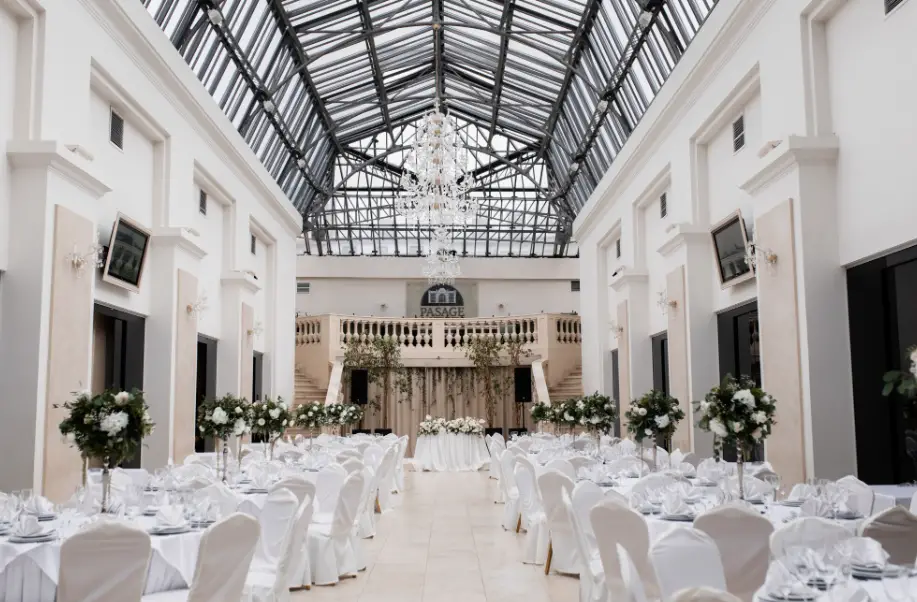
The air in the bridal suite of The Plaza Hotel tasted like expensive hairspray, wilting white roses, and something I could not yet name but would soon recognize as the last morning of my old life.
I stood before the floor-to-ceiling mirror in a hundred thousand dollars of custom Vera Wang, watching a stranger stare back at me. The gown was a masterpiece of silk and heirloom lace. The diamonds at my throat felt less like jewelry and more like a beautifully crafted guillotine.
This is duty, I reminded myself. This is what you were bred for, Eleanor.
Carter Harrington was waiting downstairs. Or supposed to be. Carter was the golden boy of Manhattan’s oldest money, a man whose bloodline was as pristine as his empty, smiling eyes. The memory of our rehearsal dinner swam sickening to the front of my mind. I had leaned close to him and whispered a suggestion about restructuring our joint trust fund to mitigate incoming capital gains taxes. Carter had not even looked at me. He had picked an invisible piece of lint off his tuxedo lapel, patted my hand condescendingly, and said, “Let the men handle the math, Ellie. You just focus on looking pretty for the cameras.”
I had swallowed the bile and swallowed the insult and swallowed my pride. Our marriage was not a romance. It was a corporate merger dressed in peonies and champagne. My family’s empire, Sterling Global, needed the Harrington liquid capital. His family needed our political leverage. Four hundred elite guests sat in the grand ballroom below, senators and Wall Street titans and media moguls, their collective net worth rivaling the GDP of a small nation, waiting for the spectacle of our union to begin.
The antique grandfather clock chimed. Ten minutes to the wedding march.
My phone vibrated on the marble vanity.
Ten characters. That was all it was. Ten characters that stopped the breath in my lungs and the blood in my veins.
FOUND SOMEONE BETTER. DON’T WAIT UP.
The room began to spin. A high-pitched ringing filled my ears. I read it again. A text message. He had ended a generational alliance with a text message while four hundred people waited downstairs. The phone slipped from my fingers and met the marble floor in slow motion, the screen shattering into a web of fractured glass. I collapsed to my knees in yards of white silk.
Before the first sob could tear its way out of my throat, a heavy knock echoed on the mahogany door.
I could not speak. I could not move. I waited for my mother, or my maid of honor, someone who belonged in this moment. Instead, the door was pushed open by a polished Italian leather shoe, and a tall, imposing figure stepped into the suite and looked down at my crumpled form.
A low, unfamiliar voice said, “Well. Isn’t this a tragic waste of premium champagne.”
I blinked through the stinging tears. The man standing above me was Julian Vance.
At thirty, Julian was a self-made tech billionaire and the sworn corporate rival of my father, the wolf pacing at the borders of our old-money territory. He despised the Harringtons and the Sterlings with equal measure. His dark eyes were sharp and calculating and entirely devoid of the pity I expected to see. He wore a Tom Ford suit that looked like armor and carried an aura of dangerous, kinetic energy.
He knelt, entirely unconcerned that the dusty marble floor was scuffing his trousers. He did not offer a tissue. He did not offer comforting platitudes. He held out his hand.
“He’s a fool,” Julian said, his voice a low steady rumble that commanded absolute attention. “If you walk out there alone right now, you are the jilted bride. You will be a weeping victim for the tabloids by midnight, and Sterling Global’s stock will hemorrhage at the opening bell.”
I stared at him. He knows. How does he know?
“Marry me instead,” Julian said. The words hung in the air, heavy and lethal. “Right now. I will hand you the sword to make sure Carter Harrington regrets this for the rest of his pathetic life.”
I looked at my shattered phone on the floor, still dimly glowing with my humiliation. Then I looked at Julian’s outstretched hand. I thought of Carter, likely laughing somewhere, leaving me to face the media slaughter alone. A strange terrifying heat bloomed in my chest, burning away the icy paralysis of grief.
Weeping would destroy my family. Striking back? Striking back with the devil himself? That would make me something else entirely.
The terrified, obedient girl incinerated in a sudden violent spark of cold clarity. I placed my gloved hand firmly in his.
“Make him bleed,” I whispered.
Julian’s lips curved into a dangerous predatory smile. “Every last drop.”
Ten minutes later, the grand ballroom doors swung open. The string quartet swelled into the wedding march. The crowd rose to their feet.
Carter, I quickly realized, had not left the hotel. He had slipped into the back row by the exit doors, wanting to watch my public breakdown when the announcement came. Instead, he watched in absolute horror as I glided down the aisle, head held high, clutching the arm of his family’s greatest enemy.
The collective gasp from four hundred people sucked the oxygen from the room. Carter’s jaw went slack. The smug satisfaction melted off his face and was replaced by pale sickly terror. His phone slipped from his fingers, clattering against the wooden pew just as a thousand camera flashes ignited the room, capturing his devastation and my absolute composure.
I did not look back.
We reached the altar. The priest stumbled through the vows, sweating and visibly terrified by the sudden swap of groom. We said I do in a haze of adrenaline and flashing bulbs.
As Julian pulled me in for our first public sealing kiss, his grip tightened possessively on my waist, and against my lips he whispered, “Phase one is complete, Mrs. Vance. Now prepare yourself, because the woman Carter left you for is your younger sister.”
The fallout was apocalyptic.
The Vance-Sterling alliance sent immediate violent shockwaves through Wall Street. By Monday morning, Harrington Enterprises stock had plummeted fifteen percent. The market hated instability, and the sudden alliance of two rival titans against the Harrington legacy was blood in the water.
Carter launched a desperate PR counter-offensive. He leaked stories to the tabloids painting me as a manipulative schemer who had been conducting an illicit affair with Julian for months. He paraded my sister Chloe in front of cameras, positioning himself as a tragic romantic who had simply followed his heart away from a cold, calculating fiancée.
It hurt. The betrayal of my own blood cut deeper than Carter’s cowardice ever had. But I did not have time to bleed. I had an empire to dismantle.
Late at night in the glass-walled penthouse overlooking the glittering grid of Manhattan, the real work began. Julian taught me how to read the hidden narratives in corporate ledgers, how to uncover buried assets, how to use negotiation tactics that bordered on psychological warfare. Our relationship remained strictly transactional, a partnership built on mutual benefit, but it was laced with an undeniable simmering tension. Two predators sharing a cage, circling each other with cautious respect.
“He’s moving funds offshore to the Cayman accounts,” Julian noted one evening, leaning against the edge of the glass desk, swirling a glass of scotch. “He’s panicking. Thinks he’s hiding the liquid cash from his father before the board demands an audit.”
I leaned closer to the screen, tracing the complex web of shell corporations Julian’s software had uncovered.
“He’s arrogant,” I murmured. “He’s using the same encrypted routing numbers he used to buy my engagement ring. He thought I never noticed the offshore wires.”
I brought up a shadow ledger Julian had legally acquired through a proxy firm.
“I don’t just want to trace it,” I said. “I want to freeze it. All of it. I know the debt covenants on the Harrington estate. If his personal liquid assets drop below fifty million, it triggers a default on their prime real estate holdings.”
Julian watched me with an expression I had never seen on his face before. Something close to profound, terrifying admiration.
“Do it,” he said.
I clicked Execute, initiating a cascade of proxy transfers and legal injunctions that would effectively freeze and bankrupt Carter’s personal liquid assets by sunrise.
What neither of us knew, in the blue glow of those monitors, was that across the city Carter was sitting in a dim parking garage, frantically handing a thick manila folder to a corrupt federal prosecutor. Inside the folder were meticulously forged documents that perfectly framed Julian Vance for international corporate espionage and treason.
The Metropolitan Museum of Art was a battlefield draped in haute couture.
Julian and I arrived at the Met Gala not as guests but as conquering royalty. I wore a crimson silk gown that pooled around my feet like fresh blood, a diamond choker resting against my collarbone like armor. When we stepped onto the carpet, the paparazzi lost their composure entirely. We were the undisputed story of the city.
Inside the Temple of Dendur, surrounded by ancient Egyptian stone and a sea of glittering socialites, Carter finally made his move. He looked haggard, driven to the edge by his frozen assets and his rapidly evaporating social standing. He marched toward us flanked by a man I recognized: Prosecutor Miller, a federal attack dog with a reputation for creative ethics.
Carter stopped inches from Julian and threw a stack of folded papers at his chest. They fluttered to the marble floor like dead leaves.
“You’re done, Vance,” Carter said, his voice cracking, loud enough for nearby senators and fashion icons to hear clearly. “The FBI is waiting outside. That’s an indictment for corporate espionage.”
He turned to me, and the condescension was so familiar it was almost comforting.
“Come back to me now, Ellie. Leave him. Beg for my forgiveness right here, and I might just save your family’s name.”
I did not flinch. I did not look at Julian. I simply stepped forward, planting my heels onto the indictment papers on the floor.
“Carter,” I said, my voice carrying an icy devastating calm that echoed off the ancient stones. “You really should have paid attention when I tried to talk to you about high-level finance.”
He blinked, confused by my absence of panic.
“Through three proxy shell companies,” I continued, projecting my voice so the surrounding crowd caught every word, “I bought the debt on your family’s estate in the Hamptons. I own the Cayman accounts you tried to hide from your father’s auditors. You are entirely, irrevocably bankrupt.”
Carter swallowed hard. “You’re lying. The FBI—”
“And as for the prosecutor,” I said, gesturing toward Miller, who had gone the color of old paper, “Julian bought the mortgage on his private residence yesterday morning. The FBI is not here for Julian, darling.” I leaned in close, so only Carter could hear the final words. “They are here for your father’s embezzlement. The ledgers were delivered to the Bureau an hour ago.”
The triumphant sneer left Carter’s face so completely it was as though it had never existed. He looked past me, his eyes widening in primal terror as two federal agents stepped out from the shadows of the sphinx statues, badges gleaming in the dim light.
Carter screamed obscenities as the agents closed in, snapping handcuffs on his wrists. He thrashed and cried out as they dragged him through the crowd of flashing cameras and horrified onlookers. The Harrington legacy died on that marble floor.
I turned to Julian, expecting a shared moment of triumph. But Julian had gone completely rigid. His jaw was clenched tight. He was staring over my shoulder.
I followed his gaze.
My father stood by a pillar, swirling a glass of champagne, watching us. He didn’t look angry or shocked. He slowly raised his glass in a mocking, sinister toast, and mouthed two clear words across the room.
Checkmate, son.
The storm hit Manhattan that night with a vengeance, rain lashing against the penthouse windows.
Carter’s ruin was absolute. The news networks ran continuous coverage of the Harrington collapse. His father was in custody. Carter was facing trial, penniless and disowned. We had won the war.
But in the quiet aftermath, as the adrenaline faded, a hollow exhaustion took its place. The revenge was over. Now I was left to navigate the reality of this sprawling penthouse and my fake marriage to a man I barely knew and yet intimately understood.
I found Julian in the dark of his private study, the only light the amber glow of the city filtering through the rain-streaked glass. He wasn’t working. He was sitting in his leather armchair, staring at something in his hands.
As I approached, I saw what it was.
A crumpled, yellowed newspaper clipping from ten years ago. A small local article featuring a picture of a much younger version of me, smiling fiercely as I held a collegiate debate championship trophy.
He hadn’t noticed me only at the wedding. He had been watching me for a decade. He had seen the brilliance Carter had tried to smother. He had been waiting for me to break free.
Julian looked up. His dark eyes held a vulnerability I had never seen on him before. The ruthless billionaire persona was gone, stripped away by the shadows.
“The contract is fulfilled, Eleanor,” he said quietly. “Carter is destroyed. You have your empire back. You are free to walk out that door with no strings attached. The lawyers can have the annulment ready by noon.”
I looked at him. This man who had weaponized my pain and taught me to be ruthless but had also, for the first time in my life, demanded that I use my own mind. I didn’t need him to define my power. I had my own now. But as I looked at the newspaper clipping in his hand, I understood something profound.
I walked toward him and gently took the delicate ancient paper from his hands. I set it on the desk and leaned down, resting my forehead against his.
“I spent my whole life being told where to walk, what to wear, and who to smile at,” I murmured. “For the first time in my life, I am exactly where I want to be.”
He opened his eyes. The fierce intensity returned, but this time it was laced with raw, unadulterated devotion. He pulled me into his lap, and our lips met in a kiss entirely devoid of strategy or cameras or PR spin. Two guarded souls finally dropping their weapons.
Then the private secure server across the room erupted in a blaring, rhythmic alarm.
Julian pulled back. “That’s a level-one breach alert.”
He crossed to the glowing terminal and typed a frantic string of commands, decrypting an incoming message flagged from the Swiss banking investigative unit we had hired months earlier.
Text scrolled across the black screen in bright green letters, and my blood ran ice cold as I read it.
URGENT. FORENSIC ANALYSIS COMPLETE. CARTER HARRINGTON WAS NOT THE AUTHOR OF THE WEDDING DAY TEXT MESSAGE. PACKETS INTERCEPTED. IP ADDRESS TRACED BACK TO THIS EXACT TERMINAL.
The silence in the study was deafening.
Julian turned slowly from the screen to face me.
“You played me,” I whispered. My voice didn’t sound like my own. “You orchestrated my destruction.”
Julian stood tall. He didn’t cower. He didn’t offer frantic apologies. He offered only the brutal, terrifying truth.
“I orchestrated your liberation, Eleanor,” he said, his voice steady. “Carter was going to leave you. He was already sleeping with your sister. But he wasn’t going to do it at the altar. He was going to marry you, secure the Sterling capital, and then bleed you dry for decades behind closed doors. I merely accelerated the timeline.”
“You hacked his phone,” I said, stepping back. “You sent that message to humiliate me in front of four hundred people so you could swoop in and play god.”
“I forced you to wake up,” Julian countered, stepping toward me, his eyes blazing. “I couldn’t stand by and watch you shrink yourself to fit that gilded cage for one more day. Yes, I burned down your prison. But I gave you the matches to build a throne.”
I stared at him.
The fury was white-hot, burning through my veins. But right beneath it, darker and more profound, was a realization I could not push away. He was right. Carter would have destroyed my soul slowly, over years of polite society dinners and silent betrayals. Julian had inflicted one singular agonizing wound to save the limb. He was a monster.
But looking at him, looking at the man who had treated me as an equal, a strategist, a weapon worth building, I realized I had become a monster too.
Two years later.
The mahogany boardroom table stretched out before me, polished and long, an expanse of absolute authority. I sat at the head of it, a fountain pen poised over heavy legal documents. To my right sat Julian, my partner, my husband, my equal.
I signed my name. Eleanor Vance. Finalizing the hostile takeover of the last remaining Harrington subsidiary.
A smattering of applause broke from the board members. Carter was currently serving year two of a federal sentence. Chloe was a forgotten socialite in disgraced exile in Europe.
We ruled the city.
As the board members filed out, I stood and walked to the floor-to-ceiling windows, looking out over the sprawling grey skyline. Julian came up behind me, wrapping his arms around my waist, pressing a soft kiss to my temple.
“What’s our next target, Mrs. Vance?” he murmured against my skin.
My eyes locked onto a distant gleaming skyscraper across the financial district. The headquarters of Sterling Global. The company belonging to my own treacherous father, the man who had raised his champagne glass to Julian’s supposed downfall at the Gala, the man who had always viewed me as a bargaining chip and never once thought I would remember.
“We clean house,” I replied, my voice chillingly calm against the glass. “Starting with the man who taught me how to betray.”
Julian’s grip tightened around my waist, pulling me flush against his chest. He buried his face into the curve of my neck, and I closed my eyes, letting the cold glass cool my forehead while the steady grounding thrum of his heartbeat warmed my spine.
He gently turned me around, forcing me to look away from our conquered city and up at him. His dark eyes, usually so calculating and guarded against the rest of the world, had softened entirely. In the quiet emptiness of the boardroom there were no corporate masterminds, no monsters. Just a man who had waited ten years in the shadows for a girl in a gilded cage to finally break free.
He reached up, his thumb tracing the line of my jaw with a tenderness that made my chest ache.
“But even if it all burns tomorrow,” he murmured, his voice thick with a raw vulnerability he saved only for me, “even if they strip us of every dollar, every board seat, every piece of this skyline. As long as you are standing in the ashes with me, I have everything.”
I reached up, my hands framing his face. The hunger for vengeance faded, replaced by something overwhelming and entirely different. I did not need to conquer the world to prove my worth anymore. I already held my entire world right here.
I pulled him down, meeting his lips in a slow deep kiss that tasted of absolute devotion.
I had walked into that bridal suite as an obedient daughter in a gilded cage. I had walked out as something else entirely. Something forged in humiliation and fire and the cold clear air of the morning after everything burns down.
They had all underestimated me. Carter, who told me to focus on looking pretty. My father, who had traded me like a commodity. Every man who had ever patted my hand and looked away while I tried to speak.
They had given me the matches, thinking I would light candles.
I had burned the house down instead.
And built something magnificent in the ashes.

Specialty: Emotional Turning Points
Rachel Monroe writes character-driven stories about betrayal, second chances, and unexpected resilience. Her work highlights the emotional side of family conflict — the silences, the misunderstandings, and the moments when someone quietly decides they’ve had enough.