I knew something was wrong before I could name it. That’s the part that still gets me when I think back on it. I pulled into my driveway after a long weekend in Tennessee, the kind of drive where you’re tired enough that your body is on autopilot but your mind is still somewhere on the highway, and something about the light stopped me cold. Not a noise, not a sign, just the light. Too much of it, coming from the wrong direction, hitting the side of the house in a way it never had in eight years.
I sat in the truck for a moment with the engine off, just looking. The porch was the same. The gravel drive was the same. The mailbox was still leaning at the same slightly embarrassing angle I kept meaning to fix. Everything looked exactly as I’d left it on Friday morning. And yet something was wrong. The kind of wrong that lives in your peripheral vision and refuses to be ignored.
I got out and walked around the side of the house.
The shade was gone.
That was the first coherent thought I had. The cool, dappled shade that blanketed my back lawn from mid-morning until late afternoon, that particular quality of light filtered through oak canopy that made the yard feel like a separate world from everything beyond it, just gone. Replaced by open, flat, indifferent sunlight pouring in from where the trees had been.
And then I saw the stumps.
Four of them. Cut clean and low to the ground, the exposed wood still pale, almost white, the way fresh cuts look before weather and time start to close them over. I walked toward them slowly, the way you approach something you already understand but aren’t ready to confirm. I crouched down next to the nearest one and put my hand on it. Still faintly damp. Sawdust in the grass around the edges.
I planted two of those trees myself, the year I bought the house. The others had been there far longer than I had, oaks that had probably stood through decades of North Carolina weather, through ice storms and drought years and the slow creeping development that kept pushing further and further out from Asheville. I used to lie in a hammock under those trees on summer afternoons with a book I wasn’t really reading, just listening to the wind move through the upper branches. People talk about a house feeling like home. For me, it was those trees that did it.
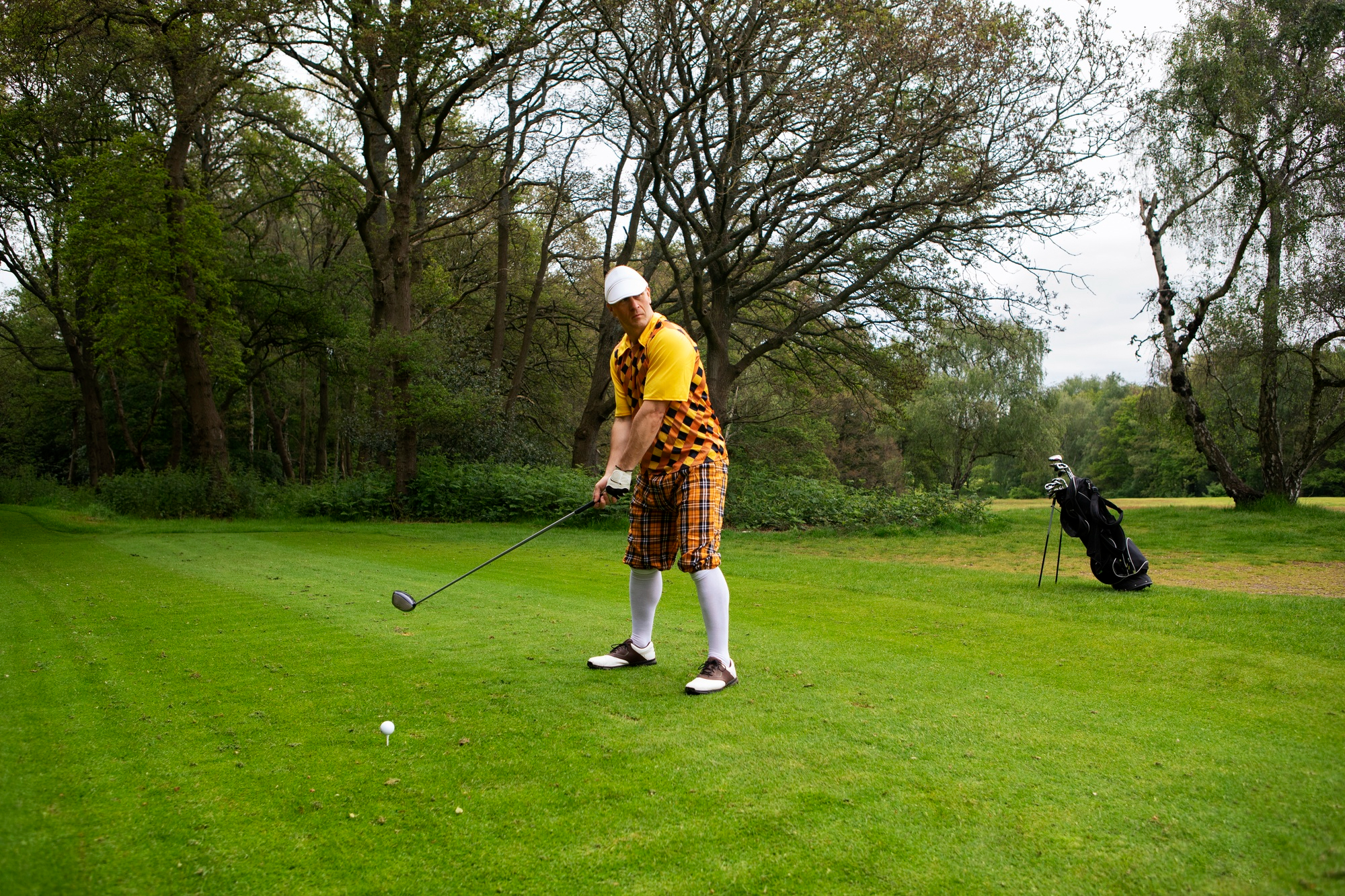
Now I was looking at what was left of them, four pale stumps, cut with a precision that made the whole thing feel even more deliberate, and through the gap they left behind I could see straight across the back of my property and onto the golf course. Clear as a window someone had opened without asking. And right there, maybe forty yards out, freshly constructed and perfectly level, was a brand new tee box. Raised just enough to give a direct line of sight down the fairway. Which, as I now understood, had previously been obscured by four oak trees that someone had decided to remove.
I walked down to the edge of the property. Two maintenance workers were near a cart path, doing whatever maintenance workers do in that unhurried way that makes everything look routine.
I called out to them. Asked who had authorized the tree removal.
One of them shrugged. Said they’d been told to clear overgrowth along the boundary.
I told him those weren’t overgrowth. Those were my trees, on my property.
Another shrug. We just follow orders.
I walked back to the house and stood in the kitchen for a while, not doing anything in particular. Then I went to the junk drawer, the old one at the back of the counter where I keep things I never look at and can never throw away, and pulled out the property survey from when I bought the place. I spread it out on the table and traced the boundary line with my finger, following it slowly from one corner to the other.
The stumps weren’t near the property line.
They were a solid six feet inside it.
I folded the survey back up and set it on the counter and stood there in the kitchen with the late afternoon light coming in from the wrong direction, and I felt something settle in my chest. Not rage, not panic. Something quieter and colder than either of those. The feeling of understanding exactly what had happened and exactly what it meant.
They hadn’t made a mistake. They had made a decision. And the decision was based on a calculation: that I was the kind of person who would let it go.
I didn’t sleep much that night.
The next morning I called Pete Holloway, a surveyor whose name I found through a local listing. He had one of those voices that belongs to a person who has spent more time outside than most people spend awake, gravelly and unhurried, the kind of voice that implies competence without trying to. When I described the situation, there was a pause on the line, then a low sound somewhere between a laugh and a sigh.
“Let me guess,” he said. “Developer came in and started moving lines that weren’t theirs to move.”
Something like that, I told him.
“Seen it before,” he said. “I’ll be out tomorrow.”
He arrived just after sunrise in a truck that looked like it had survived several different eras and hadn’t yet decided to stop. No small talk, no pleasantries. Just a nod, a grab of his equipment, and straight to work. I followed him out back and watched him move across the property with the slow, methodical focus of someone conducting a physical argument with the ground. Setting markers, checking angles, cross-referencing the old survey with his own measurements. He muttered occasionally, small sounds that seemed directed at the land itself rather than at me.
After about an hour, he straightened up, wiped his hands on his jeans, and looked at me.
“You’re not crazy,” he said. “Good to know.”
He pointed toward the stumps. “Every single one of those was at least six feet inside your boundary. Not even close to the line.”
Six feet.
“That’s not a mistake,” I said.
Pete gave me the look of a man who has seen enough of people’s choices to have stopped being surprised by them. “No,” he said. “That’s someone thinking they won’t get called on it.”
He planted bright orange survey markers along the actual property line. Clear, physical, impossible to explain away. Then he handed me a copy of the updated survey and told me that if this was going where he thought it was going, I was going to want documentation. I told him I was already planning on it. He nodded once, climbed back into his truck, and left without further ceremony.
I spent the next couple of hours photographing everything. The stumps. The markers. The measured distance between them. Wide shots, close-ups, angles from multiple directions. I documented it the way you document something you know is going to matter later, not because anyone told me to, but because I understood, standing there in my own backyard looking at the evidence of what someone had done, that being right was only half the battle. The other half was making sure that being right meant something.
But after the photographs, after the survey copy was slid into a folder on the kitchen counter, I did something that turned out to be the most important part of all of it. I sat down at my kitchen table with a cup of coffee and started looking through public records. Permits, zoning filings, county planning documents, the kind of paperwork that most people never voluntarily read and that tends to sit unexamined in public databases, enormous and boring and occasionally devastating.
The development group had needed special county approval for the new tee box. Not because of the structure itself, which was straightforward enough, but because raising the elevation in that area altered the drainage pattern of the course, and the county takes runoff seriously in ways that developers sometimes forget until it becomes their problem. The approval had been granted conditionally.
One line, buried inside the permit language: Existing tree buffers adjacent to residential properties must be maintained to preserve safety and visual separation.
I read it three times.
Then I sat back in my chair and felt something I hadn’t felt since I pulled into my driveway and saw the light was wrong. The particular satisfaction of understanding that the situation was not at all what the other side thought it was.
This was no longer just about my trees.
This was about their entire project.
I filed a complaint with the county planning department that same afternoon. I kept it clean and factual. Property line confirmed by licensed surveyor. Trees removed without permission or notification. Permit condition specifically requiring maintenance of tree buffers demonstrably violated. I attached the photographs, the updated survey, the permit language, and Pete’s report, and I submitted it without embellishment, without drama, without asking for anything beyond an official review.
Then I waited.
Five days later, a white county truck pulled up in front of the house. Two inspectors stepped out: a younger one with a clipboard and the efficient posture of someone new enough to still take this seriously, and an older one who moved at a different pace entirely, slower, more considered, looking at everything with the unhurried attention of a person who has seen every trick in the book and stopped being fooled by most of them.
I walked them through it. The survey markers, the stumps, the photographs, the measurements. They checked everything themselves, quiet and professional, not offering much in the way of commentary. The older inspector crouched near one of the stumps and ran his hand across the cut surface with what I can only describe as a clinical kind of sadness.
“These were healthy,” he said.
“Yeah,” I told him. “They were.”
We walked over to the tee box together. Standing at that elevation and looking back toward my property, the problem was even more obvious than I had anticipated. Without the tree buffer, there was nothing between the new teeing ground and my backyard. No separation, no protection. A sliced shot or a pulled drive could travel well inside my property line without any impediment.
The younger inspector pointed down the line of play. “From here, a bad shot carries right over into that property.”
“Yes,” I said. “Which is exactly why that buffer requirement exists.”
The older one just sighed. The particular sigh of a person who has seen this particular situation before and knows how it ends.
They left without much more than that. But two days later, a notice appeared on the newly built tee box. Stop Use Order. Until further notice, the structure was not to be used pending investigation of permit compliance.
Brand new construction, tens of thousands of dollars in planning and materials, shut down before a single round had been played from it.
I will admit that I walked out that evening just to look at it. The notice bright against the clean wood of the structure. Golfers gathering nearby with the confused, frustrated energy of people who have paid for a premium experience and are not receiving it. Staff answering questions with the specific discomfort of people who have no good answers. And in the middle of all of it, silent and still and completely unusable, the tee box that had cost my trees.
I went back inside and made dinner.
The knock came two days later. I already knew who it was. Daniel Cross stood on my porch, looking almost exactly as he had the first time except that the smile was different now. Still present, still polished, but tighter around the edges, more controlled, like something being held carefully because he knew it could drop.
He said there had been a miscommunication with the landscaping crew.
I told him there hadn’t been.
He said they believed the trees were part of the boundary buffer, implying some ambiguity about ownership.
I told him they were on my side of the boundary. Six feet inside it, to be precise. Which he knew, or should have known, or deliberately chose not to verify before sending a crew out there with chainsaws.
He shifted gears. Offered to plant new trees along the fence line. Fast-growing species, he said. Would restore the look quickly.
I laughed. Not loudly, not cruelly. Just enough to convey that we both understood what he was actually proposing.
“You cut down thirty-year-old oaks,” I said, “and you want to replace them with saplings.”
He started to say something about growth rates.
“They’ll be mature in about twenty years,” I said. “Meanwhile your tee box stays closed.”
I watched that land. Watched his eyes make the quick calculation that every practical person makes when they realize the script they prepared is not going to work on the person in front of them.
I stepped inside for a moment and came back with a folder. Professional, organized, itemized. Inside was an estimate I had requested from a landscaping company that specialized in large-scale tree transplantation. Mature oaks, transplanted with reinforced root systems and immediate canopy coverage. Not saplings. Not the visual suggestion of trees. Actual trees, substantial enough to restore the buffer as it had existed before his crew removed it.
There was a second section in the folder as well. A quote for a high-tension protective net system to be installed along the course-facing side of my property. Tall, anchored, effective. The kind of barrier that stops golf balls from landing in residential yards.
Daniel flipped through the pages slowly. The number at the bottom was not a small one.
“This isn’t cheap,” he said.
“Neither is a closed tee box,” I replied.
He looked up at me with an expression that had finally dropped the performance entirely. Just a person looking at another person, understanding that the situation was not what he had assumed it would be when he walked up the porch steps.
We stood there for a quiet moment and then, almost as though the property itself had a sense of timing, we both heard it. A sharp crack from somewhere down the fairway, and a golf ball sailed wide, bounced once on the dry grass, and rolled to a stop about ten feet from my back steps. Neither of us said anything for a moment.
I looked at him. “Still think the netting is excessive?”
He watched the ball settle. “No,” he said quietly. “That’s not ideal.”
He asked what happened if they declined the proposal. I stepped off the porch and walked him out to Pete’s orange markers, still standing bright along the property line. I told him I would build a barrier fence. Steel posts, reinforced mesh, twenty feet tall, entirely within my property line, directly in the line of sight from the new tee box. Completely within my legal rights given that a neighboring property was now demonstrably creating a safety hazard.
I could see him building the picture in his head. Not just the cost of it, but the image. A massive utilitarian barrier fence running along the edge of a newly renovated premium golf course, visible to every member, every guest, every potential investor who ever stood on that tee. The story it would tell without saying a word.
He stood there for a long moment. The afternoon was quiet around us. Somewhere behind him the empty tee box sat with its stop order notice. Somewhere to my right, that golf ball rested in my grass.
“All right,” he said finally.
Just that. No negotiation, no counter-proposal, no renewed attempt to minimize what had happened. Just a quiet acknowledgment that the situation was what it was, and that the path forward was the one I had outlined.
We shook hands. It was a different handshake from the first one. No performance in it this time.
Three days later I had the agreement in writing, signed, detailing every element of the plan. The mature tree transplants. The root system reinforcement. The irrigation support. The netting installation along the course-facing boundary. All of it, on the timeline I had specified, at their expense.
Watching a mature tree transplant is an experience that makes you reconsider the scale of things. These are not landscaping operations. They involve cranes, root balls the size of compact cars, teams of specialists working with the kind of deliberate coordination you associate with surgical procedures. Each tree has to be excavated carefully to preserve as much of the root structure as possible, wrapped, transported, set into a prepared hole with exactly the right soil composition and drainage, then supported and irrigated while it adjusts to its new ground.
I watched from the porch. Not to gloat, or not entirely. Mostly because there was something in it that I needed to see. Something about watching those trees go back into the ground, one by one, that felt necessary. They weren’t the same trees. Nothing could replace what had been there, decades of growth, the particular way those branches moved in a specific wind. But they were substantial, immediately present, real. The shade came back sooner than I expected.
The netting went up along the course side at the same time, nearly invisible from a distance but perfectly functional. A boundary that didn’t need to announce itself to do its job.
A couple of weeks after the work was completed, the county inspectors returned. Checked the buffer compliance, the safety measures, all of it. The stop order was lifted. The tee box opened. Golfers came back and play resumed and life on the other side of my back fence returned to whatever normal looks like on a premium golf course.
My normal changed too, but in smaller, quieter ways.
I started spending more time in the backyard again. Early mornings with coffee, the light coming through leaves at the angle I remembered, that dappled, moving quality that makes you feel like you’re somewhere slightly apart from the rest of the world. I hung the hammock back up. Started reading out there again in the afternoons, or pretending to read while I listened to the wind in the branches.
The tee box was visible through the netting when I looked for it, but I stopped looking for it. It belonged to its side of the boundary. My yard belonged to mine.
What I think about now, when I think about all of it, is not the legal process or the county permit or the back-and-forth with Daniel Cross on my porch. Those were just mechanics. What I think about is that first evening, standing in front of the stumps with the survey map on the table behind me, understanding that someone had looked at my trees and at me and had decided that neither of us were worth the trouble of asking.
That calculation is common. It happens in small ways and large ones, all the time, in every kind of dispute between people who have something and people who want what they have. The assumption is almost never that you are powerful or well-connected or litigious. The assumption is simpler than that. It is that you probably will not bother. That the friction of pushing back will be greater than the loss of whatever they took, and so you will absorb it, call it a bad experience, maybe complain to someone who will nod sympathetically, and move on.
What they miscalculate, almost every time, is the difference between someone who is quiet and someone who is passive. Those are not the same thing, and the confusion between them is expensive.
I did not sue them. I want to be honest about that and about the fact that I still think about whether I should have. The legal case was genuinely there. Trespass, destruction of property, violation of permit conditions. I could have pursued damages. There were people who told me I was leaving money on the table by settling for restoration.
Maybe they were right. But what I wanted was not money. What I wanted was my yard back. I wanted the shade back and the privacy back and the sense of that space being mine in the way it had been before someone decided their sight line was more important than my property line. I got those things. The trees are in the ground, growing. The boundary is what it should be. The problem they created is corrected.
And they know now, which is its own kind of outcome. Daniel Cross knows. The development company knows. Whatever crews and managers and site supervisors were involved in the decision to send that landscaping team onto my property without so much as a phone call, they know that the quiet guy on the back end of the course boundary looked into the permit and filed the complaint and hired the surveyor and sat at his kitchen table long enough to understand exactly what leverage he had. They will be more careful now. Maybe not everywhere, maybe not with everyone, but with properties like mine, backed up against their projects, owned by people they have already learned to underestimate. They will be more careful.
The oaks are doing well. Transplanted trees take a few years to fully settle, to stop spending all their energy on the stress of relocation and start growing again in earnest, but they are healthy. The root systems are established. By next summer, the canopy will be substantially fuller. In five years, you will not be able to tell they were not always there.
I still don’t golf. Still keep odd hours. Still like my quiet. Some mornings I sit on the back porch before the rest of the neighborhood is awake and I listen to the wind in those leaves, that sound that had always reminded me of something oceanic, something that moves with a logic older than anything we build, and I think about what it would have cost me to say nothing.
Not in money. In something harder to quantify. The daily experience of sitting in a yard that felt compromised, exposed, changed by someone else’s decision without your knowledge or consent. The accumulated weight of that. The way it would have sat in the back of every morning out there, a low, persistent awareness that the place was not entirely yours anymore.
That was the thing they almost took that mattered most. Not the trees themselves, though I loved those trees. The sense that the boundary was real and that I was the one who decided what happened inside it.
I have that back now.
The survey markers are gone, pulled after the work was completed and no longer needed. But I know where the line is. I always did. And now, so do they.

Specialty: Emotional Turning Points
Rachel Monroe writes character-driven stories about betrayal, second chances, and unexpected resilience. Her work highlights the emotional side of family conflict — the silences, the misunderstandings, and the moments when someone quietly decides they’ve had enough.