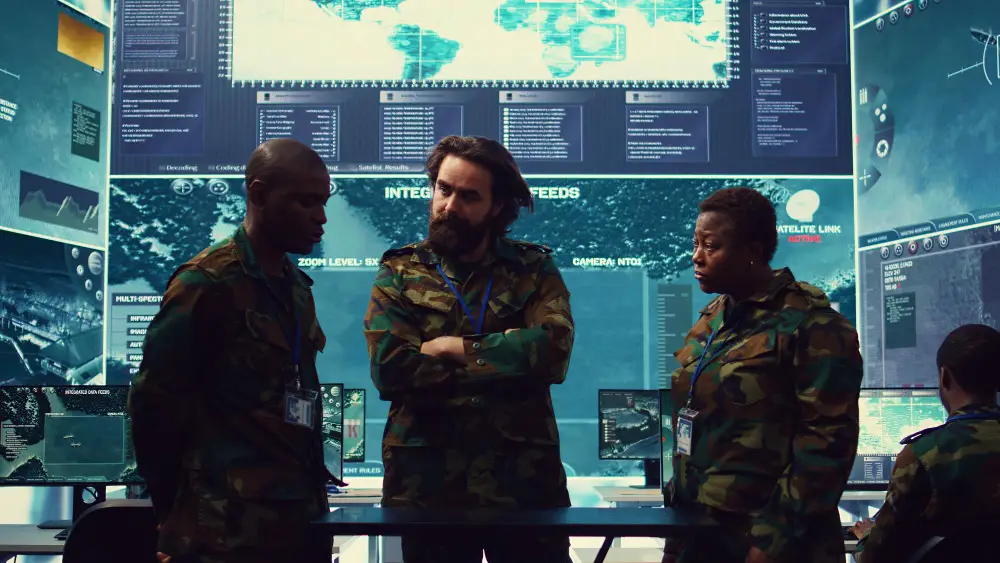
The briefing room at MacDill Air Force Base smelled the way all briefing rooms smelled: burnt coffee, industrial floor wax, and the particular metallic chill of air conditioning pushed past the point of comfort into the territory of institutional assertion. Cold rooms made people alert. Alert people made fewer mistakes. The logic was sound and the effect was real and I had sat in enough of these rooms to have stopped noticing the cold years ago.
I sat in seat Z14, back row, spine straight against the hard plastic, hair in a regulation bun tight enough to pull at my temples. I had chosen the back row deliberately and I had chosen it for the same reason I chose most things, which was that the back row was where you could see everything without being seen. Two hundred senior officers occupied the rows in front of me, their ranks increasing as you moved toward the stage, the careful stratification of institutional power made visible through seating.
In the front row, under the full weight of the fluorescent lights, my father held court.
General Arthur Neves was sixty years old and wore his years the way he wore his uniform, with aggressive precision, as if time itself were a subordinate that had been told to make him look good and had obeyed. His silver hair was cut high and tight. His skin was tanned from weekends on golf courses with senators. He was laughing at something a lieutenant colonel had said, the laugh large and carrying, designed to establish the radius of his social gravity.
The officers nearest him laughed along. They always did. It was not that he was funny. It was that he was a three-star general and their careers existed within his orbital range.
I looked at my hands. They were steady. They had to be.
I had learned a long time ago that steadiness was not the absence of feeling but the containment of it, the channeling of whatever was running through you into something that did not show. It was a skill I had developed not in any military program but at the dinner table, across the same mahogany surface where my father had once looked at my Air Force acceptance letter and asked if I meant nursing.
The atmosphere in the room changed before anyone said anything.
It was a pressure shift, not a sound. The heavy double doors at the back opened with controlled force, not the usual bureaucratic creak but the deliberate movement of someone who understood that how you enter a room is itself a form of communication. The chatter died. Even my father’s laugh got caught in his throat.
A man walked down the center aisle.
Navy working uniform in a sea of Air Force blue. A silver eagle on his collar. On his chest, the trident of a Navy SEAL. Colonel Marcus Hail moved without acknowledging the two hundred heads turning to follow him, which was itself a kind of power, the power of a person who does not need the room’s attention because he already has its respect.
He stopped ten feet from the stage and addressed my father directly.
“General Neves. I need a Tier-One asset. Immediate deployment. I was told the asset is in this room.”
My father recovered quickly, the way practiced performers recover, with a smile and a posture adjustment and the slight rearrangement of features that signals benevolent authority reasserting itself after a momentary displacement.
“We have plenty of operators here, Colonel. Take your pick.”
“I don’t need an operator,” Hail said. “I need a ghost. Top Secret, SCI, sniper qualified, deep reconnaissance capability.”
The room went quiet in a different way. Top Secret SCI was not merely high clearance. It was a category of clearance that most of the people in that room had never encountered in person, the kind that appeared in briefings only when other people left the room first.
Hail’s eyes moved through the space methodically, the way a trained observer scans terrain, not searching exactly but processing, and when they reached the back row they stopped.
My heart was hitting my ribs with more force than usual.
I stood up.
The scrape of my chair carried through the silence like a crack of sound. Two hundred faces shifted from the stage to the back row, to me, to this major in seat Z14 who had been invisible until the moment she chose not to be.
My father looked at me.
The benevolent general was gone. The man who replaced him was one I had known my entire life, the one whose approval I had been attempting to earn since I was old enough to understand that earning it was possible in theory and that the theory had never yet been proven in practice.
“Sit down,” he said.
Not a question. Not a request. The voice he used when he had decided something and the deciding was the end of the matter.
“Major Neves,” he continued, addressing the room rather than me, offering the surrounding officers a tight apologetic smile, the smile of a man whose subordinate has misbehaved publicly and who is now restoring order as evidence of his management competence. “My daughter. She works in logistics. Administration. Supply chain coordination.” He let the laugh arrive naturally, just enough of it. “She has a tendency to overstate her importance.”
The release of tension in the room was almost audible. Someone near me whispered admin and laughed. Another voice said that’s rich, the same phrase my father had used thirty seconds earlier about something else, borrowed without knowing it.
“Sit down, Lucia,” he said, dropping into the register that was only for me, the family register, the one that had been telling me where I stood for thirty-three years. “You are a zero in this equation. Don’t make me ashamed of you. Not here.”
I stood there for three seconds.
In three seconds you can squeeze a trigger. You can change your mind. You can decide whether you are the person you have always been or the person you have been building toward without anyone’s permission.
The heat in my face was not shame. I had learned the difference between those two things in a drainage ditch in Georgia, lying face down in forty-degree mud for eighteen hours with every joint feeling ground to powder, and what I had understood at the end of those eighteen hours was that shame required your cooperation, it required you to agree with the person who was applying it, and I had quietly stopped agreeing somewhere between Kandahar and a hospital room in the Mojave.
I lowered myself back into the chair.
My father nodded. The dog was back in the kennel. He turned to Hail with the restored smile of a man who has handled a small disruption and is returning to the main event.
Hail had not moved during any of this. He had watched it the way he watched everything, with the complete undemonstrative attention of someone who is gathering information and not yet done gathering.
He turned back to my father.
“I still need the ghost,” he said.
He looked at me.
“Major. I’ll ask you directly. Are you the asset I’m looking for?”
My father stepped forward.
“Colonel, I just explained that my daughter is a logistics officer. She does not have the background you’re describing, and frankly this line of questioning is wasting everyone’s time.”
Hail took one step to the side.
It put him between my father and me. His back to the general. His eyes on me. The breach of protocol this represented was so naked and so deliberate that a gasp moved through the front row like wind through grass.
“Major Neves,” he said. “Status and identifier.”
I had known this moment was coming since the doors opened. I had felt it arriving the way you feel weather arriving, in the pressure rather than the precipitation, before anything visible has changed. I had spent thirty-three years being invisible and I had been very good at it and the goodness of it had kept me alive in two active combat zones and had kept the people I was covering alive as well. But there is a difference between choosing invisibility and having it chosen for you, and my father had been making that choice on my behalf since the Thanksgiving when I was eighteen and he had looked at my Air Force acceptance letter and told me war was blood and I didn’t have the stomach for it.
I stood up again.
“Ghost Thirteen,” I said.
The call sign moved through the room differently than sound usually moves. More like a change in pressure. I watched it reach the front row and watched the people there make the rapid recalculations that people make when a piece of information arrives that requires their entire understanding of a situation to be restructured.
My father’s face was doing something I had never seen it do.
“Sector,” Hail said.
“Sierra Tango. Hindu Kush. Operation Valley of Death. Overwatch for Team Six.”
“Clearance level.”
I let my eyes move to my father for a fraction of a second. He was very still in the way of someone who has just understood something and cannot yet move inside the understanding.
“Level Five. Yankee White. Special Access Program.”
What followed was not loud. Loud would have been manageable. What followed was the specific silence of two hundred trained professionals simultaneously realizing that the man they had been deferring to for years had spent that entire time believing his daughter sorted supply manifests.
My father was a three-star general with Level Three clearance. The gap between Level Three and Level Five was not a matter of degree. It was a different category of existence. It meant that the thing his daughter had been doing in the dark, in the places that did not appear on official records and were not discussed in strategic briefings that generals attended, had been operating in an entirely separate system, one whose existence he could be told about but whose contents would never be available to him.
He was the most powerful man in the room.
His daughter’s file was more classified than he was.
The water in his glass sloshed over the rim. He stared at me with the expression of a man confronting not a stranger but a version of the person he thought he knew that has turned out to be irreconcilable with the version he constructed.
“She’s lying,” he said. But the word came out without conviction, and conviction was the only thing that had ever made his pronouncements stick.
“Lucia,” he said. Quieter. “You never told me.”
“You never asked,” I said. “You were too busy telling people I was backpacking in Europe.”
A murmur moved through the room, carrying the specific resonance of people recognizing the thing they had been told at social events, the harmless story of the general’s daughter finding herself on a gap year, revealed now as a lie constructed to make a decorated combat operative fit into the narrative her father preferred to present at his garden parties.
Marcus Hail checked his watch.
He had what he came for.
“Bird is spinning on the tarmac,” he said to me. “Wheels up in ten. You have gear?”
“In my car.”
“Move.”
I stepped out of the row. Officers who had been laughing three minutes ago pulled back their legs and shifted, creating the aisle clearance you give to someone you have just recategorized. A few started to rise without meaning to.
My father was standing in the center aisle.
He was not blocking me deliberately. He was simply standing there, the way you stand when you have been moving through a space with complete confidence and have suddenly forgotten how to navigate it. He reached out and his hand closed around my arm.
I stopped.
I looked at him.
He was sixty years old. The uniform fit him the way it always had, with the precision of a life organized around its requirements. But the man inside it was not the man I had spent my life calibrating my behavior around. He was smaller. The authority had been a projector, and someone had turned it off, and what was left standing in its absence was simply a father who had missed something enormous and was only now beginning to understand the size of what he had missed.
“Lucia, wait,” he said. “I need to understand. You should have told me.”
I thought about the Nike shoebox under my bed when I was sixteen, the blue ribbons from the shooting range tucked inside it next to the JROTC certificates, all of it hidden because he had told me guns were for men and the talent I had been born with looked ridiculous when it lived inside a woman’s body. I thought about the hospital in the Mojave, the fractured ribs and the torn rotator cuff, and the text that arrived four days later suggesting that my injury was proof he had been right and that I should come home and marry the neighbor’s son Patrick who was a lawyer. I thought about the officers’ club, the glass of gin and tonic I had carried across the room for a senator while my father watched with the satisfied expression of a man whose idea of managing a subordinate and whose idea of raising a daughter had become indistinguishable.
“You don’t have the clearance to discuss this,” I said. My voice was quiet. I delivered it without heat, because this was not the moment for heat. “That’s not a rebuke. It’s a fact.”
His hand released my arm.
“Goodbye, Dad,” I said. “Enjoy the meeting.”
I walked through the heavy double doors into the Florida sun, which was white and absolute and carried no memory of the room I had just left.
The tarmac smelled of jet fuel and heat shimmer and the particular neutrality of places designed for departure. The Black Hawk’s rotors were already turning and I did not look back at the building.
Yemen was nothing like Florida.
The air there was diesel and burning trash and the electric smell of overheated equipment. The tactical operations center was a temporary structure reinforced with sandbags, cooling fans screaming through server racks, a bank of high-definition monitors showing green drone feeds of a village three miles out.
I wore Multicam fatigues with a CheyTac M200 Intervention in front of me, a piece of machinery chambered to send a round supersonic past two thousand yards. On the monitors, Hail’s four-man element threaded through alleys below while a sniper in a minaret suppressed them with enough consistency to keep them from reaching the hostages.
“Distance is twenty-four hundred meters,” I said.
No one in the TOC cared who my father was. No one asked whether I was dressed appropriately for the occasion or whether I had considered the neighbors’ son Patrick who was a lawyer. They cared about one question and the question was simple: could I do the math.
I turned the turrets. Wind value. Humidity. Temperature. Coriolis effect. At this distance the planet itself moved underneath the trajectory and the calculation had to account for the movement.
My sat phone buzzed on the corner of the table. The screen lit up with his name. I looked at it. Twenty missed calls from a man who was calling not because he feared for me, since he still had no confirmed knowledge of where I was, but because the narrative had left his hands and he needed it back.
For thirty-three years that phone had been a leash.
I held the power button until the screen went dark.
Something physical lifted from my chest. Not dramatically. Just a release, the specific feeling of a load that has been present for so long you stopped registering its weight, now absent.
I settled behind the scope.
“Solution set,” I said. “Windage three mils left. Elevation one-two-zero.”
“Send it.”
I exhaled and waited for the pause between heartbeats.
The recoil hit my shoulder. The wait. At this distance the bullet traveled for almost four seconds, and in those four seconds I was not my father’s daughter and I was not a number on a promotion list and I was not the woman who had fetched gin and tonics across an officers’ club while a senator chuckled. I was the math.
The heat signature in the minaret snapped backward. Pink mist against old stone.
“Target down,” I said. “Window is open.”
“Moving,” Hail said.
I watched his team breach on the monitor, watched them extract the hostages and load them into the vehicle. I opened the bolt and the spent brass casing chimed onto the floor.
I picked it up. It was warm and heavy in my hand, the weight of an action completed, a life protected, a fact that existed regardless of whether anyone acknowledged it, a truth that did not require my father’s clearance to be real.
Three months later I was in a Starbucks in South Tampa.
I had chosen the location for the same reason I chose most things in the field: the terrain favored me. Not his house, where his medals lined the walls and the space itself communicated the hierarchy he wanted maintained. Not the base, where rank could strangle honesty before it drew breath. A civilian coffee shop on a Tuesday morning, where he was just a man and I was just a woman and the stars on his collar were in a closet somewhere.
I arrived early, ordered black coffee, chose the back table.
When he walked in I almost did not recognize him.
The man I knew wore his uniform the way other people wore armor, not for protection from external threat but for protection from the internal awareness that without it he was simply a person, subject to the same assessments as any other person. The man who entered that Starbucks wore a polo shirt that sagged at the shoulders and khakis with a slight wrinkle at the knee. Without the uniform, without the stars and the machinery of deference that had followed him through every room he had occupied for thirty years, he looked like what he was.
An aging man who had missed something important and knew it.
He spotted me and hesitated for half a second. Then he straightened and came over.
He started with the approach I had expected, the reframing of his behavior as protection, as concern for my safety in a dangerous world, as the reasonable preference of a father who wanted his daughter to have Sundays off and a husband who could offer stability. He had wanted to keep me safe, he said. He had not understood. If he had known he would have
I let him finish.
“If you had known what?” I asked. “You would have respected me? You would have listened when I talked about what I was doing?”
He paused.
“I would have protected you,” he said, and for a moment the old general surfaced, the automatic response of a man who had so thoroughly confused control with care that they had become the same word in his internal vocabulary.
“I don’t need your protection,” I said. “I need your respect. Those are not the same thing, and you have spent thirty-three years offering me one and withholding the other and expecting that the trade was acceptable.”
He looked at his coffee cup. He had been peeling the cardboard sleeve in small strips, something I had never seen him do. Fidgeting was not something General Arthur Neves did, which meant the man sitting across from me was not entirely General Arthur Neves anymore.
“I made you sit down,” he said. “In front of two hundred officers.”
“You made me sit down in front of two hundred officers,” I agreed. “And then you told them I was a logistics administrator. And then you laughed.”
He did not argue.
I placed my hands flat on the table.
“We are going to have a new relationship,” I said, “or we are going to have no relationship at all. I am not threatening you. I am describing what is true. I am not capable of continuing to participate in a dynamic where my value is contingent on my willingness to be erased.”
He opened his mouth.
I kept going.
“You will not dismiss my rank or my service in public again. You will not take credit for what I have built by claiming I benefited from your connections. You will not lie to people about where I’ve been or what I do because the truth doesn’t fit the story you want to tell about your family. And you will never, under any circumstances, send me to fetch drinks for your guests while my subordinates are watching.”
The espresso machine behind the counter ground through its cycle and went quiet.
My father sat with the shredded sleeve between his fingers, looking at me with an expression I had not seen before and did not have an immediate name for. Not anger. Not the calculated performance of paternal disappointment that had governed so many of our interactions. Something more unguarded than that. The expression of a person confronting an accurate assessment.
“I didn’t realize,” he said finally, “how much I had missed.”
It was not an apology. It was not a full accounting of the damage. But from Arthur Neves, who had spent sixty years refusing to acknowledge that his relationship with the truth was selective, it was a white flag, and I recognized it as one.
“Respect,” I said. “That’s what I’m asking for.”
“Okay,” he said. Then again: “Okay, Lucia.”
I finished my coffee, which had gone cold and tasted like the end of something and the beginning of something else simultaneously, and I stood.
“I have a briefing this afternoon,” I said.
He rose from instinct, decades of protocol moving through his body without requiring conscious instruction.
“Of course. Duty calls.”
There was a moment when we stood on either side of the table and the air between us held the weight of everything that had happened and the uncertainty of everything that had not yet happened, and it was not a comfortable moment but it was an honest one, which was rarer and more valuable.
We did not hug.
The distance between us was real and had been real for a long time and acknowledging it was more truthful than trying to close it with a gesture that would have pretended the closing had already occurred.
“Drive safe, Major,” he said.
I paused.
He had said Major.
Not honey. Not sweetheart. Not the particular dismissive flavor of Lucia that he used when he wanted to remind me of my place in the hierarchy of his regard.
Major.
It was the most respectful thing he had ever said to me, and it was eight letters, and it was enough to build on.
“You too, Arthur,” I said, and I called him by his name because he was a man, not a god, and naming him as a man was itself a form of restoration, a way of returning him to the human scale where actual relationship was possible.
I walked out into the Florida sun.
Behind me, visible through the café glass, he sat alone at the table and looked at the empty chair I had left. An old man who had spent his life believing that power was something you possessed over people, only to discover too late that the kind that lasted was something you built with them.
I felt no triumph driving away.
I felt something quieter and more durable than triumph. The satisfaction of a thing done correctly, of a situation managed not through force or avoidance but through the patient work of saying the true thing in the right moment and then living in the space the truth created.
Ten years after the Starbucks on a Tuesday morning in South Tampa, I stood at a podium at Langley Air Force Base and looked out at two hundred officers in blue.
The silver oak leaves of lieutenant colonel sat on my shoulders.
My father sat in the front row in a civilian suit that hung slightly loose on a frame that had diminished with retirement and age. He had not been invited to pin on my rank. I had asked Master Sergeant Elena Rodriguez to do that, Elena who had told me years ago at the Rusty Anchor that my father was not blind, that he knew exactly how good I was, that a man like him was terrified of the kind of respect you couldn’t purchase. Elena who had spent a career building operators and watching the institution take the credit. Elena whose hands shook a little with her cane now but whose grip on the silver insignia had been completely steady.
My father watched from his seat. When Elena pinned the rank to my collar I looked down and saw the tears on his face. Not performed. Not deployed strategically. Just the tears of a man who had been given a long time to understand what he had done and what it had cost and who was sitting in the evidence of all of it, watching his daughter take command of a room the way he had always taken command of rooms, except that the people in her room were there by choice.
I nodded at him once across the space.
He returned it.
That was all. That was everything.
After the ceremony, as the reception wound down and the cake was cut and the handshakes accumulated, a second lieutenant found me near the edge of the room. She was young and her uniform was painfully new and she had the posture of someone who is trying to hold themselves together through the application of rigidity rather than the development of genuine structure.
“My father is a colonel in the Marines,” she said, after the congratulations. “He thinks this branch is soft. He wanted me in JAG. He says I’m wasting my potential in intel.”
The words were different.
The music was completely familiar.
I handed my plate to an aide and turned to face her fully.
“Lieutenant,” I said, “look at me.”
She did.
“Your father gave you your name. That’s a biological fact. It does not give him authorship over what that name means. You are not here to be his legacy. You are here to build your own.”
Something in her posture shifted. It was small. The kind of small that is actually enormous when you understand that the person was holding their breath, and has just been told they are allowed to breathe.
“Yes, ma’am,” she said, and the voice that had arrived with a slight tremor left without one.
I watched her walk away and thought about the shoebox under the bed, the hidden ribbons, the targets with their tight groupings that I had learned to be ashamed of because the talent they represented had been declared inappropriate for the body that housed it. I thought about all the women who had been told to sit down in rooms that their own labor had furnished, and who had sat, and who had learned to be invisible, and who had gone on doing the work anyway from the invisible place because the work was real even when the acknowledgment wasn’t.
I stood for them too.
My father crossed the room when the crowd thinned. He stopped a few feet from me, as though measuring the distance that was appropriate.
“That was a good speech, Lucia,” he said.
“Thanks, Dad.”
He looked at the silver on my shoulders. His hand rose and hovered for a moment, and then rested briefly and awkwardly against my arm, not the grip that had always carried possession in it but something different, something more uncertain and therefore more genuine.
“You wear it better than I did,” he said.
It was the closest he would ever come to saying I was wrong about you. I was wrong about most of it. I am sorry for the specific and calculable cost of being wrong for this long.
It was enough.
Not because it resolved everything. It didn’t resolve everything and it never would, and the distance between us still held the weight of years, the accumulated absence of the father he might have been if he had been capable of seeing me before a Navy SEAL colonel walked into a room and made his ignorance undeniable. The scar was real. I had stopped trying to make it not real.
But I had also stopped letting the scar be the whole story.
“I have an early flight,” I said. “Pentagon briefing in the morning.”
“Of course.” He nodded, and the disappointment in his eyes was real and uncomplicated and he did not try to hide it or convert it into pressure. He simply felt it, which was its own kind of progress. “Call Sunday?”
“Sunday,” I said.
He turned toward the exit, an old man in a too-loose suit moving through a room full of people who were living the career he had spent thirty years trying to prevent his daughter from having. I watched him go without guilt and without gloating.
Forgiveness had come. Forgetting was not available and I did not pretend it was. The scar marked the boundary, the place where the skin had closed over a wound and hardened into something that would not reopen. Boundaries are not walls. They are what allows something new to grow.
I left by the side door.
The Virginia sun was warm and golden, the kind of late afternoon light that makes everything look like it has already been through the hard part of the day and arrived at something softer. Above Langley, the sky was the particular blue that only exists at altitude, the blue you see from the cockpit, the blue that has no bottom.
I breathed it in.
The spent brass casing from Yemen was in the inner pocket of my uniform jacket, had been there since I picked it up off the floor of the TOC and carried it home the way you carry home proof of something that happened. The brass was warm from my body now, thoroughly ordinary, a piece of spent metal with no military utility remaining.
I kept it anyway.
Not as a trophy. Not as evidence to show anyone.
Just as the answer to a question my father had been asking since I was eighteen years old, asking it not with words but with every dismissal, every laugh, every instruction to sit down and stop embarrassing him.
He had asked whether I had the stomach for it.
The brass was warm in my pocket.
I had the answer.

Adrian Hawthorne is a celebrated author and dedicated archivist who finds inspiration in the hidden stories of the past. Educated at Oxford, he now works at the National Archives, where preserving history fuels his evocative writing. Balancing archival precision with creative storytelling, Adrian founded the Hawthorne Institute of Literary Arts to mentor emerging writers and honor the timeless art of narrative.