For Later
By the time I turned into the driveway, the grill was already going.
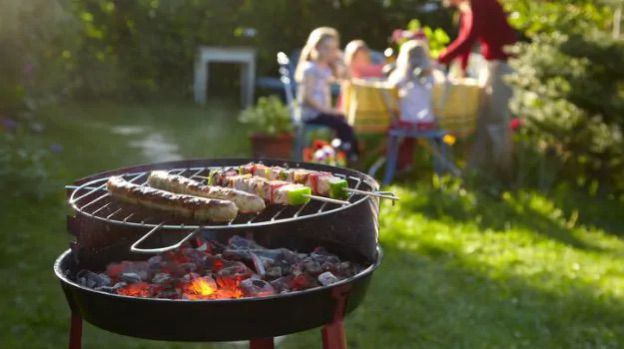
I could smell it before I could fully see it, charcoal and lighter fluid and the particular sweetness of cheap hot dogs, the smell of a hundred childhood summer afternoons collapsing into this one moment in the dry Arizona heat. Country music was coming from a portable speaker someone had turned up too loud, the kind of volume that announces a party to the whole street and is meant to. Half the neighborhood appeared to have received the announcement. Lawn chairs were arranged across the backyard in loose clusters, paper plates already loaded, people I recognized from years of waving across driveways now standing in my father’s yard with the settled ease of guests who had been invited and had come early.
I sat in my car for a moment with the engine running.
Then I saw the banner.
It was stretched across the garage door, vinyl, red letters on white, the kind of thing you order from an online print shop and which arrives rolled in a cardboard tube with plastic grommets for hanging. Someone had measured carefully enough to center it. It snapped in the dry wind with the sharp sound of something meant to last the afternoon.
GOODBYE, FREELOADER. DON’T COME BACK.
My father stood beneath it in a black apron. BOSS OF THE GRILL across the chest in white letters, the kind of apron sold at every hardware store in America, the kind given as a gift by people who run out of ideas. He had a pair of tongs in one hand and a beer in the other and he was smiling the smile of a man who has arranged something and is pleased with how it has come together.
“Look who came to claim her junk,” he said, loud enough to carry.
A few people laughed. Not a crowd laugh. The particular laugh of individuals who have been primed for something and are signaling their alignment. I knew that laugh. I had heard it at enough family dinners to understand exactly what it meant and exactly what it cost the person receiving it.
I stayed by my car.
My uncle Dean was on the patio in a fishing shirt with sweat already coming through the back of it, a bottle in his hand, the specific color in his face that means he has been drinking since before noon. He is my father’s younger brother and he has always operated, in family situations, as the voice that says the things my father wants said but prefers not to say himself, which is a function Dean performs without apparent awareness that he is performing it, which makes him more useful to my father and more difficult to reason with.
He pointed his bottle at me.
“Thirty years old,” he announced, with the projection of a man who believes his volume is the same as his credibility, “and still living off your daddy.”
Nobody corrected him. This was the thing about my family that took me the longest to fully understand. The cruelest person in the room did not need to do all the damage. He only needed to open a door. The others would walk through it on their own, at their own pace, in their own way, and the distribution of the cruelty across multiple people made it seem, somehow, more like consensus than attack.
Kelsey was by the grill in cutoff shorts and full makeup, her phone raised at the angle she uses when she is filming for social media, the practiced tilt of someone who has thought about her own image for long enough to have opinions about the best light. She is three years younger than me and has always had the particular confidence of a person who knows which side of a family dynamic she is on and has no intention of crossing to the other.
She looked at me and then at the neighbor women standing nearby, and she smiled.
“There’s our girl,” she said. “Miss Independent.”
The women smiled into their cups with the expression of people enjoying a story they have been given just enough context to follow.
I want to tell you who I was before I tell you what happened, because the banner and the hot dogs and Dean’s shouting make a different kind of sense when you understand the actual facts of the situation, which were not the facts my father had distributed to the neighborhood.
My name is Claire. I am thirty years old and I have a degree in graphic design from Arizona State and I have been working as a freelance designer and brand consultant for four years. Freelance work is, I am aware, the kind of work that sounds precarious to people who understand employment primarily through the vocabulary of salaries and offices, and I had spent four years attempting to explain to my father that the income was real and the clients were real and the work was legitimate, and I had not made meaningful progress on any of those fronts.
What my father understood was that I worked from home, which looked, from his vantage point, like not working, and that my income varied month to month, which looked like instability, and that I had moved back into his house two years earlier following a lease situation that had become untenable in ways I had explained to him fully and which he had chosen to remember selectively.
What he told other people, I was learning, was something simpler and more satisfying: that he had been carrying me, that I had no real job, that I contributed nothing, that I was a thirty-year-old woman living in her father’s house because she could not manage her own life.
This version required omissions. It required omitting the rent I had paid every month, which was below market but was real and documented. It required omitting the household tasks I had taken on, the cooking and the maintenance and the errands that had been divided between us in an arrangement we had both agreed to. It required omitting the client work I had done for him, including the complete redesign of the website for his landscaping business, the new logo, the marketing materials, the social media presence that had increased his inquiry rate noticeably, all of it provided at no charge because he was my father.
None of that made it into the banner.
I had been asked to leave three weeks earlier, in a conversation that had the shape of a discussion but was actually a notification. My father had met a woman named Linda who wanted to move in, and the house had three bedrooms, and the arithmetic was straightforward. I understood this. I had even understood it as reasonable, or tried to, because adults are entitled to make decisions about their own homes and their own lives, and if my father wanted to have Linda move in, that was his right.
What I had not understood, or had not allowed myself to understand, was that the eviction needed a story, and the story needed me to be the villain, and the villain had been constructed carefully over a longer period than the three weeks since Linda’s name first came up.
I understood it now, standing in the driveway with the banner snapping over the garage and Dean still yelling and my father watching me from under his BOSS OF THE GRILL apron with the settled satisfaction of a man who has arranged a thing and is watching it happen according to plan.
I let go of my keys.
I had come for a box. One banker’s box of things I had left in the laundry room when I packed the rest of my belongings two days ago, in a process I had conducted efficiently and without drama because I had decided, consciously and with effort, that I was not going to give anyone the satisfaction of watching me come apart. The box had some books in it, and some supplies, and a few things that mattered for reasons that had nothing to do with their monetary value.
I shut off the engine. I opened the door. I got out.
The music was too loud and the sunlight was doing what Arizona sunlight does in July, which is to say everything, relentless and flattening and making the scene look more like itself than it might otherwise. Paper plates. Folding chairs. A plastic table with condiments and a flower pot with small American flags pushed into the dirt. Neighbor kids running between the adults. The whole apparatus of a casual American summer party, assembled in service of something that was not casual at all.
My father spread his arms under the banner in the gesture of a man presenting something.
“You wanted your freedom,” he said. “There it is.”
The neighbors laughed again, more easily this time. They had been given a storyline and they were following it, because that is what people do when they have been given a storyline, they follow it, because the alternative is to notice that they have been used as an audience for something they might not have agreed to attend if it had been described to them accurately.
I walked past my father without answering.
“Too proud to say thank you?” he called after me.
Inside, the house was cooler but not comfortable. It had the particular feeling of a place you have lived in and are no longer living in, the furniture the same and the smell the same but your relationship to it entirely changed, like a word you have repeated so many times it loses meaning. I walked through the kitchen, where I had cooked probably four hundred meals over two years, and down the short hallway to the laundry room.
The banker’s box was on top of the dryer. He had put a note on it in thick black marker, the note folded and taped so it sat across the top of the box like a label.
STARTER KIT.
I lifted the flap. Dryer sheets, several packets of ramen noodles, a half-used roll of trash bags, and a printed list of apartment complexes in the area, the kind of list you would generate in about four minutes by searching online, printed and folded and placed inside a box of ramen as though it were wisdom.
I looked at it for a moment.
The word that came to me was committed. He was committed to the bit. The banner, the party, the apron, the box with its label, the printed apartment list, all of it assembled with the dedication of someone who has been planning this particular performance and wants it to land. He had not just wanted me gone. He had wanted a scene, specific and public, with himself at the center of it and me at the edge, and the neighbors as witnesses to the version of the story he needed told.
I closed the box. I picked it up. I walked back through the kitchen and I did not look at my reflection in the microwave door, though I was aware of it, the flash of a face I was trying to keep still.
When I came back outside, Dean saw me first.
“There she is,” he announced, with the energy of a man who has been waiting for a second act. “Grabbed her little survival kit.”
Kelsey was already oriented toward me, phone rising. She saw the box, and something in her face lit with the specific delight of a person who has been waiting for a particular image and has just seen it materialize.
Then she reached over to the tray beside the grill, picked up a hot dog, pulled her arm back, and threw it.
It hit the door of my car. The mustard made a yellow streak from the door handle down toward the wheel well, vivid and absurd in the afternoon light.
“There’s your last free meal, loser!”
The kids laughed. One small boy, maybe eight years old, pointed at me with the open delight of a child who has been taught, by the behavior of the adults around him, that this is the appropriate response to what he is witnessing. He did not know what he was participating in. He was just following the cues of the room.
My father did not say stop.
He stood there with his tongs and his beer and he watched his daughter get a hot dog thrown at her car by his other daughter while a child pointed and laughed and the neighbors with their paper plates stood in lawn chairs in the sun, and he said nothing, and he did not move toward stopping any of it.
That was the thing that I will carry longest from that afternoon. Not the banner. Not Dean’s shouting. Not the hot dog or the mustard or Kelsey’s laughter. The thing I will carry is my father’s stillness. The deliberate, chosen nature of it. He stood there and he let it happen because this was the plan, this was the performance, and he was the director, and the director does not break the scene.
I walked to my trunk. I placed the box inside. I closed it.
Gently. Not slammed, not dropped, not punctuated with any sound that could be clipped and posted and used. Gently, the way you close something you are done with.
Dean was yelling something about my mother. She has been dead for nine years, my mother, a fact that does not prevent Dean from invoking her in arguments the way people invoke the dead when they want a weapon that cannot be argued with. He knew where the tender places were, and the dead cannot correct the stories told about them, and he used both of these things.
I turned around.
I looked at all of them. My father under the banner with his beer going warm in the Arizona sun. Dean swaying on the patio, the bottle tilting in his hand. Kelsey with her phone and her mascara and her practiced smile, waiting for the thing she could use. My grandmother under the patio umbrella with the expression she puts on when cruelty is dressed in the clothes of moral instruction. The neighbor women with their cups, watching with the bright-eyed hunger of people who understand they are witnessing something and have decided to witness it rather than question it.
Over all of them, the banner.
I lifted my phone.
My father noticed immediately. He has always been attuned to the direction of cameras, in the way that people are attuned to things they have learned can work for or against them.
“What are you doing?” he said.
I did not answer. I framed the shot carefully, taking my time with it. The banner in the background, legible and clear. The grill smoking to the left. Dean on the patio, bottle raised. Kelsey by the table, phone in hand. My father in the center with his apron and his tongs and the expression he had been wearing since I arrived, which was somewhere between triumph and the first faint arrival of something else.
“What?” he said, sharper. “Collecting evidence for your therapist?”
A few people laughed, but the laugh was smaller than the earlier ones, less certain. The energy of the party had shifted in the way that energy shifts when someone does something unexpected, not a dramatic thing, just the lifting of a phone, but unexpected in a way that changed the room’s understanding of itself.
I kept the phone steady.
The photo click was quiet in the way that phone cameras are quiet, which is to say almost silent, but everyone seemed to hear it. Kelsey lowered her smile by a fraction. Dean stopped mid-sentence. My father took one step forward.
I looked at him directly.
“No,” I said. “For later.”
I got in my car.
I want to tell you what I meant by later, because it was not a threat, or not primarily. It was a statement of intention that I had not fully articulated even to myself until the moment I said it, but which became clearer on the drive back to the apartment I had moved into the week before, a one-bedroom on the second floor of a building three miles from my father’s house, with a kitchen window that got afternoon light and a second bedroom I was using as an office.
Later meant that I was not done yet. Not in the sense of revenge, though I want to be honest about the fact that the word revenge passed through my mind on that drive and I did not immediately dismiss it, because I am a human being who had a hot dog thrown at her car while a child pointed and her father watched. But underneath the hot dog and the banner and Dean’s shouting there was a more substantive situation, which was the situation of a person whose professional work and financial contributions had been erased from the record in favor of a story that served someone else’s purposes, and that story was now publicly installed in the neighborhood where I had grown up and among the people who had known my family for years.
Stories, I had learned in four years of brand work, are not corrected by silence. They are corrected by other stories, told with better evidence and in the right places.
The first thing I did when I got back to the apartment was download the photo and look at it on my laptop. It was a good photo, in the way that documentation is good, clear and complete and capturing exactly what it was meant to capture. The banner was fully readable. My father’s face was visible. The party around him was visible. The full shape of the occasion was present in a single image.
I did not post it. Not that day. I want to be clear about this because there is a version of this story in which I immediately shared the image to social media and watched the crowd response validate my experience, and that version would have been satisfying in a short-term way and costly in the longer ways that impulsive things are costly. I sat with it instead. I made tea. I looked at the apartment around me, the space I had made into something that functioned and felt like mine in the week since I had been in it, and I thought about what I actually wanted to do.
What I wanted was not small. I want to be honest about that.
I wanted the record corrected. I wanted the people who had stood in my father’s backyard and laughed to eventually have access to the full picture. I wanted Kelsey’s social media presence, which she had been building on the currency of our family’s dynamics for years, to encounter something she had not planned for. I wanted my father to understand that the scene he had staged had been documented and that documentation has a longer half-life than the afternoon it was made in.
But I also wanted to do this correctly, which meant doing it at the right time and in the right way, which meant not from a place of raw afternoon anger.
I called my friend Daria, who has known me since college and who I trust with the accurate version of my own history. I told her everything that had happened, from the banner to the hot dog to the starter kit, and she listened with the specific quality of a friend who is building rage on your behalf while also ensuring you do not do anything you will regret, which is the most useful combination of qualities a person can bring to this kind of conversation.
She asked me what I wanted to do.
I told her.
She said she thought it was right and that the timing I was considering was also right and that I should sleep on it and see how it looked in the morning.
It looked the same in the morning. Clearer, actually, because the anger had settled into something more organized and the organization was useful.
What I had, beyond the photograph, was four years of documentation. The design work I had done. The client invoices. The bank statements showing the rent payments I had made to my father, monthly and consistent. The text message thread in which the rent arrangement had been discussed and agreed to. Screenshots of my father’s business reviews, a number of which mentioned the new website and branding, the redesign I had done for free. The email chain in which I had delivered the final website files and in which my father had written, in his own words, this looks incredible, you really came through.
This looks incredible, you really came through.
I had that email. I had had it all along. I had the whole record, in fact, the paper trail of a person who had contributed to a household and to a family business and who had paid her rent and managed her own clients and built her own work, all of it documented in the ordinary way that life is documented when you keep your files and save your messages and pay your rent by bank transfer.
I built a folder. I organized it the way I organize client deliverables, clearly and completely, with a summary document at the front that laid out the timeline and the facts in plain language. I included the photograph at the end, after the evidence, because the photograph made more sense after the evidence than before it.
Then I waited two more weeks, because two weeks is long enough to ensure you are not acting from immediate emotion and short enough to ensure the context remains fresh.
I posted the photograph on a Tuesday afternoon, accompanied by a caption I had written and rewritten until it said exactly what I meant without saying anything I did not mean. I described what the party had been and what the banner had said and what had been thrown at my car. I described the rent I had paid and the work I had contributed and the website redesign I had provided at no charge. I linked to my father’s business, where the redesign was visible to anyone who looked. I did not name my uncle. I named the occasion accurately and I described my experience accurately and I kept my language even, because even language in a situation like this is more devastating than heated language and I knew this from four years of telling other people’s stories professionally.
Kelsey’s content from that afternoon went up the same evening, as I had expected it would. She had not posted it immediately, which told me she had been waiting for my response, which told me she had understood that my phone coming out was a development. Her version was edited, naturally, the banner cropped out of the background of the shots she chose, the throwing of the hot dog not included, the framing arranged to look like an ordinary party at which she happened to be having a wonderful time. She is skilled at this. She has spent years developing the skill.
But the internet is not a place where cropped versions are the only versions, and her audience and my audience were not entirely separate, and several mutual connections saw both accounts within the same twenty-four hour period, and the gap between the two versions was large enough to be noticeable and specific enough to be informative.
My father called me three days after the post. He did not call to apologize, which I had not expected. He called to tell me I had embarrassed him, which I had expected, and to ask me to take the post down, which I had also expected.
I told him I would think about it. This was not entirely truthful, because I had already thought about it and my conclusion was that I would not be taking it down, but I was not ready to have the larger conversation that would follow that statement and I wanted more time with my own thinking before I had it.
The larger conversation happened two weeks later. Not by my choosing, exactly, but because things had continued to develop in the neighborhood in ways that reached my father through channels I had not orchestrated and could not have. The neighbor women, several of whom had seen my post and had also seen Kelsey’s, had begun asking questions among themselves of the kind that neighbors ask when they realize they may have attended something different from what they were told they were attending. My father’s business received two reviews that referenced the website and its design in ways that led at least one reader to search for the designer, and my portfolio is not difficult to find.
The story my father had told about me encountered the story that was actually true, and the stories were not compatible, and the incompatibility had consequences that I had not designed and did not manage but also did not prevent.
When my father and I finally spoke, it was at his kitchen table, without an audience, without an apron, without a banner. It was the kind of conversation that happens between people when the performances they have been maintaining become too expensive to sustain, and it was not a reconciliation and it was not a resolution, because those things take longer and require more than one conversation.
What it was, was honest in a way our conversations had not been for a long time. He admitted that the party had been too much. He used those words, too much, which was not the admission I would have written for him but was the most he had available, and I received it as what it was rather than as what I wished it were.
I told him about the rent records. I told him about the email, the one where he had said this looks incredible, you really came through. He was quiet when I mentioned the email. The quiet of a man who has been reminded of something he said in a moment of genuine feeling and then edited out of his subsequent narrative.
We did not arrive at warmth that afternoon. We arrived at something more like a mutual exhaustion of the pretenses we had each been maintaining, which is an uncomfortable place to arrive but an honest one, and honesty is what you build from, if you build at all.
I drove home to my apartment, the second-floor one with the kitchen window and the office I had made out of the second bedroom. I had three client projects in progress and a proposal due Friday and a small but real professional life that existed entirely independently of whether my father understood it or acknowledged it.
The photo was still up. It remained up. Not because I needed it to be, but because it was true, and because I had decided some time ago that the truth of my own experience was mine to keep, and that keeping it did not require anyone else’s permission.
The banner had been taken down, I assumed, sometime after the party, rolled back up and returned to wherever you return a banner when the occasion it was made for is over. But photographs last longer than vinyl, and the record I had made in my father’s driveway on a July afternoon with the sun too bright and the music too loud and the mustard still bright yellow on my car door was specific and complete and entirely legible.
For later, I had said.
This was later.
I was still here.

Sophia Rivers is an experienced News Content Editor with a sharp eye for detail and a passion for delivering accurate and engaging news stories. At TheArchivists, she specializes in curating, editing, and presenting news content that informs and resonates with a global audience.
Sophia holds a degree in Journalism from the University of Toronto, where she developed her skills in news reporting, media ethics, and digital journalism. Her expertise lies in identifying key stories, crafting compelling narratives, and ensuring journalistic integrity in every piece she edits.
Known for her precision and dedication to the truth, Sophia thrives in the fast-paced world of news editing. At TheArchivists, she focuses on producing high-quality news content that keeps readers informed while maintaining a balanced and insightful perspective.
With a commitment to delivering impactful journalism, Sophia is passionate about bringing clarity to complex issues and amplifying voices that matter. Her work reflects her belief in the power of news to shape conversations and inspire change.