My mother’s name lit up my phone on a Tuesday afternoon at the exact time she was supposed to be sitting in her Community Health Studies class at the community college, which was why I almost didn’t answer. She was disciplined about her schedule in the way of someone who had learned to treat every available hour as a resource not to be wasted, who understood viscerally that time spent on something useful was time spent building toward a future that was not guaranteed to arrive unless you pushed it there yourself. The call went to voicemail. Then a text appeared on my screen.
He called. Your father. Can you come over?
I was in my apartment complex parking lot unloading groceries, reusable bags over both arms, phone pressed between my ear and shoulder. I read the message twice. I didn’t need it explained. Some messages carry their entire history inside them, compressed into a single sentence, and anyone who has spent their life learning to read the particular silences and implications of a family shaped by abandonment understands exactly what it means when a father who left ten years ago suddenly calls out of nowhere.
I left the groceries on the kitchen counter and drove to my mother’s house.
It was the same house she had raised ten children in, three bedrooms in a neighborhood that had gentrified slowly and unevenly, the kind of block where people still knew each other’s names and kept an eye on each other’s kids and had lived long enough in their houses to have accumulated the specific kind of attachment that comes from shared history rather than property value. My mother had raised us in it alone for ten years, had painted it twice herself, had fixed the back porch with lumber she bought from the hardware store four blocks over and instructions she found in a library book, had planted tomatoes along the south wall every spring because she said they were practical beauty, which was her way of describing most things she loved.
When I came through the kitchen door, three of my siblings were in the living room doing an imperfect job of pretending they were not listening. My mother sat at the kitchen table with her phone face down in front of her, which was how she placed things when she wasn’t sure whether to look at them. Her eyes were red but her voice was even, because she had had a decade of practice at keeping her voice even.
“He wants to come home,” she said.
I laughed. It came out before I had decided to laugh, the involuntary sound of disbelief that the body produces when the mind has not yet developed a better response.
“Home,” I said. “This home.”
She nodded. “He says the relationship didn’t work out. He says he’s been thinking about us. He says he made mistakes and he misses us and he wants to make things right.”
I pulled out the chair across from her and sat down. Behind her, along the wall above the kitchen window, she had hung school photographs in mismatched frames, ten children at different ages, different haircuts, different stages of becoming ourselves without him. They had been gathered there for years, added to as younger siblings had school picture days, a documented record of the family he had called his blessing and then decided was too inconvenient to maintain.
“Mom,” I said. “He walked out when you were eight months pregnant with Hannah. He didn’t make a mistake. He chose to leave nine children and a pregnant wife. That’s not a mistake. That’s a decision.”
“I know,” she said. “I remember.”
We were both remembering the same thing, though we had been in different positions when it happened. I was fifteen, sitting on a metal folding chair in the church basement, one of nine children arranged in a row with their feet not quite reaching the floor, my mother beside us with her belly so large she had to sit sideways, her ankles swollen, her eyes swollen worse from crying she had done before she got to the church and was trying to hide. My father stood in front of us with the worn leather Bible that had been his constant companion and the particular voice he used for difficult announcements, the voice that made them sound like something that was happening to him rather than something he was choosing.
“Kids,” he said. “God is calling me elsewhere.”
My brother Liam, who was ten and still believed that adults meant what they said and said what they meant, asked if it was another church. My father gave him the practiced smile of a man who has already decided what this conversation will be and is simply performing his version of it, and said something about that, something that did not actually answer the question, and then he talked about a new season and God’s calling and faith that he was making the right choice, and he never mentioned the twenty-two-year-old soprano from the choir who had been appearing in the pulpit with increasing frequency, and he never mentioned the suitcase that was already in the trunk of his car.
I listened through the bedroom door that night while my mother cried in the way that people cry when something structural has broken, not the quiet tears of grief but the deep broken sound of a person whose fundamental understanding of her own life has been destroyed. I heard my father’s voice through it, calm and reasonable, explaining why this was actually not as bad as it looked, actually perhaps necessary, actually sanctioned by something larger than himself.
“I deserve to be happy,” he said. “I’ve given twenty-five years to this family. God doesn’t want me to live a miserable life.”
“You’re their father,” my mother said. “We have nine children and we’re about to have a tenth.”
“You’re strong,” he told her, and I could hear the certainty in it, the way he deployed her strength as justification for his departure, as though her capacity for survival was the thing that made his leaving acceptable. “God will provide.”
Then he walked out with one suitcase and a Bible verse, and the door closed, and he did not come back.
The years after that were years of a particular kind of survival that becomes normal so gradually you forget it was not always the baseline. There were food stamps and the specific mathematics of which bills could wait and which ones would result in something being shut off. There were my mother’s hands cracking and bleeding from the cleaning chemicals she worked with through the night, coming home before we woke for school, showering quickly, making sure we had what we needed before she sat down at the kitchen table for the ten minutes of crying she allowed herself before she had to get up and keep going.
I watched her do that. I watched her ration her falling apart the way she rationed everything else, precisely and without waste. She would sit at that table with her coffee and cry for exactly as long as she could afford to, and then she would wipe her face and put the coffee cup in the sink and be our mother again.
There were school events where we were the children without a father, and teachers who asked carefully if things were okay at home, and other children whose fathers came to soccer games and school plays and whose ordinary presence in their lives was something we learned not to mention because mentioning it made the absence into something with a specific shape and weight. My father sent Bible verses sometimes. Never money. He called twice in the first year and the calls felt dissonant, his familiar voice talking about missing us while being thoroughly absent from anything that constituted our actual lives.
When we cursed him, which we did, the older ones, quietly, when our mother was not in the room, she would shut it down with the particular gentleness she brought to correcting us.
“Don’t let his choices poison you,” she would say. “People make mistakes. They’re weak sometimes. But you don’t have to let someone else’s weakness become your bitterness.”
I took that instruction seriously in the way I took most of my mother’s instructions, as something she had figured out at significant personal cost and was passing on to protect us from having to figure it out the same way. I didn’t become bitter. I became precise instead. I became someone who showed up. I became someone who worked hard enough that I would not have to depend on anyone else’s willingness to stay.
And my mother became a student.
She had taken the first class because she could not stand the idea that cleaning offices was the entire horizon, that the poverty had no exit strategy and no end date. She took it at the community college while my youngest sister was still an infant, while she was still working nights, fitting the reading into the hours between shifts and the hours after we went to school. She had said nothing about it for two months, as though she was afraid to name it in case naming it made it something she could fail at. When she finally told us, she said it quietly, sitting at the kitchen table on a Sunday morning, and several of us cried, which surprised her, and she said she didn’t know why we were crying, and we said because we were proud of her, and she looked at us like the concept of someone being proud of her was something she was still learning to receive.
Then she took another class. And another. She built the degree one course at a time across years, studying at the kitchen table after we went to sleep, maintaining her GPA with the single-minded focus of someone who understands that she has very little margin for error. She went to clinical rotations after night shifts. She wrote papers on healthcare disparities and patient advocacy and the systemic conditions that kept people sick and poor, writing from a knowledge base that was not theoretical.
By the time she graduated from the nursing program, she had a GPA that put her among the top students in her cohort, which was an achievement that sounds straightforward and is not, not when you understand that she had accomplished it while raising ten children and working nights and operating on the specific exhausted determination of a woman who had decided that her situation was not going to be her permanent condition.
The email from the nursing college came on a Friday and I read it at the kitchen table of my own apartment, the table where I sat in the mornings and sometimes thought about my mother’s kitchen table and the years it had held.
Your mother has been selected to receive the Student of the Decade award from our nursing program. This honor is given to graduates who have demonstrated exceptional commitment, resilience, and service despite significant personal challenges.
I read it three times, feeling each time the specific quality of something that has been a long time arriving and is finally here.
I called the college and spoke with the dean. I told her about my father’s call, about the situation, about what I wanted to do. She listened without interrupting, which told me she was the right person to be talking to. We made arrangements.
I told my mother we were having a family dinner to celebrate her graduation and her award. I told my siblings enough to get them dressed and ready and sworn to a temporary secrecy they mostly maintained. I told my father there was a family gathering and gave him a time and an address. I did not tell him what kind of gathering it was.
My mother stood in front of her mirror on Sunday evening in a simple navy dress and asked me if she was overdressed for a family dinner, and I told her she could show up in a wedding gown and it still wouldn’t be enough. She gave me the nervous half-smile of someone who had not yet fully processed what was actually about to happen.
“Do you think I should warn him?” she asked. “Tell him what this really is?”
I thought about it honestly. I thought about what mercy meant and what honesty meant and whether they were the same thing in this situation.
“If you want to cancel, cancel and tell him the truth,” I said. “If you want to go, then let him show up and see what he walked away from. That’s not cruelty. That’s just honesty.”
She was quiet for a moment, smoothing the fabric over her waist.
“I don’t want to be cruel,” she said.
“I know,” I said. “But what he did to us was cruel. What you’re doing is showing him what he missed. There’s a difference.”
My father pulled into the parking lot at seven o’clock, on time the way he had always been on time for things he wanted to attend, driving the same faded sedan he had always driven, only rustier now. He got out wearing a suit that hung loose at his shoulders like it had been made for a slightly larger version of himself, which maybe it had. His hair was thinner. He had the look of a man who had been running from something for a decade and had recently started to suspect that the running had not accomplished what he expected.
When he smiled at me it was the same smile, warm and practiced and confident in a way that had probably served him well for most of his life. He looked around the parking lot and asked where everyone was, said he thought we were having dinner, and I said we were inside.
He followed me toward the glass doors of the building still operating on the assumption that what was about to happen was the thing he had arranged in his mind, that he would walk into a room full of his children who had missed him, that my mother would be there, that the family would be reassembled around his return the way it had once been assembled around his presence.
Then he saw the banner.
Nursing College Graduation and Honors Ceremony.
He stopped. His smile did not disappear exactly, but something behind it shifted.
“This doesn’t look like a restaurant,” he said.
“It’s not,” I said. “It’s Mom’s graduation. She’s receiving an award.”
“Your mother is graduating,” he said, and the way he said it had a quality that I recognized from the bedroom doorway all those years ago, the sound of a man encountering information that does not fit the narrative he has been maintaining.
“Tonight,” I said. “Stay and see what we’ve built without you. You said you wanted to come home. This is home now. This is what it looks like.”
My siblings were seated near the front, and I watched their faces shift when they saw him walking down the aisle. Some of them had not seen him since they were very small. Hannah, who had been born six weeks after he left and had therefore never known him as a presence but only as an absence that everyone in the family knew the shape of without naming it directly, looked at him with the particular expression of someone encountering something they had spent their whole life understanding in the abstract and are now confronting in three dimensions.
My mother was already seated, her program twisted in her hands. When he slipped into the row behind us she did not turn around. She sat very still and I watched her understand what was happening and make peace with it.
The ceremony began with the ordinary and beautiful business of recognition, names called, families rising to their feet, the particular joy of watching someone you love receive something they have earned. Then the slideshow began.
At first it moved through various students in scrubs, images of accomplishment and pride. Then my mother’s face filled the screen, and it was not the face she wore to public events but the face from an ordinary night, tired and determined, mopping an office hallway with a stroller parked behind her, a sleeping toddler inside it, a textbook propped open on the stroller’s handle. The image stayed on the screen for a long moment and did not apologize for what it showed.
I felt my father flinch behind me.
The slideshow continued. My mother at our kitchen table surrounded by notes and textbooks. My mother in scrubs at a clinical rotation, focused in a way that read clearly even in a photograph. My mother at the table again, head in her hands, the posture of exhaustion that is not giving up. It documented her decade not as a series of triumphs but as sustained effort, day after day, year after year, in the actual conditions of her life.
The dean stepped to the microphone and described the award, described what it honored, described my mother’s record without embellishment because the facts required none. Single mother. Ten children. Night shifts. Highest GPA. Every rotation attended. Every exam taken.
“Please help me honor Maria Alvarez.”
The auditorium rose. All of us, my siblings on their feet, some of them already crying, and I was crying too, the specific tears of watching your mother receive the public acknowledgment of something you have watched privately for a decade. She walked to the stage with her shoulders back and her eyes bright and took the plaque with hands that shook slightly and then laughed, one startled laugh, like the sound surprised her.
She spoke about fear. She said that ten years ago she had been scared and tired and had not known how she was going to take care of her children alone, and she had taken one class because it was the only forward-facing thing she could think to do, and then she had taken another, and then she had understood that education was the thing that could change the trajectory she was on, and she had stayed on that path regardless of what it cost her in sleep and comfort and the ordinary pleasures she had deferred for ten years.
She looked out at the crowd and found us, her children, and she said she wanted to thank us for believing in her when she had not believed in herself.
The dean smiled and said that her eldest daughter had a few words.
My heart slammed against my ribs. I had coordinated this with the college weeks before, had written something and submitted it, and now the moment was here and my father’s hand came down on my wrist from the seat behind me.
“Mia,” he said, low and urgent. “Don’t drag our history into this. Don’t do this to your mother.”
“You wrote this history,” I said, and pulled free. “I’m telling the truth about it.”
On the stage, under the hot lights, I hugged my mother and she trembled against me and whispered please be gentle.
“You’ve been gentle for both of us for ten years,” I said. “Let me be honest.”
I turned to the microphone.
I told the room that my mother had ten children, and let the soft, surprised laughter settle. I said that she had married a man who called a big family his blessing, who bragged about us from the pulpit every Sunday, who told people we were God’s gift to him. I paused to let that land.
Then I said that the same man had told us God was calling him elsewhere when she was eight months pregnant with our tenth child. I said it simply and without inflection, the way you state a fact that speaks for itself.
The room went still.
I told them he had left that night with one suitcase. That he had said he deserved to be happy, that he had given twenty-five years and wanted to be fulfilled, that God wanted him to live a full life. I said that when I was fifteen, watching my mother cry through a closed door while he explained why leaving was actually reasonable, I had believed that was the end of the story. That the family had been permanently broken.
“Instead,” I said, “she cleaned offices at midnight and studied at three in the morning. She cried in the shower so we wouldn’t hear. She told us not to hate him, even when we wanted to. She told us not to let his weakness become our bitterness.”
I looked out at the crowd, and I found him in the back, standing now, his expression the specific mixture of anger and shame of a person hearing themselves accurately described in public.
“So I want to say thank you,” I said, “to the man who walked out. Because when he left, we learned something important. He wasn’t the backbone of this family. She was. She was the one holding everything together. He just hadn’t known it because she had been doing it quietly the whole time, in the way that people do necessary work that doesn’t get named until someone steps back and the work becomes visible in their absence.”
I paused.
“He showed us who was actually strong. And then he showed us what happens when you abandon your responsibilities. You become less important. Not more. You recede. The family closes around the space you left, and the people in it become something you didn’t make them and can’t take credit for and can’t simply return to.”
The room was silent enough that I could hear the ventilation system, the faint rustle of programs.
“She raised us alone,” I said. “She worked nights and went to school and made sure we knew we were worth sacrificing for. She showed us that you don’t need someone to rescue you. You rescue yourself. You don’t need someone to make you worthy. You already are. And you don’t need someone who walked away to define your life or to limit it.”
I looked at my mother on the stage beside me, her plaque in her hands, her face wet, laughing and crying at the same time the way she sometimes did when something was both very good and very hard to hold.
“Thank you, Mom,” I said. “For showing us what strength actually looks like. For being so much more than enough.”
The room came to its feet.
Afterward, in the lobby, my mother moved through congratulations and photographs with the particular dazed quality of someone who has been seen very clearly in public and is still processing what that felt like. Her professors stopped her. Other graduates’ families offered words. The little kids passed her plaque around between them like a trophy that belonged to all of them, which it did.
Through the glass doors I could see my father standing under a streetlight in the parking lot with his hands in his pockets, watching the lobby the way you watch something from the outside when you understand you are on the outside of it. He was looking at his children, at the life that had grown around the gap he had made, at a woman he had believed would remain in the position of needing him, and understanding that she had not.
After a while, my mother stepped outside for air, her plaque in her hand, the medal from the ceremony still around her neck. He moved toward her. I stayed near the doors.
“That was quite a speech,” he said.
She gave him the particular smile she reserved for things that were both true and sad. “Thank you for coming.”
“I deserve to come home,” he said. “I know I made mistakes. I’m alone. The choir girl, that didn’t work out, and there were others, and none of it worked out, and I think about you and the kids. I want to make things right. I want to come back.”
My mother looked at him for a long moment. She had the stillness of someone who has been making a decision for years and has finally arrived at the moment of stating it.
“I forgave you a long time ago,” she said. “I had to. Holding onto the anger was poisoning me, and I needed to be well for my children.”
He exhaled with the relief of a man who has heard the thing he needed to hear.
“Then I can come home?”
“No,” she said, gently, without heat. “Forgiveness doesn’t mean you get to move back in. That’s a different thing entirely. That’s me accepting that you’re my children’s father even though you weren’t there. Coming home is something else. Coming home is something you don’t get.”
“After twenty-five years,” he said. “After everything we had.”
“After ten years of raising ten children alone while you made other choices,” she said, just as quietly, “yes. That’s it.”
I stepped outside and stood beside her.
“We needed you when the electricity was being shut off,” I said. “We needed you when Hannah asked why her friends had dads at school events. You weren’t there.”
He looked back through the glass at the lobby, at my siblings with the plaque, at the professors congratulating my mother’s children as though they were also accomplishments, which they were, because she had made them so.
“So that’s it,” he said. Not a question.
“That’s it,” my mother said.
He walked to his car with his shoulders carrying whatever weight a man carries when he has understood, finally and fully, what his choices cost. No speech. No further attempt at negotiation. The tail lights of his sedan moved through the parking lot and turned onto the street and disappeared, the same disappearance he had performed ten years earlier, only this time without the shock of it, this time expected, this time the conclusion of something rather than its sudden rupture.
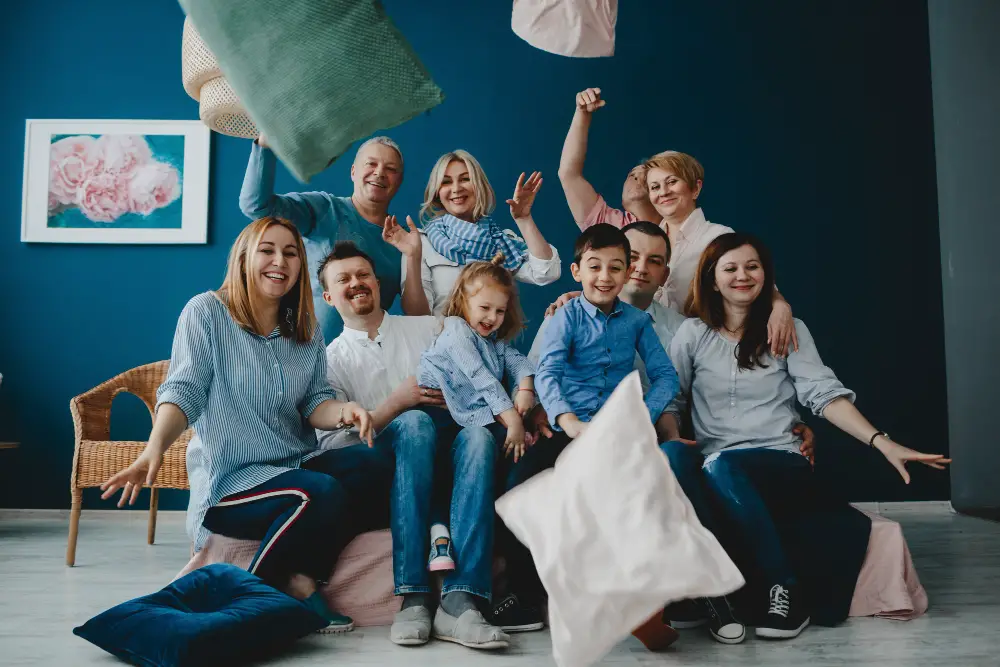
Inside, someone called for a family picture, and we crowded around my mother, pulling the children in from the edges of the lobby, handing off the plaque to whoever was closest, finding our positions. There was a space on one side of my mother, the place where fathers typically stand in family photographs, a space that had been conspicuously absent from our family pictures for a decade.
I looked at it for one moment.
Then I stepped into it and put my arm around my mother’s shoulders.
She leaned into me, and I could feel the medal cool against my arm where it pressed between us, and her smile in that moment was the real one, the one she kept for things she had actually earned and was actually allowed to have.
The camera flashed.
I had spent years understanding myself as the girl whose father walked out, as someone shaped primarily by that absence, carrying it the way you carry something heavy that you eventually stop noticing because you have been carrying it so long. It had made me precise and dependable and unwilling to leave people, which were not bad things to be made into, but they had been organized around a loss, around the specific shape of something that was not there.
Looking at that photograph, at my mother in the center of her children in her navy dress with her plaque and her medal and her degree and her decade of work visible in the straightness of her spine and the steadiness of her eyes, I understood something I had been approaching from a distance for a long time.
I was not the girl whose father walked out.
I was the daughter of a woman who had decided, at the moment of her greatest difficulty, that the difficulty was not going to be the end of the story. Who had taken one class and then another and built a future out of incremental and unglamorous effort. Who had told her children not to let someone else’s weakness become their bitterness. Who had meant it.
That was the inheritance she had given us, the actual one, not the absence our father had left but the presence she had maintained through it. The example of what it looked like to refuse to be finished by something that was supposed to finish you.
She turned toward me after the picture and I saw she was still smiling, the real smile, the one she had been practicing at the kitchen table for ten years in the small moments between everything the day required of her, the smile of a woman who had arrived somewhere she was allowed to be.
“You okay?” she asked.
“Yeah,” I said. “I’m really okay.”
She squeezed my hand once, the way she had squeezed my hand when I was small and she wanted me to understand without words that I was held, that I was not alone in whatever I was navigating, that she was there.
She was there.
She had always been there.
That was the whole of it.

Ethan Blake is a skilled Creative Content Specialist with a talent for crafting engaging and thought-provoking narratives. With a strong background in storytelling and digital content creation, Ethan brings a unique perspective to his role at TheArchivists, where he curates and produces captivating content for a global audience.
Ethan holds a degree in Communications from Zurich University, where he developed his expertise in storytelling, media strategy, and audience engagement. Known for his ability to blend creativity with analytical precision, he excels at creating content that not only entertains but also connects deeply with readers.
At TheArchivists, Ethan specializes in uncovering compelling stories that reflect a wide range of human experiences. His work is celebrated for its authenticity, creativity, and ability to spark meaningful conversations, earning him recognition among peers and readers alike.
Passionate about the art of storytelling, Ethan enjoys exploring themes of culture, history, and personal growth, aiming to inspire and inform with every piece he creates. Dedicated to making a lasting impact, Ethan continues to push boundaries in the ever-evolving world of digital content.