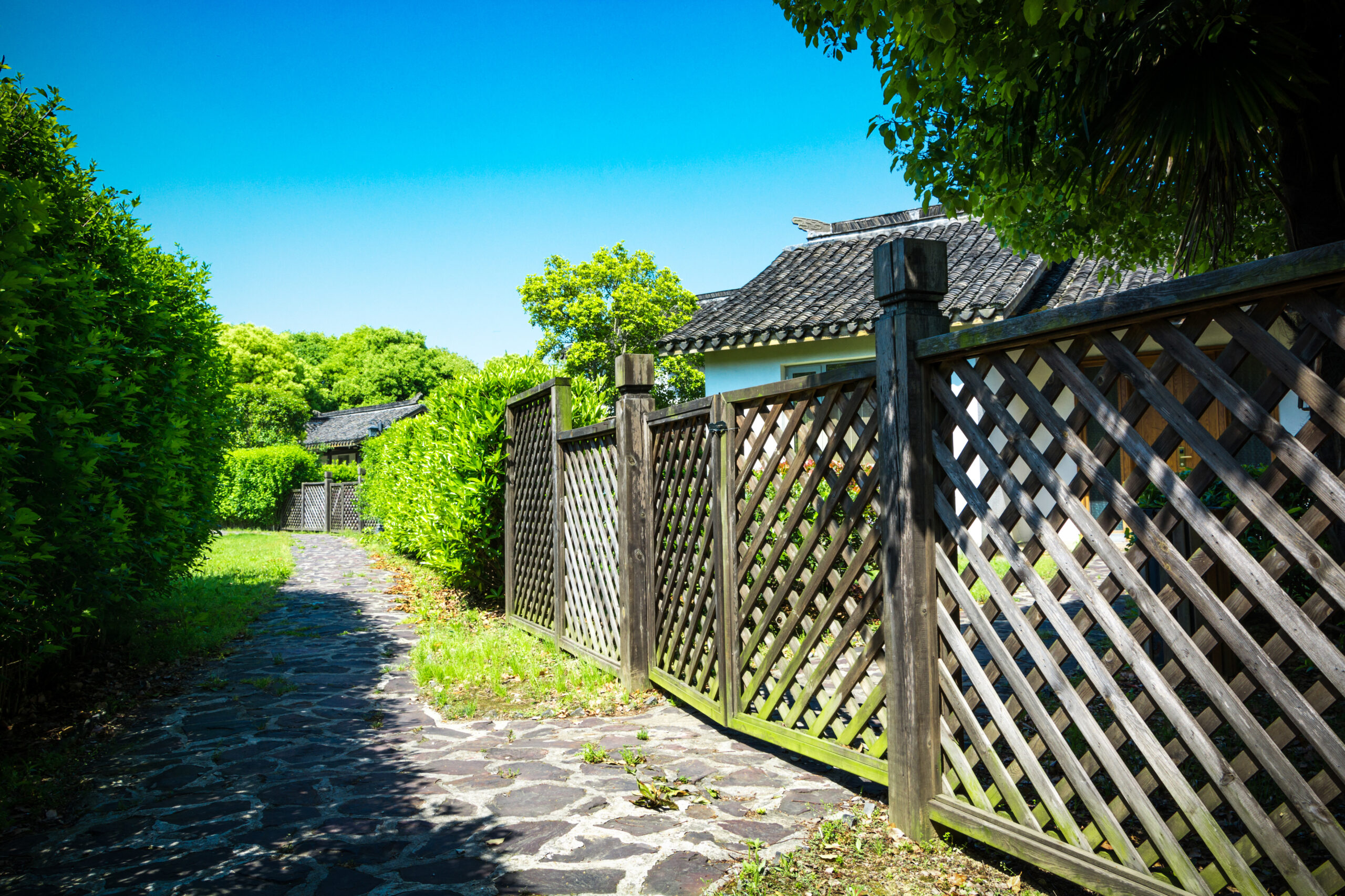
The day I realized my neighbor had quietly taken eight feet of my backyard, I stood there for a long minute just staring at a brand-new fence that absolutely did not belong where it was.
Not because fences are rare. People build fences all the time. Privacy fences, dog fences, fences because they’re sick of seeing the neighbors’ patio furniture. The strange part was how confidently wrong this one was. It sat deep inside my property like it had always been there, like the strip of grass on my side was the only real yard and everything behind it had become some kind of forgotten neutral zone.
The strangest part wasn’t even the fence itself. It was the man who built it acting like the fence was normal. Like I was the one who didn’t understand how things worked.
I live in a quiet part of Dayton, Ohio, in a neighborhood built sometime in the late seventies. Modest houses, wide streets, old trees, the kind of place where people wave as they drive by even if they don’t know your name. I bought my house eleven years ago, right after my divorce, back when I was still in that starting-over phase where you convince yourself the right paint color and a decent mortgage rate can somehow reset your whole life.
The house wasn’t huge. White siding, a small wooden porch, a garage that always felt one tool short of organized. But the backyard was the best part. The lot sits on a slight corner angle, so the back stretches wider than people expect from the street. Not a sprawling estate, but generous by neighborhood standards. For years it had been open, no fences, just grass and a row of old maple trees running along the back property line like a natural border someone planted decades ago.
Those maples were the yard’s spine. Thick trunks, high canopy, leaves that turned bright red in October. In the evenings, my dog used to run lazy circles under those trees, stopping to sniff the same spots like he was checking in with old friends. The previous owner, an older guy named Walter, told me during closing that he never liked fences.
“Fences make people think they’re enemies,” he’d said, tapping the paperwork with a laugh.
So the yard stayed open. And for a long time, it felt peaceful enough to believe Walter was right.
Then last spring, the house behind mine sold.
A young couple moved in. Their names were Tyler and Ashley. Within days there were trucks outside every morning, roofers, painters, landscapers. Their house got new siding, a new roof, new windows, and what looked like twenty grand worth of landscaping in about two weeks. I didn’t judge. First-time homeowners get excited. They want things to feel like theirs.
But then the fence truck showed up.
A big fencing company van pulling a trailer loaded with fresh cedar panels and metal brackets. The crew worked all day, and by sunset a brand-new privacy fence ran across the entire back section of Tyler and Ashley’s yard.
Except something about it felt off.
The fence looked closer to my house than it should have been. Perspective can play tricks when new structures go up, so I brushed the thought aside that night. But the next morning, curiosity got the better of me.
I walked out with a tape measure.
There was a specific spot I knew well, the corner maple tree. When I bought the house, the survey mentioned that tree because it sat almost exactly on the property line. Walter had even pointed it out once, standing there with a beer and a grin.
“That tree’s basically the handshake,” he’d said. “Your place ends, theirs begins.”
According to my documents, the distance from the back corner of my porch to that tree should have been around thirty feet.
I hooked the tape measure and walked it back toward the new fence.
Twenty-two feet.
I rewound it and did it again.
Twenty-two feet.
I stood there staring at the numbers while the morning wind rustled the maple leaves above me.
Eight feet. Eight feet of my yard was now sitting on the other side of their brand-new fence.
I told myself it had to be a mistake. Construction crews make mistakes. Stakes get moved. Measurements get misread. So I did what normal people do when they still believe they’re dealing with normal people: I walked around to their front door and knocked.
Tyler answered. Tall, athletic, with that easy confidence some people wear like a hoodie. He looked at me like I was a minor interruption.
I kept my tone friendly. “Hey, man. I think there might be a little issue with that new fence in the back.”
He tilted his head slightly. “What kind of issue?”
“It looks like it might have been built a few feet inside my property line.”
Tyler didn’t look worried. He didn’t look curious. He leaned casually against the doorframe and said, “Our contractor followed the survey stakes.”
“Okay. Do you happen to have a copy of the survey?”
He shook his head. “Not on me.” Then, with a quick shrug: “But those guys know what they’re doing.”
I asked if he’d mind double-checking with them before they finished the last section. Just to be safe.
Tyler crossed his arms. “Well, the job’s already paid for.” Another shrug. “And honestly, the fence looks great where it is.”
That was the moment the conversation shifted. Not angry. Not loud. Just dismissive. Like eight feet of my land was a rounding error. Like I was supposed to accept the reality he preferred because it was convenient.
I gave him one more chance to say, Yeah, okay, let’s check. Reality one more chance to stay reasonable.
Then I nodded. “All right. I’ll look into it.”
Tyler gave a quick smile. “Sounds good.”
And he closed the door in my face.
Two days later, a professional land surveyor named Carl showed up with a tripod, measuring rods, and a clipboard thick with paperwork. Gray beard, sunburned neck, a ball cap that said MIDWEST SURVEY SERVICES in faded letters. He moved with the calm certainty of someone who knows exactly where truth is buried.
For the next three hours Carl walked every inch of the property. About halfway through, Tyler stepped onto his back deck and leaned against the railing, arms crossed, staring down at Carl like someone watching a mechanic work on a car they’re sure doesn’t need fixing. Ashley joined him a minute later. They whispered to each other and glanced over at me. Nobody waved.
Late morning, Carl walked over and wiped his hands on a rag.
“Well,” he said. “I’ve got your line.”
My stomach tightened. “And?”
He pointed toward the fence. “You were right.”
He grabbed a bundle of bright orange flags from his truck and started placing them in the ground one by one, moving in a straight line across the back of the yard. Every single flag landed several feet in front of the new fence. When he finished, the line of orange markers sat about eight feet inside Tyler and Ashley’s enclosed yard.
Carl stepped back and looked at his work. “Textbook,” he said.
I walked out and stood there just taking it in. Eight feet of my land, my grass, my property taxes, my lot number, sealed behind their fence like it had never belonged to me.
I asked Carl to send me the official documents, then snapped a dozen photos showing the flags lined up perfectly along the real boundary. That afternoon I emailed everything to Tyler with a short message: Hey Tyler, I had the property surveyed today. Looks like the fence ended up about 8 ft inside my lot. Attached are the measurements. Let me know when you want to talk about moving it.
Professional. Reasonable. Fair.
Three days passed. No response.
A week later, I knocked on their door again. Ashley answered and called for Tyler, who appeared with the same casual expression as before, like my email with a professional survey was spam.
I asked if he’d had a chance to look at it.
“Oh, yeah,” he said.
Just that. Oh, yeah.
I waited for the next logical sentence. Something like, We’re calling the fence company, or We’ll work it out.
Tyler rubbed the back of his neck. “Look, man,” he said, “moving that fence is going to cost a lot of money. The posts are set in concrete and everything.”
Then he delivered the sentence that still makes me laugh: “You still have plenty of yard.”
I blinked. “Are you seriously suggesting I give you eight feet of my property?”
He shrugged like it was the most normal idea in the world. “Fences end up a little off sometimes.”
Then he gave a little half smile. “Anyway, we’re pretty busy right now.”
And he closed the door.
For the rest of that afternoon I was furious. Not the yelling kind. Not the break-something kind. The slow, simmering kind that sits quietly in your chest while your brain starts turning over possibilities like a lock picking itself.
That evening I opened the county property records online and pulled up the parcel map. There it was: that narrow strip of land behind their fence, still legally attached to my lot number.
Which meant something important. The fence didn’t change ownership. The land was still mine. And according to local ordinances, a property owner had the right to install structures or landscaping on their own land, even if access was inconvenient.
I leaned back in my chair slowly.
An idea started forming.
At first it was just a small thought. Then it got bigger. Then it got funnier. Then it got poetic.
The next morning I called a landscaping company. The owner’s name was Miguel. He’d done work for several houses in the neighborhood and people trusted him because he talked like someone who knew plants and dirt and property lines, not like a salesman.
I explained the situation and Miguel agreed to come take a look. When he arrived, we walked around the side of Tyler’s house where the fence connected to the property line. The orange survey flags were still there, bright and stubborn in the soil. Miguel studied them, then looked at the fence panels sitting well behind them.
He whistled. “Wow. That’s not even close.”
“Nope,” I said.
Miguel rubbed his chin. “What are you thinking?”
I pointed to the strip of land between the flags and the fence. “I want to install something here.”
“What kind of something?”
“Planter boxes,” I said.
“Planter boxes.”
“Big ones.”
Miguel smiled slowly. “How big?”
“Four feet tall,” I said. “Running the entire length.”
Miguel’s eyes shifted back to the fence. He understood now. I could see the moment the picture formed in his head and he tried not to grin too widely.
“And what are we planting?” he asked carefully.
I looked at the fence, then back at him.
“Bamboo.”
Miguel burst out laughing, a full-bodied laugh that sounded like it came from someone who spent his life dealing with people’s petty property wars and still found delight in the creative ones.
“That’s evil,” he said.
I shrugged. “It’s legal.”
He nodded, still smiling. “Completely legal. As long as it’s on your land and you pick the right type. Clumping, not running.”
“Clumping,” I agreed. “I don’t want it spreading into anyone else’s yard. I’m not trying to become the villain in the next story.”
Miguel wiped his eyes. “When do you want to start?”
“Next week.”
The following Monday morning, a landscaping truck pulled up with a small excavator and a bed full of lumber and steel posts. Right on schedule, Tyler walked out onto his deck and leaned over the railing looking confused. Ashley joined him a moment later.
From where I stood I could see both their faces slowly trying to figure out what was happening, the way someone’s expression changes when reality doesn’t match the assumptions they’ve been living in.
Tyler eventually walked down the deck stairs and came through the fence gate.
“What’s going on?” he asked.
Miguel looked up calmly. “You’ll have to ask the property owner.”
Tyler turned toward me.
I walked over slowly, coffee in hand. “We’re installing some posts.”
“For what?” he demanded, looking past me at the holes being dug.
“A structure on my property.”
He pointed at the fence behind him. “That’s my yard.”
I pointed at the orange survey flag line still visible in the grass. “That’s my land.”
For the first time since this whole thing started, Tyler didn’t have a quick answer. He stood there staring at the flags, then at the holes, then back at the flags like his brain was trying to rewrite the math with sheer willpower.
Ashley appeared behind him, arms folded, watching with the tight expression people get when they’re trying to stay polite but the stress is leaking out around the edges.
“What exactly are you building?” she asked.
“Planters,” I said.
Tyler frowned. “Planters?”
“Yep.”
Miguel, kneeling near a hole, added helpfully, “Large ones.”
The crew continued working like the conversation wasn’t happening. Post number one went in. Concrete poured. Post number two. Then three. Tyler watched every second of it.
By the end of the second day, twelve heavy steel posts ran in a perfectly straight line along the survey markers, each one sunk deep in concrete. That’s when the wooden planter boxes went in. Solid cedar, reinforced corners, four feet tall, nearly three feet wide. When they were finished and filled with soil they looked less like garden boxes and more like a raised wall running the entire width of the property.
Miguel planted the bamboo that afternoon. Fast-growing clumping bamboo, the kind landscapers use when someone wants instant privacy. At first it didn’t look like much, clusters of green stalks about four or five feet tall.
But bamboo grows fast.
Really fast.
By mid-summer the bamboo was already pushing seven feet tall. By August, it passed eight.
From my yard it looked beautiful. A lush, swaying screen of green that rustled softly whenever the wind passed through. From Tyler’s deck, it looked like a jungle wall sitting six feet away from his patio furniture.
The sunlight that used to reach his deck in the afternoon started disappearing earlier and earlier. The fancy landscaping he’d installed along the fence ended up in permanent shade. His once wide-open view had been replaced with a dense wall of bamboo leaves.
Sometimes when I sat on my porch in the evenings, I could hear them talking out there. Not shouting. Just frustrated conversations drifting through the air. At one point I heard Tyler say, “This is insane.”
Ashley replied quietly, “Well… we did build the fence.”
That comment hung in the air for a long time, like the first honest sentence anyone in that house had spoken about the situation.
Three weeks after the bamboo reached full height, Tyler knocked on my door.
When I opened it, he looked different than the last time we’d spoken. Less confident, more tired. Like he’d been waking up every day to the same leafy reminder that ignoring a problem doesn’t erase it.
“Can we talk for a minute?” he said.
We stepped onto the porch. Tyler glanced toward the backyard like the bamboo might somehow hear him.
“That stuff you planted,” he said, “it’s kind of ruining the yard.”
I nodded slowly. “It’s on my land.”
“I know,” he said quickly, like he’d rehearsed that admission and wanted to get it out before pride stopped him. He ran a hand through his hair. “But it’s blocking all the sun. The deck barely gets any light now. And the plants we put in along the fence are dying.”
I let my silence do what my anger didn’t need to anymore.
“That sounds frustrating,” I said.
Tyler looked at me for a second, probably trying to figure out whether I was being sarcastic.
I wasn’t. Not anymore. I was simply naming the consequence in the same calm tone he’d used when he told me I still had plenty of yard.
He sighed. “Would you consider taking the planters out?”
There it was.
I let the silence stretch just long enough to make the moment uncomfortable. Not as punishment. Just as reality.
Then I said calmly, “Maybe.”
His eyes lifted slightly. “Really?”
“Sure,” I said. “If the fence moves.”
He stared at me.
“You mean back to the survey line?” he asked, voice quieter now.
“Exactly.”
Another long pause. Then, quietly: “Okay.”
Two weeks later, the same fencing company returned.
The posts that had been sunk proudly into Tyler’s new yard were pulled out one after another. Concrete cracked. Wood lifted. The fence slowly crept backward until it reached the exact line where Carl’s orange flags had once stood.
It took almost a full day. By the time they finished, the fence sat perfectly on the property boundary, exactly where it should have been from the beginning.
The next morning, Miguel came back with his crew. Removing the planters went faster than installing them. Within a few hours, the eight-foot strip of land was open again. Sunlight poured across Tyler’s deck.
And my backyard quietly gained back eight feet of grass that had never stopped belonging to me.
Tyler and I still live next to each other. We wave sometimes. We’re polite, but we’re not friends. There’s a difference between peace and closeness, and some things can’t be shrugged off without leaving a mark.
A few weeks after the fence was moved, I called Carl back. Not for another survey. I wanted permanent markers, subtle metal pins at the corner points, the kind of thing you don’t notice unless you know to look, but that a surveyor finds instantly.
While Carl was wrapping up, he said something that stuck with me harder than I expected.
“Ever heard of adverse possession?” he asked.
I had, vaguely. That old legal concept where someone uses your land long enough and openly enough that they can eventually claim it.
Carl nodded. “Depends on the state, depends on the circumstances. But the longer you let a wrong thing sit, the more it becomes complicated.”
I stood there staring at the fence line.
“So if I’d ignored it,” I said slowly.
Carl shrugged. “You’d be giving them time. And time is what makes a clean problem messy.”
Tyler hadn’t just taken eight feet of grass. He’d tried to take eight feet of time. The kind of time that turns a simple fix into a court case. The kind that makes you wonder whether fighting is worth it, whether it’s easier to just let go.
I decided I wasn’t going back to the old version of open. Not because I wanted to live behind walls, but because I wanted clarity. So I installed a low line of landscaping stones along my side of the property boundary near the maples. Not a privacy fence, not something tall or aggressive, just a clean declaration of the line. The yard version of labeling your circuit breaker panel. Not because you want conflict. Because you want nobody to pretend they don’t know what connects to what.
One evening that October, as I was raking leaves, Tyler appeared at the fence gate.
He didn’t open it. He stood on his side with his hands in his pockets, looking at the ground.
“About all that,” he said finally.
I leaned on my rake and let him have the air.
Tyler’s jaw worked. “I shouldn’t have handled it the way I did,” he said, the words coming out like they had to push through something tight in his chest. “I thought it was fine. And then I didn’t want to deal with it.”
There it was. Not a grand apology. An honest admission.
I nodded slowly. “It wasn’t fine.”
“I know,” he said. Then, quieter: “I was wrong.”
The words hung there, small but significant.
I didn’t forgive him in a big dramatic way. But I also didn’t hold the moment hostage.
“We’re neighbors,” I said. “We can be good neighbors.”
Tyler nodded. “Fair.”
He turned and walked back to his house.
I went back to raking leaves. But I noticed that my hands didn’t feel tight anymore. Not because the past had disappeared. Because something had completed itself. A loop closed. A line redrawn where it was always supposed to be.
Later that night, sitting on my porch with a beer, I found myself thinking about Walter and his line about fences making people think they’re enemies.
Maybe Walter had lived in a time when neighbors defaulted to good faith. Or maybe he’d just never lived next to someone like Tyler. Or maybe Walter was right in a way he hadn’t intended.
Maybe fences don’t make enemies.
Maybe fences reveal who was already willing to be one.
The next spring, Tyler and Ashley hosted a small cookout. Not huge, just a few friends, laughter drifting over the fence. Ashley appeared at the gate and offered me a paper plate, careful not to cross it, like she understood the symbolism.
“I’m glad it’s normal now,” she said.
“Me too,” I said.
I went back to my porch and ate my burger while the evening light softened across the yard.
The fence stood in its correct place, straight and quiet. The stones marked the boundary. The maples swayed in the breeze like they always had, indifferent to human ego.
And for the first time since the fence had gone up, I felt something close to what I’d felt for eleven years before it.
Peace.
Not the naive kind. Not the kind that assumes everyone plays fair.
The earned kind.
The kind that comes from knowing your rights, defending them without losing your mind, and walking back into normal life with the quiet satisfaction of someone who didn’t let a shrug rewrite reality.
Every time I mow the lawn and reach the edge of that property line, I still glance at the fence.
Perfectly straight. Perfectly placed.
Exactly eight feet farther back than where it used to be.
Not because I’m still angry.
Because it reminds me of something important.
You don’t have to be loud to stand your ground.
You just have to be certain. You have to measure. You have to document.
And if someone decides your land is theirs now, you can either let time turn the wrong thing into a complicated thing.
Or you can plant something that grows faster than their confidence.

Specialty: Emotional Turning Points
Rachel Monroe writes character-driven stories about betrayal, second chances, and unexpected resilience. Her work highlights the emotional side of family conflict — the silences, the misunderstandings, and the moments when someone quietly decides they’ve had enough.