The Weight of the House
The first thing I saw when I pulled up to the curb wasn’t Brin’s face. It was Eleanor’s porcelain tea set, the one my wife had carried from her mother’s house in three separate trips because she was afraid of breaking it, lying shattered across the driveway like fragments of something that could never be reassembled.
I sat in the truck for a moment before getting out.
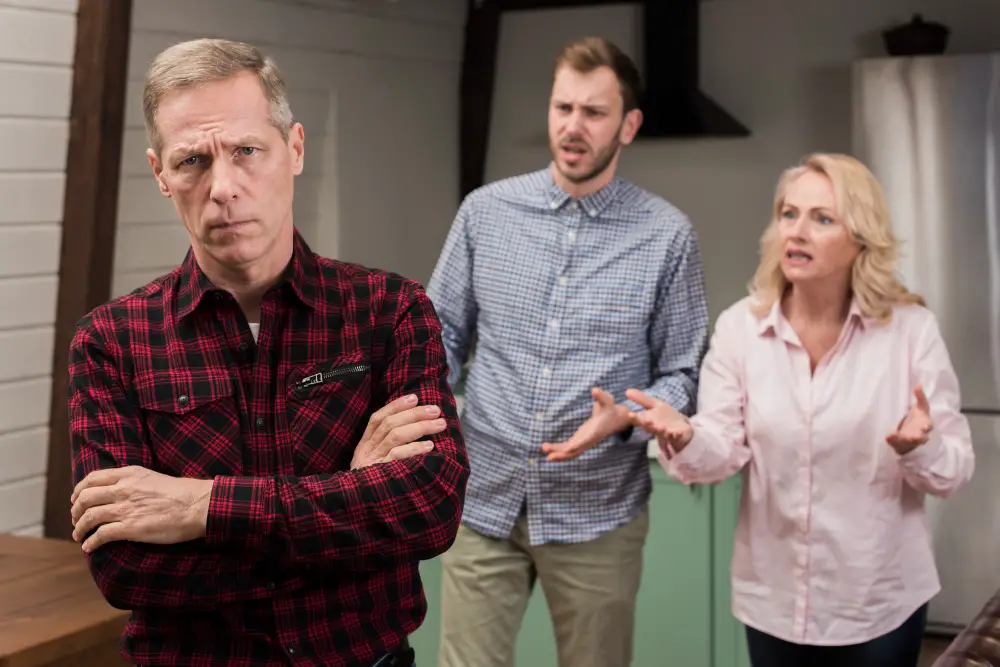
Stacked on the front porch were the cardboard remains of my life. My winter coats, my books, the leather-bound journals I had kept since the day Kellen was born. Milo Redmond, my daughter-in-law’s boyfriend, was already hauling my leather armchair toward the garage. He had the particular haste of a man who had decided this was already his house and was impatient with the last traces of the previous occupant.
Brin stood in the kitchen doorway with her arms folded, watching.
I had spent forty years as a bridge inspector in Michigan. I knew what rot looked like from the outside. I had just never expected to find it here.
“Brin,” I said, keeping my voice level. “What is the meaning of this?”
“The house is evolving, Silas,” she said. “We need the space for people who actually contribute.”
Before I could answer, the screen door flew open and Quinn ran at me, her nine-year-old face streaked with tears. She made it three steps before Brin’s hand shot out and caught her by the arm with a force that turned my vision red.
“Go to your room,” Brin told her, steering her back inside. Then she looked at me. “The basement is more than enough for a man who just sits and grieves.”
What followed was not a conversation. Milo put a palm against my chest and walked me backward through the kitchen to the narrow door behind the pantry. I tried to hold my ground, but the combined weight of their contempt was its own kind of pressure. The deadbolt clicked behind me, and I was standing in the dark, damp silence of the cellar I had helped my son pour the foundation of thirty years ago.
I stood there in the dark and breathed.
Then I pulled the cord on the single naked bulb and started taking stock.
My workbench was buried under black trash bags stuffed with my own clothes. A heavy tarp had been tied over the main heating vent with industrial twine. They had cut off the heat before I even stepped through the door. Near the back wall, where I kept a small metal safe, I found the lock pried open with such force that the hinges were nearly severed. My birth certificate, my social security card, the deed to the property, and Kellen’s final medical reports were all gone.
I sat on a plastic crate in the silence. A mouse crossed the floor. The furnace kicked on with a sound like something growling in the walls.
I had built things for forty years. Inspected things for forty years. I knew what structural failure looked like long before the collapse was visible to anyone else. A hairline fracture in a weld, a rust bloom beneath a painted surface, the particular sag of a bearing plate beginning to give. I had always trusted that instinct.
I had not trusted it here. Not with Brin, who had been precise and cold since the day Kellen introduced her, and whom I had dismissed as simply a private person. Not with Milo, who had been around the house more often in the past year than any contractor had reason to be. Not with the slow, sad dimming of my son in those final months, which I had attributed entirely to the disease that had managed him since childhood.
I had been looking at the paint and calling it sound.
On the ground near the safe, caught under a scrap of cardboard, was a single torn photograph of Kellen, his face ripped through the smile. Below it lay a piece of paper that had fallen from the safe in the rush. I picked it up. It was a copy of a voluntary power of attorney transfer, signed with a perfect replica of my handwriting.
I understood then what this was. Not grief made difficult. Not a family in conflict. This was a procedure. They had been planning it before he died, perhaps long before, and the procedure had continued without interruption from the funeral to this moment in the basement.
I took out my phone and called my brother.
Garrett Vance was sixty-four years old and retired from thirty years of Detroit homicide, and he answered on the fourth ring with the sharpening focus of a man whose instincts had never fully clocked out.
I whispered everything to him. The eviction. The forged document. The stolen papers. Then I told him what I had been too stunned to say aloud since the funeral.
“Garrett, I think Kellen was murdered.”
The silence on his end lasted exactly one second.
“Tell me why you’re using that word,” he said.
I told him about Kellen’s final weeks. The constant thirst. The nausea. The sickly sweet smell on his breath that the doctors attributed to diabetic ketoacidosis. I told him about the small cups Brin had brought into the room, the supplements she said came from Milo’s construction contacts, the high-grade electrolytes she insisted on giving him to keep him hydrated. I had thanked her for that. I remembered thanking her.
Garrett was quiet for a moment. Then he told me he had already run a preliminary background check on Brin after the funeral, because her clinical absence of grief had struck him the same way certain crime scenes struck him: too clean.
“Don’t touch anything else,” he said. “Don’t confront her. Keep that door bolted from the inside. I’ll be there by six.”
When I hung up, the house above me went quiet. Then I heard it. A slow, deliberate weight on the floorboards directly above the basement door. Not the house settling. Someone standing perfectly still.
The shadow under the door held for three long minutes before it moved away.
Garrett arrived at dawn in his Ford pickup, which he parked at an angle that pinned Milo’s sedan into the driveway. I watched through the narrow basement window as Milo came onto the porch and Garrett met him at the bottom of the steps with a manila folder against his thigh and forty years of controlled authority in his posture.
“I don’t care who you are,” Milo said.
Garrett told him that Silas Vance owned fifty percent of the property he was standing on, which made Garrett an invited guest and Milo a trespasser if anyone wanted to get formal about it.
Milo retreated into the house. His eyes had gone somewhere between angry and afraid, and afraid was the more honest of the two.
When Garrett came down to the basement, he did not hug me. He looked at the perimeter the way he used to look at crime scenes, methodically and without sentiment. He checked the coal chute at the back wall and found the hinge had been welded shut from the outside with a fresh bead of slag. He pulled the tarp from the heating vent and found the intake choked with a thick sticky residue. He knelt by a loose floorboard near the water main and pried it up to reveal a cache of empty unmarked plastic bottles and a pair of heavy construction gloves.
“This isn’t a dirty basement,” Garrett said. “This is a controlled environment.”
Then he reached into the rafters above my head and pulled out a small black plastic box with a blinking red light. A baby monitor. She had been listening to every breath, every conversation, every cough.
His eyes moved to my water jug on the workbench. He shone his light on the lip and went still.
A line of blue crystalline residue ran along the plastic edge. I recognized the color. It was the same shade as the industrial antifreeze Milo used in bulk on his construction sites.
Garrett sat on the edge of the workbench and did not touch the jug.
“Silas,” he said. “This is a higher concentration than someone would use to make a person chronically ill. Whoever is doing this is in a hurry.”
I thought about Kellen’s breath. The sweetness. The thirst. Garrett explained it to me in the language of forensic chemistry: ethylene glycol metabolizes into calcium oxalate crystals that shred the kidneys from the inside. In a diabetic patient, the presentation was nearly indistinguishable from organ failure caused by the disease itself. You had to look for it specifically. Nobody had looked.
We were still talking when Quinn appeared at the top of the basement stairs, trembling in her pajamas, her voice barely above a breath.
She told us she had watched her mother stir blue syrup into her father’s morning coffee for months. She said Brin had called it special medicine for Daddy’s kidneys. Once, to prove it was safe, Brin had made Quinn taste a small drop. It was sweet, Quinn said. But it made her tongue feel fuzzy.
I pulled her into my arms while she shook, and I looked at Garrett over the top of her head.
“She’s behind the soap under the kitchen sink,” Quinn said. “A square blue bottle with an orange cap.”
We sent Quinn with the neighbor, Margaret Holloway, who had been watching this house with the sharp attention of a woman who understood what a family in trouble looked like. The moment Brin’s car turned the corner, we moved.
We went to the grandfather clock in the living room first. Kellen had been a civil engineer, a man who designed systems with redundancies built into the redundancies. His last coherent words to me in the ICU had seemed like delirious rambling. Smoke and clocks. Don’t let her. Quinn’s birthday.
It had taken me until the basement to understand what he meant.
Garrett found the pinhole lens fitted into the case just above the Roman numeral twelve. Behind the pendulum weights was a palm-sized black storage hub connected to a separate battery backup. Even a power cut would not have stopped it from recording.
The smoke detector in the foyer held a second lens.
Kellen had turned his own house into a witness.
We retrieved both units and the engineering laptop from my truck. The cloud password was 051505. May fifteenth. Quinn’s birthday.
Forty-seven files.
We opened the first one.
The kitchen appeared on screen in high definition. Brin alone at the counter, her movements efficient and unhurried. She pulled the blue industrial bottle from beneath the sink. Measured a precise amount with a dropper. Stirred it into a ceramic mug until the tint disappeared into dark coffee. Then checked the calorie count on a creamer bottle before adding it, making sure the additional sweetness would not spike his glucose monitor and alert him to something wrong.
When Kellen walked into the frame, he looked tired but grateful. He thanked her. He took a long sip from a mug that read World’s Best Dad. She kissed him.
In the reflection of the microwave door, Milo Redmond stood in the mudroom with his arms crossed, watching.
The remaining files formed a timeline. Kellen growing thinner. His hands beginning to shake. A clip from May in which Brin drew his insulin from the vial and replaced it with saline mixed with a low-grade irritant, ensuring the injection would sting enough to feel real. She was not just poisoning him with antifreeze. She was stripping him of his only defense, letting his own blood sugar go unchecked while the crystals formed in his kidneys.
In the final healthy footage, Kellen stood in the kitchen and looked directly into the smoke detector camera. He did not speak. He held up his engineering notepad for three seconds, showing a frantic page of calculations proving that his insulin-to-carb ratio made no mathematical sense. Even as his organs were failing, he was doing the math.
He was his own lead investigator.
The audio files Garrett found in a hidden partition were the last piece. Brin’s voice, recorded in the living room with the casual confidence of someone who never imagined accountability. She spoke of Kellen’s life insurance and the home’s equity as their Florida retirement fund. She spoke of me as something to be managed until I could be disposed of. Milo laughed.
“By the time he realizes the water tastes sweet,” Milo said, “he’ll be too weak to scream.”
There was a second folder on the drive labeled with the name Doris, Brin’s mother. Wire transfers. A shell company in Tampa called DH Management. A beachfront property purchased three weeks after Kellen died. And buried in the company’s board of directors, a third name. Milo’s estranged brother.
This was not one woman’s crime. It was a family enterprise.
We had the drive copied to an encrypted USB and the house restored to its original state within the hour. I was back in the basement when I heard Brin’s car return fifteen minutes early.
On my workbench sat a fresh glass of water I had not left there. A faint blue ring marked the bottom of the glass.
She had been busy while she was out.
I sat on my cot and waited. My brother was behind the furnace. The police were two blocks away with Garrett’s signal. And the laptop was in my bag with forty-seven files and six hours of audio, ready to play.
Confrontation arrived the next morning in the shape of a settlement meeting Brin arranged herself, confident in the outcome. She sat across from me in the living room with Milo at her side, occupying the furniture as though the deed were already rewritten. She spoke of a care facility in Brighton. She spoke of cognitive decline. She said the transition would be smooth if I cooperated.
I let her finish.
Then I slid Margaret Holloway’s certified copy of the 2012 property deed across the coffee table. My name. Joint tenant with right of survivorship. Fifty percent of every board and nail in that house, reverting on Kellen’s death not to Brin but to a protective trust managed by me until Quinn came of age.
I also slid across the forensic audit Jonathan Reeves, my attorney, had spent the prior night preparing. The fraudulent loans. The forged signature. The quarter-million dollars moved to Tampa within hours of Kellen’s recorded time of death.
Brin tossed it aside without looking at it.
“You’re a confused old man with an old piece of paper,” she said. “I am the grieving widow. I have the death certificate and the estate. You are living in my basement.”
“You’re a trespasser on my son’s land,” I said.
Milo stood up. His hand went to his jacket pocket, and I caught the glint of a small medical vial. He was going to sedate me, claim I had become violent, and have me removed before the sun went down.
I opened the laptop.
The video began to play. Brin at the counter. The blue bottle. The measuring dropper. The careful check of the creamer label. Kellen walking in with tired eyes and a mug in his hand, thanking her for taking such good care of him.
The color left her face with a speed I have never seen in another human being. She sat very still for a moment, watching herself on the screen, watching the version of herself that had never imagined she would be seen. She looked like a person watching their own autopsy.
“Shut it off,” she said. Her voice cracked on the second word.
“This is a livestream,” I told her. “The district attorney’s office has been watching since you sat down.”
She tried to compose herself. She reached for the language she had always used, the language of my confusion, my age, my grief distorting my judgment. But the words did not come the way they usually did. There was a grinding quality to her voice now, like a mechanism that had lost its lubrication.
“That is a deepfake,” she said. “You are a sick old man who has been in my basement talking to himself for weeks. Nobody will believe a single word you say.”
“Then let the jury decide,” I said. “There are forty-seven files.”
Milo went for the hallway. Garrett stepped out of the dining room shadow with his service weapon leveled and a voice like iron. “Sit down, Milo.”
In her panic, Brin lunged for the laptop. I pulled it back. She turned and screamed at Milo that he should have used more, that he should have finished it the way they finished Kellen, and in that moment she confessed to two attempted murders in front of a room full of witnesses and a live connection to the district attorney’s office.
The front door opened. Officers flooded the room.
As they brought Brin to her knees, an officer found in her jacket pocket two one-way tickets to Tampa dated for that evening.
She had not planned to institutionalize me. She had planned to be gone before anyone found what was left.
“You’re going to rot in that basement,” she told me as they walked her down the porch steps she used to descend with such deliberate grace.
I leaned against the railing. “No,” I said. “I’m going to sleep in my own bed tonight. You’re the one going to the cellar now.”
The exhumation order came three days later. The lab work took two weeks. The toxicology results confirmed lethal concentrations of ethylene glycol in Kellen’s tissue, along with the calcium oxalate crystals that had made the kidney failure look like a natural progression of his diabetes. My own recent bloodwork showed early traces of the same compound.
Milo’s confession came before the lab results did. He had been recording his own calls with Brin for months as a failsafe against her double-crossing him. He gave the detectives the keys to the offshore accounts, the shell company structure, and a GPS tracker he had personally attached to Kellen’s grave to monitor whether anyone disturbed it.
When federal agents moved on Doris Hargrove in Tampa, they found the beach house purchased with the stolen funds and a document on her kitchen table: a PDF titled Diabetes Complication Mimicry, sent to Brin two years before Kellen’s death. This had not been a crime of opportunity. It had been a plan with a research phase.
The trial lasted eleven days. Brin’s defense attorney tried to portray me as confused and erratic, pacing the courtroom with the practiced ease of a man who believed that a well-dressed performance could substitute for the truth. He spent an entire morning on my age, my grief, my months in the basement, trying to construct the portrait of a man whose mind had caved under pressure and who was now retaliating against the people trying to care for him.
He introduced a surprise witness who claimed I had a longstanding history of paranoid behavior. The witness was Milo’s estranged brother, the third director of the Tampa shell company. Judge Myra Thorne, a woman with eyes like a machine that processed evidence without sentiment, threw the testimony out without ceremony and asked the defense attorney whether he had anything else he would like to waste the court’s time with.
The jury returned in less than four hours.
Guilty on all counts.
Judge Thorne looked at Brin directly when she delivered the sentence, the way you look at something you want to make sure understands it is being seen clearly. “Your crimes were not born of passion,” she said, “but of a calculated, mechanical cruelty that this court finds abhorrent.” She paused, then pronounced life without the possibility of parole into the hush of the courtroom.
I gave my impact statement standing. I told the court that my son had been a man who built things meant to last, who had spent the final months of his life constructing his own case file because he trusted that someone would find it. I told them that the two hundred and forty thousand dollars recovered from the DH Management accounts would be donated in full to a foundation for elder abuse victims. Brin’s mother would never see a cent of the Florida house she had built on my son’s grave.
As the officers led Brin away, she looked back at me once. The performance was finally, completely over. What remained on her face was not hatred, not grief, not fear. It was simply nothing. The expression of someone who had never once looked at another person and seen a person at all.
The house was quiet when I came home.
Quiet in the way a room is after furniture is moved and the air settles into new shapes. I walked through each room slowly. The family photographs were back on the mantle. Eleanor’s remaining pieces were where they belonged. The grandfather clock stood in the hallway and its steady tick was the most ordinary sound I had heard in months.
In December I found a padded envelope at the bottom of a box of Christmas decorations, addressed to me in Kellen’s precise architectural handwriting. A concierge delivery service note explained it had been set up to arrive timed. He had mailed it to himself over a year before he died.
Inside was a letter. The date at the top was six months before the end.
He apologized for the distance. He said he had known for a year that Brin was stealing from his firm, and longer than that that something in her was capable of worse. He had not told me because he did not want me inside the house while she was calculating. He had spent those final months building a record and hiding the evidence of his own mind in every structural corner he could find, turning the home into a case file. He asked me to take care of Quinn. He asked me to finish the prototype in the basement, which he had hidden behind a false wall he built himself one Saturday afternoon while Brin was out of town.
He ended with one sentence.
I know you will find this when you need it, because you always knew where to look.
I set the letter down on Eleanor’s table and sat with it for a long time.
In April, Quinn and I planted a cherry tree in the center of the backyard, in the dead patch of grass where Milo’s surveillance van had sat for months, its tires pressing slow dark circles into the soil. We dug deep into the dark earth, working in the kind of quiet that does not need to be filled, the two of us finding a rhythm with our shovels while the spring light came in low and gold through the back fence.
My shovel struck steel.
A rusted lockbox, its lock long since surrendered to the Michigan damp. Inside, sealed in a waterproof pouch that had held its shape through years of frost and thaw, were letters from Eleanor, Kellen’s mother. She had written them before she died, when Kellen was in his early thirties and she could see the shape of things beginning to form around him in ways she could not stop directly but could quietly undermine.
She had funded the purchase of the Victorian through an anonymous trust, she wrote. She had helped Kellen stage his professional failures, creating dead ends and documented disappointments to keep his real work invisible to people who would have claimed it. She had watched from a distance she hated, never visiting openly because she did not want to mark him as a target by association. The house had been a fortress long before any of us understood there was a siege coming.
She ended the last letter with a single line.
He chose you this house because you always knew where the cracks were, Silas. Trust that.
I read the letters sitting in the dirt with Quinn beside me, the two of us quiet in the late afternoon light while the newly planted cherry tree stood over us like a sentry, its roots just beginning to find their way into the dark of the soil below.
That night the house felt different. The floorboards still creaked in the same places, but the sounds no longer carried threat. I checked the locks out of habit, but did it without the cold weight of dread I had carried for seventeen months. In the nursery, the baby Kellen never lived to hold slept in amber light, breathing with the uncomplicated trust of someone who did not yet know how hard the world could be.
I stood at the rail for a moment and then went to my own room.
On the bedside table was the photograph of Kellen I had mended over weeks of careful work, tape seam by tape seam, until his face was whole again. The creases remained, crossing his jaw and brow like silver lines in the old paper, but his eyes were clear and his expression was exactly as I remembered it from the years before he got sick. Before the distance. Before the careful, protective silence he had kept to shield us from something he was trying to handle alone.
Before I turned out the light, I turned my wedding ring in my palm and noticed for the first time a small inscription on the inside of the band that I had never registered before. The letters were tiny and precise, engraved with the clean exactness of an engineer’s hand.
Always home.
I did not know whether Eleanor had put it there decades ago or whether Kellen had found some way to add it during those final careful months, building his record and hiding his evidence and doing what he could to make sure that if the worst happened, the people he loved would still have somewhere to land. Both felt possible. Both felt like him.
I closed my hand around the ring and lay back in the dark and listened to the house breathe around me, the old radiators clicking, the pines moving against the windows, the baby turning in sleep down the hall.
I had spent forty years looking for hidden fractures in steel and concrete, for the invisible flaws that announced themselves only after they had already begun to give way. I had walked suspension cables in January winds. I had crawled beneath drawbridges with a flashlight and a notepad. I had trusted the math of the physical world so completely that I had missed, for years, what was failing structurally in the one place I should have been watching most carefully.
But I had found it. I had stayed.
A bridge inspector knows that a structure is not finished when the last bolt is turned. It is finished when it holds weight. When it carries people across the thing they could not cross alone.
This house was holding.
We were across.

Ethan Blake is a skilled Creative Content Specialist with a talent for crafting engaging and thought-provoking narratives. With a strong background in storytelling and digital content creation, Ethan brings a unique perspective to his role at TheArchivists, where he curates and produces captivating content for a global audience.
Ethan holds a degree in Communications from Zurich University, where he developed his expertise in storytelling, media strategy, and audience engagement. Known for his ability to blend creativity with analytical precision, he excels at creating content that not only entertains but also connects deeply with readers.
At TheArchivists, Ethan specializes in uncovering compelling stories that reflect a wide range of human experiences. His work is celebrated for its authenticity, creativity, and ability to spark meaningful conversations, earning him recognition among peers and readers alike.
Passionate about the art of storytelling, Ethan enjoys exploring themes of culture, history, and personal growth, aiming to inspire and inform with every piece he creates. Dedicated to making a lasting impact, Ethan continues to push boundaries in the ever-evolving world of digital content.