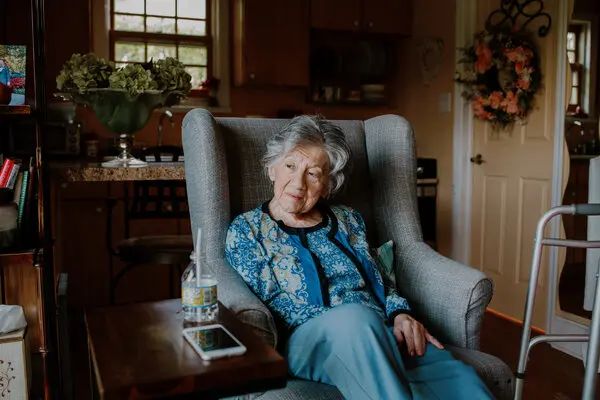
My name is Margaret Patterson. I was sixty-eight years old when my husband of forty-three years decided that a life built together could simply be folded up and handed back to him, like a coat he had grown tired of wearing. He did it without ceremony and without apology, and for a moment I almost admired the confidence of it. Almost.
I had grown up in a small town in central Ohio, the daughter of a postal worker and a woman who made the best pie crust in three counties and never once let anyone forget it. We were not a wealthy family, but we were a precise one. My mother kept every receipt in a shoebox beneath the kitchen sink. My father balanced his checkbook to the penny every Sunday evening before church. I absorbed these habits the way children absorb everything that surrounds them in childhood, quietly and without knowing it, like water rising in a room. I did not think of this as a skill. I thought of it as simply the way things were done.
I met Richard Patterson at a church social in 1979. He was twenty-six and handsome in the way that men who know they are handsome tend to be, with a kind of practiced ease in a room that I later learned was less about confidence than about performance. He was in accounting, just starting out at a small firm downtown, and he spoke about numbers with the sort of reverence most men reserved for sports or cars. I found it appealing. I was twenty-five and I thought a man who took things seriously was a man who could be trusted. That is the kind of logic that makes perfect sense when you are twenty-five.
We married in the spring of 1981, in a small ceremony that my mother spent four months planning and Richard’s mother spent two months quietly critiquing. We bought a house in the suburbs of Columbus, a brick colonial on a quiet street with mature oaks in the front yard that dropped enough leaves in October to bury a car. Richard joined a larger firm. I took a job at a school administrative office and kept it until our first daughter, Claire, was born in 1984. After that came Thomas in 1987 and then little Ann in 1990, and at some point the question of going back to work became more complicated than it was worth, and then it simply became a question nobody asked anymore.
I want to be accurate about this because accuracy matters to me and because the version of events Richard liked to tell, later, was one in which I had simply chosen not to work, as though staying home was a form of leisure I had selfishly elected for myself while he labored on behalf of our family. The truth is that someone had to be home when the children were sick and the schools called. Someone had to be there when Ann had her tonsils out at age four and was terrified of the hospital. Someone had to manage the contractors when the furnace failed in January, coordinate the carpooling schedules, sit with Richard’s mother through her hip surgery when his father was no longer able to, plan Thanksgiving for fourteen people without complaint, and still manage to have dinner on the table on weeknights with a calm expression that said everything was fine. I did all of that. I did it for decades, and I did it well, and not once in forty-three years did my husband look at it as labor. He looked at it as the background of his life.
That, I think, was always the seed of what was coming. He had spent so many years walking past me that he had forgotten I was a person who noticed things.
The first sign was the cologne.
Richard had worked in the same field for thirty-some years and had developed over that time a set of personal habits as fixed and predictable as the tides. He wore the same brand of dress shirt in rotation. He drank his coffee black with half a teaspoon of sugar, a combination I had always found oddly specific. He never wore cologne to the office because, as he had said many times, it was a professional environment and strong scents were inconsiderate. I had heard this opinion often enough that it had become one of those facts about a person you stop consciously registering, like knowing which side of the bed they sleep on.
So when he came downstairs one Tuesday morning in the spring of 2023 carrying a scent I did not recognize, something old and precise in me clicked awake. It was not alarm, exactly. It was simply attention. I noticed the way you notice when a picture on the wall has shifted an inch, not enough to look wrong at a glance, but enough to bother you once you’ve seen it.
I said nothing.
After that, things shifted in ways that were each individually small and collectively impossible to ignore. Late-night phone calls he took outside, standing in the garage with the door half-closed. Restaurant receipts I found in the pocket of his jacket when I took it to the dry cleaner, receipts from places we had never gone together and for amounts that assumed two people sharing a bottle of wine. A hotel charge on the credit card statement for a city an hour away, on a Tuesday night when he had told me he was staying late for a client dinner. Cash withdrawals of two or three hundred dollars scattered between ordinary weekly expenses like groceries and gas, amounts small enough to seem casual, regular enough to be a pattern.
I gathered all of this not with the intention of confronting him but simply because gathering information was the way I had always moved through the world. My mother’s shoebox. My father’s Sunday night ledger. I put things in order. I kept notes. I said nothing and watched and waited and tried to understand the shape of what was happening before I decided what to think about it.
The worst part was not the evidence itself. Evidence is just data. The worst part was the way he looked at me during that period, at dinner, passing in the hallway, sitting across the living room while the evening news played. He looked at me with an expression I had seen before on the faces of people sitting in waiting rooms, a kind of glazed, distant patience, as though they were simply enduring the present moment until something better arrived. He looked at me like I was a room he was renting until his real life could begin.
I asked him once, over dinner, whether everything was all right at work. A simple question. He looked up from his plate with a flash of irritation he didn’t quite manage to suppress, told me everything was fine, and turned back to his food. The irritation was the tell. When everything is actually fine, people say so without irritation. Irritation means the question has landed somewhere tender.
Then one evening in June, he pushed a folder across the kitchen table.
He did not preamble it. He did not sit down slowly and take a breath and say there was something he needed to talk to me about. He set the folder on the table between our dinner plates, and his face had the expression of a man completing an administrative task, something that needed to be done and was now being done. He said, “I want a divorce.”
I looked at him.
He said he had been unhappy for some time. He said we had grown apart. He said these things the way people say things they have rehearsed, smoothly and without apparent feeling, like lines from a script that has been run too many times in private. He did not apologize. He did not look especially regretful. What he looked like, underneath the rehearsed composure, was relieved.
The folder contained a proposed settlement. He had already had someone prepare it. He wanted the house, the car, the savings accounts, the investment accounts, and the lake house in Michigan we had bought fifteen years ago and where we had taken the children every summer until they were grown. He was willing to let me keep my jewelry, which he mentioned with the specific casualness of a man who believes he is being generous.
I want to describe accurately what I felt in that moment because I think people expect a particular story and I am not sure my story fits the expected shape. I did not cry. I did not feel the hot shock of betrayal that I imagine I was supposed to feel. What I felt was something more like the sensation you get when a piece of furniture you have been navigating around for years is finally moved and the room suddenly makes a different kind of sense. A clarity, almost. A settling.
I understood something I had perhaps known for longer than I admitted to myself. This man, the one sitting across from me with his folder and his distant eyes, was not the problem. The problem was the forty-three years I had spent making myself small enough to fit around him without disrupting anything. And that was something I had done to myself, and I was not going to compound it now by falling apart at the kitchen table.
I took the folder and told him I would have a lawyer look at it.
He looked faintly surprised, as though he had expected something more, tears perhaps, or argument, or desperate negotiation. When I stood and cleared my plate and rinsed it at the sink with the same movements I had made thousands of times before, he sat there for a moment in what I can only describe as mild confusion. Then he got up and went to the living room and turned on the television, and I stood at the kitchen sink and thought very carefully about what I knew and what I did not yet know.
The lawyer I found was a woman named Carol Simmons who had been recommended to me by a friend, a woman who had been through a contentious divorce herself a few years earlier and who told me Carol was worth every dollar. Carol’s office was downtown, on the fourth floor of a building that smelled pleasantly of old wood and carpet cleaner, and she had the kind of manner that was at once no-nonsense and deeply kind, the manner of someone who had spent years sitting across from people in the worst circumstances of their lives and had never lost respect for them.
She looked over the proposed settlement and told me it was, in her professional opinion, aggressive. It was structured to take advantage of the fact that most of the assets were in Richard’s name because most of them had been acquired through his income during a period when I had not been formally employed. She said that Ohio is an equitable distribution state and that forty-three years of marriage entitled me to a fair share, that my contributions as a homemaker and caregiver had real legal value, and that if I wanted to fight this I had a strong case.
I told her I would think about it.
What I did not tell her, because I was not yet ready to tell anyone, was that I had already begun noticing something else. Not the visible signs of an affair, not the cologne and the receipts and the hotel charges. Something quieter. Something beneath the surface of our shared finances that had only become visible to me because I had spent the weeks since Richard’s announcement going through every account, every statement, every document I could access, with the methodical patience of a woman who had been raised in a household where the shoebox under the sink was sacred.
There was a name I kept encountering that I did not recognize. It appeared in some of the financial documents Richard kept in the locked file cabinet in his home office, the one he believed I had never noticed him unlock when he thought the house was empty. I had noticed. I had been noticing things my entire marriage. I had simply never had a reason to act on what I noticed, and so the noticing had accumulated, unseen, like water behind a dam.
The name was a company. Something innocuous and forgettable, two words that could have been anything, a consulting firm or a holding entity or a property management group. Nothing about the name itself was alarming. What was alarming was how money moved in relation to it. Small amounts, consistently, over what appeared to be several years. Never large enough in any single transaction to draw immediate attention. Always timed just slightly off the rhythm of our other financial activity, like a note played a half-beat late, not enough for an untrained ear to catch but unmistakable once you were listening for it.
I am not a forensic accountant. But I am the daughter of people who counted everything, and I had spent forty-three years managing the household finances in practical terms while Richard managed them in formal ones, and I understood how money was supposed to move and how it was not. What I was seeing did not fit any innocent explanation I could construct.
I spent a week writing down everything I had found before I went back to Carol.
I did not go back to Carol.
I found a forensic accountant instead, a quiet, precise man named David Kirsch who had been recommended to me through a contact at a women’s financial support group I had been attending for two weeks by then, a group I had found through the library, which is where I have always gone when I needed to learn something I did not yet know. David operated out of a small office in a nondescript building on the east side of the city, and when I sat down across from him and laid out what I had gathered, he put on a pair of reading glasses and went through everything without rushing and without any of the condescension I had been half-bracing for.
When he looked up, he said, “Mrs. Patterson, this isn’t just preparation for divorce. This is hidden money.”
He said it simply, the way he might have said the weather was about to change. It was a statement of professional observation, not an attempt to alarm me, and the steadiness of his delivery helped me receive it steadily in return. He explained what he believed he was seeing. A pattern of transfers, modest in individual amount but significant in aggregate, moving through the company name I had flagged and into what appeared to be a separate account that was not reflected anywhere in our joint financial records. Not a recent development. Something that had been building for years, perhaps three or four at minimum.
The total he estimated, after several days of more thorough examination and with the caveat that a full audit would be required to confirm the figures, was somewhere in the range of a hundred and eighty to two hundred thousand dollars.
I drove home from that meeting and sat in my car in the driveway for a while before I went inside. Not because I was upset. I had moved past upset somewhere in the previous weeks in a way I could not fully explain except to say that there is a point at which the thing you feared turns out to be true and you feel, strangely, less afraid, because at least you know what you are dealing with. What I felt sitting in that car was something more like the gathering of purpose. A quiet sort of readiness.
I went inside and made coffee and opened every drawer I had been vaguely aware of but had never thought to examine closely, because why would I, because the house was my domain and the finances were his and that had been the unspoken agreement for forty years, an agreement I now understood had been maintained not through mutual respect but because it was convenient for him that I not look. I looked. I found documents that corroborated what David had been piecing together. Account statements. Correspondence. Records of transfers between entities whose names I had never seen on any of our joint paperwork.
I photographed everything. I organized it into folders on my computer, labeled carefully, dated where possible. I sent copies to David. I sent other copies to a second location that is nobody else’s business.
Richard, during all of this, believed I was grieving.
He moved through the house with the slightly guilty ease of a man who has done a hard thing and has decided to view the discomfort of others as evidence of his own significance. He asked me periodically whether I had looked over the papers. I told him I had my lawyer reviewing them, which was true. I did not tell him what else was being reviewed. He accepted this with patience because he expected the process to take a few weeks and then to conclude in his favor, and patience in the service of expected victory is easy to maintain.
He began, around the third week, spending less time at home. He told me he was staying at a colleague’s place, which was presumably the colleague whose cologne had first announced itself on a Tuesday morning in spring. I did not object. His absence made the house easier to work in.
There was one evening, about ten days after he had mostly moved out, when I was sitting at the kitchen table with my laptop and I heard a car in the driveway. I looked out the window and saw Richard getting out, and behind him, getting out of the passenger side, was a woman. She was considerably younger than me, which I had expected, and she had the particular energy of someone who has been told she has won something and has not yet considered what the winning might cost. She stood in my driveway and looked at my house with an assessing expression, the kind of look you give a property you are thinking of acquiring, and I watched her from the kitchen window with a cup of tea cooling in my hands and felt nothing toward her that I can honestly describe as anger. What I felt was closer to a kind of tired clarity. She had not taken anything from me that had not already been taken long before she arrived.
Richard came inside briefly to collect some things. He was pleasant in the breezy, managed way of a man who wants to believe the situation is under control. He asked again about the papers. I told him we were almost there. He nodded and went back outside and said something to the young woman that made her laugh, and they drove away, and I went back to my laptop.
I want to say something here about the two weeks I spent in that house alone, or nearly alone, because I think they have been misunderstood, in the telling and the imagining of this story, as weeks of waiting. They were not weeks of waiting. They were weeks of preparation, which is a different thing. Waiting is passive. Preparation has a direction to it. I was not sitting in my house hoping something would happen. I was methodically ensuring that when something happened, I would be ready for it.
I spoke to Carol Simmons three more times during that period. I spoke to David Kirsch several more times. I spoke to a second attorney, a man specializing specifically in financial fraud in the context of family law, who had been recommended to me by Carol once I had explained to her the full scope of what I had found. This second attorney, whose name was James Hollis, reviewed everything David had assembled and told me, in precise and careful language, that we were looking at a strong case for fraudulent transfer and intentional dissipation of marital assets, which are legal terms for hiding money that belongs to both of you so that the court divides a smaller pie.
He told me what the options were. He told me what the likely outcomes were. He told me what he would need from me, and I gave him everything he needed, organized in the format he specified, with labels and dates and supporting documents, because that is the way I have always worked.
Richard kept asking about the papers.
I told him yes. I told him I was ready to sign. I told him, when he asked directly, that I had decided to take the settlement as offered. His voice on the phone carried a note of satisfaction so unguarded it would have been almost poignant under different circumstances. He said he was glad I was being reasonable. I told him I just wanted things to be resolved.
He came back to the house on a Friday morning to collect the signed documents and a few remaining personal items. He was in good spirits, visibly so, the kind of good spirits that belong to a person who has gotten what they wanted without having to fight for it. He thanked me, in the particular tone of a man thanking someone for not making things difficult, and I gave him the signed documents with a calm smile, and he tucked them under his arm with the casualness of a man collecting his dry cleaning, and he left.
That was a Friday.
For the next two weeks I let him have his victory. I want to be honest about this because the question of why I waited has come up, and the answer is simpler than it might appear. I waited because James needed time to prepare the filing correctly. I waited because David needed to complete the full audit. I waited because in a proceeding involving fraudulent transfer of marital assets, the quality of the documentation matters enormously, and rushing a well-built case for the satisfaction of confronting someone sooner is a form of impatience I could not afford.
I also waited because I wanted there to be no ambiguity. I wanted it to be unmistakably clear, to every court and every document and every subsequent review of this situation, that Richard had acted freely and deliberately. That he had presented a settlement he believed was final. That he had celebrated. That the confidence with which he moved during those two weeks was his own, uncoerced, a full expression of what he assumed and intended. I wanted his certainty preserved, intact, as evidence of itself.
There was a morning, near the end of the second week, when I was in the garden. The roses along the back fence were coming into their late-summer bloom, deep reds and pale creams that I had been tending for twenty years, that had survived every Ohio winter through a combination of good soil preparation and the specific stubbornness required to maintain something beautiful in a difficult climate. I was trimming back a branch that had grown too heavy when I heard a car on the street. I looked up.
A dark sedan pulled to the curb. A man got out. He was professionally dressed, carrying a folder, and he stood on the sidewalk for a moment looking at the house number, then at the driveway where Richard’s car was parked, as though confirming he had the right address. Then he walked toward the front door with the purposeful stride of someone completing a scheduled appointment.
Inside the house, through the open kitchen window, I could hear the faint sound of Richard’s voice, probably on the phone, relaxed and unhurried.
I set down my shears. I pulled off my gardening gloves, one finger at a time, and I folded them together and set them on the garden bench. I stood in the morning light among the roses and watched the man reach the porch steps and raise his hand to knock, and I felt something settle inside me like the last piece of a puzzle finding its place.
It was not triumph, exactly, though I understand why people would read it that way. It was more like completion. Like the satisfaction of a long calculation finally resolved, every number in its proper column, the total exactly what you knew it would be.
What followed that knock on the door, and the days and weeks that came after it, is a matter of legal record and does not require elaborate retelling here. Richard discovered, in stages, what I had found and what I had done with what I found. He discovered that the settlement he had believed was final was not final, because a signed settlement document does not supersede an ongoing proceeding for fraudulent transfer of marital assets. He discovered that the company name he had built his hidden architecture around was not as invisible as he had assumed. He discovered that the wife he had believed was too domestic, too trusting, too thoroughly managed to understand the mechanics of money, had in fact understood them all along, and had been paying very close attention.
He hired a second attorney. The second attorney advised him to negotiate.
The process took several months and was not without difficulty. I will not pretend it was painless or that the legal proceedings were simple or that there were not moments of exhaustion so deep I questioned whether any of it was worth the effort. There were days when I sat in James Hollis’s office and listened to the back-and-forth of offers and counteroffers and felt something very close to grief, not for Richard specifically but for the version of my life I had believed I was living, the version in which the man across the kitchen table was the man I thought he was. That grief is real and I do not minimize it by also saying that I did not let it stop me.
My children were not uninvolved. Claire, who is practical and fierce in equal measure and who has her grandmother’s precision with a balance sheet, was furious in the way that daughters are furious when they discover a parent has been deceived. Thomas took it harder emotionally and needed more time to process what it meant about the father he thought he knew. Ann, the youngest, surprised me. She sat with me one evening in the kitchen, the two of us with cups of tea at the same table where the folder had been pushed across, and she said, “Mom, I always knew you were the one holding everything together. I just didn’t know you knew it too.” I did not cry at this, but I came closer than I had come at any other point in the preceding months.
The final settlement, negotiated and formalized over the following year, bore very little resemblance to the folder Richard had pushed across the kitchen table. The hidden assets, once fully documented and traced, were treated by the court as part of the marital estate, which they were. The lake house went to me. A substantial portion of the investment accounts went to me. The house, the brick colonial with the oak trees that buried the front yard every October, went to me. Not because I wanted to defeat Richard, though I understand that is the narrative people reach for. Because those things were as much mine as his, and the only reason they had ever appeared not to be was that someone had spent forty-three years ensuring that I would not think to question the appearance.
I still live in the house. The roses along the back fence came back beautifully this past spring, as they always do, patient survivors of difficult winters. I take my coffee on the back porch in the mornings now, without the faint tension that had lived in that house for longer than I had admitted to myself. Claire visits often. Thomas brings his family at Christmas. Ann called me last week to tell me she had recommended me to a friend of hers who is going through something similar, a woman who needed, Ann said, to hear from someone who had been through it and had not simply endured it but had met it on her own terms.
I told her to have the woman call me.
I think about what people assume when they look at a woman like me, sixty-eight years old, white-haired, a homemaker, a grandmother, someone who spent four decades in the background of a story that seemed to belong to someone else. I think about what Richard assumed, which is essentially the same thing. That the background is passive. That the person who manages the household and remembers the appointments and knows where everything is and has been paying attention every day for forty years is somehow less equipped to understand the world than the person whose name is on the accounts.
My mother kept every receipt. My father balanced his ledger every Sunday. I learned, without knowing I was learning it, that the careful management of small things is not a lesser form of intelligence. It is a form of power, quiet and patient and precise, that announces itself only when it needs to.
Richard made many mistakes in those final months of our marriage. He underestimated what forty-three years of paying attention looks like when it is finally pointed in a direction. He confused my patience with passivity. He assumed that because I had never fought, I did not know how.
That was the only mistake that mattered.
I set the shears down. I pulled off my gloves. I stood among the roses in the morning light, and I smiled, and I was not afraid of a single thing.

Lila Hart is a dedicated Digital Archivist and Research Specialist with a keen eye for preserving and curating meaningful content. At TheArchivists, she specializes in organizing and managing digital archives, ensuring that valuable stories and historical moments are accessible for generations to come.
Lila earned her degree in History and Archival Studies from the University of Edinburgh, where she cultivated her passion for documenting the past and preserving cultural heritage. Her expertise lies in combining traditional archival techniques with modern digital tools, allowing her to create comprehensive and engaging collections that resonate with audiences worldwide.
At TheArchivists, Lila is known for her meticulous attention to detail and her ability to uncover hidden gems within extensive archives. Her work is praised for its depth, authenticity, and contribution to the preservation of knowledge in the digital age.
Driven by a commitment to preserving stories that matter, Lila is passionate about exploring the intersection of history and technology. Her goal is to ensure that every piece of content she handles reflects the richness of human experiences and remains a source of inspiration for years to come.