Trust the Farm
Seven days after I buried my wife, a lawyer in Century City read her will aloud in a room that smelled of leather and air conditioning, and handed my son the keys to a five-million-dollar penthouse in Los Angeles. Then she turned to me, slid a rusted iron key across the mahogany table, and told me that Jenny had left me an old farm two hours north, a property no one in the family had discussed in years. Marcus called it a burden before we had even pushed back our chairs. Within a week he had contractors moving through the penthouse with paint samples and lighting fixtures, and a legal notice waiting on the dresser in the guest room where I was sleeping. I drove toward that farm with one duffel bag, a wedding photograph, and my wife’s gray cardigan folded on the passenger seat, trying to understand why she had wanted me there so badly.
Jenny always had a reason for the things she did. That was the first thing you learned about her and the last thing you forgot.
She was the kind of woman who could walk into a room full of men in expensive suits, men who had been in that room for decades and believed they owned it, and leave with the lease, the permits, and the best coffee on the table. She had built a career in commercial real estate the way she built everything: with clean lines and no wasted motion, every decision carrying weight. She read contracts the way I read history, looking for what was underneath the surface, what the language was protecting or concealing, what the original intent had been before it got translated into fine print.
I was a history teacher.
Chalk dust, red pens, yellow legal pads, the steady rhythm of semesters. For forty years I had stood in front of classrooms and tried to convince teenagers that the past was not dead, that it was pressing on them right now whether they felt it or not, that understanding it was the only honest preparation for whatever came next. I loved the work. I was not ambitious in the way Jenny was ambitious, and she had never needed me to be. We made that difference between us look easy for four decades, which is its own kind of achievement.
Then she got sick.
The diagnosis came on a Tuesday in October, in a doctor’s office with a window that faced a parking structure, and the way Jenny received the news was the way she received all difficult news: quietly, with complete attention, asking the specific questions that cut through the soft language doctors sometimes use when they are trying to be kind. She left that office knowing exactly what she was dealing with. She did not cry until we were in the car. Then she cried for about three minutes, and then she stopped, and she said: all right. Let’s think about what needs to be done.
In the months that followed, she began making quiet preparations I did not fully understand at the time. She took meetings with her attorney behind a closed door. She asked me to find old family documents from boxes in storage. She made several trips I did not know about until later, driving somewhere north of the city and coming back in the late afternoon with a look on her face that I recognized as the look she wore when she had accomplished something significant and was not ready to talk about it yet.
She kept saying: trust the farm. When it happens, whatever else is happening, trust the farm.
I thought she meant sentiment. She had grown up spending summers on her family’s property in the central valley, the same land that had eventually passed to her, and I had always understood her attachment to it as the particular attachment people have to childhood places, the places where a version of yourself still lives in the walls. I thought she wanted me to hold onto that connection after she was gone. To let it be a comfort.
I did not understand that she meant it as an instruction.
At the will reading, Marcus arrived in the suit he wore to closings, the charcoal one that his wife had told him made him look authoritative. He brought Jessica, who sat beside him with her hands folded and her expression calibrated to the occasion. They were not unkind people, Marcus and Jessica. They had been good to Jenny during her illness in the ways that were convenient, stopping by with food, sending flowers, organizing one family dinner that had gone awkwardly but with the right intentions. I did not know yet who my son was becoming. I was still seeing him through the long lens of the boy he had been.
The lawyer’s name was Patricia Aldren. She had been Jenny’s attorney for twelve years and she conducted the reading with the precise, respectful formality of someone who has done this work long enough to understand what grief looks like at a conference table. She got through the preliminary language, the identification of assets, the descriptions of accounts and holdings, and Marcus was fine through all of it, upright and attentive, until she reached the penthouse.
His whole posture changed.
It was subtle but unmistakable: a slight rise of the shoulders, a settling back in the chair, the release of a breath he had been holding. Jessica touched his wrist. The small private smile passed between them, quick as a signal.
Then Patricia said my name.
To Samuel Preston, she read, the property known as Preston Farm, including the farmhouse, outbuildings, and surrounding acreage, held in trust since her grandmother’s time, to be transferred in full and without encumbrance.
Marcus turned to look at me.
“That’s it?”
Patricia adjusted her glasses and continued. There was also a sealed letter, she said, to be opened on the property.
My son laughed. Just once, under his breath, the way people laugh when they are genuinely surprised and the surprise is not entirely welcome.
“A run-down farm and a mystery envelope,” he said. “Mom really knew how to make a point.”
I was looking at the key in my palm. Old iron. Cold in a way that had nothing to do with temperature. Heavier than a key had any reason to be.
“Your wife was very deliberate in her decisions,” Patricia said. She said it to Marcus, quietly, with the tone of someone who has earned the right to say a thing like that in a room like this.
Marcus stood and collected his jacket from the back of the chair. He looked at me with an expression that I had seen before on other people but had not expected on my son: the expression of someone who has already written a story about you and is slightly irritated that you have not read it yet.
“Dad, don’t be surprised when you get up there and find a tax bill and a bad roof.”
I should tell you something about Marcus.
He was not always this person. I want to be precise about that, because it matters and because the convenient version of this story would cast him as straightforwardly villainous, and he was not that, not exactly. He was a man who had spent fifteen years in a city that rewarded a specific kind of clarity about what things were worth, and that clarity had gradually migrated from his professional life into the rest of it. He had learned to evaluate. He had gotten very good at it.
There was a boy before that man, a boy who used to run across our backyard in bare feet with a plastic shovel, convinced that any patch of turned earth might be holding something worth finding. A boy who helped Jenny plant roses along the patio wall and came inside with mud on both knees asking whether roots could hear people talking. A boy who used to fall asleep on the couch with his head in my lap during the long summer evenings and wake up confused and soft and not yet embarrassed about it.
Grief does different things to different people, and money does other things, and the combination of the two can move a person further from themselves than they know how to measure. I am not excusing what Marcus did. I am trying to be accurate about how it happened, the way I always tried to be accurate in the classroom, because accuracy is the only honest form of understanding I know.
Three days after the will reading, the drilling started at six in the morning.
Not one drill. Several, working in different rooms simultaneously, the sound overlapping and ricocheting through the building’s clean lines. When I made it downstairs in the clothes I had slept in, workers were moving through the foyer with boxed lighting fixtures and rolls of brown paper to protect the floors. Marcus stood in the living room with an espresso in one hand and a contractor’s clipboard in the other, already in conversation with two men who were measuring the wall.
“You didn’t say they were starting this early,” I said.
He didn’t look up from the clipboard.
“I have a schedule.”
The door to Jenny’s study stood open. I had kept it closed since we came home from the hospital. Her shelves were still full: the files she had organized by year, the notebooks she used for site visits, the small framed photographs she kept on the second shelf from the top, her and me on a beach in Portugal fifteen years ago, her and Marcus the summer he graduated, her grandmother standing in front of the farmhouse with her hand shielding her eyes from the sun. The brass lamp she read by at night was still where she had left it. On the far wall, the large framed survey map she had loved for years, the one she could stand in front of for ten minutes just tracing roads with her finger, was coming down. One worker had it off the hook and was wrapping it in brown paper.
“Wait,” I said. “Those are her things.”
Marcus finally looked at me.
“The place needs to be updated.”
“Your mother has been gone one week.”
He exhaled with the patience of someone explaining something to a person who is being unnecessarily complicated.
“Jessica and I are moving forward.”
That afternoon I found the notice on the dresser in the guest room.
It was on thick cream paper, folded along a clean crease, placed beside the lamp with the neatness of someone who had thought about where to put it. Twenty-two days. The message below the date was shorter than anything I would have expected from my son. I need the room cleared by the end of the month. Not: I think it would be better for both of us. Not: I know this is hard. Just the date, and the request, and nothing else.
When I went downstairs Marcus was in the kitchen with his phone. Jessica was somewhere in the back of the apartment. I could hear her on a call.
“You’re serious,” I said.
He set the phone face-down on the counter and leaned back with his arms crossed. He was wearing the expression he wore in negotiations, the one Jenny had once described to me as his closed door face.
“Dad, the farm is yours. You can live there, sell it, lease it, whatever you want. But this place is part of our life now, and we need to get started.”
“This was our home.”
He looked at me for a long moment.
“And now it’s mine.”
I packed that night in the guest room without turning on more lights than I needed. I folded shirts I did not particularly care about into the duffel bag. I took the wedding photo from the nightstand and wrapped it in a shirt so the glass wouldn’t break. I went to the closet where I had put some of Jenny’s things when we moved them from the bedroom after she passed, and I took her gray cardigan from the hanger, the one she wore on cool evenings when we sat on the balcony, the one that still held the faintest trace of her perfume near the collar.
In the morning, loading the last box into the car, I noticed the recycling bins near the curb.
Something bright and glossy was sitting on top of the other paper: a brochure for a private residential community outside Bakersfield. I recognized the type immediately: beige carpet, manicured hedges, photographs of smiling older people arranged in comfortable common rooms under soft lighting, the whole visual vocabulary of a place that was designed to seem cheerful and managed not quite to be. Behind the brochure was a draft intake form.
My name was already typed on it.
A move-in date had been selected.
The date was three weeks before Jenny died.
I stood in the driveway with the California sun moving across the windshield of the truck and read the form twice, slowly. Marcus had not put it there to be found. It had been in the recycling by accident, discarded when the plan became unnecessary because the will had solved the problem for him more neatly than assisted living would have. He had not planned for me to stay and he had not planned for me to simply go. He had planned for me to be placed.
Jenny had known.
I did not know how much she had known, or exactly when she had understood what Marcus was becoming, but I understood now why she had spent those last months making quiet preparations. I understood the meetings with the attorney and the trips north and the instruction she had delivered in that calm voice she used when she needed me to pay attention. She had known I would need somewhere to go that was genuinely mine. She had known I would need a reason to go there that was stronger than sentiment.
She had built me a door before I needed it.
I put the brochure under the blanket in the trunk, not because I planned to use it later but because I did not want to leave it where Marcus might realize it had been seen. Then I drove out of the parking structure and into the pale morning and left Los Angeles behind.
The city loosened its hold slowly, the way it always does. Towers and interchanges giving way to warehouse blocks and flat commercial stretches, then the wide dry margins where the basin meets the edge of things. I stopped once for coffee at a truck stop north of the city, standing at a counter that smelled of diesel and burnt coffee and the particular sweetness of packaged pastries, and I looked at the map on my phone and thought about nothing for a few minutes. Then I got back in the truck.
The central valley opened up around noon, wide and honest under a sky that had more room in it than the sky I was used to. I had always liked this part of the state, the flatness of it, the working quality of the landscape, the fields and orchards and long straight roads that made no pretense of being anything other than what they were. I stopped for lunch at a diner in a small town where the booths had vinyl seats and the coffee was bad and the waitress called me hon without irony, and I sat by the window and watched pickup trucks pull in and out of the lot and felt, for the first time since the hospital, something in my chest that was not grief. Not the absence of grief. Something alongside it. Something that had more space in it.
The county road leading to the farm was narrower than I remembered from the one time Jenny had brought me here, years before, when she had wanted to show me the property she had inherited from her grandmother and had not yet decided what to do with. The gravel drive at the end of it needed work, washed out in places, edged with overgrown grass. The gate sagged but opened when I lifted it.
I sat in the truck at the top of the drive with both hands on the wheel and looked at what Jenny had left me.
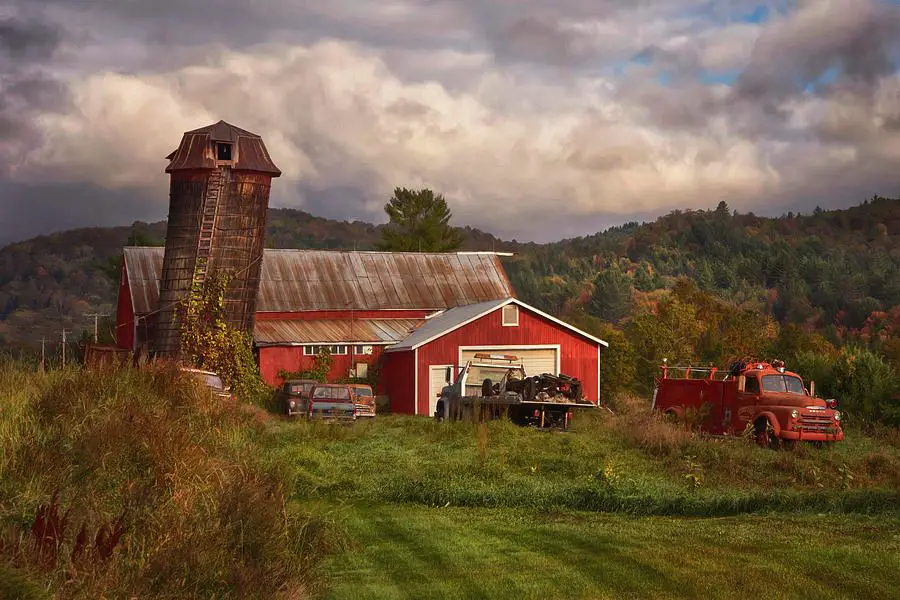
Peeling white paint. A shutter hanging crooked from one window. Porch steps that listed to one side. A barn farther back, its weathered boards silver-gray in the afternoon light, leaning with the patient lean of something that has been standing a long time and intends to keep standing. Dry grass at the field edges. A water trough gone the color of old blood. The kind of place Marcus could dismiss in a single sentence, and the kind of place that sentence would be completely wrong about.
I sat there for a while. The engine ticked itself quiet. A hawk moved in a slow circle over the far field.
Then I remembered the cardigan on the passenger seat.
I pulled it on, and as I slid my arm through the left sleeve, I felt something in the pocket. A small resistance. I reached in and found a piece of paper, folded twice, the size of a notecard.
Jenny’s handwriting.
She had beautiful handwriting. It was one of the first things I had noticed about her, the year we met, the way her letters had a particular certainty to them, like they knew exactly where they were going.
Trust the farm. Check the barn after you go inside.
That was all. No explanation. No preamble. Just the instruction she had given me in her last weeks now written in blue ink on paper torn from a legal pad and folded into the pocket of a cardigan she had worn on cool evenings, knowing I would take it with me, knowing I would put it on.
She had planned this moment. Not desperately, not sentimentally, but with the same practical intelligence she had brought to every other problem she had ever faced. She had understood what was coming, and she had prepared a path through it, and she had trusted me to walk it.
I got out of the truck.
The porch boards were soft underfoot but held. The rusted key felt familiar in my palm now, no longer cold, just present, just itself. The wind moved through the dry grass in the field beside the house, a low sound, almost a voice. I stood at the front door for a moment and thought about Jenny making this same approach, some months ago, arriving alone to do whatever she had come here to do.
Then I put the key in the lock.
It turned cleanly. No resistance. No shoulder needed.
The door swung inward and I stepped into the cool, dim interior.
The room smelled of old wood and dust and something I could not immediately name, something faint and specific, a smell that took me a moment to place and then did: the particular dry sweetness of old paper. Documents. Files. The smell of a room that has been holding important things.
There was a wooden table in the center of the room.
On it: two sealed envelopes. An old olive-drab trunk, military-style, with brass hardware. And on top of the first envelope, in Jenny’s handwriting, three words.
For you first.
I sat down in one of the two chairs at the table. The chair was solid, recently cleaned, without the layer of grime I would have expected. Someone had been here not long ago. Jenny, or someone working on her behalf, had prepared this room.
I picked up the first envelope and opened it carefully, the way you open something you want to keep intact.
It was a letter. Twelve pages, handwritten, dated eight months before she died.
She started it the way she started conversations that mattered: without ceremony, going directly to the thing.
Sam, she wrote, if you are reading this you have already done the hard part, which was leaving. The rest is just information.
She had discovered, she explained, in the first months after her diagnosis, that her grandmother had not simply left her a neglected farm. She had left her something considerably more complicated and considerably more valuable, something that the family had never talked about and that Jenny herself had not fully understood until she hired a land surveyor and a title attorney and spent several weekends going through her grandmother’s papers in the trunk now sitting on the table in front of me.
Her grandmother had owned water rights.
Not the land rights alone: water rights, documented and legal and attached to the property title, covering three separate aquifer access points on the acreage. In the dry central valley, in the decade that followed decades of drought, water rights of this scale and this documentation were not a footnote. They were the entire story.
Jenny had spent months having them assessed, verified, and quietly understood by the right people. She had not told Marcus because she had seen, in the year before she got sick, what her son was becoming, and she had understood that telling him would change the arithmetic in ways she could not control. She had not told me earlier because she had not wanted me to carry the weight of it while she was still alive, had not wanted the time we had left to be spent talking about after.
She had wanted it to be this: me, at the table, the letter in my hand, the information arriving in her voice.
The water rights, she wrote, had been independently appraised at just over three million dollars.
There was also the land itself, which a separate assessment had valued at another nine hundred thousand, not because of the farmhouse or the outbuildings, which needed real work, but because of its acreage and position and the agricultural infrastructure that her grandmother had quietly maintained through a long-term lease arrangement with a neighboring family. That arrangement was still active. The lease payments had been accumulating in a dedicated account for eleven years. The account balance was in the envelope marked second.
I sat at the table for a long time after I finished the letter.
Outside the window, the afternoon light was doing what central valley afternoon light does: turning the dry grass gold, flattening the shadows, making the ordinary landscape look briefly like something from a painting. A bird landed on the porch railing and cocked its head at the window and then left.
I thought about Jenny driving up here in the last year of her life, arriving at this property she had inherited and never quite known what to do with, and discovering in it something that would make everything all right. I thought about her making the appointments, hiring the specialists, sitting in offices and asking the questions that cut through soft language to the thing underneath. I thought about her folding the letter into the cardigan pocket, trusting that I would put it on.
I thought about Marcus standing at the counter with his espresso and his clipboard, already moving forward.
I opened the second envelope.
The account balance was two hundred and forty-one thousand dollars.
Then I did what Jenny’s letter told me to do. I went out to the barn.
The barn was in better condition than it looked from the outside. The structure was sound, the interior dry, the floor swept. Along the back wall, on a series of metal shelving units that were clearly new, were the physical files: the water rights documentation, the survey records, the title history, the lease agreement, the appraisal reports, the attorney correspondence. Everything organized, labeled, complete. Beside the shelving units was a folding table with a laptop on it, charged and waiting, and a handwritten note taped to the lid.
The attorney’s number is saved. Her name is Clara. She knows everything. She has been waiting for your call.
At the bottom of the note: one more line, the last thing Jenny had written me.
I built you something solid, Sam. You know what to do with solid things.
I stood in the barn in the late afternoon light coming through the gaps in the old boards and I held the note and I let myself, for the first time since I had stood in the hospital room watching the machines go quiet, properly cry. Not the functional grief I had been carrying since then, the manageable, surface-level mourning that allowed me to pack boxes and sit at a table and drive a truck and eat a sandwich. The real kind. The kind that comes from forty years of loving someone and losing them and only now beginning to understand the full dimensions of what they were.
She had seen it coming. She had built around it. She had left me not with a memory, not with a sentiment, but with a life.
When I was finished I walked back to the farmhouse and washed my face at the kitchen sink, where the water ran brown for thirty seconds and then ran clear, and I looked out the window at the wide field in the late light and at the barn and at the gravel drive and at the gate I had lifted to come in.
That night I slept in the farmhouse on an air mattress I found rolled up in the hall closet, covered with a blanket that smelled of cedar, listening to the quiet that is particular to places where the nearest light source is stars. It was the best sleep I had managed in months.
In the morning I called Clara.
She had indeed been waiting. She walked me through everything in a single two-hour call with the same no-wasted-motion energy that Jenny had always respected in people, and by the end of it I understood not just what I had but what it meant and what the options were and what Jenny had recommended and why. Clara had worked with Jenny long enough to know how she thought and she explained it all as though she were translating, which I suppose was exactly what she was doing.
The water rights were the foundation. They could be sold outright for the appraised amount, leased on a long-term basis to one of several interested agricultural operations that Clara had already quietly identified, or retained as collateral for other purposes. The land could be developed, continued as farmland, or simply held. The lease income would continue regardless. The accumulated account was mine to use immediately.
I told Clara I wanted to think about it.
She said Jenny had told her I would say that.
She said Jenny had also told her to tell me: don’t think too long.
I spent a week at the farm before I made any decisions. I walked the property each morning with a cup of coffee, getting the feel of the acreage, learning which parts were flat and which had a slight grade, where the light came first in the morning and where it held longest in the evening. I met the neighboring family who held the lease, the Garcias, three generations working the surrounding land, people who had known Jenny’s grandmother and who shook my hand with the warmth of people welcoming someone to a place where they belong. They told me stories about the property I had not known. They told me things about Jenny’s grandmother that helped me understand where Jenny had gotten some of herself.
I had the porch steps fixed. I had the shutter rehung. I called a local contractor who came out and walked through the farmhouse with me and gave me an honest assessment: the bones were excellent, the work needed was substantial but not structural, and the cost to make it genuinely livable was a fraction of what I had feared.
I did not call Marcus.
He called me, after ten days, in the early evening when I was sitting on the repaired porch steps watching the light change over the field. He wanted to know how the farm was. His tone had the careful pleasantness of someone who has considered that he might have handled things badly and is not ready to say so directly.
I told him the farm was fine.
He asked if I was settling in.
I said I was.
There was a pause, the kind that happens when a person realizes the conversation is not going to open into something that makes the earlier behavior understandable.
“Dad,” he said. “I know the last few weeks were hard.”
“They were,” I said.
Another pause.
“I’m glad you have somewhere to land.”
I looked at the field, at the last of the light going gold across the dry grass, at the barn standing patient and solid at the far end of the drive. I thought about what was in that barn. I thought about Jenny driving up here alone, making her preparations, folding a piece of paper into a cardigan pocket.
“I have somewhere to land,” I said. “Your mother made sure of that.”
Marcus was quiet for a moment.
“I’ll call again soon,” he said.
“All right,” I said.
I did not say: she knew what you were planning. I did not say: I found the brochure. I did not say any of the things I had the right to say, because the time for those conversations would come or it would not, and either way the result of this week was the same. I was sitting on a porch that was mine, above ground that was mine, in the long evening of a place that Jenny had spent the last year of her life making safe for me.
Some things are too well-built to require explanation.
I said good night to my son and hung up and sat on the porch until the field went dark and the stars came out and the night sounds started, the ones I was beginning to recognize, the particular chorus of a place that has been here long before any of us and will be here after.
Inside, on the table, was Jenny’s letter.
I had read it four times now. I would read it more. There are some things a person says that do not exhaust themselves on the first reading or the fourth, that keep yielding as you keep returning, the way good history does. She had ended it with one sentence that I kept coming back to more than the others, more even than the practical information, more than the numbers and the names and the instructions.
She had written: I always knew you were built for the long view, Sam. I just wanted to make sure you had somewhere worthy of it.
I folded the letter and put it back in the envelope and set it on the table under the brass lamp I had brought from Los Angeles.
Then I went to bed.
Outside, the farm settled into the dark, solid and patient, holding everything she had put into it, waiting quietly for whatever I was going to build next.

Sophia Rivers is an experienced News Content Editor with a sharp eye for detail and a passion for delivering accurate and engaging news stories. At TheArchivists, she specializes in curating, editing, and presenting news content that informs and resonates with a global audience.
Sophia holds a degree in Journalism from the University of Toronto, where she developed her skills in news reporting, media ethics, and digital journalism. Her expertise lies in identifying key stories, crafting compelling narratives, and ensuring journalistic integrity in every piece she edits.
Known for her precision and dedication to the truth, Sophia thrives in the fast-paced world of news editing. At TheArchivists, she focuses on producing high-quality news content that keeps readers informed while maintaining a balanced and insightful perspective.
With a commitment to delivering impactful journalism, Sophia is passionate about bringing clarity to complex issues and amplifying voices that matter. Her work reflects her belief in the power of news to shape conversations and inspire change.