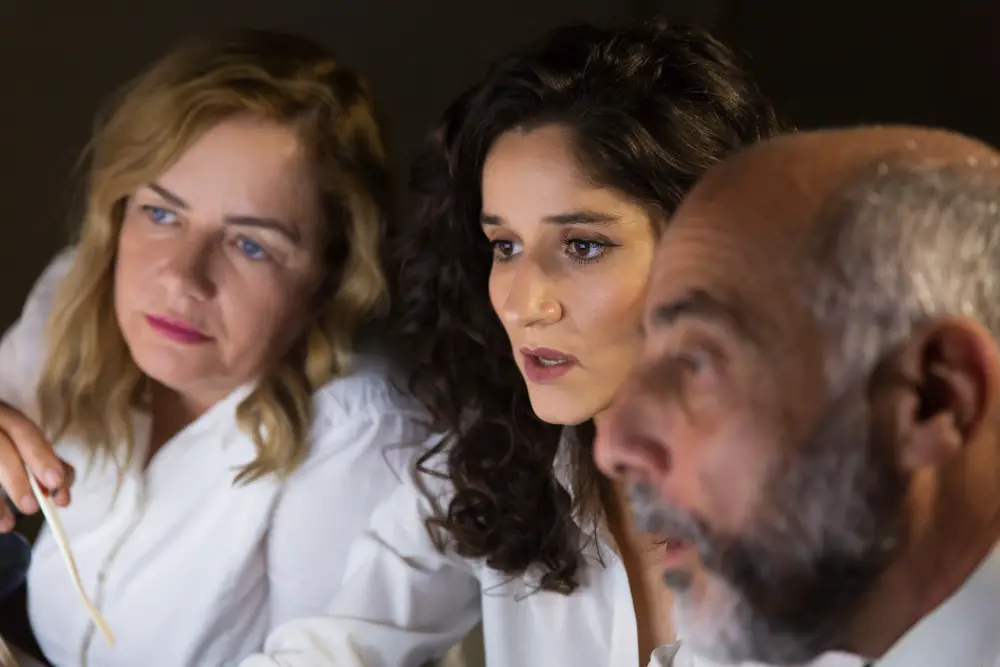
The question hung in the study while the pond outside went on reflecting the sky with its indifferent perfection. Simon did not rush to fill the silence, which was one of the things I had always valued about him. He understood that some questions required the asking to settle before the answer could land cleanly.
“Your options,” he said at last, “are significant. The recording Brooke made is inadmissible as evidence of anything except her own behavior. The edited version she posted contains you speaking words you actually said, stripped of the context that explains why you said them. That context is documented. The original, unedited footage is recoverable.”
“From where?”
“From her phone’s cloud backup, which she connected to the family’s shared cellular account, which your grandmother’s estate has been paying for and which I have administrative access to.”
I closed my eyes briefly. “My grandmother.”
“She was thorough,” he said, with something that was almost warmth.
“What else?”
“The messages from the group chat Emma shared. The financial records in the blue boxes. The draft documents your parents placed before you to sign. The email chain from five years ago attempting to flag you as compromised. Taken together, what you have is a documented pattern of coercive interference spanning nearly two decades. That is not a family dispute. Under the laws of several states, it constitutes actionable financial abuse of a beneficiary under fiduciary management.”
“You’re saying I could sue my own parents.”
“I’m saying you could,” Simon said. “I’m also saying there is something more precise than a lawsuit available to you, if you want it.”
I waited.
“Your grandmother’s trust includes a provision I have not fully disclosed to you yet,” he said, “because the timing required that certain conditions be met before it activated. Those conditions were met yesterday morning when your parents presented falsified trustee documentation and attempted to obtain your signature through coercion.”
My hand tightened on the phone.
“The provision establishes what Eleanor called a public accountability clause,” he continued. “If the trustees were found to have acted in bad faith against the primary beneficiary, the trust becomes empowered to require full disclosure of all trustee activity to a court-appointed independent auditor. The results of that audit become part of the public financial record.”
“Meaning anyone could read them.”
“Anyone who knew to look.”
I thought about Brooke’s video, still circulating in the edges of my former social world, carefully cut to show me distressed and without explanation. I thought about my mother’s composed voice on the phone that morning: sweetheart, we need to handle some things. I thought about my father’s face when he handed me the revocation papers, the absence of hesitation in his expression, the practiced efficiency of someone who had rehearsed the scene.
“Do it,” I said.
“Be certain.”
“I am.”
He was quiet for a moment. “The audit will take six to eight weeks. During that time, your parents will almost certainly escalate the social campaign.”
“Let them.”
“Brooke may post more.”
“Then she posts more.”
Another pause. “Your mother will cry publicly.”
“My mother has been crying publicly in ways that cost me for thirty years,” I said. “I have spent considerable energy ensuring no one could see what those tears were actually about. I am done spending that energy.”
Simon said nothing for a long moment. Then: “I’ll file the activation paperwork this afternoon.”
After we hung up I sat with my phone face down in my lap and looked at the room my grandmother had built with such deliberate care. The shelves of records. The map on the wall. The mission statement in the green folder that was not nostalgia but blueprint. She had not left me this room as a memorial. She had left it as a starting position.
I heard Emma’s footsteps on the stairs and then in the hall, hesitant outside the door.
“Come in,” I said.
She appeared in the doorway with two mugs of tea, handing one to me before sitting cross-legged on the small settee by the window. She had been crying too, I could see, though she had done it privately, which was the family style we had both inherited and were both apparently trying to unlearn.
“I talked to my mother this morning,” she said.
I watched her.
“She said I was overreacting. That family loyalty means letting things go.” Emma looked down at her mug. “I told her I’d been letting things go since I was approximately twelve and that the pile of let-things-go was approximately tall enough to drown in.”
“How did she take that?”
“She hung up,” Emma said. “Then she called back to tell me I’d regret it.” She paused. “Then she texted to ask if I needed a ride home.”
I let out a breath that almost qualified as a laugh. “The full cycle in under ten minutes.”
“She’s efficient.” Emma looked up. “I’m not going back, Alyssa.”
“I know.”
“Not to stay silent about any of it.” Her voice steadied as she said it, gaining the quality of something decided. “I knew about that chat for three weeks before I sent you the screenshot. Three weeks. I kept telling myself it would blow over, or I was misreading the tone, or it wasn’t my place.” She shook her head. “I was protecting myself by protecting them. And you were the one who paid for it.”
“You sent it when it mattered.”
“I should have sent it sooner.”
I did not argue, because she was right and she knew it and the dignity of truth between us mattered more than comfort. “Yes,” I said. “You should have.”
She nodded, accepting the sentence the way someone accepts a bill they are relieved to pay because at least they know the real number now.
We drank our tea while the pond outside went from silver to the pale, beaten gold of late autumn sun. June moved through the house below us with the steady purposeful sounds of someone who had been tending this place long enough to know its needs the way you know a person’s rhythms: which doors swelled in damp weather, which windows needed coaxing, which floorboards had learned to be quiet and which ones hadn’t.
“Tell me about Hawthorn House,” Emma said after a while.
So I did.
I told her what I had read in the green boxes, what my grandmother had sketched out in that spidery, decisive handwriting eight years ago, what she had understood about the particular shape of harm that does not look like harm from the outside because it happens inside families and inside institutions that are supposed to be protective and inside the ordinary transactions of love gone mercenary.
Emma listened the way she always listened, leaning slightly forward, eyes steady, not filling in the ends of sentences. It was a quality she had that her immediate family had never seemed to notice because they were too busy talking.
“She thought you’d build it,” Emma said when I finished.
“I think she thought whoever ended up here would build it,” I said. “She just assumed it would probably be me.”
Emma looked out the window. The orchard was bare-limbed and patient in the cold, the kind of beautiful that belongs entirely to November, uninterested in being decorative.
“I studied social work for two years before I switched to communications,” she said, almost to herself.
I turned to look at her.
“My mother said it wasn’t practical,” she continued. “That I’d end up burned out at forty, taking on other people’s problems for a salary that insulted my education.” She smiled thinly. “She said what I needed was a career with upward mobility and networking potential.”
“What did you want?”
She looked at me with an expression that was equal parts old pain and sudden clarity. “I wanted to build things that helped people who didn’t have advocates.”
Something settled in the room. Not resolution—it was too early for resolution, and anyone who has lived through real difficulty knows the difference between a door opening and an arrival. But something, an alignment, a possibility suddenly visible in the space between two people who had both been made smaller than they were.
“I need someone who knows systems,” I said carefully. “Not just software systems. Human ones. The kind that decide who gets helped and who gets turned away and who gets told to wait and eventually stops asking.”
Emma set her mug down on the windowsill. She had gone very still, not the paralyzed stillness of someone bracing for disappointment but the concentrated stillness of someone who is listening hard enough that the rest of her has temporarily stopped.
“The first phase would probably take a year,” I said. “Permits, renovation assessments, the legal structures for a nonprofit versus a foundation versus a hybrid model. I don’t know which yet. I’d want to understand the landscape before I choose.”
“And after the first phase?”
“Partnerships. Legal advocates. Financial literacy programs. Emergency housing that isn’t contingent on victimhood narratives.” I paused. “And maybe a communications function, because the work only exists if people who need it can find it.”
Emma looked at me for a long moment.
“Are you offering me a job?”
“I’m offering you a problem worth solving,” I said. “The compensation would be real. The work would be harder than anything you’ve done in communications. The outcomes would be unmeasurable in the short term and fundamental in the long one.”
She was quiet long enough that I wondered if I had moved too fast, collapsed too much distance between the present chaos and an imagined future in a way that mistook recovery for momentum.
Then she said: “What would the title be?”
I almost smiled. “We’d have to figure that out.”
“I’m good at titles,” she said. “Professionally. I’m very good at naming things accurately so the right people can find them.”
“I know,” I said. “That’s why I asked.”
She picked up her mug again and looked out at the orchard. “Okay,” she said simply.
Outside, the light shifted as a cloud moved across the sun, and the orchard went briefly into shadow and then back into that pale winter gold. Somewhere in the pines at the edge of the property, a woodpecker started up with its irregular percussion and then stopped.
Over the next three days we worked in the study with the blue and green boxes spread across the floor and the desk and the settee in an organized chaos that looked nothing like what it was, which was the deliberate dismantling of two decades of accumulated silence and the first structure of something different being laid out in its place.
Simon called each afternoon with updates from the legal front. The audit paperwork had been filed. My parents had retained an attorney, predictably, who had sent a letter asserting emotional duress and demanding a thirty-day stay before any financial actions were formalized. Simon had responded in four sentences, the fourth of which contained the phrase documented history of coercive trustee conduct and the phrase we look forward to the auditor’s review, both of which, he noted, had produced an unusually long pause before any reply came back.
Brooke’s video had accrued limited reach. The family members who knew me well enough to ask questions had mostly asked them in private, and the private answers I gave were brief and factual. I did not litigate the relationship in text threads. I stated what had happened in the language it deserved: an attempted coercive transfer of trust assets, documented and filed. Those who found that hard to believe were welcome to wait for the audit results.
My mother called twice. I did not answer. She left voicemails in which her tone moved through her full register: sorrowful, confused, injured, bewildered, then briefly cold in a way she could not quite sustain. I kept the voicemails as part of the record. I did not return the calls.
On the third night I sat alone in the kitchen long after Emma and June had gone to bed. The fire had burned down to a low red glow. I had a glass of wine I had barely touched and my grandmother’s last letter open on the table in front of me. I had read it so many times by then that I had stopped reading and started simply sitting in its presence the way you sit with something that has become familiar enough to be a form of company.
Do not spend too long trying to discover why they are the way they are. There is no reward in becoming an archivist of other people’s damage when you should be designing your own future.
I had spent three days doing exactly what she advised against. I had catalogued the damage, traced the timelines, read the emails and the memos and the drafted proposals for how to hollow me out while remaining plausible. I had done it because it was necessary. It was also, I now understood, finished.
The archive was complete. Simon had what he needed. The auditor would find what was there to find. Whatever my parents tried to build in the court of social opinion against me would meet the unadorned factual record, and factual records do not lose to narratives in the end, even if they lose to them temporarily.
What I had left to do was the harder work, and the only work that was actually mine.
I pulled the green folder toward me and opened it again to my grandmother’s mission statement.
The language was not polished. It was not designed for a donor presentation or a board meeting. It was the language of someone who understood the problem personally and had not yet decided to translate it into anything more palatable. Not charity. Infrastructure. Teach ownership, not gratitude. No one should have to perform collapse to deserve help.
I opened my laptop.
I began to write.
Not a business plan, not yet. Something more preliminary than that, the kind of document you write when you need to understand what you believe before you can explain it to anyone else. I wrote about the specific texture of what I had spent the last week living through, not as a victim’s account but as a systems analyst’s: here is how the mechanism works, here is what it requires of its target, here is the point at which the target begins to mistake the mechanism for reality. I wrote about the exhaustion that made it easier to accept someone else’s explanation of your life than to insist on your own. I wrote about money as a lever used not to build but to bind.
I wrote for three hours.
When I stopped, the fire had gone out entirely and the kitchen had cooled and outside the windows the night was fully dark and entirely still, the particular stillness of rural places in autumn that has nothing to do with emptiness and everything to do with completion, the world having reached the end of what it was doing for the day.
I read what I had written.
It was not good writing in the literary sense. It was clear writing, which is different and more useful. It identified the problem precisely enough that a solution could be built around it. It named the people who needed the solution without reducing them to their need. It located the gap between where help currently lived and where people who required it actually were.
It was, I thought, a beginning.
I closed the laptop and sat for a moment in the quiet of my grandmother’s kitchen. On the wall beside the window, June had hung a small framed photograph I had not noticed until now: Eleanor in her sixties, standing at the edge of the pond in early spring, wearing rubber boots and an expression of complete and entirely private satisfaction.
She was not looking at the camera. She was looking at the water with the focused contentment of someone who had worked hard for a specific outcome and was watching it begin.
I understood the expression now in a way I could not have understood it a week ago.
The pond in the photograph was not remarkable. The boots were practical. The satisfaction on her face had nothing to do with audience. She was looking at something she had built in a place she had made genuinely hers, and the joy of it was not despite its privacy but because of it. Because it required no one else’s acknowledgment to be real.
I turned off the kitchen light and went upstairs.
In the east room I stood at the window for a while, looking out at the dark outline of the property: the pond, the orchard, the barn, the pine stands at the edge where the land met the unknown beyond. None of it asked anything of me. All of it was simply there, waiting for whatever I chose to make of it, governed by no one’s interpretation but mine.
The key was on the windowsill where I had set it the first night. I picked it up and held it in my palm, feeling its unremarkable weight, the worn smoothness of metal that had been handled by a person who used the things she owned.
Somewhere in the house Emma slept, her duffel bag on the floor of the orchard room, her halfempty mug still on the study windowsill from that afternoon. Somewhere June was presumably doing whatever June did in the small hours, likely something efficient and unsentimental and deeply necessary to the functioning of this place.
I thought about what came next with a clarity I had not felt in years.
The audit would happen. The records would be reviewed. Whatever my parents had done would be confirmed in the language of courts and ledgers, which was the only language that could not be edited into something more convenient. That process would take months and it would be public and it would be ugly in the specific way of ugly things that are also true.
I would not watch it closely. That was not my work anymore.
My work was in the green folders. My work was the draft on my laptop and the conversation with Emma and the blank wall of the barn I had looked at during our walk yesterday morning and thought, that would hold a classroom. My work was the thing my grandmother had understood before I had the vocabulary to understand it: that the most effective response to having been made smaller was not to insist on the facts of your own size, though those facts mattered, but to build something that could not be reduced to a version of you someone else preferred.
I set the key back on the windowsill.
Then I sat down at the writing desk and opened the laptop again.
At the top of a new document I typed one line and then stopped.
The Hawthorn House Initiative, Founding Statement.
I looked at it for a long moment.
Then I began.
Some harm wears formal clothing. Some theft is signed by trustees. Some silence is trained into people so early and so thoroughly that they have forgotten it was trained and have begun to believe it is simply their nature to be quiet.
The work of this place begins in that recognition and does not end there.
We are not building a refuge. We are building a position from which people can move.
The difference is everything.
I wrote until the window behind me went from black to the deep blue of early morning, which in November in Vermont means the world has not yet decided to be visible but has agreed to stop pretending night is permanent. When I finally stopped, my hands were cold and the desk lamp made a small warm circle in the grayness and outside the pond was invisible but present, the way things are when you know they are there even before you can see them.
I saved the document and closed the laptop.
The foundation of a building and the foundation of a life share this quality: what matters is not whether the thing above ground is beautiful but whether what is underneath it will hold.
My grandmother had known that. She had built underneath me for years without my awareness, in silence, in legal documents, in property records, in a room with locked shelves and a brass recorder that still carried her voice.
I had thought, arriving here, that I was looking for shelter.
What I found instead was ground.
I stood up from the desk and stretched my arms above my head, feeling the length of my spine, the particular aliveness of a body that has been sitting still for hours. Then I went downstairs to start the coffee, because June would be awake within the hour and Emma would want tea, and the work that mattered was waiting for the morning to arrive properly so it could begin.

Lila Hart is a dedicated Digital Archivist and Research Specialist with a keen eye for preserving and curating meaningful content. At TheArchivists, she specializes in organizing and managing digital archives, ensuring that valuable stories and historical moments are accessible for generations to come.
Lila earned her degree in History and Archival Studies from the University of Edinburgh, where she cultivated her passion for documenting the past and preserving cultural heritage. Her expertise lies in combining traditional archival techniques with modern digital tools, allowing her to create comprehensive and engaging collections that resonate with audiences worldwide.
At TheArchivists, Lila is known for her meticulous attention to detail and her ability to uncover hidden gems within extensive archives. Her work is praised for its depth, authenticity, and contribution to the preservation of knowledge in the digital age.
Driven by a commitment to preserving stories that matter, Lila is passionate about exploring the intersection of history and technology. Her goal is to ensure that every piece of content she handles reflects the richness of human experiences and remains a source of inspiration for years to come.