Three days after I made my final mortgage payment, my younger sister sent me a Pinterest board titled Our Dream Living Room Makeover.
I was at my kitchen table when the notification came through. The table was scarred pine I had bought off Facebook Marketplace six years earlier and sanded down myself with an orbital sander that sounded like a lawn mower in a small space. Morning light was coming in over the sink, cold and pale, falling across the room in that quiet way that makes a house feel like it belongs to you. My coffee had gone lukewarm. My scrubs were wrinkled from the overnight shift I had just come off at Riverside. I remember every detail because that was the moment something in me changed.
I thought at first Colleen had sent it by mistake. She did that sometimes, forwarded the wrong link, texted the wrong person, acted breezy afterward as if confusion were a personality rather than a pattern. Then I opened it.
Thirty-seven pins. Cream sectionals. Woven baskets. Pale green throw pillows. Framed prints with words like gather and grace and family is everything. A whitewashed coffee table with fake distress marks. At the top of the board, in Colleen’s handwriting: For when we finally make the place ours.
Ours.
There are words that should not have the power to knock the air from your chest, but sometimes one small word lands harder than a fist. I stared until the screen dimmed in my hand. The room stayed still. The house was the same house it had been sixty seconds earlier. But something had shifted at the edge of it.
Nine years. Nine winters of overtime. Nine summers of saying no. Nine years of treating every dollar like it had somewhere specific to be.
I had driven a car with a spiderweb crack across the windshield because the four hundred and sixty dollars to replace it belonged on principal, not glass. I had patched worn shoes with glue, brought lunch to work in the same blue cooler until the zipper broke and I stitched it back with fishing line. I had picked up extra respiratory shifts through flu season and RSV spikes and the long winter months when every ICU room seemed to hum with alarms and the stale smell of bad coffee in paper cups.
I had given my twenties to that house.
And three days after the bank confirmed the balance was zero, my sister was sending me mood boards for our living room.
That should tell you something. But to understand how a woman can pay off a house at thirty-four and still find herself defending it to her own family, you need to understand where I came from and what my family had been training me to accept my entire life.
My name is Margot Ellis. I am a respiratory therapist in Columbus, Ohio. I live in a three-bedroom ranch on the west side of the city, in a neighborhood where half the mailboxes lean a little and most people still wave when they catch you hauling groceries from your car. It is not fancy. The houses are modest, mostly brick or siding, built in the seventies. But it is the first place I have ever lived where the floor beneath my feet belonged only to me.
My mother, Diane, believes in family the way some people believe in weather. In her version of the world, family means loyalty, sacrifice, generosity, and never keeping score. It sounds noble until you see how those values get assigned in practice.
Whatever I had growing up, I was expected to share. Whatever Colleen had, she was expected to enjoy.
If I got birthday money from an aunt, my mother would say wouldn’t it be sweet if I helped my sister pick something too. If Colleen got birthday money, she deserved to spend it however she wanted. If I made straight A’s, my mother told me not to make such a big thing of it around my sister because school just wasn’t her gift. If Colleen barely passed, we were all told to celebrate effort. When I got my license first, the car keys were for both girls. When Colleen sideswiped a trash can and dented the quarter panel, it became one of those things siblings work out together.
My father, Frank, was never cruel. That matters. He wasn’t the kind of man who slammed doors or made home feel dangerous. He was soft-spoken, conflict-averse to the point of near-disappearance. He fixed cabinet hinges on weekends, watched baseball with the sound too low, and treated every argument like a pothole he hoped the car might glide over if nobody looked directly at it. If my mother declared something fair, Dad almost always nodded and said your mother has a point.
I used to think that meant he trusted her judgment. As I got older, I understood it meant he was afraid of what happened if he didn’t.
And then there was Colleen.
Colleen is two years younger than me, and she had charm, which is a form of currency if you learn early how to spend it. She worked at a boutique for seven months until the manager had a weird vibe. She waitressed until the shifts were too draining. She tried dog grooming, sold candles online for three weeks, started a lifestyle Instagram, signed up for a real estate course, abandoned a photography side business, and once announced at Thanksgiving that she was seriously considering becoming a travel nurse despite having fainted during a flu shot in high school. My mother called every abandoned path evidence that Colleen was still finding herself. I, on the other hand, was expected to have found myself at sixteen and stay found.
The only adult in my family who saw this clearly was my grandmother, Ruth McKenna. Nana Ruth was eighty-one, five feet tall on a generous day, and sharper than any blade I owned. She kept a little notebook in her purse with actual phone numbers written in it because she didn’t trust those glass screens, and she made coffee strong enough to strip varnish. She loved me with the direct, unsentimental loyalty that leaves no room for confusion.
I bought the house at twenty-five. It was a foreclosure the bank had clearly wanted rid of for some time. The front yard was patchy dirt. Someone had ripped the medicine cabinet from the bathroom wall and left a jagged hole behind. The basement smelled like damp cardboard and old paint. When the realtor kept apologizing for the condition, Nana Ruth leaned toward me and said, “If you wait for the perfect house, you’ll end up paying for somebody else’s choices. Buy the ugly one and make it yours.”
So I did.
I signed a thirty-year mortgage and decided before the ink dried that I would not spend thirty years paying for this place. Thirty years sounded like a sentence. I wanted the bank out of my life before I started waking up at three in the morning wondering where my best years had gone.
Nobody in my family understood that.
When I told my parents I had bought the house, my mother said it seemed awfully lonely for one person. My father asked if I was sure I wanted all that responsibility. Colleen walked through in flip-flops and said, “Are you, like, trying to be old already?” I laughed at that because I was still young enough to smooth things over reflexively. I stopped laughing over the years.
The first twelve months in the house were a grind I still feel in my shoulders if I think about it too long. I worked full-time and picked up extra shifts whenever I could. On days off I stripped wallpaper and painted trim and watched YouTube videos on replacing faucets. I spent entire Saturdays in leggings and a dust mask scraping adhesive off old linoleum. My friend Tamika came over with pizza and helped me haul broken cabinets to the curb. When my bathroom subfloor turned out to be worse than expected, Nana Ruth wrote me a check I didn’t want to cash and told me pride was useful only until it became stupid. I paid her back in eleven months. She never asked about it once.
The house changed slowly, which is the truest way most good things change. Cabinets replaced one section at a time. Bedroom doors sanded and painted. Drywall patched. Used tools kept in a red plastic bin in the hall closet. Hostas planted along the front walk because they were hardy and hard to kill, which matched my mood those years better than roses would have.
The discipline became its own habit. I stopped noticing what I went without because I was measuring life by a different ruler. Every extra payment felt like laying one more brick under myself. My friends went to Nashville for bachelorette weekends, financed SUVs with heated seats, ordered takeout three times a week without thinking. I packed chili in reusable containers, patched my coat at the seam, and sent money to the mortgage company like I was paying ransom for my future.
My family watched all of this and called it excessive.
“You don’t have to live like a nun,” my mother told me once, when I turned down a beach trip to throw the money at principal instead.
“No offense,” Colleen said over a diner milkshake she couldn’t afford, “but your whole mortgage thing is kind of intense. Like, it’s a house, not a hostage negotiation.”
I looked at her across that booth and thought: that is exactly what it is.
The winter I made my final payment, Columbus had the kind of February that felt like someone forgot to install daylight. I had been planning this moment for months, shifting money around, taking an extra Christmas shift because holiday pay was good and I cared more about freedom than turkey with cranberry sauce. The morning the balance hit zero, I was in my kitchen in flannel pajama pants and an old hospital hoodie. The bank website took an absurdly long time to load. Then the screen showed it.
Principal balance: $0.00.
I stared long enough to worry the page would refresh and take it back. I took a screenshot. Then another. I printed it and touched the paper like it might disappear. I laughed once, too loud in the empty house, and then cried in the sudden ugly way that catches you before you can prepare for it. Not delicate tears. Ugly, relieved, body-shaking ones that came from somewhere old and private. I cried for every overnight shift. For every grocery list calculated to the dollar. For every time I had said no.
Then I called Nana Ruth.
She answered on the second ring and said, “Well?”
“It’s done,” I said, and my voice cracked.
A brief silence. Then, softly: “Read it to me.”
I read her the line from the screen. Zero balance. Loan satisfied.
“Your granddaddy would have been beside himself,” she said. Her voice had gone thin. “Baby, I’m so proud of you.”
That sentence reached places nothing else could touch.
I should have kept the news small after that. Protected it longer. Instead, because I was still trying to be a good daughter, I called my mother two days later. She was running a grocery errand. I heard carts in the background.
“I just wanted to share some good news,” I said. “I made my last mortgage payment.”
There was a pause long enough to picture her switching the phone to her other ear.
“Oh,” she said. “That’s wonderful, honey.”
I waited. For congratulations. For some acknowledgment of what it had taken.
Instead she said, “You know, Colleen’s landlord raised her rent again. She’s really having a hard time.”
That was my mother. That was the entire architecture of my family condensed into one sentence. My achievement walked into the room and was immediately rearranged into a conversation about my sister’s need.
Four days after that call, Colleen texted.
Hey, random, how many bedrooms does your house have again? Do you still use the room with the big closet? Honestly your place is huge for just one person lol.
I showed them to Tamika during lunch at the hospital.
She read them, took one slow sip of Diet Coke, and said, “Your sister is measuring for curtains.”
When the Pinterest board arrived, the knot forming in me cinched tight.
That Sunday I drove to Nana Ruth’s apartment and handed her my phone. She put on her reading glasses and scrolled through everything with the careful deliberateness of a judge reviewing evidence. By the time she reached the board, one corner of her mouth had gone flat.
“That girl is planning to move into your house,” she said.
“She wouldn’t just show up,” I said.
Nana looked at me over her glasses. “I raised your mother. Don’t argue with me about how this family thinks.”
She set the phone down.
“Your mother has spent your whole life confusing your reliability with availability,” she said. “You’re dependable, so she assumes you’re usable. And Colleen learned from her.”
I frowned into my coffee.
“She’s my sister, not a stray cat.”
“Exactly. Which means she knows better.”
When I finally asked what to do if they pushed, Nana said, “You say no once. Calmly. Clearly. Then you close the door.”
That sounded simple in her kitchen. It did not feel simple in my chest.
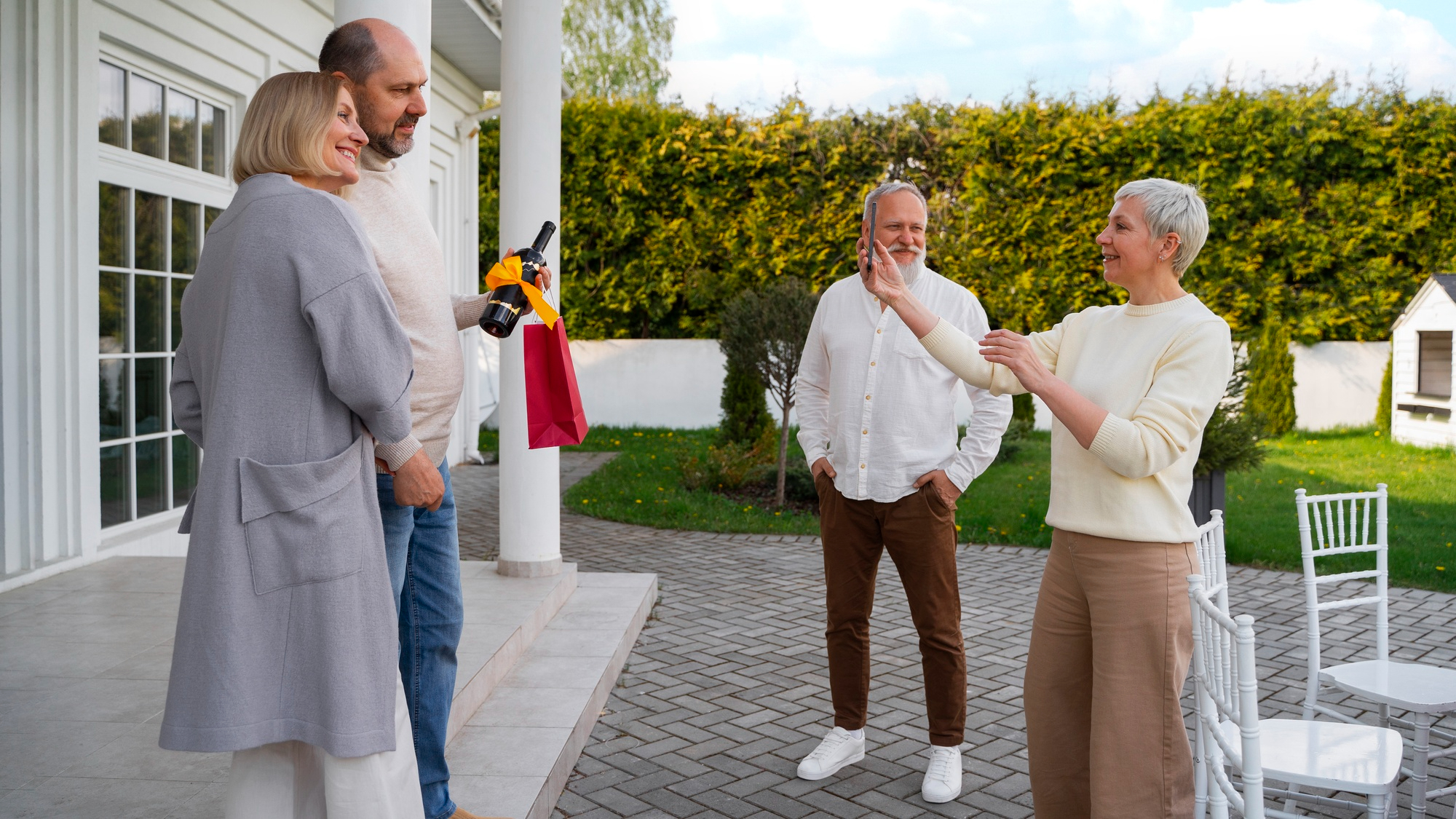
Two weeks later, I came home from a twelve-hour night shift and found a U-Haul parked in front of my house.
Late March. Sharp wind. Low cloud cover pressing down over the neighborhood like damp wool. My eyes burned from being awake too long. I turned onto my street and saw the truck before I fully processed it. White and orange, parked half over the curb in front of my mailbox. For one ridiculous second I thought someone next door was moving. Then I saw the boxes stacked on my front lawn. Banker’s boxes, plastic totes, a rolled rug, a lamp with the shade off, one of those dusty fake ficus trees.
Colleen stood beside them in a puffer vest, talking on her phone.
My mother was at the front walk holding a foil-covered casserole dish like a woman arriving for a church supper.
My father was halfway down the U-Haul ramp carrying a floor lamp.
I stopped the car in the driveway with both hands on the steering wheel.
Then Colleen turned, saw me, and waved. A bright, cheerful, eager wave, as if I had just come back from errands and she was welcoming me with good news.
Something in me went cold.
I got out slowly. As I came up the walk I noticed my mother’s good jacket, the navy one she wore to Sunday service when she wanted to look respectable without seeming flashy. She had dressed for this. She had planned an outfit for the day she intended to move my sister into my house.
“Margot!” she said, smiling that tight smile. “Good, you’re home.”
No hello. No acknowledgment of the truck.
Colleen stepped forward. “I know this looks sudden, but I didn’t want to bother you with every tiny detail.”
My father set down the lamp and wiped his hands on his jeans. “Morning, kiddo,” he said, as if we had run into each other at Home Depot.
I looked from face to face and waited, because part of me still couldn’t believe I was going to hear them actually say it.
My mother said it.
“It’s only fair to share, Margot. You have all this space, and your sister needs help. Family takes care of family.”
Neat and polished. A moral principle wrapped around a land grab.
“Nobody is moving into my house,” I said.
My mother blinked. The sentence did not fit anywhere in her expectations.
She recovered quickly. “Don’t be dramatic. Colleen just needs a little time to get back on her feet.”
“I said nobody is moving into my house.”
The second time, my voice was steadier.
Colleen gave a small laugh that was not really laughter.
“Margot, I’m not trying to take over. It’s temporary.”
I looked at the boxes. The rug. The lamp. The fake ficus. Temporary was not the word for what was sitting on my lawn.
“You brought a moving truck,” I said.
“Well, yes, because I have things.”
My mother stepped in. “She can’t afford these rents anymore. And honestly, it seems selfish to let a whole room sit empty while your sister struggles.”
That word landed like a spark on dry paper.
Maybe it was the exhaustion. Maybe it was nine years of swallowed responses rising at once. Whatever it was, something old and obedient in me finally cracked open.
“No,” I said. “What’s selfish is deciding that because I worked for something, it belongs to everyone else. What’s selfish is showing up with a truck without asking. You don’t get to volunteer my house. Not today, not next week, not ever.”
My mother’s mouth opened. My father stared at the ground. Colleen’s eyes filled, almost impressively fast.
“I did not raise you to turn your back on your own blood,” my mother said.
“You raised me to clean up everyone else’s mess without complaint,” I said. “That’s not the same thing.”
Her face changed. It is hard to describe the exact moment a parent realizes the script no longer works. It was not rage first. It was shock. She had spent my entire life believing that if she pressed the right buttons, guilt and obligation and appearances, I would fold. She was discovering in real time that the wiring had changed.
Colleen crossed her arms.
“I’m literally about to be homeless.”
I knew that was not true from the way she said it. Broad and theatrical, unmoored from specifics. I had sat with her six months earlier at my own kitchen table and opened a spreadsheet, laid out her income and expenses, shown her what would happen if she saved three hundred dollars a month. She had stared at it for forty seconds before saying she was not going to live like a monk because capitalism was broken. Then she had gone to brunch.
“If you were in real trouble and you asked me for help, that would be one conversation,” I said. “Showing up with a truck and assuming you can move in is a different one.”
My father cleared his throat.
“Your mother has a point, Margot.”
I turned and looked at him.
“Dad,” I said, “when is the last time you had a point that wasn’t hers?”
He took a half step back. Hurt flickered across his face. I almost apologized. Then I looked at the boxes on my lawn and did not.
My mother drew herself up and said we had brought lunch and thought we would get her settled, as if she were describing something entirely ordinary. As if the house I had paid for were a hotel she had booked on my behalf.
I stepped aside and pointed toward the street.
“Take the boxes. Take the truck. Leave.”
Silence.
Colleen started crying then, real or practiced, I couldn’t tell anymore.
“I can’t believe you. I thought you loved me.”
“I do love you,” I said. “That’s why I’m telling you the truth instead of pretending this is normal.”
My mother’s eyes flashed. “God is watching how you treat this family.”
I looked at her. “Then He watched me work for nine years while everyone told me I was wasting my life. I think He knows exactly what this is.”
She went very still. Then she turned to my father and told him to put the lamp back in the truck. He hesitated a half second, then bent and picked it up. Colleen marched toward the truck. My mother followed. My father moved like a man walking through deep water.
I stayed where I was until the car pulled away and the U-Haul followed. Not because I was afraid they would come back. Because I needed to watch them leave.
When the street was empty I went inside and locked the door and stood with my palm flat against the hallway wall, breathing. Then I sat on the couch and felt my hands begin to shake. Anger is glamorous in memory. In the body it is often just trembling and a strange emptiness where certainty used to be.
I called Nana Ruth.
She answered with, “Well?”
I laughed once, breathlessly.
I told her everything. Not the cleaned-up version. The real one. The casserole dish, the floor lamp, the exact words my mother used and the exact words I used back. When I got to the part about asking my father when he had last had a point of his own, I said that one might have been a little rough.
Nana made a dismissive sound. “Then maybe he should grow one.”
When I finished, she was quiet for a moment. Then she said, “Good. It’s about time. You didn’t do anything wrong. You finally stopped handing over your peace just because somebody asked for it in a church voice.”
By afternoon, Tamika was at my door with pad thai and the look on her face that meant she was ready to help me hide a body if circumstances required. We ate cross-legged on the living room floor and I told her the story. She stopped halfway through a bite of noodles and said, “Your mother brought a casserole dish? Like she was colonizing a frontier?”
I laughed so hard I snorted, which was the first decent sound I had made all day.
Then Tamika got practical. “Change the garage code.”
“They don’t have it.”
“Then change the locks anyway. Install cameras. Don’t underestimate the imagination of people who think your boundaries are a form of aggression.”
So I did. That week I ordered a video doorbell, motion lights for the back patio, and new deadbolts I installed myself with a YouTube tutorial playing beside me. Was it dramatic? Maybe. Did it make me feel like the house was unambiguously mine again? Yes.
The calls started four days later.
First Aunt Gloria from Dayton, with the soft voice people use when they are absolutely about to meddle. She said she had heard there was a misunderstanding with Colleen.
“There was no misunderstanding,” I said. “There was a moving truck.”
She made a small wounded noise, as if I had disturbed her preferred version of events.
Next came my cousin Brendan, who rarely called unless someone had died or the Browns were unexpectedly winning. “Just checking in,” he said. “Your mom seemed pretty upset.”
“Then she should probably sit with that,” I said.
Then came what I privately called Church Linda. Every family has some version of Church Linda: not actual family, but close enough through casseroles and Bible studies that she believes she has spiritual visitation rights over your personal business. She called to say she was speaking in love and then delivered a speech about grace, sacrifice, and how the Lord tests us through opportunities to serve. When she paused, I said, “With respect, Linda, if God wanted Colleen housed, He could have inspired her to sign a lease.”
The silence on the line was almost worth the call.
The campaign itself ended when I went back through two years of texts with Colleen and found exactly what I needed. Her asking how many bedrooms I had. Her joking that she might move into my spare room someday. And, months earlier, her sending the words: Seriously though, if I ever get priced out, I’m moving into your spare room.
My reply, five minutes later: No, Colleen. That’s not happening.
Timestamped. Clean. Unambiguous.
I screenshotted everything, including the Pinterest board, and sent it to Gloria, Brendan, and Linda with one line: For clarity, I never offered. Here is what was actually said.
Gloria replied within the hour: I’m sorry, Margot. I didn’t realize.
Brendan sent a thumbs-up.
Linda never replied, which was a gift.
My mother called that night, furious. Not because I had been wrong, but because I had corrected the narrative publicly enough to ruin the comfort of her version.
“You embarrassed your sister,” she said.
“She lied about me.”
“She was upset.”
“So was I.”
A sharp intake of breath, as if equality itself were insulting. “You have become so hard.”
“No,” I said. “I’ve become visible.”
She hung up.
Several weeks later, Colleen came to my door on an ordinary evening, no car full of boxes, no parents, no truck. Just Colleen in a gray hoodie with her hair pulled back and her face bare, both hands in her front pocket like she was holding herself together. I opened the door but kept the screen between us.
She swallowed.
“I lied,” she said. “I told people you had offered. You hadn’t. Mom told me if I phrased it that way they would understand my side better, and I let her. I’m sorry.”
I said nothing.
She kept going. She told me her friend Megan had pointed out that showing up at my house with a moving truck was not a gray area. That Megan had given her a therapist’s number. That she had been going for three weeks and that apparently it was a problem when your whole plan for life was that someone more responsible would eventually rescue you.
“Why are you here?” I asked.
She looked at me.
“Because I’ve spent years acting like you’re a vending machine that dispenses stability when my life gets messy. And I don’t want to be that person anymore.”
I opened the screen door. “Five minutes,” I said.
She came in like a guest in a museum, careful and self-conscious. We sat at the kitchen table where I had once tried to help her budget her money. She told me she had been jealous. Not just of the house, she said, but of everything. The folders and the plans and the clean gym shoes and the packed lunches. The way I seemed to know what to do. She said our mother had always held me up as an example, and it had made her hate the sound of my name, and then when I actually built something real she had kept telling herself it looked boring so she would not have to admit it looked solid.
“When you paid off the house,” she said, “Mom made it sound like the spare room was basically already mine if I just pushed a little. At first I knew it was insane. But I kept hearing it, and I wanted it badly enough to start pretending it made sense.”
There it was. Not melodrama. Ordinary selfishness, fueled by family mythology until it learned to call itself virtue.
“I’m proud of you,” she said then, quietly. “I never said that. I should have.”
That sentence hurt in the way healing often does. Sharp first, then warm.
I looked at her and saw, for the first time in years, not just the performance but the thing underneath it: a woman who had been cushioned so long she no longer trusted herself to stand.
“You don’t get another truck,” I said.
A startled laugh escaped her. “Fair.”
“You don’t talk to other people about me as if my limits are up for debate.”
“Fair.”
“You don’t hint or joke or Pinterest-board your way into my house again.”
“That one was humiliating in retrospect,” she said.
“It was humiliating in real time.”
“Also fair.”
She had found a studio apartment near Grandview. Small, overpriced, hers. She had taken a scheduling job at a dental office and, because life has a sense of humor, she was good at it. She showed me her savings app with something close to reverence. Four hundred and twelve dollars.
“Frame it,” I said.
“That’s exactly what I’m going to do.”
When she stood to leave, she paused.
“I told Gloria and Linda I lied,” she said. “I thought you should know.”
The rain had started again outside. The air smelled like wet dirt and lilacs.
“Thank you,” I said.
It was not absolution. But it was true.
My father surprised me in early summer. He called on his cell, just him, and asked if he could stop by for ten minutes. He arrived in his old windbreaker holding a bakery box.
“Your mother didn’t send that?” I asked.
“No,” he said, mildly offended. “I bought cookies.”
I let him in.
We sat in the living room in the evening light and he folded his hands too tightly and finally said he should have said something that day in the driveway. That he had known it was wrong before I even got home. That he had seen the truck and known.
“I’m sorry,” he said. “You worked hard for this place. I always knew that. I just…” He exhaled. “I’m not good at stepping in once your mother gets going.”
That was the nearest my father had ever come to naming the shape of his own silence.
I looked at him and saw, maybe for the first time, not just the father who had been absent in all the ways that counted, but the man inside the habit. Someone who had chosen peace over honesty so many times the choice had become invisible to him.
“That day,” I said, “I wasn’t just angry about the truck.”
“I know.”
“I was angry that nobody ever said I had done enough. Not until there was something to take from it.”
He looked at his hands.
“I am proud of you, Margot. I always have been.”
The room went quiet.
“I just figured you knew,” he said.
“That’s not one of the things kids just know,” I told him.
He nodded and let the hit land without defending himself from it.
We talked for almost an hour and it was the most honest conversation we had ever had, built on actual truth instead of habit. He told me he used to drive by the house sometimes and notice what I had fixed. The new shutters, the front steps, the way the yard slowly started looking cared for. He told me he had admired it from the beginning, even when it was a wreck. He did not ask me to forgive my mother. That mattered.
When he left he hugged me longer than usual. The snickerdoodles he brought were slightly stale and I ate every single one.
My mother remained herself. Some people change by revelation. Others only by limitation, and even then only around the edges. She still made occasional remarks about family closeness and how homes should be full. I stopped resenting the limitation and started treating it like weather. You do not argue with rain for being wet. You bring an umbrella.
That winter I finally tackled the project I had put off for years. I turned the third bedroom, the one everyone kept eyeing as available territory, into something intentional.
Not a guest room for a hypothetical future. Not a placeholder. Mine.
I painted the walls a deep, quiet green. Tamika helped me move in bookshelves and a secondhand desk with good bones. I bought a reading chair in caramel leather after talking myself in and out of the expense for three weeks. I framed three photographs in a row: my grandfather in his Navy uniform, Nana Ruth at twenty-two in cat-eye glasses, and a picture of me at ten sitting on a porch step with a paperback and skinned knees. I put a lamp in the corner that cast warm light at exactly the right angle for late-night reading.
When the room was finished, I stood in the doorway and felt something settle inside me.
That room had been the subject of so many conversations that never included me. A space others had projected onto because they believed emptiness meant entitlement. But emptiness is not invitation. Sometimes it is simply waiting for the owner to decide.
I had decided.
The following spring, one full year after my final payment, I hosted Sunday lunch at my house for the first time since the driveway. Nana Ruth, Tamika, Colleen, Dad, and yes, my mother. Chili on the stove, cornbread, salad, store-bought lemon bars because I am not a person who bakes under pressure.
My mother arrived with flowers and that careful expression people wear when they know they have already overplayed a hand. Colleen brought seltzer and a bowl she was very proud to have bought on sale. My father offered to shovel the walk even though there was no snow, which was so entirely him that I nearly hugged him on the spot.
They wiped their shoes because I asked. They sat where I directed because it was my house. When my mother wandered toward the hallway I said we were staying in the kitchen and living room today, and she paused and nodded. That mattered more than any speech.
After lunch, my father asked if he could see the room I had made. I said yes.
He stood in the doorway of the reading room and looked around slowly.
“This is nice,” he said. “Real nice.”
Colleen appeared behind him.
“Oh, wow,” she said. “You made it into a grown-up dream room.”
“That’s one phrase for it,” I said.
She leaned against the frame.
“For what it’s worth,” she said, “this is much better than the Pinterest board.”
“The Pinterest board was terrible.”
“It was genuinely very terrible.”
We laughed.
When everyone had gone and the house settled back into evening quiet, I stood at the kitchen sink washing dishes and looked around at traces of people who had come in and left because I had invited them, not because they claimed a right.
There was a water ring on the table from somebody’s glass. A lemon bar crumb on the counter. Faint muddy prints near the back door.
I washed the dishes slowly and felt proud.
Not only of the mortgage. Not only of the drywall and the painted doors and the replaced cabinets and the nine years of discipline. Proud of the more invisible thing, that I had learned to hold my own life without apologizing for its edges.
That may sound obvious to people who grew up in families where no was a complete sentence. In mine, it had never been obvious. In my family, love was measured by how much inconvenience you would absorb before you objected. If you were easy to lean on, you were good. If you objected, you were difficult. I had spent years trying to earn goodness inside a system that rewarded my erasure.
The house taught me otherwise.
A mortgage is a long lesson in consequence. Keep paying, month after month, with no applause and no visible transformation, and eventually you hold the deed and realize that endurance can become structure. That is what the house was for me. Not just property. The first argument I ever won with time.
Nana Ruth still comes by on Sundays and sits in the reading room with her coffee, complaining about modern lamp design. Colleen is past two thousand dollars in savings and insufferably proud of it, which is exactly correct. My father comes by more than he used to, and last fall he helped me hang storm windows and stayed for chili afterward. We are still learning each other in a new language, the one where he says what he means before the moment passes.
My mother remains my mother. The woman who exists shows up with flowers and presses her lips together when I redirect conversations and has, in her way, accepted that there are rooms in my house she does not get to enter. That is not the relationship I would have chosen. But it is one I can sustain without diminishing myself to maintain it.
Nana Ruth sat at my kitchen table last Sunday, wrapped both hands around her coffee mug, and looked around the room with the expression she wore when she was about to say something definitive.
“You know what the best part is?” she asked.
“The fact that you can criticize my hydrangeas without paying property tax?”
She snorted. “The best part is not that you own this place. It’s that you finally understand what ownership means. It means you decide what enters. People. Noise. Obligation. All of it. You decide.”
The radiator clicked behind us. Wind moved through the early leaves outside.
I looked around my kitchen, at the pine table I had sanded myself, at the cabinets I had painted, at Nana Ruth alive and exact in her cardigan, at the ordinary, unhurried fact of being in a place nobody could claim on my behalf.
Nine years to pay it off. Longer, maybe, to truly understand it.
But I do now.
My house is not a reward for being the responsible one. It is not a family resource by default. It is not a spare room waiting to be moralized into sacrifice.
It is my home. I bought the ugly one and made it mine, dollar by dollar, shift by shift, season by season, and one necessary Saturday morning in my own driveway.
Now when I unlock the front door after a long shift, the house meets me the same way every time. Quiet, steady, mine. When the evening light comes through the front windows and stretches gold across the floorboards, I feel a peace so rooted it almost has weight.
Not the peace of staying quiet so nobody calls you difficult.
The peace of ownership. The peace of finally, fully, taking your own side.

Lila Hart is a dedicated Digital Archivist and Research Specialist with a keen eye for preserving and curating meaningful content. At TheArchivists, she specializes in organizing and managing digital archives, ensuring that valuable stories and historical moments are accessible for generations to come.
Lila earned her degree in History and Archival Studies from the University of Edinburgh, where she cultivated her passion for documenting the past and preserving cultural heritage. Her expertise lies in combining traditional archival techniques with modern digital tools, allowing her to create comprehensive and engaging collections that resonate with audiences worldwide.
At TheArchivists, Lila is known for her meticulous attention to detail and her ability to uncover hidden gems within extensive archives. Her work is praised for its depth, authenticity, and contribution to the preservation of knowledge in the digital age.
Driven by a commitment to preserving stories that matter, Lila is passionate about exploring the intersection of history and technology. Her goal is to ensure that every piece of content she handles reflects the richness of human experiences and remains a source of inspiration for years to come.