My brother Ryan turned forty-three this week, and I find myself thinking about a Saturday afternoon thirteen years ago when he stood up in the middle of my wedding reception and did something that left a hundred and twenty people completely silent.
I am thirty-nine years old now. My days are school runs and soccer practices and the particular chaos of a household with two children who have opinions about everything, and most mornings I stand at the kitchen counter drinking my coffee before the noise begins and think, quietly and with real conviction, that I have a good life. Not a perfect life. A good one, which is better in most of the ways that matter. Ed is in the other room reading the news or helping our daughter find her cleats or doing any of the small ordinary things that have accumulated into thirteen years of a marriage I almost did not stay in. Ryan is forty minutes away and calls on Sundays and still makes me feel, when he walks into a room, like the eight-year-old girl who used to trail behind her twelve-year-old brother because that was where safe was.
I want to tell this story properly, which means starting before the wedding.
I met Ed at a coffee shop on a Tuesday in November when I was twenty-six years old and working a job I was competent at but not particularly interested in, a marketing assistant position at a firm downtown that paid decently and left me, on most days, with exactly thirty minutes of lunch during which I could go to the coffee shop two blocks over and sit by the window and write in my notebook. This was not writing anyone would read, just the kind of writing you do when you need to hear your own thoughts in a form that is not just noise. I was in the habit of arriving at the same time and ordering the same drink and sitting at the same table, because routine makes a thirty-minute escape feel longer than it is.
There was a man who came in every day and ordered a caramel latte and, at some point, began trying to guess my order before I placed it. He was wrong every time for several weeks. He guessed vanilla chai with extra foam. He guessed plain black coffee. He guessed green tea. He was cheerfully, consistently incorrect, and the attempts were charming in the way that persistence is charming when it is accompanied by self-awareness, when the person doing it knows they are being slightly ridiculous and is fine with that.
The Tuesday he finally got it right he announced my order with the expression of a man who has won something significant, which made me laugh before I could decide whether I wanted to, and he asked if he could buy the coffee since he had spent weeks working up to this specific moment, and I said yes, and we sat at the small table by the window until my thirty minutes were gone and then I went back to work thinking about him with the low warm frequency that means something has begun.
His name was Ed. He worked in IT for a company whose name I no longer remember. He loved old movies, the black-and-white ones with the sharp dialogue and the overlit rooms, and he had the specific and slightly endearing habit of quoting them at moments that half-fit. He had been working up the courage to talk to me for months, he said, which I believed because there was something in the way he talked about himself that was not performative, that had the quality of honest self-reporting rather than the managed disclosure of someone curating an impression.
Our dates were the kind that reveal character before you know you’re looking for it. He remembered that I liked sunflowers and brought me single stems rather than expensive arrangements, which was both more affordable and more personal. He planned picnics with sandwiches he had noted I preferred. When I had bad days at work, which happened more often than I liked, he would show up with ice cream and jokes that were not actually funny but were delivered with such commitment that they became funny by a different mechanism. He paid attention to the specific shape of my preferences rather than the general shape of what women were supposed to like. This is a more unusual quality than it should be.
For two years he made me feel like the most important person in whatever room we were in together. I understand now that this is a thing you can do deliberately as well as naturally, and that the difference matters, but I believed then that it was simply who he was, and the believing was not entirely wrong, only incomplete.
The proposal happened at sunset on a pier. The sky was doing the thing skies do occasionally, the specific cooperation of light and color and reflection that makes even ordinary people reach for words like magnificent, and Ed dropped to one knee on the wooden boards with a ring that caught the light perfectly and said my name with his voice slightly unsteady, and I said yes before he finished the question because the answer was already assembled and had been for some time.
My father died when I was eight and Ryan was twelve. This is the fact that structures everything else in the story, the load-bearing wall that makes the rest of the architecture make sense. He died suddenly, the kind of death that leaves no time for preparation, and my mother and Ryan and I were left in a house that had been organized around four people and was now organized around three, with a gap where the fourth had been that did not diminish with time so much as become familiar enough to navigate around.
Ryan was twelve years old when our father died. Twelve is too young to be the man of the house, which is a phrase I have always found slightly suspect in the way it assumes a specific kind of replacement is possible, but Ryan became something that year that he has been ever since. Watchful in a way that is not anxious, attentive in a way that is not intrusive. He looked out for my mother and for me in the specific way of someone who has understood that looking out for people is his job now, not because anyone assigned it but because the job existed and he was the person who could do it.
He is my brother and he has always been my best friend, and when it comes to the men in my life he watches with a particular care that has, over the years, made several men decide they were not interested in the project of being scrutinized by someone who would notice whatever there was to notice.
The night I brought Ed to meet the family was a test I did not phrase as a test but which everyone in the room understood was one. Ed was, as he generally was, genuinely pleasant company. He asked Ryan about his work with real interest and listened to the answers. He laughed at my mother’s stories, which required no effort because my mother is funny, and at Ryan’s jokes, which required more. He did not try too hard, which is the mistake men who understand they are being evaluated most often make. He simply behaved like himself, which was, I had come to understand, a reasonably good person.
By the end of the meal Ryan had given me the look. My brother has a specific signal, a half-smile with a particular quality that means he has made his assessment and the assessment is positive, that whatever reservation he arrived with has been, if not dissolved, set aside for now. He gave me that look across the dessert plates and I felt the relief of it.
The planning happened in the compressed, dreamlike way that wedding planning happens when you are the person doing it, every decision significant in the moment and blurred in retrospect. A hundred and twenty guests. A reception hall with tall windows and crystal chandeliers that caught light the way I had imagined. White roses and fairy lights and golden accents because I had seen enough weddings to know what I wanted and this was what I wanted. Months of decisions made in sequence, each one a small irreversible commitment to a version of the day I was building in my imagination and intended to inhabit.
On the morning of the wedding I felt like I was floating. That is the word, floating, the sensation of being lifted above the ordinary weight of your own life by an occasion that everyone around you has agreed is extraordinary. My mother cried before I was even in the dress. My bridesmaids were efficient and kind and made the morning feel managed. I looked at myself in the mirror when it was done, the veil pinned and the dress correctly arranged, and thought that I looked like the version of myself that existed only in that particular context, the wedding-day version, and felt the specific privilege of that.
Ryan looked extraordinary in his charcoal suit. He is not a man who requires a suit to look authoritative but the suit helped, and when I saw him at the top of the aisle his face did the thing his face does when he is prouder than he knows how to express, the particular composure of someone who feels something large and is managing it with dignity. He watched me walk and I watched him watch me and there was a whole conversation in that exchange that did not require words.
Ed at the altar was grinning, not the composed expression of a man performing composure but the actual unguarded expression of someone who is genuinely happy, who sees his future walking toward him and finds it good. I believed that. I still believe it. What came later does not erase what was true in that moment.
The ceremony was everything I had planned it to be and more, which ceremonies sometimes are when the planning has been sufficient and the people participating in them are actually feeling what the ritual asks them to feel. We said our vows under the arch of white roses with light coming through the stained glass in that particular way that makes people instinctively reach for their phones, the light you cannot quite reproduce. When the pastor said what pastors say and Ed lifted my veil and kissed me, the room made the sound rooms make when a hundred and twenty people are moved at the same moment. I was not aware of anything except him and me and the weight of what we had just said to each other.
The reception began. The room was as beautiful as I had imagined. The light was right. The flowers were right. The food was right. People were moving through the space with the comfortable warmth of guests at an event that is going well, finding their seats, finding each other, the specific pleased hum of a room where everyone is glad to be there.
Then came the cake.
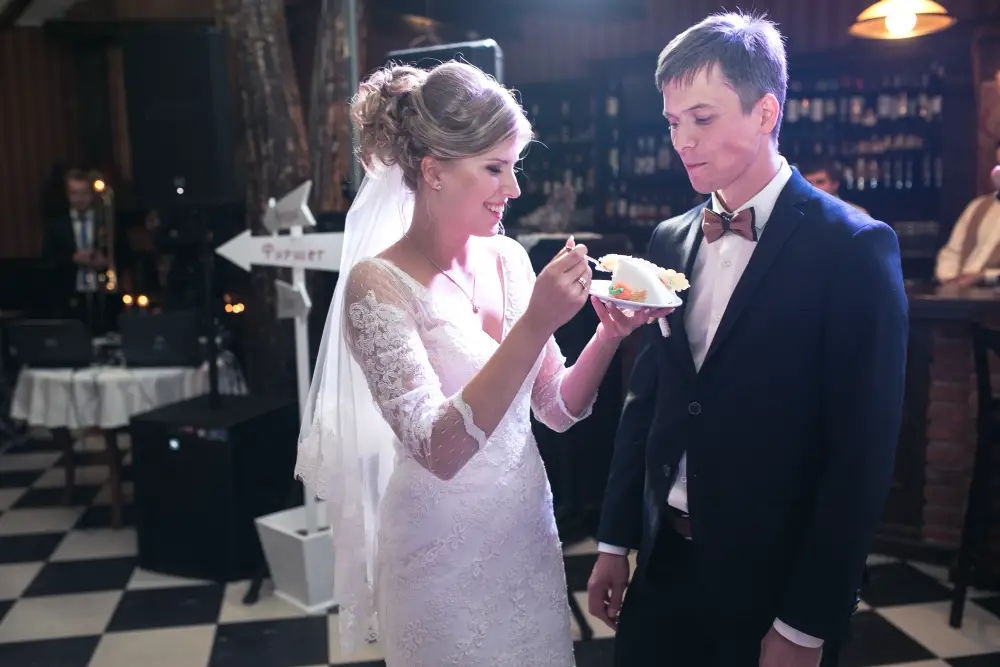
I had thought about this moment in the vague anticipatory way you think about small ceremonial pleasures. The knife held together, the first slice, maybe the feeding of a small piece, the laugh, the wiping of frosting from a lip. The kind of moment that ends up in wedding photographs with a slightly blurry intimacy to it because it is genuine rather than posed. I had not rehearsed it or planned it with the care I had brought to other elements of the day, because it seemed like the kind of thing that did not need planning, that would simply be what it was.
Ed looked at me with an expression I had seen before, the specific mischievous quality that in other contexts had been charming, the look that meant he had a plan. I saw it and registered it and did not process what it meant.
“Ready, babe?” he said, his hand covering mine on the knife.
“Ready,” I said.
We cut the cake together and I was reaching for the serving utensil when his hand moved from mine to the back of my head and shoved my face directly into the cake. Not lightly. Not the little tap-on-the-nose gesture that some couples do when they agree to it in advance. My face went into the cake and he held it there for a moment, and when I came up I was covered, the veil ruined, the makeup destroyed, buttercream in my hair and on my dress, and I could not see clearly because my eyes were full of frosting, and the room had made the sound of a hundred and twenty people catching their breath simultaneously.
He was laughing. That is the detail that stays with me most clearly, not the cake itself, not the public nature of it, not the ruined dress or the ruined veil, but the laughter, which was the laughter of someone who found what he had done genuinely funny and was expecting me to find it funny too. He reached over and swiped frosting from my cheek with one finger and licked it and said something about it being sweet, said it loudly, for the room.
I stood there with cake on my face on my wedding day in front of a hundred and twenty people and felt something that I cannot describe as a single emotion. It was shame and it was hurt and it was confusion, because I did not understand how the man who had brought me sunflowers and packed my favorite sandwiches and showed up with ice cream on bad days had looked at this day, the most important day of both our lives, and decided that this was the funny thing to do. I felt the lump in my throat that precedes crying and I did not cry because I was too shocked to cry and because a hundred and twenty people were watching.
The room had gone very quiet. Not the warm hum of a moment before. Something more uncertain, more uncomfortable, the sound of people who do not know what the correct response is and are waiting for someone to tell them.
That was when Ryan stood up.
He pushed his chair back with a motion that was not dramatic but that had a decisiveness to it that drew every eye in the room. His jaw was set in the way I have seen it set when he has made a decision and is past the point of reconsidering it. His face had the particular quality of controlled anger, the kind that is more frightening than the uncontrolled kind because it is purposeful.
He crossed the dance floor in a few quick strides. Ed, still laughing, had not fully processed what was happening before Ryan had him by the back of the head with the same motion Ed had used on me, and pressed his face into what remained of the wedding cake with the full and deliberate pressure of someone making a point rather than playing a game.
He held it there. Not briefly. Long enough for Ed to understand what was happening and why, long enough for the frosting to cover his face and his hair and the lapels of his tuxedo, long enough for the room to understand that what they were witnessing was not a continuation of a joke but the end of one.
When Ryan let him up, Ed was sputtering, trying to clear frosting from his eyes, the laughter gone completely from his face and replaced with something between embarrassment and the nascent shape of anger at the wrong person. Ryan looked at him steadily.
“This is the worst joke you could have come up with,” he said, loud enough for the room to hear. “You humiliated your new wife in front of her family and her friends on one of the most important days of her life.”
Ed was wiping cake from his face. Frosting dripped from his hair onto his tuxedo jacket. He said nothing.
Ryan was not finished. “Does it feel good? Having your face shoved into cake while everyone watches? Because that is exactly what you just made Lily feel.”
Then he turned to me, and his expression changed completely. The anger was still there but underneath it was something else, the thing that has always been underneath his expressions when he looks at me, the quality of someone who took on a responsibility decades ago that was too large for him and has never once considered putting it down.
“Lily,” he said quietly, “think carefully about whether you want to spend the rest of your life with someone who shows no respect for you or for this family.”
Ed had found his voice. He pointed at Ryan and said he had ruined the wedding. He said it with the accusation of someone who has done something indefensible and has decided that the person who responded is more culpable than the person who began it. Then he turned and walked toward the exit with the rigid back of someone who has nothing else to say and knows it, leaving a trail of cake crumbs across the reception hall floor, and the heavy doors swung closed behind him.
The room was completely silent.
Ryan came to my side. “Come on,” he said. “Let’s get you cleaned up.”
He walked me to the women’s restroom and stood outside the door while I stood at the sink and looked at myself in the mirror and worked at removing the frosting from my face and hair with wet paper towels. I did not cry in the restroom. The crying happened later, alone, when there was no one who needed me to be composed.
When I came out, Ryan was leaning against the wall in the corridor with his hands in his pockets, the controlled anger still visible in the set of his jaw. He had found, somewhere in the previous ten minutes, a hair tie and two bobby pins, which he offered to me with the practical matter-of-factness of someone who has decided that moving forward is more useful than continuing to process what just happened.
“I will never let anyone treat you like that,” he said. He paused. “If Dad were here, he would have done the same thing.”
I looked at my brother, his knuckles still faintly white, his charcoal suit perfect except for a small smear of buttercream on the sleeve he had not noticed. Twelve years old, standing in a house that had just lost its fourth person, understanding without anyone telling him that things were going to be different now and that different was going to require something from him. Forty-three years old now, standing in a corridor outside a women’s restroom at his sister’s wedding, having just done, without a moment’s hesitation, exactly the thing that needed doing.
“Thank you,” I said, and meant it in the specific way you mean something when the word is the only container for something much larger than itself. “You did the right thing. You stood up for me when I couldn’t stand up for myself.”
We went back out into the reception.
What followed was the particular strangeness of a party continuing after its central premise has been disrupted. The guests, who were mostly kind people and mostly found themselves in a situation with no obvious script, did their best. There was talking and there was eating and there was music at a volume that was slightly too low to be festive and slightly too high to be somber. My aunt kept shaking her head and saying things about how men used to know how to behave. Uncle Joe patted Ryan on the back several times with the satisfied expression of a man who believes justice has been served. My mother sat with me for a while and held my hand and did not say anything, which was exactly right.
Ed did not come back to the reception.
I went home to our apartment in my ruined wedding dress and sat on the couch with the specific disorientation of someone who has had the most important day of her life go in a direction she did not plan for. The dress still smelled of buttercream. The veil was in a bag I had carried out of the reception hall without fully deciding to carry it. I sat there for a long time in the quiet and thought about the pier at sunset and the ring catching the light and the two years of sunflowers and sandwiches and bad jokes delivered with full conviction, and I thought about the moment in the reception hall when I realized I was covered in cake and the man who had covered me in cake was laughing.
I did not have a clear answer about what to do. I am not sure I expected to have one that night.
Ed came back the following morning still in the tuxedo, which had dried with the frosting in the fabric. He looked like someone who had spent the night with whatever he had done, which in my experience is what most people look like when they have spent the night with whatever they have done. His eyes were red. He dropped to his knees in the living room without any apparent self-consciousness about the gesture, which is not natural for him, and which therefore told me something about the genuineness of what he was about to say.
He told me he was sorry. He told me that when Ryan shoved his face into the cake he had felt, for the first time and completely involuntarily, exactly what he had made me feel, and that the feeling was much worse from inside than it had looked like from outside, and that he was ashamed. He said he had thought it would be funny and he had been wrong and he was not sure how he had been so wrong about something that now seemed so obvious. He said he would never do anything like it again and meant it in the way you mean things when you have recently learned them from a source you cannot forget.
I believed him. Not immediately and not without the particular condition that belief carries after it has been asked to recover from something significant, but I believed him. The apology had the texture of something that had cost him, and things that cost the person saying them tend to be closer to true than things that come easily.
I forgave him, though it took time. The time was necessary. Forgiveness that happens too quickly sometimes turns out to be conflict-avoidance wearing forgiveness’s clothes.
Ryan kept a watchful eye on Ed for weeks afterward, the specific watchfulness of someone who has made a point and wants to be sure the point has been received rather than simply endured. Ed received it. I believe he received it on the dance floor and then again, more thoroughly, on the floor of the reception hall with his face in the remains of a wedding cake, and that these two receptions constituted a lesson he did not need to be taught twice.
Thirteen years. Two children who are opinionated and funny and loud and exactly as much work as I was told they would be and more joy than anyone could adequately describe in advance. Ed, who has spent thirteen years being the person he was when he was bringing me sunflowers and packing sandwiches and showing up with ice cream, which it turns out was always who he actually was, the cake incident being not a revelation of a hidden self but a single terrible lapse in judgment committed by a person who is otherwise genuinely decent. These things coexist. People are not only their worst moments, and I am glad I understood that then even though the understanding required more work than it should have.
Ryan, who calls on Sundays and comes to soccer games and stands in kitchens at family dinners looking at Ed with the expression of someone who has made his peace with a person while retaining the option to revisit that peace if necessary, which Ed knows and which I believe has made Ed a better husband than he might otherwise have been.
I want to be careful about how I tell the rest of this, because the easy version of the story has Ryan as a hero in a way that papers over what the day actually cost. He did the right thing. I believe that completely. But doing the right thing in public at a wedding, in front of a hundred and twenty people, with the full knowledge that the consequence might be the end of his sister’s marriage before it properly began, required a courage that I did not fully appreciate until I was older and had more context for understanding what courage actually costs.
He did not know, when he stood up and pushed back his chair, whether I would thank him or be angry at him. He did not know whether I would choose to leave Ed or to stay with him, and he was not making that choice for me, he was making a different choice, the choice to make clear that what had happened was not acceptable and that there was someone in the room who would say so regardless of the social cost. He was not protecting me by making my decision. He was protecting me by ensuring I had full information about what kind of person I had married and what the people who loved me thought about it.
The man of the house is a phrase I have always been slightly suspicious of, as I said. What Ryan became when our father died was not a replacement for our father, because that replacement is not possible and the attempt to force it is generally a disservice to everyone involved. What he became was himself, earlier and more completely than he might have otherwise, a person who understood that the people he loved required his attention and his willingness to act, and who has given both consistently and without calculation for three decades.
He turned forty-three this week. I called him and told him I was thinking about that day, and he laughed and said he thought about it sometimes too, usually when he was at a wedding and the couple got to the cake. He said he had no regrets except that he had gotten buttercream on the jacket and the dry cleaner had not entirely been able to remove it.
I told him that if our father had been there, he would have done the same thing.
Ryan was quiet for a moment. “Yeah,” he said. “I think he would have.”
The sunflowers are on the kitchen counter now, where I put them because Ed brought them home last weekend the same way he always does, one stem, chosen for the specific reason that I like them and not because a bouquet seemed like the more impressive gesture. He has been bringing me single sunflower stems for fifteen years, since the coffee shop, since the table by the window, since the afternoon he finally guessed my order correctly and asked if he could buy it for me.
I still have the notebook I was writing in when I met him. I found it a few years ago in a box in the back of the closet. The writing is the private, unedited kind, the thoughts of a twenty-six-year-old who was competent at a job she was not passionate about and using thirty minutes a day to hear herself think. I read a few pages and put it back.
There is nothing in those pages about the man who would become my husband. He had not guessed my order yet. He was still the person at the counter ordering his caramel latte, working up the courage that would eventually produce a guess, a conversation, a laugh over blueberry scones, a walk on a pier at sunset, a ring in the light, and everything that followed.
Everything that followed, including the cake on my face and my brother standing up.
I am glad it happened the way it happened. Not the cake, not the humiliation, not the ruined veil and the ruined makeup and the stunned silence of a hundred and twenty guests. Those parts I could have done without. But what came after: the clarity, the choice I made with full information, the thirteen years built on the honest foundation of having seen something real and decided it was not the whole truth, those I am glad for.
My life is a good one. Not perfect. Good, in the full and specific and hard-won way that good means when you have had the occasion to understand what the alternative looks like and have chosen this instead.
Happy birthday, Ryan.
Some heroes wear capes, and some wear charcoal suits and stand up without hesitating in the middle of a reception hall because their little sister is covered in cake and no one else is going to say what needs to be said. Mine is the second kind, and I have been grateful for him every single day of the thirty-nine years I have been his sister.

Ethan Blake is a skilled Creative Content Specialist with a talent for crafting engaging and thought-provoking narratives. With a strong background in storytelling and digital content creation, Ethan brings a unique perspective to his role at TheArchivists, where he curates and produces captivating content for a global audience.
Ethan holds a degree in Communications from Zurich University, where he developed his expertise in storytelling, media strategy, and audience engagement. Known for his ability to blend creativity with analytical precision, he excels at creating content that not only entertains but also connects deeply with readers.
At TheArchivists, Ethan specializes in uncovering compelling stories that reflect a wide range of human experiences. His work is celebrated for its authenticity, creativity, and ability to spark meaningful conversations, earning him recognition among peers and readers alike.
Passionate about the art of storytelling, Ethan enjoys exploring themes of culture, history, and personal growth, aiming to inspire and inform with every piece he creates. Dedicated to making a lasting impact, Ethan continues to push boundaries in the ever-evolving world of digital content.