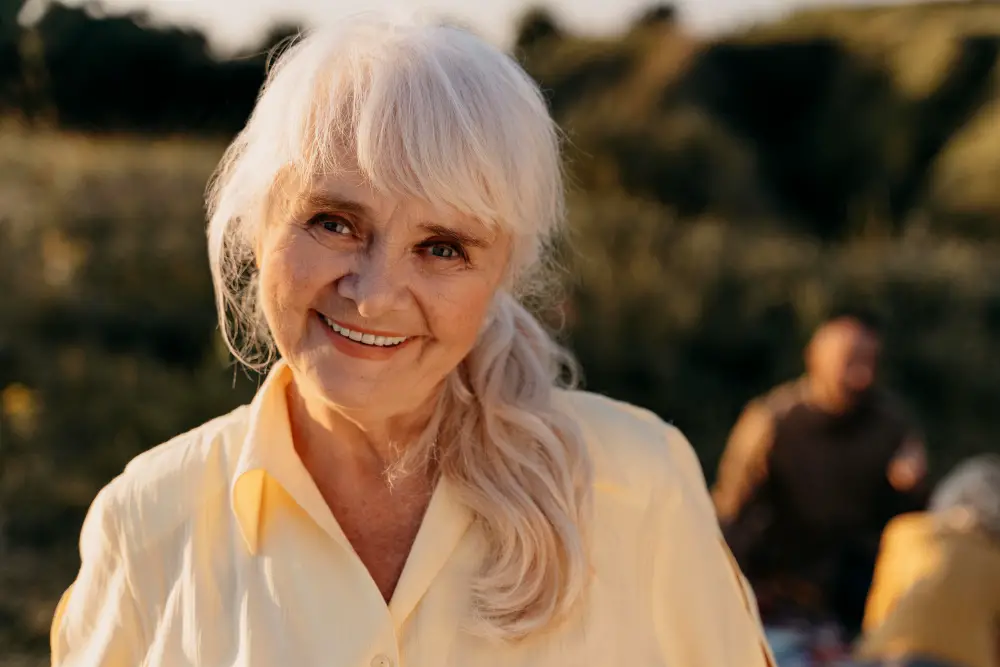
The pie arrived before I had unpacked a single box.
I had been in the house for less than forty-eight hours, still operating in the exhausted and slightly disoriented state that follows a move, when I heard the knock. I opened the door to find a woman in her mid-seventies standing on my porch with a pie dish covered in a blue checkered cloth and a smile that had the quality of something entirely without agenda, the smile of a person who is simply glad you exist and wants you to know it.
“Blueberry,” she said, holding it out. “Still warm. I’m Ruth Whitmore. I live two houses down, the white one with the flower beds. Welcome to the street, dear.”
I took the pie. I thanked her. She waved away the thanks with one small hand and said she hoped I would be very happy here, and then she walked back down my porch steps and along the sidewalk with the purposeful step of a woman who has places to be and things to tend to and has simply made a small detour in her afternoon to do something kind.
I stood in my doorway holding the pie and felt, for the first time since I had signed the lease and loaded the truck and driven away from the city with everything I owned, that I had made the right decision.
Mrs. Whitmore became one of those neighbors you find in the best versions of your life, the ones who become so quietly present that you stop noticing the specific acts of their kindness and begin simply living inside it. She was there in the background of my days the way good weather is there, not dramatic, not demanding attention, just reliably good. We talked over the fence in the evenings when I got home from work. Occasionally she invited me for tea, and I would sit at her kitchen table in the warmth of a house that smelled like lavender and baked things, and we would talk about ordinary topics, my work, the street, the changing of the flower beds she maintained with the exacting seasonal care of a person who believes that attention paid to small things is not small.
She was a widow. Her husband had been gone some years and she did not talk about this with grief so much as with the settled acceptance of someone who has processed a loss thoroughly enough that it has become part of the landscape rather than the weather. She lived alone and did not seem lonely, or at least did not seem to want the kind of help that loneliness requires. She was self-sufficient in a way that I admired, the kind of woman who fixes things before they break and keeps track of things before they are lost.
There was one thing about her property that did not fit the otherwise immaculate picture she presented to the world.
In her backyard, half-obscured by the fence line at the rear of the garden, sat an old shed with a padlock on the door. Heavy, brown with rust, the padlock looked as though it had not been opened in years. The shed itself had weathered to the color of old wood, and the contrast between it and the rest of her garden, the careful flower beds, the painted fence, the lawn that was always exactly the right length, was striking enough that I noticed it the first week I was there and kept noticing it without ever quite finding a natural way to ask.
I never asked. It was her shed, and she was a private person in the way of people who are warm without being disclosing, who give you their full attention without giving you their full interior. Whatever was in the shed was hers to keep, and I kept myself from wondering too persistently in the way you learn to do when you respect someone.
Mrs. Whitmore died four days ago. Quietly, in her sleep, at seventy-eight years old. The kind of death that people describe as peaceful and mean it, the kind that is only sad for the people left outside it.
The church service was small. Neighbors I recognized, a few faces I did not. I was standing on the steps in the cool air afterward, not quite ready to go home, when a girl of about eleven approached me with the directness of someone who has been given a task and intends to complete it properly.
“Are you Amber?” she asked.
“I am.”
She held out a small envelope. “Mrs. Whitmore asked me to give you this today. On the day of her funeral. She said it had to be today.”
I took it. The girl disappeared into the small crowd before I could ask her anything, moving away with the unselfconscious efficiency of a child who has done what she was asked and considers the matter complete.
The envelope had my name on it in Mrs. Whitmore’s handwriting, the careful, slightly old-fashioned script I recognized from the notes she occasionally left on my porch when she left things for me. A key slid out when I opened it, and a folded note with it.
Amber dear, I should have kept this a secret even after my passing. But I cannot. You must know the truth I have kept from you all these years. You will understand everything when you open my shed.
I stood on the church steps with the key in my palm and the note in my other hand, and I knew with the certainty of someone who has just received an instruction that comes from beyond the usual reach of instructions that I was not going home before I opened the shed.
The afternoon light was going thin by the time I came around to her backyard through the side gate. Her yard had the particular stillness of spaces that were recently maintained and recently abandoned, the flower beds still holding their late-season color, the lawn still cut, everything as she had left it, waiting for a person who was not coming back.
The padlock was heavier than it looked, and the key took a moment of adjustment before it caught, the way locks do when they have not been used in a while and need to be reminded of what they are for. The door swung inward with a groan that was loud in the quiet yard.
The smell that came out was cool and dusty with something underneath that was faintly earthy, the way clay smells or old plaster. Inside it was dim, the late light reaching only the first few feet of the interior, and what I could see in that light were shapes under white sheets, several of them arranged along the walls and workbench, and in the center of the room, larger than any of the others, a shape that rose to approximately my height and was draped in a sheet of its own.
It was roughly the proportions of a person. Standing still in the dim interior, it had the presence of something waiting.
I stood in the doorway for what was probably only half a minute but felt longer. Then I walked forward and took hold of the sheet with both hands and pulled.
What I did next I am not proud of as a rational response to what was actually in front of me, but it was an entirely honest one. I screamed. I stumbled backward through the doorway and my phone was in my hand before I had made any conscious decision to reach for it, and I told the dispatcher there was something in the shed and I needed help, and I did not wait for the officers to arrive before I put significant physical distance between myself and the door.
They came within ten minutes, two of them, with flashlights and the professional calm of people who have been dispatched to situations that turned out to be misunderstandings more often than not. One of them pulled the sheet all the way off and swung the flashlight across what was underneath and then turned to look at me.
“Ma’am,” he said, “it’s a sculpture.”
I stepped forward slowly.
He was right. It was a life-sized figure lying on a long worktable, constructed from sculpted wax and plaster, finished with the kind of careful detail that accumulates over many hours of patient work. The hands were defined at the knuckle. The face, when I leaned in and looked at it directly, had the specific quality of a face that someone has studied for a long time, the features not generalized but particular, the nose not simply a nose but this nose, the eyes not simply eyes but these eyes, with their particular spacing and their particular depth.
The face was mine.
I stood there in the shed with the two officers behind me and looked at a wax and plaster face that was my face, and I felt something move through me that I did not have a name for yet but which I would come to understand in the next few hours as the first tremor of a much larger earthquake.
I apologized to the officers. I thanked them for coming. I waited while they left and then I turned back to the workbench and looked more carefully at what else the room contained.
Beside the sculpture, partially covered by a cloth, were sketches. Dozens of them, loose and stacked, some rolled and tied with string. I picked up the first one and held it toward the light from the open door. A pencil drawing of a woman’s face, precise and studied, the work of a hand that had drawn the same subject many times and had learned, in the repetition, to find it from any angle. It was the face of the sculpture. It was my face.
There was a date in the corner.
March 12th, 1995.
Thirty-one years ago. I had not been born yet in 1995. I was twenty-eight years old standing in this shed, and someone had been drawing my face for more than three decades before I came to live two houses down from them.
I picked up another one. The same face, a slightly different angle. And there was something about it now, something I had not let myself fully see in the first drawing, that the face was not quite mine alone. The jaw had a quality. The way the eyes sat in the face. I picked up a third drawing and held all three in my hands and looked at them together and understood, slowly and with the specific reluctance that attends understanding you are not ready for, that the face in these drawings also looked very much like my mother at twenty.
The sketches went back decades when I looked at the dates. The same face appearing and reappearing across thirty years, aging in some, younger in others, as though someone had been imagining a whole life from a starting point that preceded my existence.
Beneath the sculpture, pressed flat against the table, was another envelope with my name on it in Mrs. Whitmore’s handwriting. Beneath that was a bundle of photographs, the slightly washed-out color of pictures printed in the early nineties, that era’s light preserved in its particular way.
I held the first photograph up to what remained of the daylight from the open door.
Two women, arms around each other, smiling at the camera. The older one was a younger Mrs. Whitmore, her hair still mostly dark, her face holding the same expression I had seen so many times over the fence, the warm uncomplicated pleasure of being where she was. The younger woman beside her was perhaps twenty years old, laughing at something happening just beyond the frame, her whole face open with it.
She looked exactly like a photograph of my mother at twenty that had sat on the mantelpiece in our house my entire childhood.
A memory surfaced then, the involuntary kind that arrives fully formed.
Several weeks after I had moved in, I had been showing Mrs. Whitmore something on my phone, a photo of a place we had been discussing, and I had swiped too far and landed on a photograph of my mother. I had said, without thinking anything of it: that’s my mother, Jeanne. And I had kept scrolling to find what I was looking for.
Mrs. Whitmore had gone quiet for a moment. She had looked at the screen a beat longer than the occasion called for. I had noticed it, registered it as a small thing, and continued with what we were doing. It had not stayed in my mind because there was no frame for it to be held in.
There was a frame for it now.
I opened the letter.
She wrote that she had known her health was declining and had made arrangements, through a girl she had befriended during her hospital visits, for the envelope to reach me on the day of her funeral because she had understood, with the precision of someone who has thought a thing through completely, that it had to be that day. That there was a kind of truth that needed the occasion of an ending to be finally speakable.
She wrote that she had carried this for too long. That I deserved to know it even if she was not there to give it to me in person.
And then the sentence that took my legs: Amber, you are my granddaughter. I knew it the day you showed me your mother’s photo on your phone. You have her face, and your mother is my daughter.
I sat down on the floor of the shed.
I sat there for some time. Not thinking, exactly. More being rearranged from the inside, the way you are when a truth arrives that is too large to hold upright immediately and needs to be sat with before it can be carried.
Mrs. Whitmore was my grandmother. She had known who I was from the moment I showed her a photograph of my mother by accident, and she had said nothing. She had brought me pies and talked to me over the fence and waved when I came home from work and had never once told me.
And she had been drawing my mother’s face for thirty years before I came to live two houses away from her.
I drove to my mother’s house in the city with the photographs on the passenger seat and the letter in my coat pocket, and I drove without fully thinking about what I was going to say because there was not a version of what I was going to say that I had any preparation for.
My mother, Jeanne, was in her kitchen when I arrived. She looked at my face and set down what she was holding without asking any questions, which is what she does when she understands that the situation is beyond the ordinary register of things that can be approached normally.
I put the photographs on the kitchen table without speaking and watched her face.
She went very still. She sat down slowly and picked up the top photograph with both hands, the way you handle something fragile or something that requires your whole attention, and she looked at it for a long time.
“Where did you get this?”
“From Mrs. Whitmore’s shed. My neighbor. She left me a letter, Mom.”
I told her what the letter said. I watched my mother’s face while I said the words, and I watched her in the same moment understand everything I was telling her and be taken apart by it, the years-long weight of something she had been carrying becoming visible all at once in the way that things become visible when they are finally named.
She pressed a hand over her mouth. I sat down across from her and waited, because whatever she was carrying she had been carrying it alone for a very long time and it was not mine to rush.
It came out in pieces, the way things do when they have been held in one shape for too long and need to be released slowly to keep from breaking the person they are coming out of.
Mrs. Whitmore and her husband had adopted my mother as an infant. They had raised her with everything they had, in the white house with the flower beds, the house I had been in hundreds of times over the past three years drinking tea at the kitchen table. My mother had grown up in that house. She had been loved there.
When my mother graduated, her father had just received a serious diagnosis, and his one hope in the time he felt he had was to see his daughter settled before he could no longer be present for anything. My mother was in love with someone her parents did not know, a man she had met through friends, my father, and the pressure of family expectation collided with the intensity of new love in the way it sometimes does when someone is young and frightened and not yet capable of understanding that the things they feel urgently cannot wait are usually the very things that can.
She left a note. She took my father and ran.
“I told myself I’d explain later,” she said, her voice quiet and effortful, the voice of someone dragging something heavy across difficult ground. “That I’d go back and make them understand. But later kept moving further away.”
My father had died less than two years after they eloped, leaving my mother alone with an infant and a grief for him that arrived at the same time as a guilt about her parents that she did not know how to hold separately from the grief. She had been surviving, which takes everything, and survival does not leave much room for going back and making things right. And when she was finally stable enough, finally herself enough to go back, Mrs. Whitmore had sold the house and left no forwarding address.
“I thought my mother cut me off completely,” she said. “I thought I had lost her for good.”
She did not know that the loss had been as devastating on the other side. She did not know that her mother had not cut her off but had simply been unable to stay in the house where everything was her daughter’s absence, and had moved to a new street to try to continue living, and had spent the next thirty years sculpting the face she was afraid of forgetting.
I told my mother about the shed then. All of it. The sculpture lying on the worktable with the face that was hers and mine together. The sketches dated across three decades, the same face appearing in pencil over and over from 1995 forward, drawn with the devoted repetition of someone practicing an act of memory so that it would not fail.
My mother’s face did what faces do when something breaks loose inside them. She pressed her lips together and looked somewhere I could not follow and then looked back at me, and her eyes were full.
“My mother sculpted,” she said, half to herself, the way you say something you know but have not thought about in years. “She used to say she could remember a face forever once she’d drawn it.”
She had never forgotten. All the years my mother believed she had been abandoned, Mrs. Whitmore had been in a shed at the back of a yard on a different street, drawing the face of her daughter from memory because she could not afford to let herself forget it.
We drove back to Mrs. Whitmore’s house together that evening. I unlocked the shed and stood back while my mother went in ahead of me, and I watched her move through the space with the careful, reverent attention of someone entering a place they understand to be sacred.
She stood in front of the sculpture for a long time.
Then she crouched beside the workbench and began going through the sketches one by one, slowly, holding each one briefly before moving to the next, the way you hold things you are trying to fully understand. The shed was quiet around us. The light from the open door had gone amber with the evening, and in that light I watched thirty years of grief and guilt and the specific loneliness of believing yourself abandoned move across my mother’s face in real time, each sketch a year, each year a loss that had been privately and faithfully mourned.
“She kept drawing the same face,” my mother said finally, her voice very low. “Over and over. As though she was trying not to forget.”
In the morning we went to the cemetery together. Mrs. Whitmore had been laid to rest beside her husband, my grandfather, a man I never knew and whose name I was only now connecting to myself in the way that names become real when you understand whose they are.
My mother stood at the grave for a long time. I stood beside her and said nothing because there was nothing for me to say that was more important than the silence she needed. Then she crouched and pressed her palm flat against the headstone, the way you touch something you need to feel in order to believe is real.
“I’m so sorry, Mom. Dad.” Her voice broke cleanly and she let it. “I’m sorry I left. I’m sorry I didn’t come back. I’m sorry you never got to know her.”
I put my hand on her shoulder. She reached up and covered it with hers, and we stayed there in the cool March air, my hand on her shoulder and her hand on mine, the wind moving quietly through the cemetery around us.
The lawyer’s office was warm and simply furnished, the kind of office that has been arranged to communicate solidity without pretension. Mr. Calloway was a careful man, unhurried in the way of people who understand that what they do has weight and treat that weight with respect. He handed us each an envelope before he said anything about the will, and he said that Mrs. Whitmore had asked that we read the letters before the rest.
I opened mine.
Amber, she wrote, and the handwriting was the same careful script I had seen on the envelope at the church, the same hand that had written the names of the drawings in the corners for thirty years.
I knew the moment I saw you. And I knew for certain the day you showed me your mother’s photo. I was afraid to say it out loud. Afraid of losing you before I even had you. So I stayed close in the only way I could. Every pie, every wave, every small moment. That was my way of loving you, sweetheart.
It may not have been enough. But it was everything I had.
You were the sweetest part of my life.
I set the letter down on my knee when I could not see the words anymore. Across from me, my mother was already reading hers, her hands very still on the page, her face moving through something private and enormous.
“She forgave me,” she said softly, almost to herself, the way you say something that you have needed to hear for so long that hearing it does not resolve the longing but rather confirms what you had given up hoping for. “After everything. My mother forgave me.”
I looked at my mother and she looked at me and something passed between us that did not need language. The specific, wordless recognition of two people who understand simultaneously that they have been part of the same story without knowing it, that the love they needed was present all along in a form they could not see.
Mr. Calloway read the will. Mrs. Whitmore had left everything to me. The house, its contents, the savings accumulated over a careful and modest life. All of it, to a granddaughter she had loved at a distance for three years and had loved in the form of pencil drawings and memory for thirty years before that.
I thought about the forty-eight hours after my move when she had appeared on my porch with a pie that was still warm. The careful timing of it, arriving before I was unpacked, before I had begun to feel at home, as though she had been watching for me. Not watching in the unsettling sense but watching in the way of someone who has been waiting a very long time and wants to be present from the first moment available.
She had known within days of my arrival. She had recognized my mother’s face in my face and had understood what it meant and had made a decision that I am still, even now, trying to fully understand. She had decided to be my neighbor. To be the woman who brought pie and talked over the fence and waved when I came home. To love me in the only way she felt she safely could, which was in proximity, without disclosure, without risking the conversation that might have driven me away before she had had any time with me at all.
I had thought she was simply a good neighbor. She was that. She was also a grandmother who had been given, in the final three years of her life, an accidental and extraordinary gift, which was that the granddaughter she had never known had moved two houses down the street.
She had never got to say the word aloud. I had never got to use it for her. There is a specific grief in the things that were not said in time, the names not spoken, the conversations not had, and I feel that grief in a quiet and permanent way when I think about the three years we had together as neighbors rather than as what we were.
But she made sure I would know. She arranged it with the same careful attention she brought to her flower beds and her fence and the letter left in the hands of a child who was instructed to find me on a specific day. She planned the revelation the way she had planned everything else in her life, with precision and patience and the long view that knows some truths need the right moment to be received.
The shed is mine now. The house is mine. The sketches are mine, all of them, three decades of my mother’s face drawn from memory by a woman who could not let herself forget.
I have been going through them slowly, in the evenings, taking them out one at a time. There is a quality to them that is not quite like anything else I have seen, which is the quality of sustained devotion expressed through a medium that requires you to look and look again, to keep returning to the same subject until you understand it from every angle. She drew my mother’s face from the front and in profile and in three-quarter view, in different lights and at different ages she imagined, a young woman and then a woman growing older and then an older woman, a life constructed in pencil across the years she was not able to witness in person.
She told my mother in her letter that she forgave her. I have read my mother’s letter, which my mother shared with me, and in it Mrs. Whitmore writes about the day my mother left, not with bitterness but with the understanding of an older woman looking back at a younger one, seeing the fear and the love that produced the decision and being unable, after so many years, to hold it as a wrong. She wrote that she had missed her every day. She wrote that she had kept drawing the face because she could not afford to let memory do what memory does without effort, which is slowly soften and generalize the specific, beloved features of a person until you can remember that you loved them without quite being able to remember why.
She did not want to forget why. So she kept drawing.
My mother goes to the cemetery regularly now. She brings flowers when the season allows it. She stands at the grave for a while and says things I cannot hear, private things, the conversation she is finally having thirty years after she should have started it. I wait on the path and give her the time, and when she comes back to walk with me she sometimes talks and sometimes does not, and both are right.
We have been going through the house together. There are things in it that my mother remembers from her childhood, objects that have followed Mrs. Whitmore through the years: a particular lamp, a set of dishes, a small painting that hung in the hallway and that my mother stopped in front of the first time we walked through and pressed her hand to her mouth.
We are not hurrying. There is no need to hurry.
What I understand now, going through it all, is that Mrs. Whitmore was a woman who knew how to love in the long term, across distance and time and the absence of reciprocation, without letting the absence turn the love into something smaller. She had been given a loss and had carried it without becoming bitter about it, without closing herself off, without letting the grief of one relationship prevent her from being warmly present in all the others. She was the woman who brought pie to the new neighbor within forty-eight hours. She was the woman who tended her flower beds with seasonal precision and waved from the porch in the evenings. She was the woman who had a locked shed in her backyard that nobody questioned because she was so clearly a person of good faith that the one private thing she kept did not trouble anyone.
She had a granddaughter for three years who did not know she was her granddaughter.
She made the most of it. Every conversation over the fence, every cup of tea at the kitchen table, every wave from the porch was, I understand now, a small and deliberate act of love performed in the only register available to her. She could not say grandmother. She could not say I have been drawing your mother’s face for thirty years and I want you to know that you were wanted all along. She could not give me the history that was mine.
But she gave me what she had. She gave me the pie and the wave and the presence. She gave me the sense that the street was a good place to live and that there was someone nearby who was glad I had come. She gave me three years of the texture of being loved by a grandmother, even without the name for it.
And then, when she knew she was running out of time, she gave me the name too.
The letter is on my desk now, the one she had delivered to me at the church. I have read it many times. I keep returning to the specific sentence: I was afraid to say it out loud. Afraid of losing you before I even had you.
She had loved me for three years, and still she had been afraid that if she told me the truth I might not receive it, might not believe it, might pull back from the closeness she had been careful to build. The fear of losing love is present even in people who have been practicing it for decades and who love with the patience and the long view and the steady commitment that Mrs. Whitmore brought to everything. It does not go away because you have become good at love. It simply becomes something you carry quietly alongside the love itself.
She carried it all the way to the end. And then she put the key in an envelope and arranged for a child to find me at the right moment, and she told me the truth from a letter because she could not tell me in person.
It may not have been enough, she wrote. But it was everything I had.
I fold the letter carefully along its original creases and put it back in the envelope and think about a woman in a shed at the back of a yard drawing the same face over and over for thirty years so that she would not forget it.
It was more than enough. It was extraordinary. It was the kind of love that does not require the person being loved to know about it in order to be real, and which becomes, in the end, more fully itself when it is finally known.
I am her granddaughter. I know it now.
I wish I had known it three years ago, over the fence, in the warm light of all those ordinary evenings.
But I know it now, and that is what she wanted. That is what she arranged, with her characteristic care and her characteristic patience, so that I would know: she never forgot. She never stopped. She was always there, two houses down, with the flower beds and the porch and the pie that was still warm when it arrived, loving me the only way she could.

Laura Bennett writes about complicated family dynamics, difficult conversations, and the quiet moments that change everything. Her stories focus on real-life tensions — inheritance disputes, strained marriages, loyalty tests — and the strength people find when they finally speak up. She believes the smallest decisions often carry the biggest consequences.