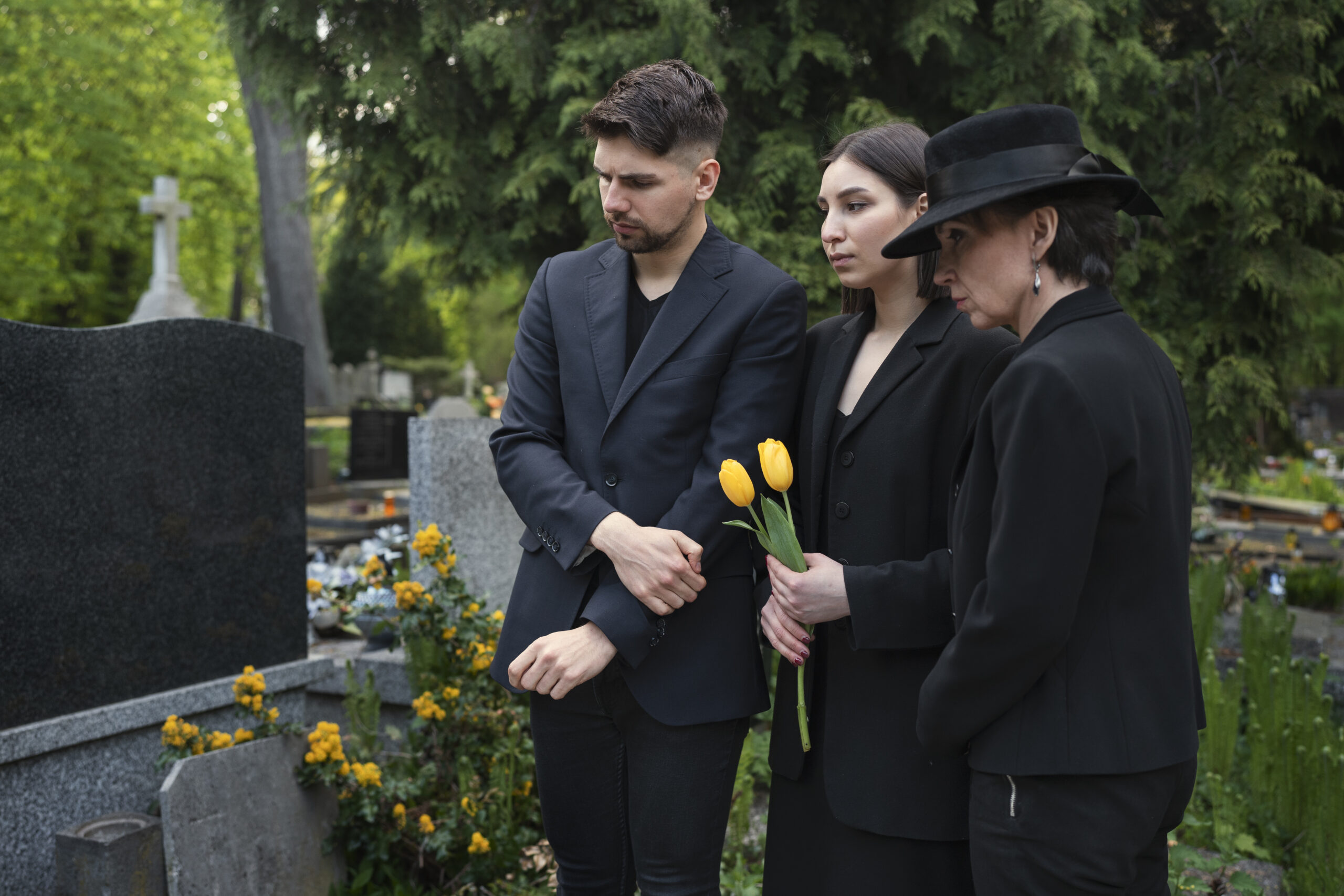
On the day of my husband Eduardo’s funeral, the air carried the scent of marigolds and damp soil.
I was dressed in black, a shawl too thin to hide my tears, standing in the cemetery beside a man I had loved for thirty-one years while they lowered him into the ground. Beside me stood Diego, my son. His jaw was set, his eyes locked on the coffin as if it were an unfinished responsibility rather than his father.
Eduardo had died from a sudden heart attack three weeks earlier. No warning. No goodbye. Just a phone call from the hospital that rearranged everything I had believed about the shape of my life going forward. In the weeks that followed, Diego became distant in a way I told myself was grief. I heard whispers at the edges of family gatherings, fragments about money and the house in Colonia Roma and Eduardo’s business and a woman named Valeria. I refused to believe any of it. I was too busy surviving to pay close attention to what was circling us.
When the priest finished and people began approaching to offer condolences, Diego grabbed my hand.
Too tight to be comfort.
He leaned toward my ear and said quietly, with complete calm, “You are no longer part of this family, Mom.”
My stomach dropped. I tried to respond but no words came. He was still holding my hand when he signaled Eduardo’s lawyer, Mr. Ramírez, who had been standing a few steps away the entire time, briefcase in hand, as if he had been waiting for exactly this moment.
Ramírez opened the briefcase and produced a sealed envelope.
“The will,” Diego said aloud.
I recognized Eduardo’s signature on the outside. I recognized the notary seal. Diego took it from the lawyer as if it had always belonged to him, as if he were simply collecting something set aside in his name.
Then he reached into my bag and removed my keys.
All of them. The front door, the garage, the office.
“This is a mistake,” I managed.
Ramírez avoided my eyes. “Mrs. Mariana, your son is the sole heir according to this document,” he said, his voice mechanical, rehearsed.
Several people standing nearby lowered their gaze. I felt shame, and anger, and a sorrow so deep it made me dizzy. I understood what Diego was doing. He had chosen to do this here, in front of everyone, at his own father’s funeral. He wanted an audience. He wanted witnesses to my humiliation so that afterward there would be people who could say they saw me accept it.
I didn’t shout. I didn’t cry out. I didn’t make the scene he was perhaps hoping would discredit me.
I turned and walked toward the cemetery exit.
Behind me I heard murmurs. Phrases like poor woman and how awful followed me through the rows of headstones. None of them mattered. Because as I passed Diego, I paused for just a moment. I reached up and adjusted his coat, the way a mother does, the gesture so ordinary and familiar that no one looked twice.
And in that moment I slipped the small device deeper into his coat pocket.
He didn’t notice.
But I heard the faint click as it settled into place.
I had taken the tracker that morning from Eduardo’s desk drawer, the one he used during business trips to track important shipments. I hadn’t planned it exactly. Something in me, some instinct sharpened by weeks of quietly watching my son become a stranger, told me to take it. I had slipped it into my coat before leaving for the cemetery without fully understanding why.
Now I understood.
Outside the cemetery gates, my phone vibrated. The signal was active.
I didn’t return home. It was no longer mine. Instead, I sat in a quiet café near Buenavista station and stared at my phone while the city moved around me, indifferent and loud, the way cities always are when your life is falling apart inside them.
The tracker app showed movement. From the cemetery, Diego had gone directly to the city center. He was not at home grieving his father. He was moving forward with whatever came next.
I thought about something Eduardo had said to me weeks before he died. We had been sitting at the kitchen table after dinner, and he had given me his email password, written on a small piece of paper in his careful handwriting. He had also given me a number. A safety deposit box at the bank on Insurgentes.
“If anything strange happens,” he said, “trust what I left outside the house.”
I had kissed his cheek and told him he was being overly cautious. He was always organized, always preparing for contingencies. I thought it was one of the habits of a man who had run a business for decades. I did not take it seriously enough.
Now I knew better.
I followed the tracker signal on my phone. It led me to a notary office on a side street in the centro. Through the glass I saw three people inside. Diego. Ramírez. And a woman I recognized immediately.
Valeria.
Eduardo’s business partner. The woman he had always described as simply professional, simply business, simply a colleague. She was standing near the desk with the posture of someone who had been waiting a long time for something to finally go her way.
I didn’t go inside. I stood on the pavement and watched through the glass as Ramírez handed over documents, as Diego signed them one by one, as Valeria smiled the smile of someone who believes she has already won.
Then they left, and the tracker moved again, heading back toward my house. I followed at a distance and watched from the street as Diego unlocked my front door with my own keys and walked inside with Valeria beside him, the two of them moving through the entrance with the easy familiarity of people who have been anticipating a moment for a long time.
I stood on the pavement with my hands shaking.
Then I turned and walked back to the café.
I opened my laptop and logged into Eduardo’s email account using the password he had given me. I searched through his inbox, then his drafts folder, and found a message I almost missed because of how it was labeled.
It was scheduled. Set to arrive in my inbox that morning if Eduardo had not manually cancelled the send before a certain date. He had prepared it knowing he might not be there to deliver it in person.
For Mariana, the subject line read. If you’re reading this, Diego has tried to remove you. Do not sign anything. Go to box 317. Everything is there.
My chest tightened so hard I had to press both hands flat on the table.
Eduardo had known.
Not suspected. Known. Which meant this was not a sudden opportunity Diego had seized in the chaos of grief. This was a plan that had been in motion before Eduardo died. A plan Eduardo had discovered, had been unable to stop, and had spent his final weeks trying to protect me from.
He had been carrying all of that alone so I wouldn’t have to worry.
The next morning I went to the bank on Insurgentes and asked for safety deposit box 317. I showed my identification. The young woman at the desk checked the records and nodded. My name was listed as co-holder, added years ago by Eduardo, quietly, without ever mentioning it.
Inside the box was a folder of documents. A USB drive. And a letter in Eduardo’s handwriting.
I sat in the small private room the bank provided and read the letter first.
Then I opened my laptop and played the video on the USB drive.
Eduardo was sitting at his desk, the one in our home office where he spent Sunday mornings reviewing accounts. He looked tired in the way that people look when they have been carrying something heavy for too long. But his voice was steady and his eyes were clear.
He spoke directly to the camera, directly to me, as if he had rehearsed it enough times to get it right.
He explained that Valeria had approached Diego months earlier with a proposal. If Diego helped her gain control of the business and the property after Eduardo was gone, she would give him a significant share. Diego had been struggling financially and had listened. Eduardo had discovered the plan through an intercepted email and had confronted Valeria. She had denied it. But the pressure had continued, and Eduardo, whose heart had already been showing signs of strain that he had been keeping from me, had understood that he might not have the time to fight it publicly.
So he had prepared.
The folder contained the real will, signed and notarized separately, held by a different lawyer whose name I didn’t recognize because Eduardo had specifically chosen someone neither Diego nor Valeria had any connection to. It also contained evidence. Email exchanges between Diego and Valeria dating back eight months. Financial records showing transfers Valeria had been making from the business accounts into a separate holding company. And a forensic analysis of the document Diego had presented at the funeral, which showed irregularities in the notary stamp consistent with forgery.
Eduardo had built an entire case from inside the last months of his life, knowing he might not be there to present it.
At the end of the video, he looked directly into the camera and said one word.
Fight.
I cried in that small room for a long time. Not from grief, though grief was there too. I cried from clarity. From the particular devastation of understanding how much someone loved you by seeing the lengths they went to in order to protect you even after they were gone.
Then I dried my eyes, put everything back in the folder, and called a lawyer.
The attorney I hired, a woman named Sonia who specialized in estate disputes and had the efficient manner of someone who had seen every variety of family betrayal, reviewed the documents that afternoon. By the following morning she had filed motions to suspend the fraudulent will pending investigation and had begun the process of freezing the accounts Valeria had been systematically emptying.
When Diego called that evening, he was furious. His voice had the pitched, desperate quality of a man who had believed something was settled and was suddenly watching it come apart.
“You’re destroying me,” he said.
“No,” I replied. “They are using you. They have been using you from the beginning.”
He hung up.
I sat with the phone in my hand for a moment and thought about the boy he used to be. The one who used to fall asleep watching football on the couch with his father. The one who called me every Sunday for years before Valeria entered his life and Eduardo’s business and started whispering into whatever dissatisfaction she found there.
I did not know what Valeria had promised him. I did not know exactly when he had decided that power was more valuable than his parents. But I knew that he had been told what he wanted to hear by someone skilled at identifying what people want and using it against them. That did not excuse him. But it helped me understand him.
Two weeks later, in court, the false will was suspended pending full investigation. Sonia presented the forensic analysis of the notary stamp. She presented the email chain between Diego and Valeria. She presented Eduardo’s real will and the testimony of the attorney who had prepared it. Ramírez, who had apparently not fully understood the extent of what he had been participating in, cooperated with the investigation rather than face additional charges.
Valeria’s attorney attempted several procedural delays. None of them held.
The investigation expanded to include the fraudulent transfers from the business accounts. By the end of the month, Valeria’s access to everything connected to Eduardo’s company had been revoked and the matter had been referred to prosecutors.
Diego did not appear in court. Sonia told me he had retained his own attorney and was being advised not to make public statements. I heard through a cousin that he had moved into a small apartment in Narvarte and was not responding to most calls.
That afternoon, after the hearing, I drove back to the house in Colonia Roma.
I had a new set of keys, made the week before. I unlocked the front door and walked in.
The house smelled the way it always had, like old wood and the faint trace of the coffee Eduardo made every morning at six. Someone, Diego or Valeria, had moved a few things in the living room. The books on the shelf near the window were in the wrong order. One of the chairs had been repositioned. Small things, but I noticed them the way you notice when someone has been through your belongings.
I moved the chair back. I straightened the books.
Then I called a locksmith and had every lock in the house changed.
That night I cooked for the first time since Eduardo died. Nothing complicated, just soup and bread, the kind of meal you make when you need warmth more than anything else. I ate at the kitchen table where Eduardo and I had eaten ten thousand dinners, where he had given me that slip of paper with the password and the box number, where I had kissed his cheek and told him he was being too careful.
He had not been too careful.
He had been exactly careful enough.
I don’t know yet what will happen to Diego. The legal process will take time. There may be consequences he cannot avoid. There may also be a version of events in which he eventually understands what he participated in and what it cost him, not in legal terms, but in the simpler and more permanent currency of having chosen power over his own mother at his father’s funeral.
Maybe one day he will want to talk. I don’t know if I will be ready when that day comes. But I have stopped trying to predict it.
What I know is this.
Eduardo spent the last months of his life building something in secret, not out of distrust of me, but out of love for me, out of the knowledge that I would need something solid to stand on if the ground gave way. He could not stop what was happening. But he could make sure I was not left with nothing when it did.
He gave me a number. A box. A password. A video recorded on a Sunday morning at his own desk, looking tired but clear, saying one word at the end of it.
Fight.
I fought.
And on the day Diego stood at the cemetery and whispered that I was no longer part of this family, slipping my keys from my bag with the smile of someone who believes he has already won, he had no idea that his mother had already slipped something into his coat pocket that would lead her back to everything he thought he was taking.
He thought he had taken everything from me at that graveside.
He had no idea I had already taken the truth back.

Laura Bennett writes about complicated family dynamics, difficult conversations, and the quiet moments that change everything. Her stories focus on real-life tensions — inheritance disputes, strained marriages, loyalty tests — and the strength people find when they finally speak up. She believes the smallest decisions often carry the biggest consequences.