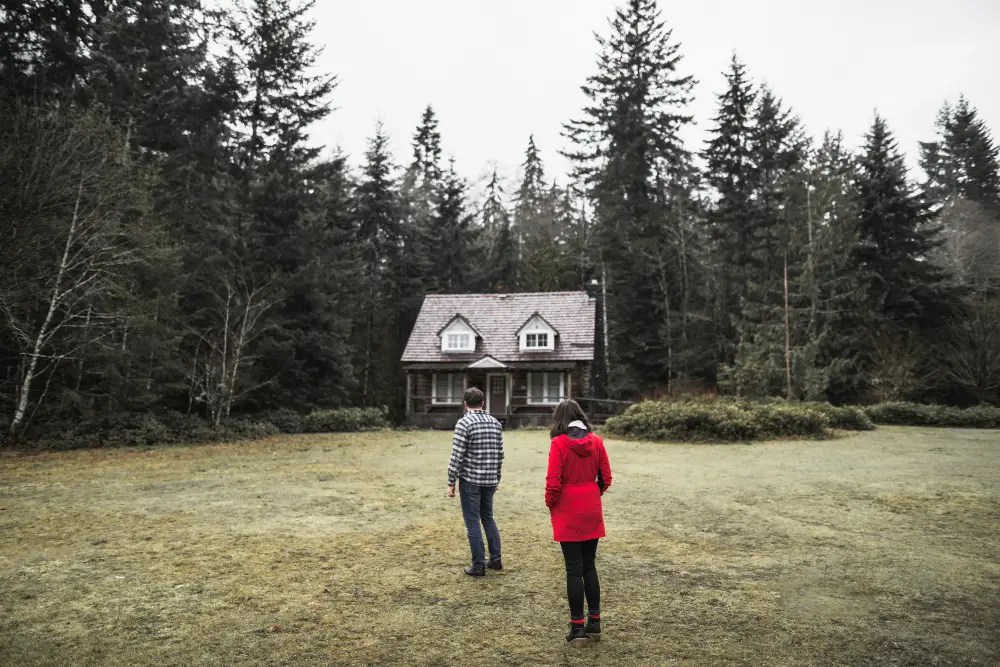
The padlock was rusted shut. I stood on the porch in the dark with two suitcases and a flashlight I had bought at a gas station forty miles back, and the door would not open, and for a long moment I simply stood there listening to the lake. The water moved against the dock my grandfather built when I was seven, the same dock where he taught me to tie a proper knot and told me that patience was not about waiting but about knowing what you were waiting for. I did not understand what he meant then. I drove four hours and arrived after dark to a door I could not open, and I sat down on the porch steps and listened to the water and still was not sure I understood.
There was a rock by the woodpile. It took six hits to break the padlock.
The smell came first when the door swung open: pine, dust, and underneath that the particular dry warmth of cedar. My grandfather kept cedar blocks in every drawer and closet. He said it kept the moths away, but I think he also just liked the smell, the way some people attach themselves to a scent not for its function but because it belongs to a version of their life they want to keep close. I swept the flashlight beam across the room and everything was where he had left it: the plaid couch with the sunken middle cushion, the bookshelf he built himself still crowded with paperbacks whose spines had cracked and recracked from years of rereading, the kitchen table where we played cards by lamplight while he made hot chocolate too sweet. His paintings were still on the walls, nine of them, landscapes he had made himself over decades: the lake at sunrise, the birch trees in autumn, the old stone bridge two miles up the road, a deer at the edge of the clearing with its head raised as though it had just heard something it was not sure about. They were not masterpieces. They were his, which was better.
I set the suitcases down and sat on the couch and something cracked inside me. Not the dramatic kind you see in films, no single breaking note. More like the sound an old house makes at night, something shifting, settling into a new position under weight it has been carrying for too long. I cried for three hours. Then I found the fuse box and flipped the breakers and the kitchen light flickered on, and the cabin was cold and dusty and mine, and it was the only thing in the world that was still mine.
Two weeks earlier I had sat in a courtroom and watched a judge divide my life.
I had not been there the first time either, not really. I had been in the marriage but not in possession of it, if that makes any sense, which it probably does not unless you have lived inside the particular dynamic where one person’s confidence colonizes the available space and the other person’s contributions become so thoroughly absorbed that they leave no visible trace. Brandon was good at that, at receiving effort in a way that made it disappear. When we married he was selling insurance out of a rented office with a broken air conditioner. I worked double shifts at the hospital for three years so he could get his broker’s license. When he finally started earning real money he told me I could quit. I did, because I believed the sentence that followed, which was that he would take care of us. I believed him because I had been believing him since the beginning, and by then it was a habit too deep to examine.
His lawyer stood before the judge and explained that my client has been the sole financial provider for the duration of this marriage, and the judge reviewed the documents, and the documents said what Brandon’s lawyer had arranged them to say, and I sat beside my own lawyer who was checking his phone and shuffling papers and who had told me beforehand that it was straightforward, that word he used, straightforward, as though the simplicity of the arrangement were a comfort rather than a verdict.
The judge awarded Brandon the house I had chosen, the one where I had painted every room myself because we could not afford a contractor. Both cars. The savings account with my name still on it. The retirement fund. The life we had built together, which turned out to have been built primarily on the site of his future and not mine. My settlement was eleven thousand dollars and a handshake from a lawyer already pivoting toward his next case.
When the judge reached the matter of my grandfather’s cabin on the lake, Brandon’s lawyer glanced at it and moved on. Direct inheritance received before the marriage. Never incorporated into marital property. The judge ruled it stayed with me. Brandon rolled his eyes. His lawyer shrugged. An old cabin in the middle of nowhere. Neither of them cared enough about a shack in the woods to give it a second thought, which is the thing I would keep returning to in the weeks that followed, the specific texture of what it means to be dismissed.
My friend Megan had let me stay on her couch since the day I left the house. She never complained, never made me feel like a burden in words, but her apartment was small and I could hear her at night whispering to her boyfriend about how long this would last, and I did not blame her for that either. She had her own life. My presence was making it smaller. The cabin was the only answer. Megan was the one who suggested it, in the parking lot outside the courthouse with me staring at the dashboard of her car unable to identify a direction I was willing to travel in.
So I drove north for four hours and broke a padlock with a rock from the woodpile and spent my first week doing the ugly kind of survival, not the romantic kind, not the woman-finds-herself-in-nature kind. The kind where you scrub mold off bathroom tiles at two in the morning because you cannot sleep and you need something to do with your hands. The water heater produced lukewarm water after twenty minutes of negotiating. The nearest grocery store was thirty minutes on a road with no cell signal for the first fifteen miles. I ate canned soup four days running because I was afraid to spend money I did not know how to replace.
I found his toolbox under the kitchen sink on the fifth day, every tool in its place and labeled in his handwriting. Phillips head. Flathead. Three-eighths wrench. He had organized it with the care of a man who expected someone would eventually need these things. I fixed the leaking faucet and the broken latch on the back door and the window in the bedroom that would not close all the way, and the work felt purposeful in a way that the previous year of my life had not.
On the sixth day I started cleaning the paintings.
I moved through the cabin with a damp cloth, wiping windowsills and bookshelves and the frames of his pictures. When I reached the painting above the fireplace, the largest one, a winter scene with the lake frozen over and the trees bare and the sky the particular gray that announces snow, I lifted it to wipe the frame and felt something shift behind it. Heavier than it looked. I steadied it with both hands and felt an object between the canvas and the wall, something flat, something taped there.
I lifted the painting off the hook and set it carefully against the couch.
An envelope was taped to the back of the frame with brown packing tape yellowed with age. My name was written on it in his handwriting. Not Clare. My full name: Clare Elizabeth Ashford. And beneath it, in smaller letters: If you are reading this, it is because I am already gone.
I sat on the floor with it in my lap for a long time. The cabin was quiet. The lake was quiet outside. I peeled the tape slowly and found inside a folded letter, a brass key, and a business card for a man named Thomas Wilder, Attorney at Law, with an address in the town twenty miles down the road where I had been buying my canned soup.
The first line of the letter made every hair on my arms rise.
My dear Clare, if you are reading this in the cabin, then you came back to the only place I could leave something for you that no one else would ever look.
I read the letter seven times. I sat on that floor with my back against the couch and read it until I could close my eyes and see his handwriting on the inside of my eyelids. He wrote that he had watched me give myself away to people who did not know my value. He wrote that he had watched it with my mother and with the man I married and that he could not stop it, and that the hardest part of loving me was knowing I would have to learn the hard way what I was worth. He wrote about the cabin, how he had bought it in 1974 for twelve thousand dollars with money saved from the paper mill, how everyone told him it was a waste, too far from town, no resale value, bad investment, and how he did not care because the first time he stood on that porch and looked at the lake he felt something he could not explain and had learned not to try to explain. Then the tone of the letter changed.
The key opens a safety deposit box at First Heritage Bank on Main Street in Milbrook. Box 1177. Thomas Wilder knows everything. He is the only person I trusted with this, and I am trusting you to go see him. Do not tell your mother. Do not tell your uncle. Do not tell anyone until you understand the full picture.
The last paragraph I read eight times and still read it before I sleep.
I was not a rich man, Clare, but I was a patient one. Patience and time can build things that money alone cannot. What is in that box is not a gift. It is a correction. The world took things from you that it should not have taken. This is my way of putting them back.
He signed it the way he signed his paintings. Just his initials. A.H.
I drove to Milbrook the next morning. Main Street was four blocks long, a hardware store, a diner, a post office, and then First Heritage Bank in a stone building that looked as though it had been standing since before the town had a name. The woman at the front desk took my name and her expression shifted slightly, not surprise, something more like recognition, as though she had been holding a place for this specific moment and was only now watching it arrive. The manager who came out a minute later was a man in his sixties named Gerald who had managed the branch for thirty-one years and who looked at me and said, without framing it as a question, Arthur’s granddaughter. He told me my grandfather had talked about me every single time he came in. Every single time. He led me to the vault and handed me the bank’s key and together we opened box 1177.
Inside the box was a thick folder, a sealed envelope, and a small leather journal with a rubber band around it.
The folder held seven deeds. Seven parcels of land, all surrounding the lake, purchased over a span of thirty-seven years beginning in 1978. Two hundred and forty-three acres in total.
The journal was a ledger, not a diary, my grandfather was not the diary type. Every purchase documented in his careful handwriting: dates, amounts, parcel numbers, brief notes. 1978: forty acres north of the lake, eight thousand two hundred dollars, farmer needed cash for his daughter’s surgery, fair price, good land. 1983: twenty-two acres east of the access road, the bank was going to foreclose, bought it before they could, family doesn’t know it was me. 1991: thirty-five acres including the ridge, used the timber sale money from the north parcel, replanted everything. He never borrowed. Every purchase was cash, saved across decades from the paper mill, from firewood, from small timber operations on land he already owned, the income from each piece funding the acquisition of the next. Patient. Methodical. Invisible.
The sealed envelope contained a letter from Thomas Wilder dated the year my grandfather died, a legal summary of everything. The trust, the holdings, the assessments. I read the number three times. I set the paper flat on the table and pressed my palms against it because my hands would not stop shaking.
Two hundred and forty-three acres of lakefront property in a region that had seen significant development pressure over the previous decade. Assessed value at the time of my grandfather’s death: four point two million dollars. Estimated current market value, per Thomas Wilder’s appended note: between seven and nine million depending on how the parcels were sold.
My grandfather had spent thirty-seven years quietly assembling every piece of land around the lake. The man who drove a truck older than me and lived in a one-bedroom cabin and painted landscapes of the place he loved had built a nine-million-dollar land trust, and he had held all seven deeds under a trust name, Hawkins Land Trust, so that no search of public records would connect them to old Arthur in the cabin by the lake. Annual taxes paid directly through the trust. To anyone looking, the land belonged to an entity. Nobody had ever thought to look.
I went to the last entry in the journal, 2019, the year before he died. No purchase. Just a note.
Clare’s husband does not love her. He loves what she gives him. There is a difference, and she will learn it. When she does, she’ll come to the cabin. And when she comes to the cabin, she’ll find this. That is why I never sold. That is why I never told her. Some things can only be received when you are ready to carry them.
I sat on the porch for a long time when I got back from Milbrook. The lake was flat. The sky was gray. The trees on the far shore were beginning to turn. All that land, every hill and tree line and stretch of shoreline I could see and most of what I could not, belonged to me. My grandfather had spent thirty-seven years wrapping that lake in a quiet fortress and had put me inside it, and he had done it without telling me because he knew that if someone told me I would doubt it, and that if I found it myself I would believe it.
Thomas Wilder’s office was above the hardware store on Main Street, one room with a desk, two chairs, and filing cabinets floor to ceiling. He was in his late fifties, gray at the temples, the kind of man who wore a tie even when no one was coming in. He told me he had been waiting for this call for three years. He explained the trust carefully: set up in 2005, fourteen years before my grandfather died, with me as sole beneficiary. The documents were accessible only through the safety deposit box. No notification would be sent. No lawyer would come looking. I had to find it myself.
He told me the terms were designed for that moment. My grandfather had been specific: he did not want me to have it while things were comfortable. He wanted me to have it when things fell apart.
Then Thomas slid a letter across the desk. Lake View Development Group had been acquiring land around the lake for five years, assembling parcels on the west and south shores for a luxury resort project, golf course, spa, waterfront condominiums, private marina, total projected investment one hundred and twenty million dollars. They had most of the private land on those shores. But the east shore and the north ridge, my grandfather’s holdings, were the lynchpin. Without those parcels the project could not function. The offer they had sent to the estate of Arthur Hawkins, fourteen months earlier, was eight point seven million dollars. My grandfather had never responded. Thomas had never responded. They were waiting for me.
And then Thomas told me one more thing. Lake View Development’s primary investor was a group called Mercer Capital Partners. Their regional director was a man named Scott Kesler.
Brandon’s business partner.
The kitchen went quiet. The lake was quiet beyond the window. I held the edge of Thomas’s desk and breathed.
I told him to set the meeting.
Three days before the meeting, while I was working through Lake View’s environmental filings and project prospectus at my grandfather’s kitchen table, Brandon’s mother called. Her voice was warm the way it had always been warm, that particular warmth that functions as camouflage. She said Brandon was worried about me. She said he felt terrible about how things had gone. She mentioned, as a practical matter, nothing emotional, that his accountant had identified a complication with the settlement involving the cabin, and whether I might be willing to sign it over for tax purposes.
I held the phone and looked through the window at the lake. My lake. The shoreline curving east. My shoreline. The ridge where the pines grew thick and dark. My ridge.
I told her the cabin had been left to me by my grandfather and was not part of the marriage and not part of the settlement.
She said of course, and that Brandon only thought since it was not worth much and I was living there temporarily.
I told her I was not living there temporarily.
After I hung up I opened the divorce settlement agreement and found the language Brandon’s lawyer had used when categorizing the cabin: inherited assets of negligible value. That phrase, negligible value, was a crack in the wall. The cabin was not what mattered. The trust was what mattered, and the trust had been set up in 2005 and inherited in 2020, three years before the divorce, and had never been marital property. Brandon had never known it existed. His lawyer had never asked. The judge had never considered it. Brandon had rolled his eyes at a shack in the woods while standing three feet from seven deeds worth nine million dollars, and the performance of his contempt had been so convincing that he had fooled himself along with everyone else.
The meeting was on a Thursday morning. Scott Kesler arrived with his attorney and a financial analyst and a man I did not recognize, older, white-haired, the kind of suit that announces its own expense. The investment director of Mercer Capital. The big money.
I told them I was not selling.
Scott said we could renegotiate the price.
I said it was not about the price. Not a single lot, not a single acre, not at any price.
Then I passed the pages across the table.
Long-term lease. Sixty years, reviewed every decade. Lake View would receive the right to use all seven parcels. I would retain full ownership of every deed. Thomas walked them through the terms. The white-haired man, whose name was Richard Hail, read every page without expression. When he looked up his face had not changed.
He said this was highly unusual. I said my grandfather was an unusual man. He said investors preferred outright acquisition. I said a lease created complexity. He said exactly that, complexity for them and security for me.
He said if I refused to sell and they refused the lease, the project would simply move to another location.
I said, with respect, they had forty-eight million dollars already invested in land on the west and south shores that only had value if the project was here. They were not going anywhere. Everyone at the table knew it.
Richard Hail looked at me for a long moment. Then he laughed, short and contained and genuine. He said my grandfather knew how to pick his heirs.
At that moment the office door opened and Brandon walked in as though he had been invited.
The room went still in the particular way of rooms where everyone has understood simultaneously what is happening and no one has decided yet how to respond.
I said his name and then I said the rest of it: that he was my ex-husband, that he had legally challenged the trust protecting the land and therefore had no standing at this table, and that Scott could represent Mercer because Brandon could not.
Scott looked at Richard Hail. Richard gave the smallest motion, barely perceptible, a shake of his head.
Brandon stood frozen for three seconds. Then he walked out. The door closed with a soft click.
I looked at Richard Hail and asked where we were.
He said he would take the lease to the investors. He would call in a week.
I told him two weeks. I said I was busy.
The legal challenge arrived before the call did. Thomas phoned me at eight on a Tuesday morning. Brandon was contesting the trust, claiming it should have been disclosed during the divorce proceedings as a potential asset, arguing that failing to disclose it constituted bad faith on my part. He was asking to reopen the case.
I told Thomas I had not known the trust existed during the divorce. He said he knew. He said the argument was weak but weak did not mean it disappeared, and that if a judge agreed to reopen it the process could take months, and any negotiation with Lake View would freeze while litigation was pending.
That was exactly the design. Not to win, but to buy time. To drain me until the eleven thousand dollars was gone and I had no remaining options. I had lived with Brandon for twelve years. I knew this method from the inside. He never threatened directly. He created mazes and waited for you to exhaust yourself navigating them.
Thomas told me defending the challenge could cost between forty and eighty thousand dollars. I told him I had eleven thousand in my account. He told me the land, as long as legal dispute was pending, was frozen. Could not be used as collateral. Could not generate income. No bank would touch it.
Nine million dollars in land and I could not reach a cent of it.
I went back to the journal. I read every entry from the beginning the way I should have read it the first time. On page forty-seven there was a note different from the others, no purchase date, no amount, just an instruction.
If there is a legal challenge to the trust, Thomas has Protocol B in the gray filing cabinet, third drawer, green folder. I paid for the best. You will not need to pay again.
I called Thomas immediately and said those words exactly. He was quiet for a moment and then laughed in the way people laugh when they have just remembered something that fills them with uncomplicated admiration. He had forgotten. My grandfather had commissioned Protocol B in 2018: a complete preemptive defense package, independent legal opinions from three different lawyers in three different cities confirming the legal separation of assets, notarized declarations that the beneficiary had no knowledge of the trust, a letter from my grandfather himself explaining why the trust was kept confidential and from whom.
All three lawyers had signed off. It was airtight.
I told Thomas to send everything.
Brandon’s lawyer withdrew the challenge eleven days later.
The call from Lake View came twelve days after the meeting, which I noted with private satisfaction was two days ahead of my stated timeline. Thomas came to the cabin to tell me in person. He sat in the rocking chair my grandfather had made by hand and held his coffee and looked at the lake before he spoke.
Sixty years. Review every decade. Fixed annual revenue of six hundred and eighty thousand dollars plus 2.3 percent of the resort’s gross revenue. Environmental protection clauses intact. Reversion clauses intact. Every deed stays in my name.
Then he told me Scott Kesler had been let go from Mercer Capital the previous week. Conflict of interest. The attempt to challenge the trust while the company was in active negotiation had been the final straw.
I looked at the lake. The sun was dropping behind the north ridge, the ridge my grandfather bought in 1991 with money from timber he cut and replanted himself, the ridge that was now the permanent northern boundary of my land.
Thomas asked if I wanted to know how Brandon was doing.
I said no.
I signed the contract on a Friday morning. No photographs, no ceremony. Seven deeds and one lease agreement and my name on every page. Richard Hail shook my hand and told me that if I ever wanted to invest I should look him up. I thanked him and said my grandfather had taught me to invest in land and I intended to stick with what I knew.
I drove back to the cabin and parked and sat on the porch for a while. It was real autumn now. The trees had gone red and gold. The lake reflected all of it, the colors and the clouds and the dark pines at the top of the ridge, holding everything the sky offered and giving it back doubled.
Then I went inside and pulled the easel from the corner of my grandfather’s bedroom where he had kept his supplies: brushes, oil paints, blank canvases leaning against the wall, everything covered in dust, everything waiting. I set the easel up on the porch and opened the paints and started painting the lake.
I cannot paint. I could not paint as a child when he let me smear color on paper beside him while he made landscapes that looked like the places they depicted. He never corrected me. He just said to paint what I saw and not what I thought I should see.
So I painted what I saw. The trees came out wrong, too round, the color of the sky was not the orange I was reaching for, the water had the wrong quality of light. I worked at it for two hours and produced something genuinely terrible, which is to say something that was entirely and completely mine.
I signed it in the bottom right corner. Not his initials. Mine. C.A. Clare Ashford.
Then I carried it inside and hung it on the wall beside his nine paintings. The tenth, the worst of them by every measure, and the one that made the most sense there.
That night I sat on the porch until full dark came. The lake disappeared slowly, first the colors fading, then the shapes going soft, then everything resolving into the sound of water moving against the dock my grandfather built when I was seven. I thought about what he told me on that dock, that patience was not about waiting but about knowing what you were waiting for, and I thought about what it had taken me to understand it: the courtroom, the parking lot, the four-hour drive north, the broken padlock, the letter behind the painting that was there because he had known I would come back, not because anyone told me to but because the cabin was the only place I had ever felt fully safe.
He knew that. He built around it. He spent thirty-seven years building the thing I would need, and he held it for me without telling me he was holding it, because he understood that a gift arrived at the wrong moment was not yet a gift. It was only potential, waiting for its occasion.
The occasion was the night I arrived with two suitcases and a gas station flashlight and could not get through my own door. Everything before that had been preparation for that moment, his and mine both, and everything after it had been finding out what I was actually made of when the visible structure of my life had been taken away and what remained was only what I had carried in myself all along.
I was not the woman who had stood in a parking lot unable to name a direction. I was the woman sitting on her grandfather’s porch on her land beside her lake, with his paintings on the wall and her worst painting beside them, listening to water that had been moving against that dock for longer than either of us had been alive, and would keep moving long after both of us were gone.
The water did not know about the divorce or the settlement or the legal challenge or the lease agreement. It moved with the patient indifference of things that do not need the story to be about them in order to continue.
My grandfather had been right about that too. The land doesn’t lie. The land doesn’t leave. I understood it now in the way you understand things that have stopped being abstract and started being the actual texture of your actual days.
I was exactly where I was supposed to be. Not because someone told me I belonged there. Because I had found my way back when everything else fell away, and the thing waiting for me when I arrived had been there the whole time.

Specialty: Quiet Comebacks & Personal Justice
David Reynolds focuses on stories where underestimated individuals regain control of their lives. His writing centers on measured decisions rather than dramatic outbursts — emphasizing preparation, patience, and the long game. His characters don’t shout; they act.