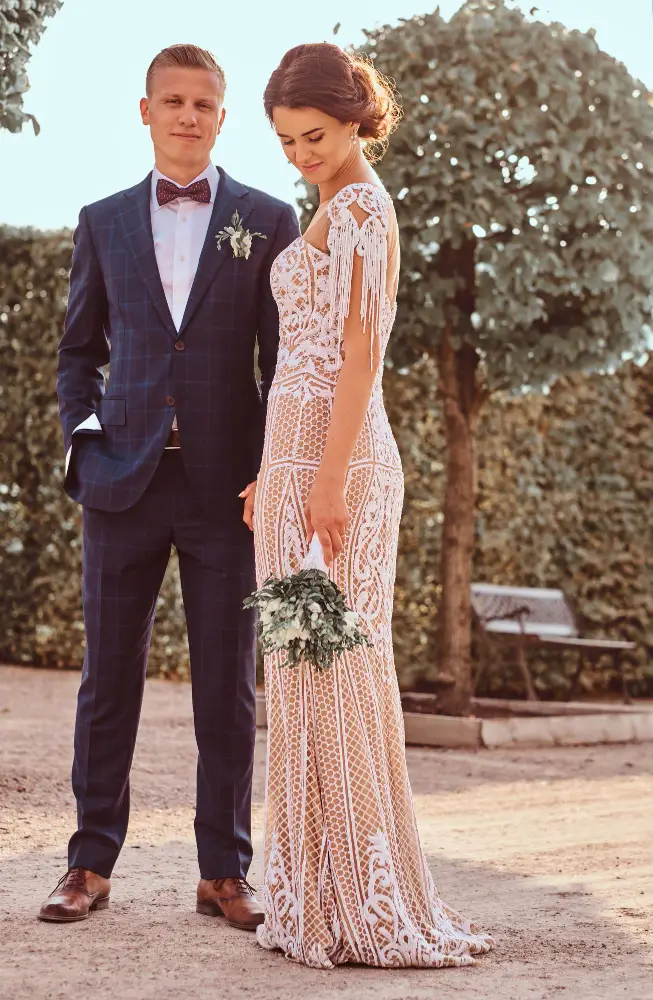
The first thing Lori said when she met Nick was that if I didn’t marry him, she would.
We were at my mother’s house for Sunday dinner, the kind of dinner that always ran two hours longer than planned because someone would remember a story halfway through dessert that required the table’s full attention. Nick had helped carry plates without being asked, had laughed at my uncle’s terrible jokes with what seemed like genuine appreciation, and had complimented my mother’s roast in specific terms that told her he had actually tasted it rather than simply eaten it. He was good at that, at paying the kind of attention that made people feel chosen.
Lori leaned close to me while he was in the kitchen and said it quietly, like a private joke between sisters, and I laughed and felt the warmth of the evening and thought nothing of it. Later, alone in the kitchen, she turned my ring slowly under the light and said, with a small smile, “You always get everything first. The good job. The good guy.”
Then she handed it back and the smile held and she made it sound like she was joking.
When I told Nick about it that night, he laughed too. “Good to know I have options,” he said.
Families make these jokes when everything feels safe. When there is no reason to read between the lines because the lines themselves are clear. I was twenty-nine years old and engaged and the only subtext I was aware of in my life was the good kind, the private language of two people who have decided to build something together. Nick had proposed six months after Lori’s comment, in the park where we had our first date, and I said yes before he finished opening the ring box, before the sentence was complete, because the answer had been assembled for some time and simply needed the occasion to be spoken.
“I didn’t even finish,” he said, laughing.
I threw my arms around his neck and pictured growing old with him. It is a specific and painful thing to remember now, that image, its particular domestic shape, the version of the future I was holding in my mind while he slid the ring onto my finger in the late afternoon light.
We began planning in the way of people who have never planned a wedding before and therefore have no framework for how quickly it becomes a second occupation. The guest list expanded past what either of us had intended. The venue was beautiful and expensive. The flowers required consultations I had not anticipated. Nick was involved in all of it, or present for all of it, which I believed were the same thing.
Early in the process we decided to split costs evenly, which felt mature, like the beginning of a partnership that would extend through the rest of our lives. One night I slumped over a table covered in vendor packets and screamed into the paperwork in the specific fashion of a person who has been doing arithmetic for four hours. Nick took the stack from me and said he would handle the contracts. He was the groom, he said, with the easy grin he deployed for all situations that required someone to be charmed rather than alarmed. He should do something besides show up and look handsome.
I could just transfer my share of each payment before the wedding.
So I handled flowers and color swatches and the forty-five-minute conversation about table linens that I did not know I would someday be able to recite from memory. He handled signatures. Whenever we finalized something, he showed me the invoice and noted what I owed. It felt like the logistics of a shared life, nothing more. I transferred the money when he said to transfer it, without looking too closely, because trust is partly the willingness to stop checking.
The venue manager, when she named the final cost, made Nick whistle. “Good thing we’re splitting it,” he said. “Otherwise I’d have to start selling organs.”
I laughed. Three months before the wedding, I came home early from work because a client meeting had been canceled, and Nick’s car was in the driveway when it should not have been. My first thought was the uncomplicated kind, that we would have an unexpected quiet evening together. I set my heels by the door and walked in quietly, moving toward the sound of voices from the living room.
“Andrea still has no idea,” Lori said.
I stopped.
“Of course she doesn’t.” Nick’s voice. “She trusts us completely.”
I stood in the hallway, not breathing, while the two of them continued in the living room. Lori asked when he was actually going to dump me, and she called him baby, and the word landed somewhere below rational comprehension, in the part of the body where real knowledge lives before the brain has had time to narrate it. Nick said that by the wedding day, I would have paid for everything, and Lori could simply take my place. He said it was perfect, with the satisfaction of someone who has been planning something that has finally reached its final shape.
I backed away down the hall. I walked out the front door and got into my car and drove several blocks before I stopped. I cried first. The honest, physical kind, the kind that does not wait for permission. Then I stopped crying, and what replaced the tears was something colder and more specific, a clarity that arrives in the wake of certain shocks, when the noise clears and what remains is very simple.
Then I started planning.
The first decision was the most important, and the simplest. Every time Nick asked about the next payment over the following three months, I told him the transfer had already gone through. “Sent it this morning,” I would say, with whatever degree of casualness the conversation required. He never checked. Why would he. As far as he knew, his plan was proceeding exactly as designed. As far as he could see, I was still the woman who trusted him completely, still the wallet in a white dress, still the person who would arrive at her own wedding and be handed the bill for her humiliation.
I was, in fact, preparing the bill for someone else.
They were careless because they believed they had already won. Nick left his phone on the bathroom sink one evening, and when messages lit up the screen I read enough to eliminate whatever remained of my doubt. The photographs and texts confirmed what I already knew. But they were not the worst thing I found in those three months.
I was at my parents’ house when a message preview from Lori appeared on my mother’s iPad, which had been left unlocked on the kitchen table. What do we do if Andrea freaks out? I tapped on the thread and read backward through the conversation, and I found my mother’s reply before Lori’s question: She won’t. She’s always been too soft to fight back.
I read the message above it. Let her pay for the wedding first. Andrea will land on her feet. She always does.
I stood in my mother’s kitchen and understood several things simultaneously. That the three of them had planned this together. That my mother had been the one to tell them I would not fight back, which meant she had offered that assessment of me as reassurance, as a strategic asset. That the phrase she always does, which had always been delivered to me as a compliment, was the mechanism of the whole arrangement. I was reliable and resilient and I landed on my feet, which apparently meant I could absorb this and they could walk away from it.
I took a screenshot and deleted it from her thread and sent it to myself. Then I walked back out and said goodbye to my mother and drove home and continued planning.
The wedding planner knew the shape of what I was doing before I explained it fully. She was a practical woman who had seen enough to be unsurprisable, and when I laid out the situation she listened without interruption and said that since Nick had signed every vendor contract, every outstanding balance was legally his responsibility. She would be present at the ceremony with the final invoices. The caterer was informed. The venue manager was informed. The band. Each of them was told that payment would be required before services continued, and that the person legally responsible for those payments was the groom.
The technical operator for the sound and video equipment received a specific folder of files and a specific instruction about when to play them.
The church was beautiful on the morning of the wedding. The flowers, the decorations, the way the light came through the tall windows and lay across the pews in long warm rectangles. I stood in the doorway of the bridal suite and let myself see all of it, knowing what it actually was, and wiped my eyes because I needed to be clear-headed and there was still work to do.
My wedding gown was gone from its hanger.
I stared at the empty hanger for a moment and then I understood, with the specific quality of understanding that is almost admiration for a particular boldness, that they had intended to take even this. There was not a single thing they had not been willing to take.
I walked back out in the clothes I had arrived in. Most of the guests were already seated, two hundred people filling the pews with the settled expectation of people who have been promised a ceremony and are waiting for it to begin. As I drew level with the main entrance, the doors opened.
Lori came through first, in my gown, and it fit her because we had always been roughly the same size, and she wore it with the particular satisfaction of someone who has acquired the thing they wanted most and is now in public with it. Nick was beside her, her hand looped through his arm, the two of them arranged like the leads in a performance that had been rehearsed. Which it had been.
“Surprise,” Lori said to the room, in a voice designed to carry to every row. “We’re getting married instead.”
A few people gasped. A few sat very still. Several looked toward me, waiting for the scene they expected, the collapse, the tears, the performance of the devastated woman that the moment seemed to require.
My mother rose from the front pew and began to clap. “Well,” she said, in the carrying voice she used when she wanted an entire room to understand that she was speaking for the record, “this makes much more sense.”
I took a breath.
“I’m glad you’re all here,” I said. “Because I have a surprise too.”
Nick looked at me. The first real look he had given me in three months, now that I was able to identify the difference between his real attention and the performance of it. Something moved in his expression, the first edge of something that was not certainty.
“What’s that supposed to mean?” he said.
I looked toward the back of the room and gave the signal.
The lights dimmed. The screen at the front of the church filled with text and images. The photographs, the messages, the thread from my mother’s iPad, all of it rendered large enough to read from the back pew. Every screenshot I had collected over three months, every message in which the three of them had discussed the plan, every exchange in which Lori called Nick baby and my mother told her that I was too soft to fight back and advised them to let me pay for the wedding first.
Two hundred people read my family’s private communications projected on a church screen.
The whispers began immediately and then became voices. Someone near the front said oh my God, clearly enough to reach the adjacent rows. Another voice: they’re stealing her wedding. A third, from somewhere toward the middle: her own family did this to her.
Nick’s face had gone the color of someone who has just understood that the room they are standing in is not the room they thought it was.
Lori let go of his arm. “Turn that off,” she said.
“If you don’t like people knowing the truth about you,” I said, “then perhaps you shouldn’t put the truth in writing and leave your devices unlocked.”
My mother tried. She said I was making a scene out of nothing, that Lori and Nick were in love, that they had not known how to tell me, that there were ways of understanding this situation that would cast everyone in a more forgiving light. She had the composure of someone who has spent a lifetime managing the presentation of difficult realities, and even now she was trying to find the frame that would make this survivable for her.
“They didn’t know how to tell you,” she said, “so they—”
“Decided to hijack my wedding?”
She opened her mouth. Around her, the people in the nearest pews had shifted almost imperceptibly away from her, the unconscious social distancing of people who have just read something they cannot now unread.
Nick stepped toward me. He had gathered himself, or was attempting to, and the version of him I was facing was the one who had always managed situations with a particular easy confidence, the gift I had once called his best quality. “So what? You found out. Congratulations. But the wedding is happening anyway.”
Lori straightened beside him. “You can’t stop it.”
I smiled at them both. “I have no intention of stopping it.”
They looked at each other. The confusion in the exchange between them was genuine, and there was a specific satisfaction in watching people who believed they had planned for every contingency encounter the contingency they had not imagined.
I pulled out the folder.
“I decided that if you want my wedding so badly, you can have it. I just wasn’t prepared to pay for any of it.”
Nick stared at me.
“You handled the vendor contracts,” I said. “You signed everything while I paid my share. So the only person legally responsible for paying for this wedding is you.”
The moment he understood was visible on his face. I have replayed that moment many times since, not from cruelty but because it was the clearest thing that happened that day, the only piece of it that was entirely honest: the precise instant when a person understands that they have been on the wrong side of a plan.
The wedding planner stepped forward from her position near the side wall, clipboard in hand, with the expression of a professional who has done stranger things than this and emerged competent on the other side of all of them.
“The final balances for today’s event are still outstanding,” she said to Nick, in the careful tone of someone delivering information that is entirely factual and in no way her personal responsibility.
Nick turned to me slowly. “You never paid anything?”
“I told you it was handled whenever you asked,” I said. “I never paid a cent.”
“You lied.”
“Yes. You planned to humiliate me and steal my wedding. Did you genuinely expect me to pay for it as well?”
The caterer stepped forward. The venue manager joined him. The band leader raised his hand from near the aisle. Each of them, in their professional capacity, indicated to the groom that payment was required before services continued. Nick looked around him with the expression of a man in a burning room who has just discovered that all the exits he believed were unlocked are not.
“This is insane,” he said.
Lori grabbed his arm. “You have money, right, baby?” she said, and the endearment landed in the silent church with the full weight of everything the screen had already displayed.
He swallowed. “Not enough. Not eighty thousand.” He turned to her. “What about you? Can’t you pay your sister’s share?”
Lori’s jaw dropped. “Of course I can’t!”
Something cracked in the room.
Nick’s father rose from the second pew with the expression of a man who has been storing a specific kind of fury for a long time and has just been handed the occasion for it. He told his son in front of two hundred people that he had embarrassed the family, and the sentence carried the specific quality of something that will not be taken back regardless of what follows. Lori turned to the room with the desperation of a woman watching a stage collapse while she is still standing on it and announced that she and Nick were still getting married, which produced, from a guest near the aisle, a laugh of genuine disbelief.
“With what money?” the guest said.
The caterer, without inflection, answered that it would not be without payment.
I looked at my sister standing there in my gown, in the church I had paid for, at the ceremony I had planned, and I said, “You wanted the wedding. I’m giving it to you, bills and all.”
Then I turned and walked toward the doors.
One of my bridesmaids said she was with me. Then another. I heard movement through the church, the sound of people rising, low voices conferring in the brief way of people who have made a quick collective decision, and by the time I reached the doors a significant portion of two hundred guests was following.
Nick called after me, his voice finally breaking through into something unmanaged. He said I could not just walk away.
I looked back once.
He and Lori were still near the altar, surrounded by vendors who needed answers, by his father who needed explanations, by my father who had crossed the room to stand near Nick’s parents with his judgment perfectly legible on his face. My mother was beside the front pew, and the people nearest her had arranged themselves in the way of people who do not want to be associated with someone at the center of a particular kind of attention.
I turned and walked out through the church doors into the sunlight.
It was a clear morning, the light generous and without particular commentary, the kind of morning that does not know it is significant. My bridesmaids came through the doors around me and behind me the sound of guests following continued for another minute or two. Someone handed me a jacket because I was still in the clothes I had arrived in. Someone else said something about getting brunch, because brunch is what people reach for when the occasion has become entirely undefined and the body still knows it is hungry.
I stood on the church steps and let the morning settle around me.
What I felt was not triumph, or not only triumph, or not triumph in the clean simple form that the word implies. There was something grief-adjacent underneath the clarity, the particular quality of loss that arrives when you understand that the people you lost were not who you believed they were, which means you are also grieving the version of your life that had been organized around those beliefs. My mother had told them I was too soft to fight back. She had offered that as a reassurance. She had told them I always landed on my feet, which in the context of her message meant that I was durable enough to absorb this specific harm and they could proceed without concern for my wellbeing.
She had known me my entire life and concluded that this was true.
She had been wrong about whether I would fight back. She was not wrong that I would land on my feet. I had been landing on my own feet for a very long time, in the particular way of people who learn early that they are the reliable one, the strong one, the one who will be fine. I had never stopped to examine what that designation had cost me, what it had allowed other people to assume they could take.
I examined it now, on the church steps, in the sunlight, with my bridesmaids around me and the sound of two hundred guests having a very different morning than they had expected.
One of my bridesmaids, Claire, who had known me since nursing school and had the specific loyalty of a person who shows up before they are asked, put her arm through mine and said, “What do you want to do?”
I thought about it for a moment.
“I want breakfast,” I said.
“Done.”
We walked down the steps and across the parking lot, and I did not look back again. There was nothing to see that I had not already seen, and nothing behind me that I was still waiting for. The vendors would handle Nick. The guests would handle the story, because guests always handle the story, and the story would travel in the way that stories do when they contain everything required for the telling: betrayal, exposure, consequences arriving in real time in front of witnesses.
At a diner two miles from the church, twelve people including my bridesmaids and several guests who had apparently decided to follow us all the way to breakfast sat around pushed-together tables and ordered eggs and coffee and talked about everything and nothing in the specifically alive way of people who have just shared an unusual experience and are still metabolizing it. Someone made a joke. Someone else told a story about a different wedding disaster they had witnessed years earlier, which led to another story, and the table became briefly raucous and then settled into the comfortable noise of people who are glad to be where they are.
I ordered pancakes.
I had not eaten since the night before, and the pancakes arrived quickly and I ate them steadily and felt the morning return to something that had the texture of ordinary life, which was the thing I had come through the previous three months working toward. Not the exposure, not the confrontation, not the vendors demanding payment from a groom who had signed every contract. Those had been necessary and they had gone as planned and I was glad of it. But what I was working toward, sitting in that diner with maple syrup and a second cup of coffee, was the ordinary life on the other side of the whole thing.
My phone had messages I would not read until later. Several were from relatives who had been at the church and had seen the screen and wanted to say something about it, in the various registers that people use when they have witnessed a public revelation. A few were from people who had not been at the church but had already heard, because news of this nature travels fast and does not require assistance.
There was nothing from Nick. Nothing from Lori. Nothing from my mother.
I set the phone face down and finished my pancakes.
Claire asked, without particular drama, whether I was all right. It was the honest question rather than the social one, the one that acknowledged that all right covered a wide range of territory and she was asking about the actual interior landscape rather than the presentable version of it.
I thought about the honest answer.
“I’m going to be,” I said. Which was true, and more accurate than all right, and contained everything that needed to be in it.
She nodded. “That works.”
Someone at the far end of the table was telling another story and the table laughed, and I looked at the people around me, most of whom had been guests at a wedding I had planned and which had not happened in any form I had imagined when I planned it. They had come to watch me marry someone and had instead watched something else entirely, and they had gotten up from their seats and followed me out, and now they were having breakfast with me on what had been my wedding morning, and the morning was bright and the coffee was good and the company was real.
The contracts Nick had signed would be Nick’s problem to resolve. He had signed them as the legally responsible party, which he was, and the vendors would pursue payment through whatever channels were available to them, which was not my concern. The money I had kept back had been my money, the transfers I had not made had been transfers I had chosen not to make, and I had been under no legal or ethical obligation to fund a fraud that had been perpetrated against me.
What he and Lori would say to each other once the vendors were through with them I did not know and would not spend much time imagining. What my mother would say to my father, or to her sister, or to the neighbors, was similarly outside my jurisdiction. The screen had displayed everything. The room had witnessed it. The story was in the world now, complete and accurate, requiring no amendment or supplementation from me.
I left the folder of screenshots with the wedding planner because she had asked for documentation, and she had earned it.
At the diner I paid for my own breakfast, and then I paid for Claire’s, because she had shown up and stayed and because some debts are worth paying immediately and fully rather than over time.
Walking out into the parking lot afterward, into the generous ordinary sunlight of a morning that was now simply Saturday, I felt the specific quality of lightness that comes not from the absence of difficulty but from the absence of concealment. I had been carrying the knowledge of what I knew for three months, arranged around it, planning from within it, and the carrying was done now. The thing had happened. The plan had executed. The vendors were talking to Nick and the guests were talking to each other and I was walking to my car with syrup on my jacket and the rest of my life in front of me, entirely intact.
I had been told I was too soft to fight back.
I had not, as it turned out, fought back in the sense they feared, which was the messy, emotional, unpredictable form of fighting that can be managed and redirected and used against you. I had simply planned. I had been patient and methodical and I had documented everything and I had allowed the situation to reach its natural conclusion, which was the one I had prepared for.
I sat in my car for a moment before starting it.
There was grief still, and there would be more of it later, the slow kind that does not arrive all at once but settles in over weeks, the grief for the man I had believed Nick was and the sister I had believed Lori was and the mother I had been working to earn the approval of for most of my life. Those losses were real and I would not pretend otherwise. The version of the future I had been holding in my mind on the night of the proposal, the specific domestic image of growing old with someone, would need to be replaced with a different image, and that replacement would take time.
But the losses were not ambiguous. They were clean. I knew exactly what I had lost and exactly what I had not, which is a kind of clarity that has its own value, separate from the question of whether the clarity was worth the cost.
I started the car.
I drove home in the sunlight with the radio on, through the ordinary Saturday morning streets of the ordinary town where I lived, past the diner where we had just had breakfast and the church where the vendors were still presumably having a conversation with Nick about outstanding balances, past the park where Nick had proposed and I had said yes before the sentence was finished, out to my apartment where I would return a few phone calls and change my clothes and eventually figure out what came next.
What came next was mine to decide. That was the essential thing, and the thing that the previous three months had been in service of protecting, and it was intact.
I pulled into my parking space and sat for a moment with the engine off.
The morning was still generous. The light was still good. I had plans with Claire on Tuesday, and there was a work project I had been putting off, and somewhere in the future, past the immediate business of the next few weeks, there would be other things, better things, things I had not yet imagined that would turn out to be the shape of what my life actually was.
I got out of the car and walked toward my door and went inside.

Sophia Rivers is an experienced News Content Editor with a sharp eye for detail and a passion for delivering accurate and engaging news stories. At TheArchivists, she specializes in curating, editing, and presenting news content that informs and resonates with a global audience.
Sophia holds a degree in Journalism from the University of Toronto, where she developed her skills in news reporting, media ethics, and digital journalism. Her expertise lies in identifying key stories, crafting compelling narratives, and ensuring journalistic integrity in every piece she edits.
Known for her precision and dedication to the truth, Sophia thrives in the fast-paced world of news editing. At TheArchivists, she focuses on producing high-quality news content that keeps readers informed while maintaining a balanced and insightful perspective.
With a commitment to delivering impactful journalism, Sophia is passionate about bringing clarity to complex issues and amplifying voices that matter. Her work reflects her belief in the power of news to shape conversations and inspire change.