Not Worth the Investment
The envelopes arrived on the same afternoon in late June, both of them thin and white, both carrying the weight of the next four years. My sister Clare opened hers first. She had been accepted to Redwood Heights University, an elite private school with tuition high enough to make most families pause.
Our family did not pause.
My mother gasped and immediately began talking about campus tours. My father smiled in the warm, rare way I had learned not to expect directed at me. Clare laughed and hugged them both while plans formed instantly around her future, the way plans always formed around Clare’s future, spontaneously and without effort, as if the universe had been waiting to arrange itself in her favor.
I opened my own envelope carefully. Cascade State University. A solid, respected public school with strong academics. I had worked quietly for years to earn this. I sat with the letter in my hands and waited for the same excitement.
It never came.
My father called a family meeting that evening. He sat in his usual chair with the posture he reserved for business decisions. My mother beside him, hands folded. Clare leaning casually against the wall, already smiling as if she knew what was coming.
I sat across from them with the acceptance letter in my hands.
“We need to talk about college finances,” my father began.
He turned to Clare first.
“We’ll be covering your full tuition at Redwood Heights. Housing, meals, everything.”
Clare threw her arms around him. My mother began listing orientation dates and dorm decorations. Then my father looked at me.
“Lena,” he said, his voice even. “We’ve decided not to fund your education.”
I held very still.
“I don’t understand,” I said.
He clasped his hands together with the deliberate patience he used when explaining something he had already decided.
“Your sister has exceptional networking skills. Redwood Heights will maximize her potential. It’s a smart investment.”
Investment. The word landed with the specific coldness of a word that has been chosen carefully to mean something else.
“And me?” I asked.
He hesitated only briefly.
“You’re intelligent. But you don’t stand out in the same way. We don’t see the same long-term return.”
My mother stared at her lap and said nothing. Clare was already texting someone, smiling at her phone, either unaware of what was happening or simply not moved by it.
“So I figure it out myself,” I said. It was not quite a question.
“You’ve always been independent,” my father said.
That was the end of it. No discussion. No reassurance. Just a decision already made.
I went upstairs and lay on my bed for a long time, staring at the ceiling. I expected to cry. I did not cry. Instead, a series of memories I had spent years carefully not assembling suddenly arranged themselves into a pattern that was impossible to ignore.
The year Clare turned sixteen, she walked outside to find a car in the driveway with a red ribbon across the hood. Our parents filmed her reaction. That same evening, my father handed me Clare’s old tablet. It still works perfectly, he said. You don’t really need anything new.
I thanked him. I always thanked them.
Family vacations planned around Clare’s preferences. Hotel rooms divided so Clare had her own space. A designer prom dress for her, a discounted one for me. Leadership camps for her, extra work shifts for me. Birthday celebrations where hers were elaborate and carefully planned and mine were quieter, not forgotten exactly, just not thought about with the same care.
Each moment had seemed small enough to explain away on its own. Together they formed something I had been trying for years not to see.
I found my mother’s phone on the kitchen counter one afternoon, a message thread with my aunt left open on the screen. I knew I should not read it. I read it.
I feel bad for Lena, my mother had written. But Daniel’s right. Clare stands out more. We have to be practical.
Practical. The same word my father used during the college conversation.
I set the phone down exactly where I had found it and walked back upstairs. Something inside me did not break. It settled. The way sediment settles to the bottom of water, leaving everything above it suddenly clear.
That night I stopped waiting for fairness. I opened my laptop, Clare’s old one, passed down when she got a new one, and started searching. Full scholarships for independent students. The results filled the screen: deadlines, essay requirements, odds that looked impossible from where I was sitting. I bookmarked everything anyway, because belief sometimes begins before confidence exists. I grabbed a notebook and began writing numbers. Tuition totals, job estimates, rent. Every calculation frightened me. But the calculations also gave me something I had not expected.
Control. A word that had never really belonged to me before.
The summer unfolded in two parallel stories. Downstairs, my parents helped Clare order dorm furniture and plan orientation trips. My mother scrolled through bedding options and my father researched meal plans as if it were a business investment, which I now understood it was. Boxes accumulated in the hallway with an excitement that had a specific sound and smell.
Upstairs, I researched affordable housing near campus and estimated work hours against tuition. I packed thrift-store bedding into a worn suitcase.
The night before we both left for our respective schools, Clare knocked on my door. She said, almost as an afterthought, that I should text her if I needed anything. She meant it, I think, in whatever way seventeen-year-olds mean things: genuinely but without full understanding of what it would cost me to need something and admit it.
I said thanks and that I would.
Neither of us believed it.
I arrived at Cascade State with two suitcases, a backpack full of borrowed textbooks, and a bank account balance that tightened my stomach every time I looked at it. Dorm housing was beyond my budget, so I rented a room five blocks from campus in an old house with four other students who kept different hours and moved through the shared spaces like polite strangers. My room fit a mattress and a narrow desk. The heater clanged at night. The paint near the window was peeling.
It was affordable, which meant it was possible.
My alarm went off at four-thirty every morning. By five I was at Morning Current, a campus café, tying on an apron while half-awake students lined up for coffee. I learned drink orders the way other people learned lecture material. Smiling became automatic even when the exhaustion had settled so deep behind my eyes it felt structural.
Classes filled the daylight hours. I sat near the front and took careful notes because I could not afford to miss anything. Evenings went to studying or my second job cleaning residence halls on weekends. Sleep averaged four hours. Some mornings I woke uncertain which day it was.
Thanksgiving arrived and the campus emptied almost overnight. Parking lots cleared. Dorm windows went dark floor by floor. I stayed. Plane tickets were impossible, and honestly I was no longer entirely certain I was expected. I called home anyway, because not calling felt like giving something up I was not ready to give up.
My mother answered, her voice distracted by something happening in the background, laughter and the particular warmth of a house full of people.
Can I talk to Dad, I asked.
A pause. Then his voice, faint, from somewhere in the background: Tell her I’m busy.
She came back quickly. He’s in the middle of something.
It’s okay, I said. I just wanted to say hi.
She asked if I was eating enough, if I needed anything. I looked at the instant ramen on my desk and the borrowed blanket wrapped around my shoulders.
No, I said. I’m fine.
After hanging up I opened social media without thinking about whether it was a good idea. The first photo was Clare between our parents at the dining table, candles lit, everyone smiling, the particular warmth of a Thanksgiving that was unambiguous and complete. Three place settings. Three chairs.
I stared at the image longer than I should have. Then I closed the laptop and sat in the quiet of the room, which was very quiet, and thought about the specific difference between being alone and being left.
Something shifted that night. The quiet hope that things might eventually feel equal began to loosen. Not disappear, just settle into something less sharp. Without that hope to lose, disappointment lost its sharpest edge. Without the sharpest edge, I had more room for something else.
I was in Economics lecture, first semester, two weeks before finals, when Professor Ethan Holloway handed back our papers. I had written mine between café shifts, revising in the margins of my notebook during my lunch break, finishing the final draft at midnight the night before it was due.
At the top, in red: A+. And below it, Please stay after class.
My stomach tightened. Praise always felt like the precursor to a correction.
I waited until the hall had nearly emptied before walking to the front. Holloway was organizing his notes with the methodical calm of someone who is never rushed.
“Lena Whitaker,” he said without looking up. “Sit.”
I sat.
He placed my paper on the desk between us. “This essay is exceptional.”
I looked at it, then back at him. “I thought I might have misunderstood the prompt.”
“You didn’t.”
The silence that followed felt unfamiliar. Compliments usually came with conditions. This one seemed to be simply sitting there, not asking anything of me.
He asked about my background. I told him: public high school, nothing specialized. He asked about my family. I hesitated, then told him they were not involved in my education. Financially or otherwise.
He waited without rushing me.
I had not meant to say more. I said more. The early shifts, the cleaning job, the four hours of sleep. And then, without planning it, my father’s exact words.
Not worth the investment.
When I finished I stared at my hands, regretting the oversharing. Holloway leaned back.
“Do you know why this essay stood out?” he asked.
I shook my head.
“It wasn’t written by someone trying to sound impressive. It was written by someone who understands effort.”
He opened his desk drawer and produced a thick folder. “Have you heard of the Sterling Scholars program?”
I had. National scholarship. Twenty students selected per year. The odds were brutal.
“That’s for people with perfect résumés,” I said.
“Adversity doesn’t disqualify candidates,” he replied. “Often it distinguishes them.”
He placed the folder in front of me. “I want you to apply.”
I told him I worked two jobs and barely kept up with my courses.
“That’s exactly why you should apply,” he said. “You’ve already proven discipline. Now you need opportunity.”
I left his office carrying the folder as carefully as if it might dissolve. Outside, students crossed campus in small groups, laughing about things I could not hear. I walked back to my room and laid the application materials across the desk.
The deadline was twelve weeks away.
I opened a blank document and began.
The hardest section asked me to describe a moment that had changed how I saw myself. I sat with the cursor blinking for almost an hour. I had not traveled anywhere notable or led anything impressive. What I had done was survive four years of being nobody’s priority and emerge from it with, if nothing else, a precise understanding of my own endurance.
I wrote about that. Morning Current at five a.m. Calculating grocery money to the cent. Studying in the empty library after closing because I had nowhere better to be. Learning discipline without anyone there to reinforce it.
When Holloway returned my draft, the margins were covered in his handwriting. You’re still protecting people who didn’t protect you, he had written at the top. Tell the truth.
I rewrote the entire thing. It took three nights. It was harder than writing the first version because the first version had been about surviving; this one had to be about being seen, and there is a specific kind of vulnerability in telling the truth about pain to strangers who will use it to make a decision about your worth. I had spent four years not telling that truth to anyone, because no one had asked. Now someone was asking.
I wrote about the living room. About my father’s voice and the word investment and the way my mother had sat quietly while he said it, not arguing, which I understood now was its own kind of answer. I wrote about the three place settings in the Thanksgiving photo and the empty chair on graduation morning that was not saved for me. I wrote about all of it without softening it, because Holloway had told me to stop protecting people who hadn’t protected me, and for the first time I understood what that actually meant: it meant letting the truth be as heavy as it actually was.
When I submitted the final version, I sat for a long time after clicking send, feeling the strange lightness of having put something down that you have been carrying alone.
The application also required recommendations. I hated asking for help. Two professors agreed without hesitation. One of them said, quietly, that I was one of the most determined students he had encountered. I tucked the words away carefully and did not let myself look at them too often, in case they wore out.
The weeks passed in their relentless rhythm. Midterms, shifts, bus rides, four hours of sleep. Holloway and I practiced interview questions in his office, him pushing on every answer until I stopped giving answers that sounded impressive and started giving answers that were true. One afternoon during practice he stopped me mid-sentence.
“You keep using the word managed,” he said. “You managed to pay rent. You managed to stay enrolled. Stop managing. What did you do?”
“I worked,” I said.
“Then say that.”
I practiced until the truth came out without apology.
One afternoon, carrying a tray of drinks, the room tilted. I grabbed the counter. My manager caught me before I fell.
“You fainted,” she said.
“I’m okay,” I said. I was back two days later.
That night I counted the money left in my account after rent. Thirty-six dollars. I ate instant noodles and reread interview preparation materials and did not let myself think about the fact that somewhere across the country, other applicants were probably preparing in warm houses with full refrigerators and families asking them how it was going.
Weeks later, an email arrived while I was unlocking the café in the early dark.
Sterling Scholars Application Update.
I read the subject line twice before opening it.
Congratulations. You have advanced to the finalist round.
I leaned against the counter and read it again. Fifty students remained. I had not been eliminated. I stood there for a long moment in the empty café, in the dark, not quite breathing.
When I told Holloway that afternoon, he said simply: I expected this. We prepare for interviews now.
The final interview took place in a quiet conference room. I wore my one blazer, slightly too large, pressed carefully. They asked about adversity, about goals, about success without recognition. For the first time in an interview, I stopped trying to sound like someone they should want and simply told the truth about who I actually was.
Walking out into the cold evening afterward, I had no idea whether I had succeeded.
I waited. Every notification made my pulse spike. Every quiet day stretched.
Then one Tuesday morning, crossing campus, my phone buzzed.
Sterling Scholars Final Decision.
I stopped walking. Students moved around me. I held the phone in both hands.
I tapped it open.
Dear Lena Whitaker, we are pleased to inform you that you have been selected as a Sterling Scholar for the class of 2025.
I sat down on the nearest bench. My hands were shaking. A laugh came out before I could stop it, followed immediately by tears, the kind that come when something you have been holding together for years finally, carefully releases.
I called Holloway.
I got it, I told him.
I know, he said. I received confirmation this morning.
He told me something else. Sterling Scholars could transfer to a partner university for their final academic year. Many chose schools aligned with their career goals. He sent me the list.
I scanned it.
Redwood Heights University.
The school my parents had paid for Clare. The campus they had decided I did not deserve.
Time stopped for a moment.
The program’s honors track at Redwood Heights typically selected the Sterling Scholar transferee to deliver the commencement address, Holloway said. Valedictorian consideration.
I sat very still with the phone against my ear.
Not worth the investment. My father’s voice, as clear and flat as the day he said it.
I’m not doing this to prove anything, I said quietly.
I know, Holloway replied. You’re doing it because you earned it.
I completed the transfer paperwork that evening. I did not tell my parents. I wanted at least one thing in my life to remain untouched by their expectations until I had finished building it.
Redwood Heights in the fall. Stone buildings, manicured lawns, exactly the campus Clare had photographed for four years. Students here moved with a different kind of certainty, the confidence of people for whom the next step had always been assumed. I stayed quiet for the first weeks, invisible by habit, attending class and rebuilding my routine.
Three weeks into the semester, I was alone in the library when a voice froze me.
“Lena.”
Clare stood a few feet away, iced coffee in hand, looking at me the way you look at something that should not be there.
“How are you here?” she asked.
“I transferred,” I said.
“Mom and Dad didn’t say anything.”
“They don’t know.”
The silence between us carried four years’ worth of things we had never said to each other. Finally she asked, carefully, how I was paying for it.
“Scholarship,” I said.
Something moved across her face that I did not try to name. I gathered my books.
“I have class,” I said, and walked away.
I knew Clare would tell them. She had never been good at keeping surprises.
The missed calls started that evening. My father’s name appeared the following morning while I was crossing the courtyard. I answered.
“Your sister says you’re at Redwood Heights,” he said.
“Yes.”
“You transferred without telling us.”
I thought about how many things had happened in my life without anyone telling me. How many decisions had been made in rooms I was not invited into. How many evenings I had sat in a different city while my family gathered at a table with three chairs.
“I didn’t think you’d care,” I said calmly.
He said of course he cared, that I was his daughter. The words sounded like something he was trying to believe as he said them.
“You told me I wasn’t worth investing in,” I said. “I’ve been figuring it out myself. That’s what you asked me to do.”
The silence on the line was long.
“I’ll see you at graduation,” I said, and ended the call.
The weeks before the ceremony moved quickly. Honors meetings. Speech preparation. Rehearsals in the stadium. I submitted drafts, revised them, stood at a practice podium in an empty auditorium and read aloud to nobody until the words felt natural and mine rather than assembled.
Holloway came to one of the rehearsals. He stood in the back and listened and said only, when you’re up there, be honest. The same thing you were in the essays. That’s all.
I thought about that a great deal in the days that followed. I had spent four years building something real through nothing but work and time and the refusal to stop. Whatever happened on that stage was already true. The ceremony was not the proof of it. It was just the moment other people would see it.
My parents still did not know. Clare had told them I was at Redwood Heights, but not, I gathered from a brief phone call with my mother, why. They were attending graduation the same as always, for Clare, the day they had been planning around since freshman orientation.
The night before the ceremony, sleep would not come. I lay in the dark and let the memories move through me without trying to stop them. The living room. The envelopes. My father’s voice and the particular flatness of his certainty. Thanksgivings on the phone in an empty dorm. The three place settings. The empty chair at the front row that was never saved for me.
I expected to feel angry. The anger had long since exhausted itself. What had replaced it was something quieter and more durable. I had spent four years proving something, but I understood now that the thing I had been proving was never about them. It was about me. Whether I was the person I needed to be to walk through the door I had found.
I was.
Whatever my parents felt tomorrow was their experience to have. Mine had already happened, one early morning and one late night at a time, over four years of choosing not to stop.
I fell asleep just before dawn.
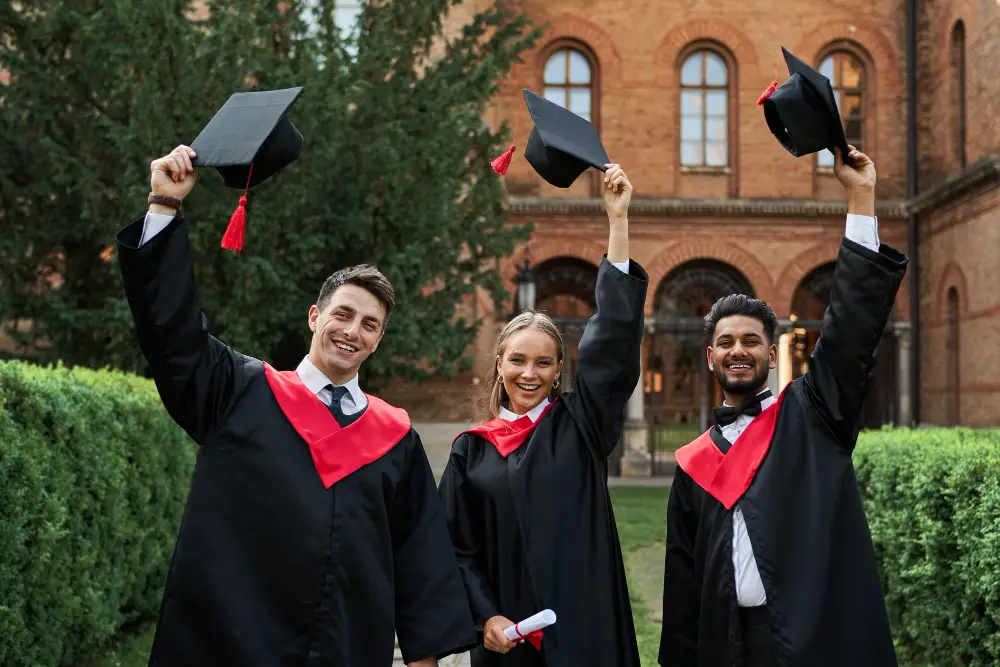
Graduation morning came clear and bright, the kind of spring day that suggests the world is more ordered than it actually is. The Redwood Heights campus hummed with families carrying flowers and balloons, cameras and celebratory noise. I entered through the faculty gate alone, moving quietly into the lines of black gowns.
My robe looked like everyone else’s. The gold honors sash across my shoulders felt heavier than fabric should.
I found my seat near the front of the graduate section and looked out at the stadium.
Front row, center. My parents. My father was checking his camera, adjusting angles, preparing to capture Clare’s moment. My mother held a large bouquet of white roses. Between them sat an empty chair with a folded jacket. It was not saved for me. I noted this without surprise.
Clare was a few rows back, laughing with friends, adjusting her cap for photos. She had not seen me yet.
I watched my parents for a moment. They looked happy in the uncomplicated way of people who are confident they know how a day will unfold. My father raised the camera to practice a shot aimed at where he expected Clare to be standing when the important moments came.
The ceremony opened with music and introductions. Names, addresses, applause rising and fading. I sat with my hands folded, breathing slowly.
Then the university president returned to the podium.
“It is my honor to introduce this year’s valedictorian and Sterling Scholar,” he said, his voice amplified across thousands of seats. “A student whose resilience and academic excellence embody the spirit of Redwood Heights University.”
My mother leaned toward my father. He raised his camera, directing it toward Clare’s section.
“Please welcome,” the president said.
Time slowed down in the specific way it does when you have been moving toward something for a very long time and have finally arrived at it.
“Lena Whitaker.”
For one suspended second, nothing moved.
Then I stood.
Applause rose as I walked to the stage, each step steady. My heels clicked against the floor in the particular way of things you have rehearsed until they feel inevitable.
In the front row, the understanding arrived in stages.
My father lowered his camera slightly. He was squinting toward the stage, recalibrating.
My mother’s smile faded. The bouquet tilted as her hands shifted. She pressed one hand to her mouth.
Clare turned sharply from her section, scanning until her eyes found me. Her lips formed my name without sound.
I reached the podium.
Three thousand people were applauding. My parents were not. They sat completely still, as if the world had rewritten itself around them while they weren’t watching.
For the first time in my memory, they were looking directly at me. Not past me. Not through me. At me.
I adjusted the microphone.
“Good morning,” I said. My voice was steady. “Four years ago, someone told me I wasn’t worth the investment.”
A ripple moved through the audience. In the front row, my mother’s hand rose slowly to her mouth.
“I was told to expect less of myself,” I continued, “because others expected less of me.”
The stadium went completely quiet.
I spoke about early mornings and long nights. About studying in empty classrooms after everyone else went home. About learning to believe in myself when encouragement never arrived, which is a different and harder discipline than learning to believe in yourself when people are telling you that you can. I did not name anyone. I did not need to.
“The greatest lesson I learned,” I said, pausing for a moment, “is that your worth doesn’t depend on who notices you. Sometimes it begins the moment you notice yourself.”
Faces across the crowd had softened. Some parents were crying. Graduates sat quietly, many of them nodding.
“To anyone who has ever felt invisible,” I said, and I meant everyone I was speaking to, all of them, including the people in the front row, “you are not.”
When I stopped speaking, the silence held for one full breath.
Then the stadium stood.
The applause came in a wave, rising until it felt physical. I stepped back from the podium and stood with it around me, this sound made by three thousand strangers who did not know my name an hour ago and had now heard my story and decided it was worth standing for.
I did not look at my parents. I did not need to.
But as I walked off the stage, out of the corner of my eye, I saw my mother lower her face into her hands.
And my father, still holding the camera he had aimed at the wrong daughter, set it slowly in his lap.
The applause continued for a long time.
I walked toward the wings and let it follow me, and I felt, for the first time in four years, nothing like anger, nothing like triumph, nothing like the complicated satisfaction of proving something to someone who doubted you.
I felt simply free. As if I had been carrying something for a very long time and had finally set it down in the right place.
Everything that came next, whatever it would be, could begin from here.

Sophia Rivers is an experienced News Content Editor with a sharp eye for detail and a passion for delivering accurate and engaging news stories. At TheArchivists, she specializes in curating, editing, and presenting news content that informs and resonates with a global audience.
Sophia holds a degree in Journalism from the University of Toronto, where she developed her skills in news reporting, media ethics, and digital journalism. Her expertise lies in identifying key stories, crafting compelling narratives, and ensuring journalistic integrity in every piece she edits.
Known for her precision and dedication to the truth, Sophia thrives in the fast-paced world of news editing. At TheArchivists, she focuses on producing high-quality news content that keeps readers informed while maintaining a balanced and insightful perspective.
With a commitment to delivering impactful journalism, Sophia is passionate about bringing clarity to complex issues and amplifying voices that matter. Her work reflects her belief in the power of news to shape conversations and inspire change.