Room 304
I froze before I even opened the door.
I was standing in the hallway outside Room 304 at 7:12 in the morning, holding a clipboard, reading the name on the chart for the second time because the first time had not fully registered.
Margaret.
It was a common name. There were other Margarets in the world besides the one I was thinking of, obviously. I told myself this while standing very still in the middle of a busy med-surg floor, nurses and aides and transport moving around me with the organized efficiency of a morning shift getting underway, and I stood there and told myself it was definitely not her.
Then I walked in, because I have been a nurse for sixteen years and standing in the hallway dreading a room is not something I can afford to do, and muscle memory got me through the door before certainty had fully arrived.
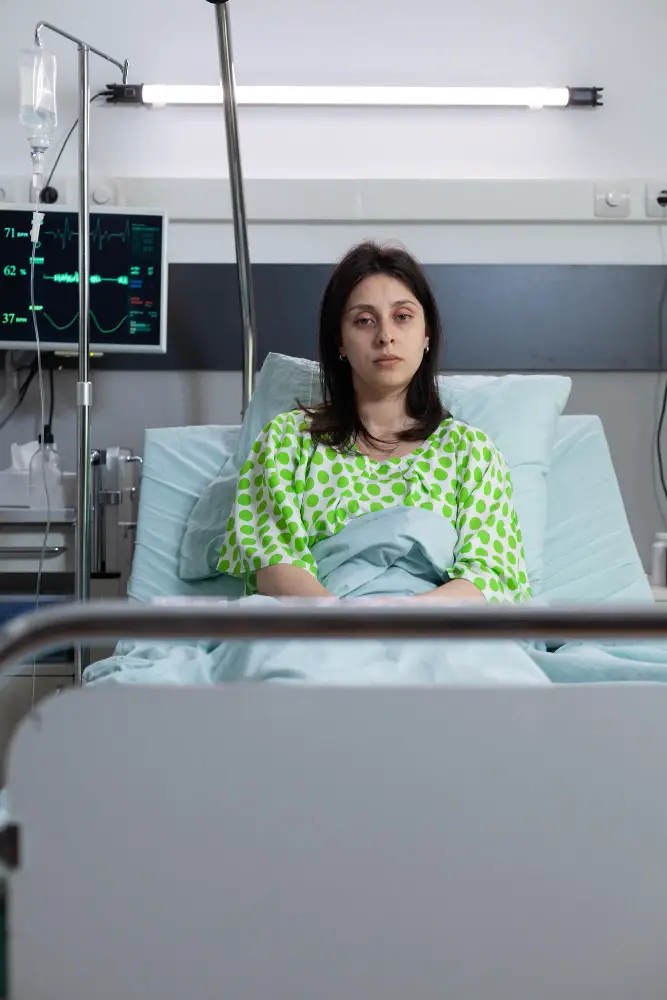
She was sitting up in bed in a pale blue hospital gown, one leg crossed over the other, phone in hand, reading glasses low on her nose. She’d aged — we all had, twenty-five years on — but the posture was the same and the energy in the room when she glanced up was the same and it was, without question, her.
“Good morning,” I said, because sixteen years of practice means the words come out level regardless of what is happening inside you. “I’m your nurse today. My name is Lena.”
She barely glanced up from her phone. “Finally. I’ve been waiting forever.”
The exact same bite.
My first thought, standing there with my clipboard and my professional smile, was: if I can get through the next few days without her recognizing me, I can do this. People like her tended not to think much about people like me. She had been the kind of person whose presence filled every room, who everyone tracked and responded to and feared. I had been the kind who kept her eyes down and her books close and tried to take up as little space as possible. She had never needed to remember me the way I needed to remember her.
I could only hope that was still true.
I checked her IV pump. I asked about her pain level and documented the score. I took her vitals and noted them in the chart. She answered in clipped, minimal pieces, each response as sparse as she could make it while still technically cooperating. I kept my voice even and my hands steady. By the time I finished the morning assessment, I had started to believe that I might actually get through this.
She was difficult in the way some patients are difficult: immediate with dissatisfaction, short with requests, slow to acknowledge when something was done correctly. I knew how to work with this kind of patient. I knew how to stay professional and competent in rooms that were not comfortable. I left Room 304 that first morning thinking: it is what it is, a few days, I can do this.
By the third day, she started watching me.
Let me tell you a little about high school, so you understand what I’m describing when I say she made my teenage years something to survive.
My mother cleaned houses for the families on the nicer side of town, which was also, roughly speaking, the side of town where our school drew most of its population. My father left when I was ten. We lived on the edge of the school district in an apartment that technically fell within the catchment area and technically qualified us for the better school, and we were quietly aware every day of what that technically meant. I wore thrift-store clothes and sensible shoes and received free lunch, and I had learned, before I was old enough to have chosen this philosophy consciously, that the safest way to exist in a space where you were not entirely welcome was to minimize the amount of space you occupied. Keep your head down. Don’t draw attention. Carry your books and your grades and your quiet survival strategy and get from one end of the day to the other without incident.
Margaret, on the other hand, was the kind of person that certain social environments are specifically engineered to produce and reward. She was beautiful in an effortless, expensive way. She had the right clothes and the right friends and the particular social confidence that comes from having never seriously had to question your right to take up space. She was funny and quick and genuinely magnetic, and the people around her wanted to be in her orbit. I understood why. I could see it clearly even from the outside.
What she also had was a talent for finding the fault lines in other people and pressing on them. Not constantly, not even frequently, but with a precision that suggested she had taken careful inventory and knew exactly where to apply pressure for maximum effect.
I was an easy target. I knew I was an easy target. I had nothing to hit back with.
She hid my backpack once, and when I reported it to a teacher, the teacher looked at me with polite skepticism and asked whether I was certain I hadn’t left it somewhere. The backpack was found in the bathroom a week later with my history notes damaged beyond use. Nothing was done. Nothing was ever done.
She spread a rumor — I can no longer remember the specific content of it, only the feeling of trying to counter something that had already spread through the entire junior class before I had even heard it. The rumor had enough plausibility that defending myself made me look worse.
She made comments, always calibrated precisely below the threshold of unambiguous harm. “Did you buy that shirt in the dark?” Said casually, not shouted, as if it were a general observation of the room. “You’re so quiet. It’s creepy.” Directed to the person beside her, but spoken at an angle that landed on me while allowing her to claim it hadn’t been directed at me. “Can somebody tell Lena not to stand so close? She smells like an old library.” This one traveled. For the remainder of that semester, I watched people shift when I sat down near them, that small rearrangement of bodies that said they had heard what Margaret said and were incorporating it into their behavior. I started eating lunch in a bathroom stall to avoid the anxiety of navigating the cafeteria. I was sixteen years old.
I don’t think she thought very hard about any of this at the time. That was always the cruelest part of it. For her it was casual, something that happened between other things, a moment of entertainment or social positioning before she moved on. For me it was the texture of every day.
You carry those things. Even when you know better, even when you’ve done the work, even when you’ve arrived at a life that is genuinely your own and genuinely good, you carry the shapes that formed around you when you were still forming. That’s just how it works. The only thing you can do with the carrying is know what you’re carrying and not let it change the direction you’re moving in.
And now she was in Room 304, under my care, and I was going to do my job.
I checked her IV pump. I asked about her pain and documented the score. I took her vitals and noted them in the chart. She answered in clipped, minimal responses, each word rationed as if she were being charged for them. I kept my voice even and my hands steady and I started to believe, by the end of that first morning, that it might actually be all right.
The first two days were manageable. She was difficult in the generic way of patients who are accustomed to being deferred to: short with requests, immediate with dissatisfaction, slow to acknowledge when something had been done correctly. This was not unusual. I know how to navigate this kind of patient. I did not like being in her room, but I did my job and I left, and the job was being done well.
On the third day, she started watching me.
Not the distracted gaze of someone passing time in a hospital bed, looking at me the way patients look at the clock or the window. Actual watching: tracking me as I moved through the room, studying my face when I looked down at the chart. I noticed it and I told myself not to interpret it. People watched their nurses. It didn’t mean anything.
I was scanning her morning medications when she looked at me in the particular way of someone on the verge of placing a face.
“Wait,” she said. And then, with a smile I knew without being able to say I recognized it: “Do I know you?”
My stomach dropped to somewhere considerably below the floor.
“I don’t think so,” I said. I clicked the scanner onto its mount on the wall and kept my eyes on the screen.
I had heard that tone — that pleased, almost lazy note of recognition in the question — too many times to mistake it. She wasn’t asking because she was uncertain. She was asking because she had already decided, and the question was just the formality before whatever came next.
“Oh, my God.” The smile widened in the specific way it widened when she was about to say something that would land. “It’s YOU. Library Lena.”
For one moment I was sixteen years old, standing in a cafeteria, staring at the lunch she had just tilted out of my tray onto the floor while her friends laughed, waiting for the moment to pass.
I held out her medication cup. “These are your morning medications.”
She took them without looking away from me. “So you became a nurse,” she said, as if she were filing this information alongside other interesting data. “You spent so much time in your books in school. I always wondered — why not a doctor? Could you not afford medical school, Lena?”
She found the truth in it with the efficiency of long practice. She had always known where to press. The scholarship I had applied for and missed. The years of weighing options against the reality of what was available to me. The choices I had made with the resources I had, which I was proud of, genuinely proud of, but which I was not going to explain to her.
I said nothing about medical school.
“What about personally?” she continued, with the manner of someone conducting a casual inventory. “Husband? Kids?”
“I have three children,” I said.
I did not tell her that I was raising them alone. That my husband had left the previous year for a woman a decade younger from his office, and that I had spent the months since recalculating everything: the mortgage payment, the school schedules, the grocery budget, the weekend shifts. I did not tell her any of this because it was not her business and because she would have found a way to use it.
“One daughter, in my case,” she said. “I’ve always thought that having more than one child makes it difficult to give each child proper attention. Harder to be a genuinely good parent.” She smiled at me, pleasantly. “But I suppose everyone makes their own choices.”
I smiled back. The professional smile, calibrated to communicate nothing except that I had heard her and was moving on.
I left the room as soon as the documentation was complete.
After that it became a game.
She would never say anything overtly wrong. She had always understood the architecture of plausible deniability, had mastered it early, and she hadn’t lost the skill. When I adjusted her pillow, she said “Can you not tug like that?” in a pained voice, though I had barely shifted it. When I flushed her IV, she flinched with an elaborate wince before I even connected the syringe, and exhaled through her nose with the careful forbearance of someone in pain being handled carelessly, though I had done nothing different than I did for every other patient on the floor.
If another staff member entered the room, she became an entirely different person. Gracious. Warm. Interested in how their day was going. Complimentary about the unit, about the care, about the hospital generally.
The door would close, and she would look at me with the old lazy cruelty turned low, like a pilot light.
One afternoon a CNA named Marcus came in to check her blood sugar. She chatted with him pleasantly, made a small self-deprecating joke about hospitals, thanked him warmly when he left. Marcus grinned and said she was one of the nicer patients on the floor that week, and I said something agreeable, and the door closed behind him.
She looked me over. “That scrub color really washes you out,” she said.
I kept entering notes. “Do you need anything else before your rest period?”
“I’ve always wondered what happened to you,” she said, with the tone of someone picking up a conversation mid-stream.
“I don’t think about high school very much,” I said.
She gave a short, light laugh. “Yeah. I wouldn’t either, if I’d been Library Lena.”
She said it in the mildest possible voice, the voice of someone revisiting a fond old memory, and it found the exact place it was aimed at. That had always been her specific talent. She didn’t shout. She didn’t make scenes. She identified the thing that would actually land and delivered it in the tone of someone making casual conversation, so that you felt the thing and then felt foolish for feeling it.
I started dreading the approach of Room 304. I started noticing, during the half-step pause before I reached for the door handle, how my breathing changed. How my shoulders went up a fraction. I would make myself release them, and take a breath, and walk in, and do the job. I did the job every time. My documentation was precise, my care was appropriate, my manner was professional throughout. But there was a cost to it, a tax paid at the door of Room 304, and I paid it every shift.
I never told anyone I knew her. Not my charge nurse, not any of my colleagues, not even Marcus, who had noticed something was off and had started asking me how I was doing in the particular way that means more than the surface of the question. It felt, somehow, like the wrong kind of information to carry into a professional space. Like an admission that I hadn’t fully contained what I was supposed to have contained. High school pain should expire. I was forty-one years old. I had three children and a mortgage and sixteen years of a career I had built one shift at a time, and the idea of sitting in the break room explaining that a patient was making me feel like a sixteen-year-old in a bathroom stall seemed impossible to do without something being lost in the translation.
So I kept it to myself, and I counted down to her discharge date, and I told myself: a few more days. Just a few more days.
When it arrived, Dr. Stevens stopped me outside the supply room around noon. He was a quiet, observant man, the kind of attending who actually noticed what was happening on the floor. “Hey, Lena,” he said. “I’d like you to handle Room 304’s discharge personally.”
“Sure,” I said.
“Let me know just before you go in.”
Something in his tone was not quite casual. I said of course, and I meant it, and I filed the request under things I would understand later.
At a little after three, I knocked and entered.
She was already dressed. Lipstick on, purse packed, discharge folder on the tray table in front of her. She had the look of someone who had been sitting there waiting for exactly this, not the discharge, but this particular moment.
“Well,” she said. “Perfect timing.”
I lifted the discharge folder. “Let’s review your discharge instructions.”
She folded her hands in her lap.
“You should resign, Lena,” she said. “Immediately.”
I honestly thought I had misheard her. “I’m sorry?”
“You should resign,” she repeated, precisely, as if she had rehearsed the words. “I’ve already spoken to Dr. Stevens.”
“About what?”
She tilted her head in the patient way of someone explaining something obvious to someone slow. “About the way you’ve been treating me. Of course.”
“I’ve treated you appropriately throughout your stay.”
“You’ve been rough. Adjusting things harder than necessary. Taking your time when I called. And the tone when you speak to me—” She shook her head slowly. “You’ve used your position to mistreat me because of history between us. I’m sure they’ll take that seriously.”
For one terrible second I was sixteen again, standing in a cafeteria, looking at the lunch she had just knocked out of my hands, watching her explain to a passing teacher that she hadn’t meant it, it was an accident, she felt terrible. Her face had been perfectly composed. The teacher had looked at me, at the floor, at my expression, and then at Margaret’s expression, and made a calculation the way people always made calculations in those situations.
“These things get taken seriously,” she said, her voice pleasant. “You know that.”
She sat back, one leg crossing over the other. “I’m giving you a choice. Resign quietly, and this doesn’t have to get complicated.”
I stood there for a moment with the discharge folder in my hands and I thought, methodically, about what this could cost. My mortgage. My son’s college tuition, which I was currently managing alongside the elementary school fees for the younger two. The budget I had recalculated after my husband left, which was accurate to the dollar and which did not have room for a job search. Sixteen years of performance reviews, of patient outcomes, of documentation that said clearly and repeatedly that I knew how to do this work and I did it well. The way complaints worked in a hospital system, which was to say that even a complaint that was ultimately dismissed left a record, that records accumulated, that the accumulation created its own kind of problem.
She had aimed this precisely. She knew exactly what it would cost.
For one awful second I was sixteen years old, standing in a cafeteria, looking at my lunch on the floor, watching her explain to a passing teacher that she hadn’t meant for that to happen. Her face had been composed and genuinely sympathetic. The teacher had looked at me, at the floor, at Margaret’s expression, and I had watched the calculation happen in real time, and I had known before it was finished how it was going to come out.
Then a voice came from behind me.
“That won’t be necessary.”
I turned so quickly the discharge packet nearly flew out of my hands.
Dr. Stevens was standing in the doorway with the stillness of someone who has been in a position for a while and is now ready for what comes next.
Margaret’s expression shifted toward recovery. “Doctor, I was just—”
“I heard you.” He stepped inside, and the key thing about his posture was that he was looking at her, not at me. He had made that choice and he was maintaining it. “You raised a concern earlier today about Nurse Lena’s professionalism. I wanted to form my own assessment before we reached discharge.”
“Yes, I felt that—”
“So I asked Nurse Lena to conduct your discharge while I waited in the hallway. I’ve been there throughout this conversation. What I observed does not support your complaint.”
Her mouth opened. Closed. Opened again. The composure she had been running on since I walked in with the discharge folder was doing something I had not seen it do in five days: it was failing her.
Then the door moved again, and a woman in her thirties stepped in, stopping when she saw all of us, taking in the room with the quick scan of someone who knows when they have walked into something they didn’t expect.
“Mom? I’m here for pickup. What’s happening? Is everything okay?”
Margaret found her recovery quickly: “Nothing, sweetheart. A misunderstanding.”
Dr. Stevens said, evenly: “Your mother raised a serious concern about a member of our nursing staff. Having now observed the interaction directly, I found no basis for that concern. What I did observe was a sustained pattern of inappropriate behavior from your mother directed at our nurse.”
The daughter looked at me. Then her eyes went to my name badge, and I watched her expression change as she read it, and something clicked behind her eyes.
“Mom,” she said, and the word had lost its reassurance. “Is this — is this the woman you mentioned? The one you knew from high school?”
I watched the thing that Margaret had been maintaining for five days finally give way. Not into guilt. Not into anything that resembled remorse. But into the specific expression of someone who has been managing a situation and has realized the management has failed, and what she is feeling is not regret about what she did but fear about what comes next.
“So this was personal,” Dr. Stevens said. He said it to himself, confirming something he had already worked out.
Margaret said nothing. She looked at her hands.
Her daughter’s face was red. “Please — withdraw any complaint she made. There’s nothing to pursue. I’m sorry for any disruption this caused.” She said it to Dr. Stevens, and then she looked at me. “And I’m sorry to you directly. Whatever happened here, it wasn’t acceptable.”
It wasn’t the apology I had wanted for twenty-five years. It wasn’t Margaret saying it. But it was someone in her family looking me in the eye and saying it clearly, without deflection, without the plausible deniability, and that was something I had never received.
“Thank you,” I said.
I finished the discharge instructions with the daughter present. I read through every section: the follow-up appointments, the medication schedule, the symptoms requiring attention, the contact numbers. Margaret sat in silence throughout, not the coiled and calculating silence of someone choosing their moment, but a flat, depleted silence. When I finished I held out the paperwork.
“You’re cleared for discharge.”
She stood and took it. For a moment our eyes met, and I thought she might say something. A last small cut, a parting comment calibrated to make me feel it for the rest of the afternoon.
Her daughter touched her arm, and she looked away.
They left.
Dr. Stevens paused at the door. “You’ve been professional from the minute you clocked in this week. I want that on the record.”
“Thank you,” I said. My voice was steady. My eyes were not, quite, but I held it.
He nodded and left.
I sat down in the chair by the window. The bed had already been stripped. The IV pole stood empty. The room was impersonal again, prepared for whoever came next. Margaret was gone, and whatever the next patient brought with them, it would not be this.
I sat with the quiet for a little while.
I thought about what had just happened in the specific clinical way I think about difficult things, naming each piece and looking at it before setting it aside. She had tried to end my career out of spite. A doctor had listened to me — had, in fact, gone further than listen, had positioned himself to observe — and had told the truth about what he saw. A complaint that could have damaged sixteen years of work had been stopped before it began. Margaret had been witnessed behaving exactly the way she had always behaved, and for once, someone in a position to matter had seen it clearly and said so.
That had never happened before. Not in four years of high school, where the strategy had always been to make herself unprovable while making me feel the full weight of it. Not in a cafeteria with spilled lunch, not in a hallway with a backpack, not in any of the small precise moments I had spent a long time filing under things that probably weren’t as bad as I remembered.
They were as bad as I remembered. I knew that now.
I thought about what it had cost me, in aggregate, to manage that. The energy of constant small self-suppression. The mental arithmetic of making myself less threatening, less visible, less likely to draw the kind of attention that hurt. I had gotten very good at it. I had gotten so good at it that I stopped noticing I was doing it. It had become, over time, not a strategy but a posture, and the posture had followed me out of high school and into every subsequent chapter of my life, into jobs where I second-guessed competence I had earned, into a marriage where I accommodated myself right past the point where accommodation was reasonable, into a career where I was sometimes genuinely surprised when my work was recognized because on some deep level I had never fully stopped expecting to be the girl in the bathroom at lunch.
There is a difference between learning to survive a difficult environment and letting the survival strategy define you permanently. I had stayed in the survival strategy well past its usefulness. Past the moment it kept me safe. Past the moment it became the thing that was limiting me rather than protecting me.
No more, I thought. I didn’t say it aloud because I didn’t need to. I just let it settle clearly, like a decision that had been forming for a long time and had finally arrived.
Then I straightened my scrubs, stood up, and went back to work.
There were five other patients on the floor who needed things, and I went to each of them, and I did what I had been doing for sixteen years. I did it with the same competence and care I had brought to Room 304, which Margaret had tried to use against me, and which was, in the end, the only thing that had actually mattered in that room or any other.
The chair by the window in Room 304 would have a new patient in it by evening.
I would knock. I would walk in. I would say my name and do the job.
Only now I would do it with the absolute certainty that I was not required to make myself small to deserve to be there. That I had earned my place in that room through sixteen years of work and knowledge and genuine care for people who needed someone to show up and pay attention, and that was not something anyone could take from me by filing a complaint or smiling a certain way or saying something calibrated to land.
I had earned it. It was mine.
That was enough.
More than enough.
It was everything.

Laura Bennett writes about complicated family dynamics, difficult conversations, and the quiet moments that change everything. Her stories focus on real-life tensions — inheritance disputes, strained marriages, loyalty tests — and the strength people find when they finally speak up. She believes the smallest decisions often carry the biggest consequences.