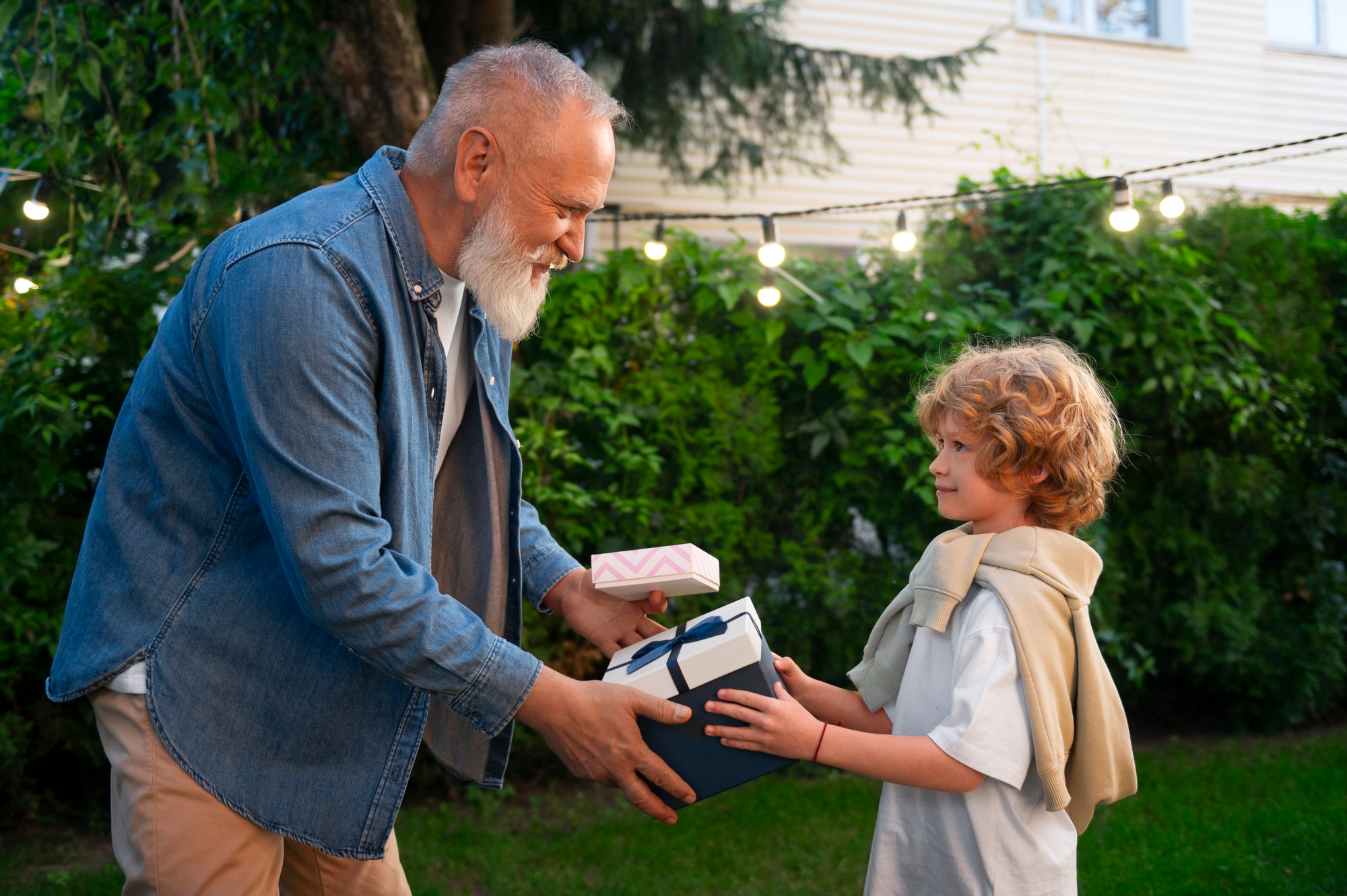
Load-Bearing
A grandfather. A laminated list. And thirty-one years of knowing exactly when a structure is about to fail.
Iwas standing in the doorway of their house in Oakville with a stuffed bear under my arm when my daughter-in-law handed me the list. It was laminated. She had taken the time to laminate it, which told me more about her than anything she had ever said directly to me in five years of shared holidays and carefully maintained pleasantries. The bear was brown and soft and cost fourteen dollars at the toy shop two blocks from my house in Hamilton. I had spent more time picking it out than was probably reasonable for a man of sixty-seven, moving between the shelves with my hands in my coat pockets and my reading glasses pushed up on my forehead, turning each option over to look at the stitching, the weight of it, whether it was the kind of thing a three-month-old boy would reach for someday and recognize as safe.
Vanessa slid the document across the quartz counter without preamble, the way a property manager slides a lease across a desk. She had printed it on good paper and then sealed it in plastic, so the ink would not smear. So it would last.
I read it twice.
No unannounced visits. No outside food without explicit prior approval. No discussing family finances with my son. No transporting Noah anywhere off the premises without written consent submitted forty-eight hours in advance. The font was clean and even, the bullet points carefully spaced. It had the appearance of a document that had been revised before being finalized. At the bottom, no signature line. It was not a negotiation. It was a policy.
“Just so we are all on the same page, Walter,” she said. Her voice had no inflection at all, the way a recorded announcement has no inflection. It communicates the information and nothing more.
My son Michael was standing near the pantry with the particular quality of stillness a man develops when he has decided that the safest position in a room is the one closest to the wall. He was studying his shoelaces with the intensity of someone who has discovered something important there. He was forty-one years old.
I looked at the list. I looked at Vanessa’s face, which was symmetrical and carefully maintained and entirely closed. I offered a mild, accommodating smile, because there is a specific kind of person in the world who counts on your instinct toward civility as a tactical resource, and I was not yet ready to give her the information that I knew she was waiting for.
I never saw Noah touch the bear. It was gone within a week, and I did not ask where it went.
My name is Walter Brandt. I spent thirty-one years as a senior civil engineer for the city of Hamilton, which means I spent thirty-one years assessing the structural integrity of things that other people take for granted. Bridges. Retaining walls. Civic foundations. The invisible architecture that holds a city upright while the city goes about its business of living. The job requires a specific kind of patience, an ability to stand in front of something that looks solid and understand what it is concealing, to find the micro-fractures that appear long before the catastrophic failure does. You learn to read the signs. You learn that structures almost never collapse without warning. They telegraph their distress, if you know what to look for.
I retired on the day my wife Diane received her diagnosis.
Diane was the opposite of a laminated list. She was the kind of woman who kept a handwritten recipe box that had been started by her own grandmother, the cards so old and soft by the time Noah was born that you had to handle them the way you handle anything irreplaceable, with both hands and full attention. She once drove two hours through a January ice storm to deliver a pot of minestrone to a widower down the street she barely knew because she had heard his power was out and she could not, as she put it, just sit there about it. She loved Michael with a quality that could not be measured or earned or lost. She simply loved him, the way weather loves a particular valley.
She first held Noah two weeks before the doctors found the tumor. She used to sit in the hospital room during the treatments and stroke his cheek and tell him, in the particular murmuring voice she used for things that mattered, that he was the most beautiful reason the universe had given her to look at something on her way out the door. She said it without self-pity. She said it the way she said most true things, directly and without decoration.
The pancreatic cancer moved fast. Eleven weeks from the first grim conversation with the oncologist to the final morning. Fast enough that there was no real time to prepare, only time to be present, and then suddenly, devastatingly, time to absorb the silence that arrived the moment presence was no longer possible.
After we buried her, I assumed the hardest part of what came next would be the quality of the silence inside our house. I was wrong. The silence was bad, but I had expected the silence. What I had not expected, and was not equipped for, was the slow, systematic realization that the family I believed I still had was being organized away from me, one revised rule at a time.
It had begun before Diane was even gone. Vanessa and Michael had been married five years by then, and I had never been naive enough to believe that the atmosphere between Vanessa and me was warm. It was polite. I had attributed the brittleness to a natural difference in disposition and done what I believed was the reasonable thing: I stayed out of their way, respected the distance she maintained, and swallowed every instinct I had toward involvement. I never dropped by unannounced. I never voiced opinions about how they ran their household. When they were buying the four-bedroom house on the quiet crescent, I quietly transferred sixty thousand dollars into their account. It was the bulk of an inheritance my late father had left me. I attached no conditions to it. I did not want conditions. It was money that had come to me through blood, and I gave it to my blood, and I expected nothing in return except the ordinary continuation of a family that I believed was intact.
What I failed to understand was that in Vanessa’s internal accounting, the money had not registered as a gift. It had registered as a transaction. And transactions, in her framework, created obligation. She had quietly assigned a depreciating value to my presence and was running the numbers on how long she needed to manage it.
For the first year after Diane’s death, I navigated their world with the careful economy of someone who understands that grief makes you conspicuous and conspicuousness makes people uncomfortable. I called well in advance of any visit. I kept to Sunday afternoons and never stretched beyond two hours. I brought Noah small things, a picture book about trains, a cardboard puzzle, a square of good dark chocolate from the shop near my house, and I sat on their stiff beige sofa and watched him pull the puzzle pieces apart and reassemble them and asked him questions about the pieces he was holding, and his answers had the particular quality of his grandmother’s answers, which was that they were longer and stranger and more interesting than the question had warranted.
He had Diane’s eyes. A serious gray-blue that shifted toward green in strong summer light. He was six years old and asked questions with the relentless precision of someone who suspects the adults around him are withholding the interesting parts of every subject. Watching him grow was the most organically beautiful thing left in an otherwise gray world.
But the rules kept changing.
The Sunday visits were shortened from two hours to ninety minutes without explanation. The forty-eight-hour notice requirement was revised to require written text confirmation, as if a phone call might be subject to misinterpretation. Then I was asked not to park in their driveway because my sedan had a minor oil drip that bothered the neighbors’ aesthetic sense. The chocolate bars and homemade cookies were subsequently prohibited; Vanessa informed me that Noah had developed dietary sensitivities that I was, in her phrasing, simply unqualified to medically navigate.
Then one Sunday I drove through an hour of highway traffic and parked two houses down on the street and walked up to the porch and knocked, and Vanessa opened the door three inches and told me it was not a good time. Noah was overstimulated. He needed rest. She said it with her eyes flat and her voice even, the same tone she used for all communications, and I stood on the concrete slab for four minutes before turning around and driving an hour home with my hands hard on the wheel and something cold and coiling in my chest that I did not have a clean name for yet.
I called Michael the following Tuesday and raised the matter as carefully as I knew how. He sighed with the particular exhaustion of a man who has been carrying something heavy for a long time and has grown so accustomed to the weight that he no longer recognizes it as unusual.
“She needs her routines, Dad. You know how she is.”
I did know how she was. What was becoming clear was that my son had been inside his situation long enough that he could no longer distinguish between what his wife required and what was actually acceptable. He had been conditioned in the way that people are conditioned by any environment they stop questioning: not through any single dramatic event, but through the steady, patient accumulation of small adjustments until the adjusted position feels like the original one.
The formal notice arrived eight months after Diane’s funeral. A PDF on personalized letterhead, formatted with the clean precision of someone who has done the thing they have been planning for a long time. Saturday afternoons only, a strict two-hour maximum. All gifts required seventy-two hours of photographic approval. Prohibition on discussing family finances or family history. No sharing of photographs on any platform without written consent. No overnight stays without thirty days formal notice. At the bottom of the last page, a blank line. She expected me to print it, sign it, and return it.
I did not reply. I did not print it. Instead, I called Michael and told him I needed to see him in person. The bridge was making sounds I recognized.
We met at a Tim Hortons exactly halfway between Hamilton and Oakville, which was in itself a precise geographic measurement of how far things had gone. The concept of neutral ground exists only in the presence of declared adversaries, and I had spent five years telling myself that the word adversary was too strong a word for what Vanessa was, that I was being uncharitable, that the friction was simply the ordinary friction of different personalities living in proximity. Sitting across from my son in a plastic booth while he stirred a coffee he was not drinking, I stopped telling myself that.
He delivered his material with the strained concentration of someone reciting from a script he has been required to memorize but does not fully believe. Vanessa felt that her household boundaries had not been respected. The visits were emotionally taxing for Noah, which was a statement so implausible given Noah’s actual behavior in my presence, the way he ran to me when I arrived, the way he grabbed my hand and pulled me toward whatever he had been building on the rug, that it required a specific act of will on Michael’s part to say it without flinching.
I let him finish. The coffee grinders hummed. The highway traffic moved past the window in a steady blur. When he was done, I leaned forward and asked him directly whether he actually wanted me in Noah’s life.
“Yes,” he said immediately. The panic in his voice was genuine. “Of course I do.”
Then he swallowed and told me about the arrangement.
Eight hundred dollars a month, transferred automatically into a custodial account that Vanessa managed. Not as an occasional gift. As a standing condition for continued access. A family support arrangement, she had called it.
I looked at him for a long moment. He was forty-one years old. He was sitting in a fast food restaurant explaining to his father that seeing his only grandchild would now require a monthly subscription fee. He looked profoundly relieved when he had finished saying it, the relief of a man who has delivered a difficult message and believes the difficult part is over. The difficult part was not over.
“I need some time to process this,” I said.
He nodded enthusiastically. I drove back to Hamilton in a silence that was not peaceful.
I sat at the kitchen table that night where Diane and I had eaten breakfast every morning for twenty-three years, the battered oak table with the ring stain near the corner from the mug she always set down without a coaster because she could never remember and I could never bring myself to remind her a second time after she had already forgotten once. I sat there until the light coming through the window went from deep blue to black, and I thought about Noah’s gray-blue eyes and the way his small voice put an unusual emphasis on the word Walter, as if the name itself were interesting, as if he had examined it and found it worth repeating.
I thought about sixty thousand dollars and a house I was no longer freely permitted to enter.
Six months before this night, my neighbor Patricia had mentioned, in the middle of an ordinary conversation about property values, that her son had gone through a difficult divorce. She had recommended an attorney named Reginald Foresight, a family law specialist in Hamilton. She described him the way you describe a tool that has proven itself under serious conditions: patient, precise, and completely without sentiment when sentiment was not what the situation required.
I went to the junk drawer and found his card behind a stack of takeout menus. I set it on the table next to my coffee and looked at it for a while. I had spent my career assessing the structural integrity of things other people had built. I knew what the numbers looked like when the load exceeded the design capacity. I knew what it meant when you had been documenting your findings for a long time and the findings all pointed in the same direction.
It was time to go to work.
I called Reginald’s office when it opened the next morning. He listened without interrupting for the full forty-five minutes it took me to present the situation, and when I finished, the line was quiet for a moment that had a quality of considered weight to it.
He gave me three instructions. Export and preserve every email, text message, and document Vanessa had ever sent me. Construct a chronological ledger of every canceled, shortened, or blocked visit. And, most importantly, schedule a meeting with my accountant about the sixty thousand dollar transfer.
I asked why the accountant mattered. The transfer was a gift.
“Capital transferred to family members,” Reginald said, “is not universally interpreted as a gift under provincial family law, particularly when documentation is ambiguous or funds have been redirected after receipt. I need to understand the forensic financial architecture.”
I had used the same accountant for twenty years. Sandra Obi was a meticulous woman who treated financial records with the permanence of a museum archivist and the precision of a forensic auditor. I was at her office by two in the afternoon. I briefed her and asked her to pull everything related to the Oakville house transfer.
What she found over the following hour changed the shape of everything I thought I understood about the past three years.
The sixty thousand dollars had not simply been absorbed by the down payment. Sandra turned her monitor around and pointed at a chain of routing numbers that told a different story. A portion of the capital had moved through their joint checking account, stayed there for three weeks, and was then redirected into a separate account registered exclusively in Vanessa’s name, opened three days after the house closing. Over the fourteen months that followed, she had executed a series of transfers, each small enough to avoid triggering automated banking alerts or attracting the casual attention of a joint account holder. Twenty-two thousand dollars, methodically moved from shared assets into private control.
I sat in Sandra’s leather guest chair and felt the particular nausea of a man who has been calculating load-bearing capacity for decades and has just discovered that the foundational measurement he based everything on was false.
I thought about Michael at the Tim Hortons, his haunted face, his rehearsed delivery, his almost childlike relief when the message had been transmitted. I thought about whether he knew about the account. The longer I sat with the question, the more certain I became of the answer: he did not. He was not a participant in the deception. He was a casualty of it, being managed as thoroughly as I was, just from a closer distance and with different tools. Somehow this made everything simultaneously worse and more complicated. I was no longer just fighting for my access to my grandson. I was about to dismantle my son’s entire understanding of his own life.
Reginald and Sandra worked in tandem for six weeks while I continued attending my Saturday visits as if nothing had changed. This required a quality of discipline I had not previously understood myself to possess. I called ahead with my seventy-two hour text confirmations. I parked two houses down on the street. I stood on the porch and received the begrudging welcome and sat on the stiff sofa and told Noah about the blue jays fighting at the bird feeder in my backyard and helped him sort his puzzle pieces by color while the clock above Vanessa’s head ticked with a regularity that I had begun to hear as something other than time passing.
Noah, who had Diane’s unnerving perceptiveness about the emotional conditions of the rooms he occupied, paused in the middle of week five and looked at me with his grandmother’s eyes.
“Grandpa Walter,” he said, a wooden dinosaur suspended in his hand. “Why does your face look so sad?”
My chest seized. I made myself smile. “I’m not sad, buddy. I’m just doing some heavy thinking.”
“Thinking about what?”
“About how much I love you,” I said. Which was true, and was also the only answer I trusted myself to give in that room at that moment.
He considered this with the absolute, unshakeable confidence of a child who has never had a reason to doubt that love is the ordinary condition of the world, and then he hummed once and went back to his stegosaurus.
In the seventh week, Reginald called me to his office and slid a thick envelope across his mahogany desk.
“We have critical mass,” he said.
The document inside was a formal legal demand letter. Under the circumstances established by Sandra’s audit, the sixty thousand dollars was no longer classifiable as a familial gift. It was an undocumented loan subject to recall. Beyond the financial architecture, the letter set out a detailed pattern of systemic isolation and invoked my rights under Ontario family law, which grants grandparents the standing to petition the Superior Court for mandated access when a custodial parent is withholding a child for purposes of financial coercion or malicious control. Attached to the letter was Sandra’s complete forensic audit: every date, every routing number, every redirected dollar tracked to its destination.
The document was not emotional. It was not written in the register of a wounded father or a grief-stricken grandfather. It was written in the register of a structural engineer who has completed his assessment and is presenting his findings to the relevant authorities with full supporting documentation.
I picked it up. The architecture of what had been built around me was fully mapped. It was time to use it.
I called Michael on a Friday evening and asked, in my most ordinary voice, whether my Saturday slot was still available. He said yes, sounding distracted, somewhere between a sports broadcast and a half-eaten dinner. I said I would see him in the morning.
The drive to Oakville the next day had a quality of absolute stillness to it. The sky was the uniform gray of a February morning with no intention of improving. The envelope sat on the passenger seat. I had considered, more than once over the past six weeks, whether there was any version of this that did not end where it was going to end. I had not found one. Some structures cannot be reinforced. When the micro-fractures have extended too far into the load-bearing material, the honest and necessary thing is to map them clearly and let the building make its own decisions.
Vanessa opened the door wearing the specific smile she used for my visits, the one that operated her mouth without reaching anything behind her eyes. From somewhere deeper in the house, I could hear Noah narrating a battle between his action figures in the focused, authoritative voice he used for important dramatic events.
“I brought something for Michael,” I said.
The smile tightened almost imperceptibly at the corners. She told me it was not an optimal time. Michael was watching the playoffs. They were maintaining a quiet environment.
“It will take sixty seconds,” I said. And something in my voice, the specific quality of it, the steel that I had stopped bothering to conceal, made her pause before she turned and called down the hall.
Michael came to the door in a jersey with a water bottle in his hand, wearing the mild annoyance of a man interrupted mid-game. Then he saw the envelope and the annoyance fell away and something older and more instinctive replaced it.
I handed it to him across the threshold. He broke the seal there in the doorway and slid the papers out, and Vanessa moved up behind his right shoulder to read over his arm, and I watched my son’s face as he read the first paragraph of Reginald’s letter. The color left him in a single, comprehensive movement. Not the pale of guilt. The pale of a man who has just been handed a map of a building he has been living inside for years and is seeing for the first time where all the walls actually are.
He turned to the second page. His eyes found the routing numbers, found the account name, found the dates that aligned with perfect precision to the escalating timeline of my exclusion. He raised his head and looked at me the way a person looks at someone who has just shown them something they cannot unsee.
“Dad,” he said. “What is this?”
“It is a legal notification from my attorney,” I said, “accompanied by a forensic financial report from my accountant. I want you to read every word of both documents. And then I want you to have a very long and very honest conversation with your wife.”
Michael turned to look at Vanessa.
Her face had changed in the way a face changes when the mechanism behind it has been exposed. The composure was gone, the practiced neutrality was gone, and what was underneath it was something smaller and more frightened than I had expected to find there. She began to speak, her voice climbing in pitch, telling Michael that I was attacking them, that the documents were fabrications, that she did not know what I had been feeding him.
“Vanessa,” I said, without raising my voice, “the account is fully documented. Every transfer is time-stamped. All twenty-two thousand dollars. You cannot gaslight a bank ledger.”
The explanation sputtered and went quiet. That is the particular vulnerability of a manufactured narrative: when the external conditions that sustain it are removed, there is nothing underneath to fall back on. She had no alternative story that fit the numbers. She stood at the door and shrank, slowly, under the weight of evidence that did not need her cooperation to exist.
I addressed Michael directly.
“I did not come here to make a scene on your lawn. I came because you deserved to know the architecture of the situation you have been living inside. And I came because I am not going to allow my grandson to be used as a financial instrument.”
The soft sound of socks on hardwood interrupted the silence. Noah slipped under his father’s arm with a plastic superhero in his fist and beamed up at me with his grandmother’s eyes, utterly indifferent to the wreckage surrounding him at adult height.
“Hi, Grandpa Walter!”
“Hi, buddy.”
Michael looked at me over his son’s head. His face contained several things at once, the shattering embarrassment of a man whose private failures have been catalogued and presented to him with formal documentation, the raw and overwhelming confusion of someone learning that the person they trusted most had been quietly taking from them for years, and, beneath all of it, something that I recognized because I had felt it myself once, at the end of a long structural assessment, when the damage was finally fully mapped and the worst of the uncertainty was over. It was relief. The relief of a man who has at last been given the accurate dimensions of the thing he has been trapped inside, and can now begin to measure a way out.
“Come inside, Dad,” he said. He held the door wide open.
I stepped over the threshold.
Vanessa backed away into the interior of the house, and the shadow took her in.
We sat at the quartz island for two hours. Vanessa attempted several explanations. It was a college fund for Noah, informally managed. It was a household emergency reserve. It was a clerical error that had simply never been corrected. Each version lasted until it encountered Sandra’s documentation, at which point it collapsed and was replaced by the next one. Eventually the explanations ran out entirely, and she sat at the end of the counter in a silence that had a different quality from the composed silence she had deployed for years. That silence had been a performance. This one was simply what remained when the performance stopped.
I stayed for the part I needed to be present for and left when I was no longer needed. The conversations that came afterward, the dozens of difficult, private excavations my son had to conduct into the interior of his own marriage, those were not mine to attend. A man of sixty-seven who has spent a career assessing structural damage knows the difference between his job and someone else’s grief. I gave Michael the evidence. What he built with it was his own work to do.
Michael called Reginald the following Tuesday, not as an adversary, but as a person trying to understand his legal position. The separation was finalized over the following months. Six months after that Saturday morning, the Oakville house was listed for sale.
The sixty thousand dollars was reconciled in the separation proceedings. Michael retained the remaining equity from the sale. The eighteen thousand that Vanessa had already spent was written off entirely; Reginald advised that pursuing it through further litigation would cost more in fees than the sum itself warranted. I conceded the loss without sentiment. Sometimes removing a toxic element from a foundation costs what it costs, and the cost is worth it regardless of whether you recover the materials.
Now, on Saturday mornings, I pull into the driveway of Michael’s rented townhouse without a schedule, without an approved itinerary, without parking two houses down on the street. Noah hears the car and is usually at the door before I reach it, because six-year-olds who are expecting someone they love do not wait patiently when waiting is unnecessary.
We drive out to the conservation area along the creek in Hamilton, the one that borders the water where the herons hunt in the shallow reeds in the early morning. It was the place Diane loved most in this particular part of the world. She used to say the herons moved through the water like very old thoughts, slow and entirely certain of themselves. We would come here on Sunday mornings when Michael was small, and she would pack sandwiches in wax paper and we would sit on the bank and watch the birds and she would tell Michael their names and he would forget them immediately and ask again the following week, which she found more endearing than frustrating.
Noah calls the herons big gray birds. This is my fault. The first time he asked me what they were, the word heron had temporarily vacated my memory in the way words sometimes do when grief has been running the premises for long enough, and I said big gray birds instead, and he accepted this nomenclature with complete satisfaction. I have not corrected him since. I prefer his version. It says precisely what it means and it means precisely what it says.
We throw stones into the creek. We look for crawfish under the flat rocks near the bank. He tells me, with extraordinary attention to detail, about the ongoing geopolitical conflict between his two most important action figures, a dispute that has apparently been running for several months and involves complex territorial grievances I am not yet fully briefed on. I listen carefully. I ask clarifying questions. He appreciates the questions.
Last month he lost his first baby tooth.
He called me the moment it happened, his speech delightfully impaired by the gap in his gums, the words tumbling out faster than his mouth could properly organize them. He was so proud he could barely breathe. I drove straight over without calling ahead, without requesting approval, without parking down the street. I took a photograph of him standing in Michael’s kitchen showing me his gap-toothed grin, his face bright with the specific, full-body pride of someone who has accomplished something for the very first time and understands, in some wordless way, that this is the kind of thing worth marking.
I had the photograph framed. One copy for Michael. One for my kitchen windowsill, where it sits next to the photograph of Diane in the oncology ward, pale and glowing, holding Noah two weeks before the doctors found what was already growing inside her. She is looking at him in the photograph with the expression she wore when she had decided something was extraordinary and was not going to pretend otherwise.
She would have been completely, devastatingly excited about that lost tooth. She would have called everyone she knew. She would have baked a cake with a tooth drawn in white icing on top of it and brought it over unannounced, because she never once believed that showing up unannounced with food was anything other than a kindness. She would have made Noah feel that losing a tooth was among the most significant achievements in the history of human accomplishment, and she would have been entirely sincere about it, and he would have believed her, because she was the kind of person whose sincerity was simply not in question.
When the house is quiet on a Sunday evening and the late light comes through the kitchen window and catches the silver frame at the right angle, I sit at the battered oak table with my coffee and I think about what it cost to get here, and whether I would do it the same way again, and the answer is always the same. I would have preferred not to. I would have preferred a different set of facts. But when the facts are what they are, the engineering is not optional. You do the assessment. You document the findings. You present them clearly to the relevant parties and you let the structure make its own decisions.
Some things hold. Some things don’t. The ones that hold are worth every hour you spent in the dark, measuring.

Adrian Hawthorne is a celebrated author and dedicated archivist who finds inspiration in the hidden stories of the past. Educated at Oxford, he now works at the National Archives, where preserving history fuels his evocative writing. Balancing archival precision with creative storytelling, Adrian founded the Hawthorne Institute of Literary Arts to mentor emerging writers and honor the timeless art of narrative.