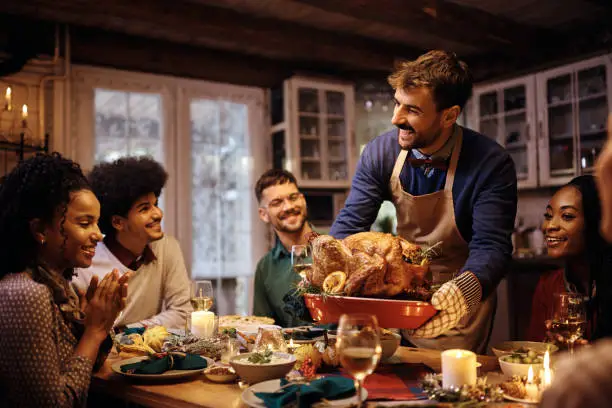
The first sign that Thanksgiving was going to tear my family apart was so small I almost missed it.
Just the sound of my grandmother’s fingernails scratching against the inside of her tote bag. A soft, frantic little tap-tap-tap, like she was trying to find something alive at the bottom of it.
Nobody else looked up. The Cowboys game was still going in the den. Someone in the kitchen set a lid down too hard and made the silverware jump. My mother was telling my cousin Eli that the baby needed more bundling before the drive home. My sister Cara was laughing too loud at something her husband Matt had said. My niece Ava had her phone propped against the salt shaker, filming some little dance in the corner of the breakfast nook because apparently even Thanksgiving had to be content now.
Then Grandma said, “Where’s my envelope?”
Not loud. Not dramatic. Just sharp enough to cut the room clean through.
I looked over from where I was rinsing the carving knife at the sink. She stood by the mudroom entry with her tote hanging open, shoulders rising in quick little jerks. She’d already pulled out her wallet, a tissue packet, a pouch of mints and receipts, the glasses case she never uses because she insists she can see better without it. The bag looked turned inside out and she was still patting it, starting over from the top like maybe she’d missed something alive in there.
“Mom, calm down,” Cara said, in that soothing voice she uses when she wants credit for being patient. “It’s in there.”
“It is not,” Grandma snapped. Her voice was thin and breathy but there was iron underneath it. “It had the green ribbon. I tied it twice. I put eighteen thousand in it. It is gone.”
Eighteen thousand dollars doesn’t just sit in the air like ordinary words. It sags the room. It changes where people look. It turns every innocent movement suspicious.
Ava froze mid-dance. Eli stopped bouncing the baby seat with his foot. Matt straightened in the den doorway, beer halfway to his mouth. My mother pressed both hands flat on the counter like she was bracing for an earthquake.
And then my sister did exactly what she’s always done when something goes wrong.
She found the easiest person to throw under it.
“He was near her purse,” Cara said, pointing across the room with a bright red fingernail. “I saw him.”
Every head in the room turned toward my son.
Miles was fourteen that year. Tall for his age, all elbows and soft eyes, wearing the charcoal hoodie I’d told him was too heavy for a house full of oven heat and people. He was standing by the roll basket with a dinner roll in his hand, still half-processing what was happening. When everyone turned toward him, he didn’t even put the roll down. He just froze.
“He was hovering over the bag,” Cara said, already building the story while the room watched.
That was true in the way some lies borrow true things for cover.
He had been near the bag. He had been helping her. He had been the one tucking Grandma’s shawl into her tote so it wouldn’t drag on the floor. He’s that kind of kid. He returns grocery carts at Kroger even when they’re not ours. He gives up his seat without being asked. He watches out for old people crossing parking lots alone. He had been near that bag because he is gentle, and in my family gentleness has always been treated as availability.
Miles looked at me.
Not guilt in his face. Confusion first, then hurt arriving so fast it almost tripped over the confusion. His shoulders drew up around his neck and something cracked in my chest hard enough that I felt it in my throat.
“Seriously?” I said.
It came out flat. Quiet. Maybe too quiet.
Cara lifted one shoulder. “Well, he was there.”
My mother moved immediately into the gap between conflict and reputation, which is her natural habitat. “Stop arguing and cover it,” she said. “Family doesn’t call police.”
That sentence. That one sentence.
It had done more damage in our family than a thousand shouted arguments ever could. Family doesn’t call police meant family doesn’t say the thing out loud. Family doesn’t write it down. Family doesn’t embarrass anybody. Family quietly reshapes the truth around whoever is loudest, prettiest, most fragile, or most exhausting. Family lets the reliable one handle it.
The reliable one was always me.
I didn’t lunge into a defense of my son. I didn’t start shouting about fairness. Years of being the one who fixes things had trained something in me deeper than anger. When the room gets ugly, I get calm.
I pulled out my phone.
Opened my text thread with Mara Yates.
Typed one word.
Proceed.
Hit send.
Nobody noticed. They were too busy staring at Miles.
“Just empty his pockets,” Matt said, in that half-casual, half-commanding voice men use when they want to sound reasonable while volunteering someone else’s humiliation. “Let’s just be done with it.”
Miles swallowed hard and set the roll down. He looked at me again, waiting to see whether this was one of those moments where being a good kid meant letting adults treat you like a problem to solve.
I hated that look more than the accusation.
He held out his hands before I could say anything.
Phone. House key. ChapStick. A folded Kroger receipt. Twenty-nine cents. A gum wrapper.
There is something obscene about how quickly innocence gets asked to prove itself.
“Daniel, tell him to cooperate,” my mother said.
“Respect goes both ways,” I said.
Cara made an impatient sound. “It’s eighteen thousand dollars. Eli’s gift is tonight. We don’t have time for this.”
And there it was. The pivot. The missing money mattered, yes, but what mattered more to them was the schedule. The appearance. The storyline.
I need to give you some context before the part where everything broke open, because you deserve to understand what this family looks like from the inside.
My name is Daniel King. I was thirty-nine that Thanksgiving. I manage a collision repair shop in Columbus, Ohio. I drive a 2014 Honda Accord that smells like brake cleaner and coffee and whatever fast food Miles swore he didn’t eat in it. I rent a plain three-bedroom on the east side because I like having a garage, and because after my divorce I found out I preferred a place that needed me more than it impressed anyone.
I am, by temperament and by long misuse, the quiet helper.
My sister Cara is three years younger and has moved through rooms her entire life like they were designed to catch her. She was cheer captain in high school. Homecoming royalty in a town small enough to care about that. She has the kind of face people immediately decide is honest because it is pretty. She owns a bridal boutique now, though owns is generous when Dad co-signed the lease and the printer still leaves a watermark on half the business cards. My mother calls her driven. I have always privately translated that as expensive.
The pattern in our family is old enough to have roots.
Cara has a crisis. Mom gets emotional. Everybody looks around the room. I pay, fix, lift, drive, patch, absorb, and shut up.
There was the credit card mess in 2021 when Cara’s boutique got sideways. A family text went out at nine forty-two at night that just said emergency, don’t tell Dad. I sent fifteen hundred through Venmo that night, four hundred more the next morning, then quietly covered the remaining balance over a week because late fees were stacking faster than shame. Nobody wrote it down. Nobody brought it up after.
There was the security deposit when Cara and Matt were between places and twelve hundred dollars had to materialize by Tuesday. I wired it from the shop during lunch, standing between an oil change and a bumper bake while my sandwich went soggy in the breakroom fridge.
There were smaller things. A tire. A copay. Two months of storage. A repair for a dryer my mother forgot to mention until after the repairman had already left.
I believed for years that usefulness was a form of love.
So when my mother said stop arguing and cover it, she didn’t just mean cover the money. She meant cover the embarrassment. Cover the accusation. Cover the crack before anyone outside the family could see through it.
And she assumed, because it had always worked before, that I would do it.
What she hadn’t accounted for was that this time, the bill had my son’s name on it.
“Take his backpack,” Cara said.
That was the moment something in me stopped being anger and became clarity.
Miles stiffened so hard it looked like it hurt. “I’m not stealing,” he said, barely above a whisper.
My mother sighed. Not in sympathy. In annoyance. “He’s a teenager. Teenagers make dumb choices. We don’t need to moralize.”
The problem wasn’t even the money. The problem was the story they were writing and how fast they were willing to stain him with it. Once a story like that sets in a family, it doesn’t wash out clean. It leaves an outline. Every future inconvenience gets fitted into that outline. The glances. The careful watchfulness around purses and cash. A kid gets marked early and carries it.
I felt the old instinct tug at me. The one that says smooth this over, don’t escalate, everyone’s emotional, we can fix it later. That instinct had cost me thousands of dollars and years of my life.
Then I looked at Miles. At the way he was trying not to cry in a room full of adults who had already decided his dignity mattered less than their convenience.
That instinct died fast.
Two weeks before Thanksgiving, Grandma had added me to one of her accounts. She wanted help moving money around without getting tricked online, and somewhere between teaching her to spot scam texts and changing a password she’d written on a church bulletin, she asked me a question in a voice that was not casual at all.
“What’s the paper you file so people stop taking your money when you say no?”
She hadn’t meant strangers.
She’d meant family.
We had started talking about guardrails. Not guardianship. Just documentation, restricted access, dual signatures. Mara, who’d handled my divorce and once got a deadbeat contractor to issue a refund just by sending a letter on proper letterhead, had told me what she always tells clients when the people around them are louder than the evidence.
Paper beats yelling.
So I had texted her that one word.
Now I walked away from the staring and the murmurs and the swelling heat of the kitchen, and headed toward the breakfast nook where Grandma had left her phone plugged in earlier.
“Daniel,” my mother hissed. “What are you doing?”
“Breathing,” I said.
Technically that was true.
Grandma’s phone unlocked with the same passcode she’s used for everything since 2014. She still had me saved as Danny Tech. I opened the Photos app.
If you had to build a legal case from one eighty-two-year-old woman’s camera roll, you could do worse than my grandmother’s. She documents life like an archivist preparing for the end of the world. Groceries. Utility bills. Snow in the driveway. The exact arrangement of canned soup in her pantry in case she wants to replicate it. She has albums labeled Rhubarb 2023 and Summer Gas Receipts and Green Ribbon 2024.
I tapped recents.
A photo from earlier that day.
The tote bag on the mudroom bench. The knit shawl draped over one end. The roll of green ribbon on the floor like a dropped snake. And because she’d held the phone a half second too long, the little yellow LIVE box glowed in the corner.
I pressed and held the screen.
The still image moved.
Not much. Maybe three seconds. The camera dipped as if Grandma had briefly lowered the phone while adjusting her scarf. The mudroom bench came into full view. A puffer jacket with a North Face logo. A slice of tiled floor. A UGG mini boot, a Chelsea boot, a sneaker with glitter laces.
Then a hand entered the frame.
Small hand. Mauve gel manicure. Tiny silver star sticker on the right ring finger.
The hand slid under the shawl, lifted the green-ribboned envelope, tucked it smoothly into the inner lining pocket of the puffer jacket, pressed the jacket flat, and slipped away.
Then the camera rose and the live photo snapped back to still.
Three seconds. That was all.
Enough to turn the whole room inside out.
I stood there for a moment just staring at it. Not because I doubted what I’d seen. Because I hadn’t expected it to be that complete. That clear. I had imagined finding a timestamp that helped narrow things down, maybe a shot of the envelope itself. I had not expected a moving record of the actual theft.
I pinched to zoom. The star sticker caught the light when the finger bent.
Not my son’s hand. Not even close.
I took one slow breath and turned back toward the kitchen.
“I think we should all take a breath,” I said.
The room leaned toward me. People always do when the quiet one finally speaks.
Cara crossed her arms. “What now?”
“Now we stop improvising,” I said. I held up Grandma’s phone but didn’t hand it to anyone yet. “Ava. Come here.”
Her face changed too fast for it to be innocent. That’s what I remember most clearly. Not fear. Calculation. The practiced smile she’d inherited from Cara snapped into place like a reflex.
“What?” she said.
“Show me your hands.”
She laughed, brittle and high. “Why would I—”
“Show me.”
She held them out.
Mauve gel polish. Right ring finger: silver star.
Grandma squinted. Then she made a small sound and said, “That’s the one from yesterday. At the salon.”
Ava’s smile wavered. “Everybody has stars.”
“No,” Grandma said. “Not that one.”
Cara moved instantly, stepping half in front of her daughter. “Stop it. You are not interrogating my child.”
I looked at Grandma. “Do you want to see something?”
“Yes.”
Cara said, “I really don’t think—”
Grandma turned toward her daughter with a fierceness I hadn’t seen from her in years. “I said yes.”
So I played it.
At full volume.
There is something sickening about hearing ordinary sounds reveal a betrayal. The rustle of the shawl. The nylon whisper of the jacket. The faint crinkle of paper and ribbon. A breath. Then stillness.
Nobody moved while it played.
When it ended, the house seemed to inhale and hold it.
I watched the truth land on every face in the room at once.
On Eli, stunned and red, standing next to a gift that had become a crime scene.
On Matt, whose whole posture shifted from authority to caution.
On my mother, whose expression moved through disbelief, dread, calculation, and then that old terrible reflex to protect the wrong person because protecting the right thing might create a scene.
On Miles, whose eyes filled so fast he had to blink hard and look away.
And on Cara, who recovered first because that is her real talent.
“Okay,” she said immediately. “Maybe Ava moved it to keep it safe. People were in and out of that mudroom. Eli’s toddler was pulling on things.”
Eli blinked. “My baby’s asleep.”
Matt stepped in. “Let’s not blow this into some huge crime situation. She’s fourteen.”
My kid is fourteen, I thought.
My mother latched onto the new narrative like a rope thrown to someone going under. “Right, right. No one’s saying she stole it. She may have panicked. Ava, honey, just go get it from your jacket.”
Ava looked at her mother.
That look said more than anything else in the room. Not confusion. Not innocence. It was the look of a kid checking which story she was supposed to use.
“No,” I said before anyone could hand her one.
Everyone turned to me.
I was still calm. That seemed to bother them more than if I’d shouted.
“Before anything else happens, two things. First, everybody in this room stops saying my son’s name in the same breath as this money. You wanted to empty his pockets. You wanted to search his backpack. You looked at him like he was a thief because he helped his great-grandmother with her shawl. That ends right now.”
Cara opened her mouth.
I held up one hand.
“Second, we stop pretending I’m going to quietly pay for whatever version of this makes you most comfortable.”
That landed differently. More personal.
“What does that have to do with anything?” she snapped.
“With anything?” I said. “You’re already talking about who can cover it, and that word always ends up pointing at me.”
My phone buzzed in my pocket.
Mara: Received. Drafting petition and bank restriction letter now. Include today’s incident?
I typed back with one thumb.
Yes. Also remove Cara from any access to Mom and Grandma’s accounts.
My mother caught enough of the screen to go pale.
“Daniel,” she said. “Don’t be cruel.”
“Boundaries aren’t cruelty.”
Cara’s laugh came out thin and sharp. “You got a lawyer involved over a family thing?”
I lifted Grandma’s phone and played the live photo again.
The crinkle. The ribbon. The hand. The star.
The thing about proof is that once a room has seen it, everything shifts. People can still lie, still minimize, still perform, but the center of gravity is gone. Everyone knows where the truth is even while they keep circling it.
Cara’s face hardened. “You’re humiliating my daughter.”
“You tried to strip-search my son,” I said. “We’re not the same.”
My mother switched to her gentler weapon. “Daniel, please. If you make this legal, you’ll ruin Christmas.”
I looked at her. And finally said the thing that had been building in me for years.
“Christmas can be ruined,” I said. “My son’s name doesn’t get to be.”
That shut her up.
Ava was crying by then. Quiet tears she kept wiping away with her heel, fast, like erasing them quickly enough might preserve some dignity.
“I only took some,” she whispered. “I was going to put it back after.”
Cara hissed her name. But Ava flinched away from her.
“After what?” I asked. “After Zara? After Apple?”
Her face told me yes.
I walked to the dining table and set Grandma’s phone down.
“Bring the envelope,” I said.
Ava looked at her mother.
“Ava.” Grandma’s voice cut right through the room. “Bring my money.”
No softness in it. No room for interpretation.
Ava turned and went toward the mudroom.
While the hallway was quiet, Miles leaned into my side for just a second. Barely perceptible, the way he used to after a rough basketball loss or a bad dentist appointment when he was small. Just a quick shoulder-check, making sure I was still there.
“You okay?” I asked without looking at him.
He nodded once. “I was helping Nana.”
“I know.”
“I didn’t touch it.”
“I know that too.”
His throat moved. He didn’t let anything fall. He’d learned from me where to put hurt when people were watching. That realization made me feel proud and guilty in equal measure.
“Thanks for not yelling,” he whispered.
“Yelling is for people without screenshots,” I said.
That pulled the smallest breath of a laugh out of him.
Ava came back carrying the envelope in both hands.
I knew before she crossed the room that it had been opened. Grandma’s ribbon was retied too fast, the loops uneven. The flap sat wrong. The paper had a different tension to it.
“Put it on the table,” I said.
I opened it carefully and started counting.
Grandma packages cash the way other people frame documents. She cuts strips from old magazines, wraps each stack, marks amounts in pencil. Eighteen thousand dollars for her isn’t one thick wad. It’s order. It’s nine neat bundles of two thousand each, balanced, aligned.
There were eight neat bundles.
And one loose stack.
I counted out loud, because the room needed to hear every number the same way it had heard every accusation.
Seventeen thousand seven hundred sixty.
Short. Not by an accident-sized amount. By the exact amount a teenager thinks can disappear inside a larger pile.
Matt cleared his throat. “It’s close enough.”
Grandma turned her head and looked at him with open contempt. “No, it is not.”
Cara threw up both hands. “Fine, we’ll transfer the difference.”
“No,” I said.
She stared at me. “Excuse me?”
“You’ll return the exact cash. In cash. Right now. If it’s in a pocket, go get it. If it’s in your car, go get it. If it doesn’t appear, Mara handles it.”
“You are making this into something it isn’t,” Cara said.
I lifted Grandma’s phone and played the live photo one more time.
The crinkle. The ribbon. The hand. The star.
Nobody said anything.
Then Grandma looked at Ava and said, very quietly, “Bring the rest.”
Shame is a good finder.
Ava went to the mudroom, then the hall, then toward the front entry where the coats were piled. When she came back she had two crumpled hundreds and two twenties in her fist. The bills were warm from wherever she’d hidden them.
She laid them next to the stack.
I counted again.
Eighteen thousand on the dot.
The Cowboys game kept talking to itself in the den. A commentator shouted about third down and field position to a house where nobody cared anymore.
Then Grandma did something that surprised us all.
She looked at Miles.
Not at Ava. Not at Cara. Straight at my son.
“Honey,” she said. “I am sorry.”
That nearly undid me.
Miles blinked fast. “It wasn’t you,” he said.
“I know,” she answered. “That is why I am sorry.”
He nodded once. Hard.
Then she turned to Cara.
“Apologize.”
Cara stared like she’d misheard.
“Now.”
“I already—”
“No.” Grandma’s voice sharpened. “You apologize to that boy for putting dirt on him.”
Cara looked at my son. You could see the effort it cost her. Not remorse. Effort.
“I’m sorry,” she said. “You were near the purse. It was an honest mistake.”
It was a coward’s apology. But it was a public one. Sometimes that’s what justice looks like in a kitchen full of pie.
Miles looked at me. I gave him the smallest shrug. Something like you don’t owe anybody grace today.
He took a breath and said, “I accept Ava’s apology.”
Not Cara’s. Ava’s.
Then he went to the sink and washed his hands for a long time. I watched the water run over his knuckles and thought about how some things you can feel on your skin long after everyone else has moved on.
I slipped the envelope into a freezer bag, put that inside a roasting pan, and set the pan in the cool oven with the light on.
Grandma watched me and gave a tired little nod. “I trust appliances,” she said.
Eli actually laughed at that. Small, exhausted, real.
We ate pie after that because people don’t know what else to do after an explosion except perform normal. Nobody tasted anything. We moved forks through whipped cream and pumpkin filling and said words that filled the silence without meaning much.
At six twelve, while my mother washed dishes too hard and Matt disappeared to smoke on the porch, I opened a folder on my phone labeled Thanksgiving Incident and saved screenshots of everything. The live photo. Mara’s texts. The count.
At six nineteen, I logged into the shared banking access Grandma had given me and removed every soft permission I could find. View access: gone. Transfer limits: set to zero. Zelle: disabled. Notifications turned on for every movement over ten dollars.
At six twenty-three, I changed Grandma’s garage keypad while she dictated a new code from the kitchen and my mother kept saying this is excessive in the same tone people use for weather they think should have asked permission.
At six forty-one, I texted Eli a link to a small fireproof safe and told him I’d help install it Sunday.
At seven ten, Mara emailed me a draft letter revoking informal access to Grandma’s finances. That is the beauty of law when it’s used correctly. It doesn’t tremble. It doesn’t smooth things over. It records.
At seven twenty-four, I removed the family emergency debit card from every wallet I’d added it to for just in case use.
At seven thirty-one, it tried to authorize at Gold Nails and Spa.
Declined.
I let the alert buzz against my palm while I stood on the back steps.
Miles came out and stood beside me in the cold. Leaves smelled damp. Someone nearby had laundry going, that clean soap smell drifting through the yard.
“If you hadn’t found that video,” he said after a while, “I’d always be the bad kid now.”
It hurt because he was right.
Not to me. Never to me. But in a family like ours, the story would have set. That’s what people who rush to accuse count on. Not just the accusation itself, but the residue. Even when proven wrong later, some stain remains. The glances. The careful watchfulness around purses and unlocked drawers. A kid gets marked early and the outline follows him.
“Not to me,” I said.
He nodded but kept staring into the dark yard. “Still.”
I stood there a moment.
“Paper beats yelling,” I said finally. “And proof beats a story.”
He gave a small half-smile. “You sound like a TV lawyer.”
“I sound like a guy who’s tired.”
That got an actual breath of laughter.
Cara and Matt left without saying goodbye. My mother cried over the sink after they drove away, though whether it was for Ava, for the family image, or for the inconvenience of consequences, I honestly couldn’t tell.
Grandma didn’t cry at all.
She asked me for a legal pad and dictated facts while I wrote them down. Time the envelope was last seen. Time the live photo was taken. Who accused whom. Who recovered the envelope. The count. The shortage. The amount returned. Verbal apologies noted. Access changes made.
She had me put it all in a folder and tuck it beside her will and her insurance receipts and three old church cookbooks. She trusts paperwork more when it lives near recipes.
By the time Miles and I got home it was almost ten. We changed into sweatpants, stood in the kitchen eating leftover turkey over the sink, and said almost nothing because some days use up all the words.
The next morning my mother texted at eight eleven.
Can we just move on?
Six words. Her entire philosophy of life, condensed.
I looked at it while my coffee cooled.
Then I wrote back: We will. With locks.
Cara called Monday morning. She’d spent the weekend deciding which version of events she wanted to sell and apparently didn’t like any of them.
“You froze me out,” she said without hello. “Mom is hysterical. Ava is devastated.”
“I’m sure she is.”
“She’s a child.”
“So is my son.”
Silence.
Then she came back harder. “You made it so official. You involved a lawyer. Over family.”
“Over theft,” I said. “Over a false accusation. Over access.”
“You act like we’re criminals.”
I leaned back in my office chair and looked through the glass toward the bays where one of my techs was cursing at a seized bolt. “Why were two hundred forty dollars missing?”
Nothing.
“Why did her text say bring cash for returns?”
Still nothing.
“You don’t touch Grandma’s money,” I said. “You don’t use my cards. If you ever accuse my son of anything again, you come with proof first.”
She inhaled sharply. “You’re unbelievable.”
“No,” I said. “I’m done being believable as a fallback plan.”
She hung up.
That afternoon I took Grandma to the bank. We opened a separate gift fund savings that would require two signatures for any withdrawal. Grandma asked if she could still use ribbon.
“Of course,” I told her. “We’ll put ribbon on cashier’s checks.”
That pleased her enormously.
At home that evening I took the family emergency debit card out of my wallet, cut it into six pieces with the kitchen scissors, and dropped the pieces into different trash bags because old habits die in strange ways.
Miles walked in from school in time to catch the last snip.
“You really did it?”
“I really did.”
He grinned in a way I hadn’t seen since before Thanksgiving. “Tacos?”
So we went for tacos.
Two people. Twenty-three dollars and forty-eight cents. Plastic booth. String lights. A ceramic taco ornament for sale by the register because the owner had started putting up Christmas decorations too early and thought it was funny.
We bought the ornament.
On the drive home Miles rolled it in his hands and said, “This feels like something.”
“It is something,” I said.
It was the first time in years I had spent money in direct proportion to joy instead of someone else’s crisis.
The family was not restored after that. This isn’t the kind of story where everyone learns a lesson and gathers back together under a warm light. Group chats got quieter. Favors got rarer. My mother developed a new hobby of sighing meaningfully whenever money came up. Cara texted sometimes but differently now, more like someone testing whether a line still existed. Civil. Not close.
Grandma started sleeping better once the safe was installed. She still wrote codes on recipe cards, but now she hid the recipe cards in places so creative she occasionally forgot them herself and had to call me laughing. I once found one tucked into a church cookbook under a molasses cookie recipe. Another was inside a box of aluminum foil because, she explained, no burglar wants to cook.
Miles got quieter for a while, but not in a broken way. In a measuring way. He started noticing who interrupted whom at dinner. Who got volunteered for things. Who apologized and who just explained. He asked better questions.
One night while I was balancing the checkbook at the kitchen table he sat down across from me and said, “Do you think people always knew you’d pay?”
“Yes,” I said. “Probably before I did.”
“Why?”
I thought about it for a long moment.
“Because I hated watching people struggle,” I said. “And because it felt easier to hand over money than to watch them be mad at me.”
He nodded like he already understood something too old for him.
“Are you glad you stopped?”
I looked around our small kitchen. The tree was long gone by then. The taco ornament sat in a junk drawer with batteries and rubber bands because we couldn’t make ourselves throw it out. There were leftovers in the fridge, school papers on the counter, a garage remote by the fruit bowl. Peace in the room. Not purchased with anyone’s dignity.
“Yes,” I said.
And I meant it all the way to the bone.
Being the quiet helper didn’t make me virtuous. It made me available. And available is useful to people who have no intention of changing. They start confusing your reliability with their entitlement. They build expectations around your silence. They say family helps family when they mean you help us and don’t ask for a receipt. They say don’t make it a thing when they mean don’t force us to live inside the truth of it. They say move on when they mean move back to where we liked you better.
I used to think love looked like absorbing impact.
Now I think sometimes love looks like refusing to let the wrong person get hit.
What haunts me most from that Thanksgiving is not Ava taking the money. She was fourteen and impulsive and stupid in the ordinary entitled way fourteen can be when adults have taught her that money is abstract and someone else will always recover it. What haunts me is how fast the room organized itself around my son. How instantly he became the obvious answer. Because he was nearby. Because he was a teenager. Because accusing him cost the system less.
That is how injustice usually walks into a room. Not wearing horns. Wearing convenience.
When luck hands you evidence, you owe it the dignity of using it completely.
I kept the family smaller after that. I kept the locks changed. I kept the accounts clean. I kept saying no until the word started sounding like what it actually was, a complete sentence, not an invitation to negotiate.
And on a cold December evening, Miles and I hauled a thirty-nine dollar pre-lit tree from Target into the house and put it up crooked in the living room and hung that ridiculous taco ornament dead center where it ruined the symmetry and improved everything.
“This feels better,” he said, stepping back to look at it.
It did.
The house was smaller than my mother’s, quieter than the family place had ever been. The lights weren’t elegant. The tree leaned left. But no one inside that house believed my son was a thief.
There are many kinds of wealth.
Not all of them come in green ribbon.

Specialty: Legal & Financial Drama
Michael Carter covers stories where money, power, and personal history collide. His writing often explores courtroom battles, business conflicts, and the subtle strategies people use when pushed into a corner. He focuses on grounded, realistic storytelling with attention to detail and believable motivations.