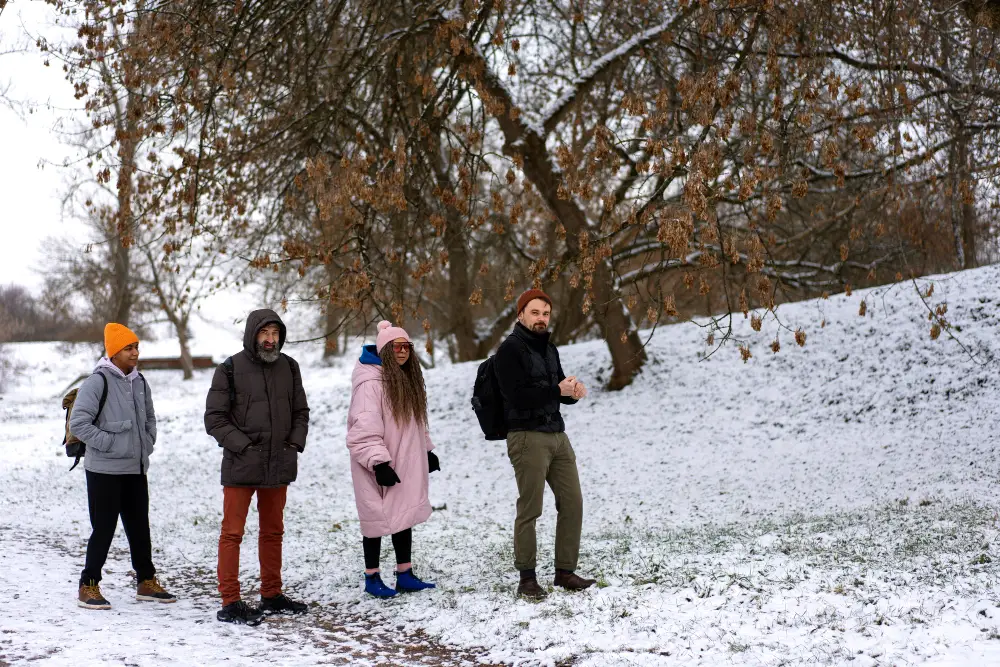
I used to believe that my life ended at ten forty-five on a Tuesday in April, in a kitchen that smelled of orange juice and disappointment, with a blizzard pressing itself against the windows like something that had been waiting to be let in.
I know now that it didn’t end there. But I didn’t know it then, standing in the snow outside my parents’ house with my daughter pressed against my chest and the sound of the deadbolt still sharp in my ears. Then, it felt very much like an ending. It had all the qualities: the finality, the cold, the particular quality of silence that follows a door closing on a person who has just been made to understand that they were never quite welcome inside it.
My name is Olivia Brooks, and for the first twenty years of my life I was a ghost in a house that belonged to other people’s ideas about respectability.
The Brooks Residence operated on a principle I understood before I could name it, which was that love was a transaction and that the terms were renegotiated daily based on performance. My father, Thomas Brooks, had built his reputation the way certain men build reputations, carefully and at significant cost to the people around him, converting every social interaction into a ledger entry, every family decision into a statement about who the Brookses were to the world. He ran a consulting firm with a good address and a better logo, and he spoke about his family the way he spoke about his business, in terms of presentation and return.
My mother had understood this arrangement and had made her peace with it in the way that people make peace with arrangements they cannot change, which is to say she had stopped noticing it. She maintained the house, maintained the social calendar, maintained the careful performance of a family that was doing well. She was not a cruel woman, I thought, until the night I learned that cruelty does not require intention. It only requires the decision not to interfere.
Ashley was the sun the household organized itself around. Three years older than me, beautiful in the particular way of people who have always been told they are beautiful and have therefore never had to develop anything in its place. She was not unintelligent, but she was incurious, which in our house was not a flaw because the house did not reward curiosity. It rewarded the appearance of success, which is a different skill and one Ashley had mastered completely.
I was the complication. Quiet where Ashley was bright, interior where she was social, already by age twelve the kind of girl who noticed things her parents had not planned for her to notice: the tension in my father’s jaw when bills arrived, the way my mother’s smile changed quality depending on who she was performing it for, the gap between what was said at the dinner table and what was meant. I had been enrolled in the Future Scholars Program at fourteen by a teacher who recognized in me something the house had been trying to train out, which was an appetite for knowing how things actually worked.
Dr. Rebecca Morgan, who ran the program, told me once that I had the mind of a philosopher and the heart of a leader, and I had held those words so carefully, turning them over for months the way you handle an object that you are afraid might not survive being touched too often. I had not been told anything like them before.
Then, at fifteen, I got pregnant.
I will not perform the confession or the shame of it because the shame was never actually mine. It was assigned to me and I wore it for years and then I set it down, and the setting down was one of the better decisions of my life. What I will say is that the pregnancy produced in my parents a response that I could not have anticipated, which was relief. Not the relief of people who were worried and then reassured, but the relief of people who had been waiting for a justification and had finally found one. My father’s face, when my mother told him, had the quality of a man who has been building a case and has just been handed the piece that completes it.
I was allowed to stay. This was how it was framed, as an act of generosity, as though the alternative had been seriously considered and the decision to permit my continued presence in my childhood home was a gift being extended, one that I should receive with appropriate gratitude. The Future Scholars Program was ended, quietly and without discussion. Rebecca Morgan called twice; both times my mother told her I had transferred to a specialized facility. I did not know this until years later. At the time I knew only that the call never came, and I understood this to mean that even Rebecca, who had said the things about my mind and my heart, had found me not worth following up on.
The terms of my staying were the terms of a ghost. I occupied space rather than living in it. I was a lesson being administered to anyone who might be watching, a cautionary exhibit, a demonstration of what happened to girls who made the wrong choices. I worked shifts at a grocery store two bus rides from the house and paid for my own groceries and covered a portion of the utilities. I was present at family dinners when required and invisible at other times. Mia was five years old and had not yet learned to be a ghost. This was the problem.
The night of the blizzard, she was thirsty.
It was the kind of April storm the city sees once a decade, forty-mile-an-hour winds and the snow coming sideways and the news channels running continuous weather coverage because there was nothing ordinary about it. Mia had woken up at ten-thirty and I had carried her to the kitchen because she was half asleep and thirsty the way small children are thirsty in the night, completely and immediately, a need that admits no deferral. I poured her a small glass of orange juice because juice was what was in reach, and her hands were clumsy with sleep, and the cup slipped.
The juice hit the Persian silk rug that my mother kept in the kitchen entryway, the rug that had come from her own mother and that occupied in the household a significance disproportionate to its dimensions. In a house where image was infrastructure, the rug was load-bearing.
My father did not come into the kitchen; he arrived, the way certain people arrive in spaces they believe they own, occupying the threshold with the quality of a verdict being delivered. My mother followed in the practiced way of someone who has learned to position herself at the shoulder of authority. Ashley stood behind them in a designer blanket she had taken from the hall closet, and her face had the particular expression of a person who has been anticipating something and is now watching it occur.
I was on my knees scrubbing at the rug with a dish towel, Mia crying behind me, when my father said he was done.
His voice was not loud. It was worse than loud. It was the voice of someone who has made a decision and is no longer interested in the conversation that precedes it. He said he was done raising my mistake. My mother said something about the rug being a wounded soldier and about how the house was for people with futures. I kept scrubbing. I said it was just juice. I said I would work extra shifts. I said please.
Then I noticed the bags. They were already packed, standing near the mudroom door, my things and Mia’s, assembled with a efficiency that told me this had been planned. Not improvised in response to the juice, but arranged in advance of it, waiting for the catalyst. Any catalyst would have done. The juice had been convenient.
My father took my house key. He twisted it off my ring with the practiced motion of someone who has rehearsed the gesture, and the metal pressed a line into my palm before it was gone, and then the door opened and the blizzard came in, and then we were outside and the door closed and the lock clicked, and Mia was crying into my neck and the snow was immediate and serious and the windows of my parents’ house were dark.
I buckled her into the car with hands that would not steady. I started the engine and drove toward a destination I had not decided on because there was no destination, there was only away, and away was its own direction in that moment. My phone had gone into the slush when I dropped it. The car had bad tires and worse luck. The visibility was close to nothing.
The headlights appeared without warning. The impact was soft as these things go, a scrape and a thud, the world tilting and then settling, and when I looked up a woman was stepping out of the other car into the swirling snow, her shape resolving as she approached my window.
I braced for the anger because anger would have been appropriate and I had no ability to manage it. What I received instead was a gloved hand tapping gently on the glass.
“Are you alright?”
Her voice was calm with the specific quality of someone who is choosing calm rather than feeling it, someone who has assessed a situation and decided that calm is what it requires. I rolled down the window and the cold came in and I told her I was sorry, that I would pay for it, and she leaned closer to look at Mia in the backseat clutching her stuffed rabbit, and then she looked at me, and the streetlamp caught the line of her jaw and the intelligence in her eyes, and I felt the world reorganize itself around a recognition I was not prepared for.
“Olivia?” she said. “Olivia Brooks?”
Dr. Rebecca Morgan had aged in the five years since I had seen her, but in the way of people who age well, the years adding depth rather than diminishment. She was still the woman who had told me what my mind was capable of, and the fact of her presence in that parking lot in that blizzard on that specific night was so improbable that I registered it first as a hallucination and then as something else, something that required a category I did not yet have.
She did not ask for explanations. She pointed to a nearby lot and said follow me and I followed her, and twenty minutes later we were in her house in the university district, the kind of house that has been organized around work and thinking rather than around the appearance of having done well, books on every available surface and the smell of cedar and old paper and the particular warmth of a space that has been genuinely lived in. Mia was wrapped in a quilt and given cocoa, and I sat at a wooden table that had hosted a thousand late-night grading sessions and told Rebecca the truth because the truth was all I had left that hadn’t been taken.
She listened. When I finished, she told me to stop saying I was a burden. She told me I had not disappeared because I had failed but because I had been silenced. She told me she had spent months trying to find me and my parents had told her I had moved to a specialized facility, which is how I learned, five years late, that the silence I had understood as abandonment had been engineered.
Then she told me what we were going to do.
The two years that followed were the years of the ledger, which is how I thought of them, the long columns of debt and payment, of hours worked against hours studied against the impossible math of raising a child while becoming someone. I worked four o’clock shifts at a grocery store, stocking shelves in the fluorescent quiet of the early morning, my back doing things that backs are not designed to do indefinitely, and then I picked up Mia and we went to the library. Rebecca navigated the financial aid system with the precision of someone who knows exactly where the doors are and exactly how to hold them open, and I walked through each one she showed me.
Community college at twenty felt like arriving at a party that had started without you and discovering that the party was actually for you, or for people like you, the ones who had not come through the expected channels. I was not the oldest person in my classes but I was among the few who had arrived with a child and a night job and the specific focus that comes from understanding exactly what failure looks like up close. I calculated gas money to the Friday deadline. I ate lunch at my desk to avoid the cafeteria cost. I rewrote papers at two in the morning after Mia was asleep, the table lamp low, the apartment quiet with the specific quiet of a space that is yours and only yours, that no one can take a key from.
The ghosts of the campus hallways found me before I found them. Women with strollers in the corners of lecture halls, men with the look of people who have not slept since a previous semester, all of us managing parallel lives that the institution had not been built for. The professor who told Jasmine that personal choices had academic consequences was speaking in the voice of my father, the voice that converts circumstance into character, that reads difficulty as deserving, that mistakes the hardness of a path for evidence that the person on it should not be there.
I told Jasmine not to drop the class. I told her we would fight it. The Student Parent Support Network began as a list of names and a shared pantry and a babysitting exchange, people helping each other navigate the bureaucracy of an institution that had not designed itself with their existence in mind. It became something larger because it needed to be, because the invisible population of the campus was not small and what it needed was not charity but visibility and infrastructure.
The newspaper article found its way back to the Brooks Residence, which I had expected. The comment from the account I recognized was signed a concerned relative and described my history of instability and the family I had abandoned, and I printed it out and pinned it to my corkboard next to Mia’s drawings because I had learned by then that the things meant to diminish you are more useful as reminders than as wounds. They had tried to keep me dark. The darkness had not held.
The lawsuit was a different instrument, more precise, designed not to win but to drain. Visitation rights to a grandchild my parents had pushed into a blizzard at five years old, the legal framing of it requiring a sustained dishonesty that I imagine cost them something even if they never acknowledged the cost. I walked into the preliminary hearing with a clear account and the specific steadiness of someone who has nothing to perform because the truth is sufficient. I told the judge about the temperature of the air and the sound of the lock and the way Mia had looked at her own hands. The case was dismissed within the hour.
In the corridor outside, my father caught my arm. His grip was the grip I remembered, proprietary, the grip of someone who believes that proximity to a person constitutes a claim on them. He told me I was a stocking clerk with a hobby and that they could wait because they had more resources than I had days in my life.
I told him to come to graduation. I told him to bring his best suit for the cameras. He laughed, and the laugh had in it every assumption he had ever made about what I was worth and what I was capable of, and I pulled my arm free and walked away.
The day itself arrived with the particular quality of days that have been anticipated so long that the reality of them feels slightly displaced from the anticipation, both more and less than the imagining. I stood backstage in my regalia with sweating palms and a heart that was conducting itself at its own tempo, and I looked out at the front row where Rebecca was holding Mia’s hand, Mia in a yellow dress the color of the particular defiant brightness she had always been, and then I looked further into the crowd and saw them.
My parents had come. They were in the middle section, already uncomfortable in the specific way of people who have arrived somewhere they believed they had a right to and have begun to sense that the right may not be recognized. My mother was performing the expression of a proud parent for the benefit of the people in the surrounding seats. My father had his chin at the angle he used when he was performing dignity. Ashley sat beside them with her phone and her boredom and the expression of someone completing an obligation.
The Dean introduced me and I walked to the podium and twenty thousand people went quiet in the way that large crowds go quiet when they have decided to receive something.
I did not speak about success in the conventional sense. I spoke about the orange juice and the sound of the deadbolt and the blizzard and the woman who tapped on my window with a gloved hand and asked if I was alright. I spoke about Jasmine in the bathroom with the paper towel and the professor who had mistaken her circumstances for her character. I spoke about the student parents who had taken exams while their children slept in the hallways and worked three jobs to pay for a single credit and had been called distracted and burdened when they were the most focused and powerful people in the institution.
And I spoke about the people who think they can silence a life because it doesn’t fit their aesthetic. I said they could lock the door and take the keys and try to rewrite the past in a courtroom, but they could not stop the sun from rising.
I said my name: Olivia Brooks. I said I was a graduate and a mother and no longer a ghost. And the roar that came back was not polite applause but the physical force of something that had been held and was now released, the sound of twenty thousand people recognizing something true.
From the podium I watched my parents try to leave. The crowd was standing, pressing in, the energy of the moment blocking their exit as completely as if the stadium had physically rearranged itself around them. They were trapped in the recognition of what they had done, witnessed by the same community whose good opinion had always been the architecture of their self-regard, and the performance of proud parenthood they had come to collect had become instead a very public indictment.
Ashley found me afterward in the space between the stage and the reception. She looked different from the sister I remembered, the smugness replaced by something hollower and more honest. She told me about my father’s firm, the investigation, the misappropriated funds, the years of using the family’s reputation to cover losses he could not afford to acknowledge. She told me the house was going to be lost.
She told me she had known, the night of the blizzard, that they were planning to put us out. She had known and said nothing because she was afraid they would do the same to her.
I had expected this admission to produce anger. What it produced instead was the specific exhaustion of learning that a thing you had suspected was true, the tiredness of having been right about something you had hoped to be wrong about.
She pressed a keychain into my hand: a miniature silver book, the prize I had won in the Future Scholars Program at fourteen, the year before everything changed. She had taken it from the trash the night I left and kept it for ten years, she said, without quite knowing why.
I looked at the small silver book and felt the distance between the girl who had won it and the woman holding it now, and the distance was not loss but accumulation, every year of it present in the weight of the thing in my palm.
She said she was leaving. She was going to a friend’s apartment in the city. She was going to try to be a person.
I asked if Mia hated her. She did not know her well enough to hate her, I said. And I did not have room in my life for hate, because hate takes up space that I had allocated to other things.
Ashley left into the crowd of black robes and I watched her go, and the feeling that remained was not triumph. It was quieter than triumph. It was the particular feeling of a chapter that has run to its natural length and has ended.
The months after graduation moved with the quality of things that have been worked toward for so long that their arrival feels like returning to a place you have always known rather than arriving somewhere new. I was appointed Director of Student Family Services, a position created partly because of the data the SPSN had produced, the statistics on retention and GPA that made the case that supporting student parents was not charity but investment. I had a salary and a health plan and a small apartment with good light and plants on the windowsills that grew without being asked to.
The call from the hospital came on a quiet Tuesday evening. My mother had suffered a stroke. My father was in custody pending bail. There was no one else to call.
I sat in my living room for a while with the silver book keychain in my hand, feeling the weight of the decision the situation was presenting. Not whether to go, because I had already decided that, but what it meant that I had decided it, and what the deciding said about who I had become.
The hospital room had the smell of all hospital rooms, antiseptic over something older and harder to name. My mother was small in the bed, smaller than the woman who had stood over me in the kitchen with the rug between us like an accusation. The stroke had taken her right side and most of her speech, and what remained was a face that looked, without the performance of disapproval to organize it, simply tired.
My father sat in the corner in a wrinkled suit, the architecture of his authority gone, an old man in a bad chair who had run out of the things that had made him what he was.
He said I had come. His voice cracked on it, and I think he meant for the cracking to be an appeal.
I told him I had not come for him. I told him I had come because I was not him.
My mother reached out with her left hand, the only one she had, and said my name in pieces, the syllables loosened by the stroke into something halting and unfamiliar. She said sorry. It came out as a syllable and a half, effortful, the word taking visible work to produce, and I watched her produce it and I did not feel the rush of emotion I had imagined for years when I imagined this moment. I felt something quieter and stranger: a profound, clear pity for two people who had spent their lives building a fortress and had ended up alone inside it.
I told them I had arranged a social worker. I told them the house was being liquidated and there would be enough after the legal costs for a modest assisted living facility for my mother. I had signed the papers. I told my father that he had the world he had built and I suggested he find out whether it was sufficient to keep him warm.
Then I walked out into the autumn night, the air crisp with the specific quality of early fall, leaves catching the light under the streetlamps, and I drove home.
Mia was on the sofa with a stack of library books and a request for grilled cheese, which was how Mia received difficult days, by continuing to be exactly herself, a quality she had possessed since infancy and that I had come to understand as not inherited but chosen, a daily decision to be present in the world as she actually was rather than as it required her to be.
We made the grilled cheese and ate it at the kitchen table and she told me about her book, an illustrated history of astronomy, and I listened to her describe the distances between things, the vast unreachable intervals of space, with the full attention she always commanded simply by speaking.
A week later, the early-season storm arrived. The wind woke me at two in the morning with the quality of an old sound, something familiar from the archive of bad nights, and I lay still for a moment assembling the present from the past, locating myself correctly in time. My apartment. My bed. My key on the hook by the door.
Mia appeared in my doorway with her quilt, the one Rebecca had given us the night of the blizzard, worn soft now from a decade of use.
“Is it going to be like the bad night, Mommy?”
I moved to make room for her and she climbed in beside me and I wrapped the quilt around us both. The apartment was warm. The refrigerator was full. The door had a deadbolt and I had the only key, and the key meant safety now and only safety, the sound of it final in the good way, the sound of a world that was ours and that no one was waiting outside of.
“No, baby,” I said, and kissed the top of her head. “It’s just weather.”
She fell asleep quickly, the way children do when they are safe, completely and without negotiation, and I lay awake for a while listening to the storm outside doing what storms do, which is to be temporary and loud and to pass.
I thought about Rebecca tapping on my window with a gloved hand, asking if I was alright in the middle of a blizzard. I thought about Jasmine with the paper towel in the bathroom. I thought about the invisible population of every campus and every institution, the people managing parallel lives in the margins of systems built for someone else, the ones for whom a flat tire or a sick child was the difference between a semester and the end of a semester.
I thought about the silver book on my key ring, which I had carried since the graduation, alongside my apartment key and my office key and the key to the old university library where I still worked late sometimes when the work required it.
I had won the silver book at fourteen for an essay on the philosophy of second chances. I had not known then what I was writing about. I knew now.
The blizzard had not ended my life. The deadbolt clicking into place had not been the final period on a sentence I wasn’t allowed to finish. They had been the beginning of the only education that ultimately counted, which was the one I had given myself in the years that followed, built from the materials available, from Rebecca’s kitchen table and the grocery store shelves and the community college classrooms and Jasmine’s paper towel and twenty thousand people standing in a stadium roaring at something true.
You build what you have to build from what you have. This is not an inspirational principle. It is simply a description of what people do when they have no alternative, and it produces, over time, something sturdier than what was taken from them, because it is entirely their own.
The storm passed before morning. By the time Mia woke up, the city outside was white and quiet and the sun was already starting to move through it, and the light on the snow had the quality it always has after a difficult night, which is the particular brightness of things that have been cleaned by weather and are now simply themselves.
We had grilled cheese again for breakfast because Mia requested it, and I made coffee, and we sat at the kitchen table in the warm apartment with the plants on the windowsills growing without being asked to, and outside the window the day was beginning.
My name is Olivia Brooks. I am the Director of Student Family Services at a university that did not know it needed me until it saw what I built. I am a graduate, a mentor, a mother, and the daughter of a woman who reached out a trembling hand in a hospital room and said sorry in pieces, and of a man who will have to find out whether his reputation can keep him warm.
I am also the woman who presses the grilled cheese flat in the pan the way Mia likes it, who knows the library’s early hours by heart, who carries a tiny silver book on her keyring because it belongs there now, less as a relic of a girl she used to be than as a record of what that girl was always going to become.
The blizzard was not my ending. The deadbolt was not my exile.
They were the beginning of a life built entirely by my own hands, from the stones thrown at me, and the view from here is clear and wide and mine.

Ethan Blake is a skilled Creative Content Specialist with a talent for crafting engaging and thought-provoking narratives. With a strong background in storytelling and digital content creation, Ethan brings a unique perspective to his role at TheArchivists, where he curates and produces captivating content for a global audience.
Ethan holds a degree in Communications from Zurich University, where he developed his expertise in storytelling, media strategy, and audience engagement. Known for his ability to blend creativity with analytical precision, he excels at creating content that not only entertains but also connects deeply with readers.
At TheArchivists, Ethan specializes in uncovering compelling stories that reflect a wide range of human experiences. His work is celebrated for its authenticity, creativity, and ability to spark meaningful conversations, earning him recognition among peers and readers alike.
Passionate about the art of storytelling, Ethan enjoys exploring themes of culture, history, and personal growth, aiming to inspire and inform with every piece he creates. Dedicated to making a lasting impact, Ethan continues to push boundaries in the ever-evolving world of digital content.