I had been counting the days for four months.
Every morning overseas started the same way, with the thought of walking back through my front door and holding my newborn daughters for the first time. That thought was the engine of everything. It got me through the bad nights and the long days and the particular grinding tedium of the final weeks before rotation ended, when you are close enough to home that the waiting becomes almost physical.
My mother had sent me a photograph of the twins the week before. I had looked at it more times than I could count. I kept it folded in the breast pocket of my uniform for the entire flight home, and I had taken it out and unfolded it so many times that the crease had gone soft and the paper had developed that worn, velvet quality of something that has been handled with love.
I hadn’t told my wife Mara about my leg.
I want to be clear about the reasoning, because it is easy to misread. Mara and I had lost two pregnancies before she got pregnant with the twins. I had watched what those losses did to her each time, the way grief settled into her differently than it settled into me, heavier and more systemic, reaching into everything. When the injury happened during my final deployment, I made a deliberate choice. She was pregnant. The pregnancy was holding. She needed to stay calm and safe and as far from fear as I could keep her. The news that her husband had lost his leg was not something she needed while she was still fragile.
I told exactly one person. Mark, my best friend since we were twelve years old. He cried on the phone when I told him and said, “You’re going to have to be strong now, man. You’ve always been stronger than you think.”
I believed him completely.
At a small market near the airport I found two hand-knitted sweaters in yellow, because my mother had written to tell me she was decorating the nursery in yellow. I bought white flowers from a roadside stall because white had always been Mara’s favorite. I did not call ahead. I wanted to surprise her. I imagined the door opening, her face, the girls, all of it arranged in my mind like a photograph I had been developing for months.
The drive from the airport felt like the longest thirty minutes of my life, and I spent most of it smiling.
I pulled into the driveway and sat for a moment, then got out and walked up to the porch with the flowers in one hand and the sweaters tucked under my arm. Something felt wrong before I even touched the door. No light in the windows. No television, no music, none of the particular domestic noise of a house with two new infants in it.
I pushed the door open.
The walls were bare. The furniture was gone. Every surface of the home I had memorized from a photograph had been stripped away, and the rooms were just empty rooms.
Then I heard crying from upstairs.
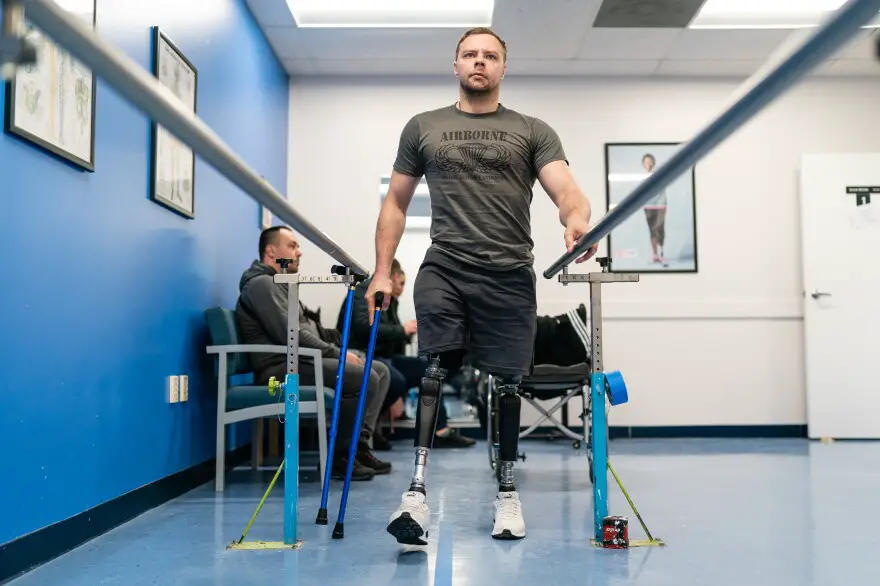
I moved up as fast as I could manage, pain moving through my prosthetic with every step. The nursery door was open. My mother was inside, still in her coat, one baby pressed to her shoulder, the other lying in the crib. She looked up when I came in and started crying immediately, her eyes going from my face down to my leg.
“Arnie.”
“Mom. What happened? Where’s Mara?”
She kept saying she was sorry, telling me how Mara had asked her to take the girls to church, said she needed some time alone, and when my mother came back the house was like this.
I saw the note on the dresser.
One line locked everything into place.
“Mark told me about your leg. And that you were coming to surprise me today. I can’t do this, Arnold. I won’t waste my life on a broken man and changing diapers. Mark can give me more. Take care. Mara.”
I read it twice. Some things require a second pass before the brain accepts them.
Mark had not just told her. He had handed her a reason to leave, information I had trusted him with in confidence, used to clear the way for himself. He was the only person I had trusted with the truth. He had decided it was worth sharing.
I put the note back on the dresser.
I picked up Katie, who was still crying, and I sat down on the floor with my back against the crib. My mother put Mia in my other arm without saying a word, and the four of us sat in the nursery with its yellow walls, me on the floor with my back against the furniture and both my daughters against my chest.
I didn’t fight any of it. I let all of it hit at once, the betrayal, the emptiness of the house, the weight of the sweaters still tucked under my arm, the white flowers I had dropped somewhere downstairs. My mother put her hand over mine and did not speak.
I don’t know how long we were there.
At some point both girls cried themselves into the heavy, still sleep of exhausted infants. They became warm weight against my chest, and I looked at their faces in the yellow light of the nursery.
“You are not going anywhere, sweethearts,” I told them, out loud, even though they couldn’t understand a word of it. “Neither am I.”
The next three years were the most demanding and the most defining of my life, and I mean both of those things equally.
My mother moved in for the first year. We developed a rhythm between the two of us, managing the girls and the house and the thousand daily logistics of infant care with the focused efficiency of people who have no choice but to figure it out. I learned to move through the world differently than I had before, and that process of adapting, of solving the daily physical problems the prosthetic created, started generating something I had not anticipated.
The joint mechanism in my prosthesis was functional but inefficient. It worked, but not well enough. It caused pain and slowed me down in ways that accumulated over a day into genuine limitation. So I started thinking about how to fix it. I began sketching ideas at the kitchen table after the twins were asleep, on whatever paper was available, in whatever spare hour the evening gave me. Small ideas at first, then more specific ones, then drawings detailed enough to mean something.
I filed the patent alone. I found a manufacturing partner who understood what I was building. The first prototype worked better than I expected. The second one was the one that mattered.
I signed the contract with a company that specialized in adaptive technology, and I did not give interviews or make announcements or turn any of it into a story. I had two daughters who needed their father present and a business to build. I had no interest in being the kind of story other people tell about themselves.
By the time the twins were old enough for preschool, the company was real. We moved to a new city. The girls started school. I went to work in a building with a view of the river and spent my days doing the unglamorous, steady work of building something from the ground up.
One Wednesday afternoon my secretary knocked on my office door and handed me an envelope that my business partner had sent, documents related to a property the firm had identified as suitable for a project I had approved weeks earlier. I opened it at my desk. Reviewed the address, the square footage, the terms.
Then I read the former owners’ names.
I read them twice. Then a third time.
Of all the properties in the city.
I folded the document, put on my jacket, and drove to the address. I did not rush. I drove quietly, thinking about nothing in particular, understanding as I drove that I was not walking into something I didn’t know. I was the one who knew. For once, completely and entirely, I was the one who knew.
When I arrived the movers were already there. A van in the driveway, men carrying boxes marked in black, furniture accumulating on the lawn in the afternoon light.
Mara was on the porch steps in old clothes, arguing with one of the movers in the clipped, rising tone of someone who understands on some level that they have already lost and cannot stop themselves from fighting it anyway. Mark was beside her, saying something she wasn’t listening to, his shoulders bent in a way I had never seen on him when we were young and everything came easily.
I sat in the truck and watched them for a moment. Long enough to understand what they had become to each other. Then I got out, straightened my jacket, and walked to the door.
I knocked.
Mara opened it a moment later and looked at me like I was something she had seen in a dream and couldn’t place. Then recognition arrived. She went completely still.
Mark heard the silence from somewhere behind her and turned.
He had less of a reaction than she did. Mostly he looked like a man who has been expecting something unpleasant to show up and has simply underestimated the timing.
“Ar. Arnold?” Mara said.
I looked at the mover nearest the door. “How much longer?”
He checked his clipboard. “Process is finalized, Sir. We’re just clearing the remaining items.”
I turned back to them.
“This property belongs to me now,” I said, and let the silence settle around it.
They stood there while it landed. Mara’s hands were shaking. Mark was very still. He looked at me with the expression of a man assembling an explanation and finding that none of the pieces fit.
I told them the outline. Not everything, but enough. The sketches at the kitchen table. The patent. The contract. The company and what it had become. The quiet, unglamorous accumulation of work that I had been doing for three years while they had been building something else entirely.
Mara’s eyes moved to my leg. Then she asked what I had known she would eventually ask.
“I made a mistake, Arnie. I was wrong. Our daughters. Can I see them? Just once?”
I looked at her without raising my voice.
“They stopped waiting for you a long time ago,” I said. “I made sure they didn’t have to.”
The movers kept working behind us, the sound of boxes and footsteps filling the space between us.
Then Mark spoke. His voice had that particular quality of someone who has rehearsed several versions of a speech and is now improvising because none of them feel right.
“It wasn’t supposed to go like this, man. Things just didn’t work out. I made some bad calls. I thought I had it handled.”
Mara turned on him with the exhausted fury of two people who have been assigning blame to each other for long enough that it has become reflexive. “Don’t start. You promised me this would work. You said you had it figured out.”
I had nothing more to say to either of them.
“There’s nothing left here,” I said. “For any of us.”
“Arnold, wait.” Mara’s voice followed me as I turned. “Please. You can’t do this. This is our home.”
Mark took a step forward, something desperate moving behind his eyes. “We’ll figure something out, man. Just give us time. Don’t throw us out like this.”
I didn’t answer either of them. I walked to the truck and got in and closed the door.
I sat there for a moment, looking at the house through the windshield. Then I picked up my phone and called the lead mover.
“I need the keys by five.”
A pause. “Understood, Sir.”
I started the engine and drove home.
When I got there, the girls were at the kitchen table with my mother, their heads bent close together over their coloring, crayons scattered everywhere, laughter coming out of them in small bursts the way it does when children are completely absorbed in something. I stood in the doorway for a moment and just watched.
My mother looked up. “How was your day, Arnie?”
“Never better, Mom,” I said.
That was a month ago.
The property that had belonged to Mara and Mark was repurposed into a residential retreat center for injured veterans. Therapy rooms, a garden, a workshop space where people with adaptive limb needs could work through problems the way I once worked through mine at a kitchen table after the kids were asleep. I did not name it after myself. I did not want a monument. I wanted a place where people who had lost something could learn they were not finished.
I heard eventually how things went for Mara and Mark. I will not go into the details because the details are theirs. Some things do not need revenge. They only need time to arrive at their own conclusions, and time is remarkably reliable about that.
What I have is this. The company, still growing. My mother, who stayed longer than the first year and shows no particular signs of leaving, which suits everyone. Two daughters who are five years old and full of opinions about everything, who color at the kitchen table and argue about crayons and climb onto my lap without warning and fall asleep against my shoulder in the car on the way home from places we went together.
They do not remember waiting for someone who did not come. I made sure of that early and I have made sure of it every day since.
On the floor of a yellow nursery, with both of them against my chest and my mother’s hand over mine, I made them a promise they couldn’t understand.
I have spent three years keeping it.
I intend to spend the rest of my life doing the same.

Sophia Rivers is an experienced News Content Editor with a sharp eye for detail and a passion for delivering accurate and engaging news stories. At TheArchivists, she specializes in curating, editing, and presenting news content that informs and resonates with a global audience.
Sophia holds a degree in Journalism from the University of Toronto, where she developed her skills in news reporting, media ethics, and digital journalism. Her expertise lies in identifying key stories, crafting compelling narratives, and ensuring journalistic integrity in every piece she edits.
Known for her precision and dedication to the truth, Sophia thrives in the fast-paced world of news editing. At TheArchivists, she focuses on producing high-quality news content that keeps readers informed while maintaining a balanced and insightful perspective.
With a commitment to delivering impactful journalism, Sophia is passionate about bringing clarity to complex issues and amplifying voices that matter. Her work reflects her belief in the power of news to shape conversations and inspire change.