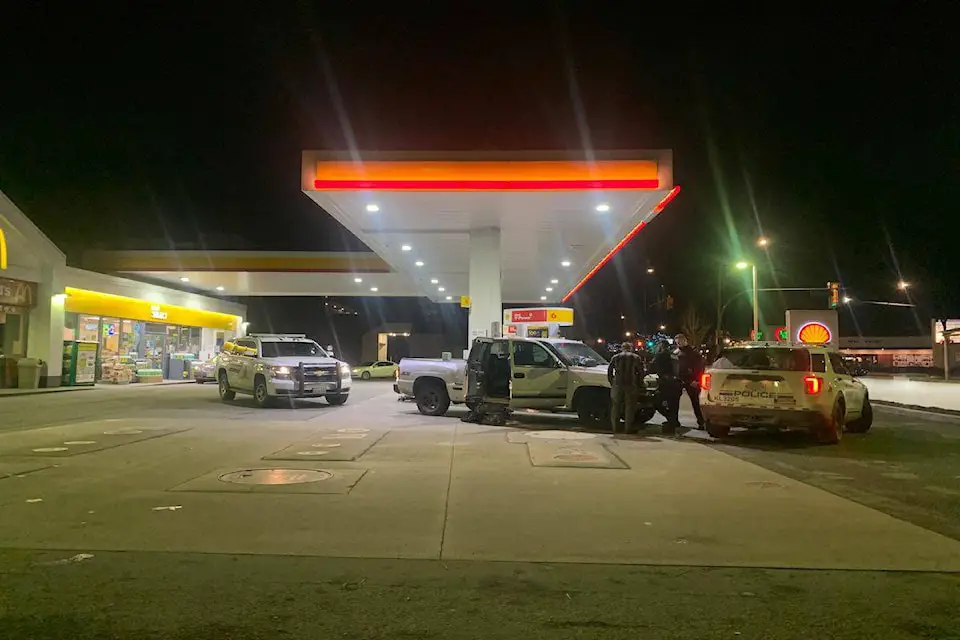
My name is Ross, and I work the late shift at a gas station off Highway 52.
That is not how I would have described myself ten years ago. Ten years ago I would have told you I was a factory man. Twenty-three years on the floor, the kind of work that gets into your hands and stays there, that you can feel in your shoulders on Sunday mornings when the week has been long. Benefits. A pension I was building slowly and carefully the way you build things when you understand they take time. A life that did not make for interesting stories but felt solid under your feet, the way a floor feels when you stop noticing it because it has never once given way.
Then one morning we clocked in like always, and by afternoon there were locks on the gates. A single piece of paper taped to the fence said the company was filing for bankruptcy. Twenty-three years, gone between one shift and the next, as cleanly and completely as if none of it had ever been real.
I spent months looking for something comparable. I sent out resumes until my printer ran out of ink twice. I knocked on doors and made phone calls until my voice gave out, then rested it overnight and started again the next morning. The younger guys got picked up quickly, absorbed into other facilities, other industries, other futures that had room for them. At my age, the good jobs were not interested, and the options that were available paid barely enough to cover the gas it took to get there. I have a wife named Lydia, two kids who grow out of their shoes faster than I can replace them, and a mortgage that still feels oversized for a house that is honestly too small for us. We needed income. I took the night shift.
So that is where I am. Highway 52, fluorescent lights that flicker when the weather changes, the persistent smell of roller grill hot dogs even at two in the morning when the machine has been off for hours. The same three songs cycling on the radio until you stop registering them as music and they become more like a variety of silence, just a different texture of background than the buzz of the lights. Most nights it is just me and the truckers who need coffee and a bathroom, and the occasional teenager buying energy drinks, and the long stretches of nothing in between where I restock and clean and listen to talk radio and wait for the shift to end.
I would be lying if I said I had made peace with it entirely. Some nights I stand behind that counter and think about the version of my life where the factory stayed open and feel the particular weight of things that did not go the way they were supposed to go. But most nights I am just tired enough to be practical about it, and tiredness is its own kind of acceptance.
That particular night started like all the others. Truckers around nine, a pair of them who knew each other from the road and stood by the coffee machine talking for twenty minutes before either of them moved toward the register. A teenager at ten, energy drinks and beef jerky, the standard order. Then quiet, the way it gets reliably after ten-thirty when the road empties out and the world seems to contract around the cone of light from the station.
I was restocking cigarettes behind the counter, half-listening to a talk radio program that I could not have summarized if someone had asked me, when the door chimed.
It was eleven-thirty.
She came in carrying a sleeping child on her shoulder, a little boy whose arms hung loose around her neck with the particular limpness of deep sleep, that boneless quality children have when they have gone completely under. She moved with the careful slowness of a mother keeping her steps soft, navigating the door and the threshold and the turn into the aisle with the deliberate attention of someone for whom waking this child would mean a significant additional cost she could not afford.
Her hair was pulled back in a messy ponytail, the kind that starts the day neat and comes apart over the hours. Her gray sweatshirt had stains on the sleeve. She was wearing sneakers that had been walked in hard and often. But it was her eyes that I kept coming back to, even as I tried not to stare, even as I went back to my restocking and let her move through the store in peace. Her eyes had that hollow quality that comes when tired has gone past tired into something more fundamental, something that is not about sleep anymore but about the weight of things.
She moved slowly down the aisles, one arm looped under the boy’s bottom to support his weight, the other reaching out for things with careful deliberation. She picked up a small carton of milk. A loaf of white bread. A pack of diapers. She put nothing extra in her arm, nothing beyond the immediate and necessary. There was something in the economy of her selections that told me she was not browsing. She knew exactly what she needed and she had calculated exactly what she could carry without waking him.
When she came to the counter she set everything down gently, one item at a time, managing the sleeping boy’s weight the whole time. He stirred when she shifted him but didn’t wake. I scanned the items without making a production of it.
“Fourteen seventy-two,” I said, keeping my voice down.
She went into her purse with one hand, the boy balanced on her other arm, and I watched her face while she looked. There is a specific expression that crosses a person’s face when they are counting money they already suspect is not enough, a tightening around the eyes and mouth, a controlled quality to the breathing, the expression of someone holding themselves very still around a fear they do not want to let out in public. She pulled out bills, crumpled ones and fives, and counted them on the counter. Then she counted them again.
Then she looked up at me.
“I’m short four dollars,” she said, barely above a whisper. “Can I put the diapers back?”
I did not think about it. That is the honest truth. There was no moment of deliberation, no weighing of my own situation against hers. The words came out before any of that could happen.
“It’s fine,” I said. “I’ve got it.” I took four singles out of my wallet and laid them in the register. “It’s late. Just get home safe, okay?”
She stared at me for a moment with an expression I could not entirely read, something that was recalibrating itself behind her eyes. Then she nodded, quickly, grabbed the bag with her free hand, and went out into the cold without another word.
Through the window I watched her pull the boy closer to her chest as she walked to her car, an old sedan that looked like it had been in service long past its intended retirement. She got in carefully, buckled the boy in without waking him, and pulled out of the lot.
Then she was gone, and the station went quiet again, and I went back to restocking, and the talk radio kept talking, and the lights kept humming, and the night continued the way nights do.
The following week passed without incident. Shifts blending into shifts, the commute home in the dark, Lydia keeping a plate warm on the nights I was late, the kids asleep by the time I got in so that I only saw them in the mornings before school when everyone was too tired and too rushed for much conversation. We did not talk about money much anymore, Lydia and I, because talking about it just made it feel heavier and we both already knew the exact weight of it without having to describe it to each other.
It was the Thursday after when Mr. Jenkins called me into his office.
He is a decent man, my manager, the kind of person who runs a gas station off a highway with more quiet dignity than the job description might suggest. Mid-fifties, steady, fair. He had his arms crossed when I came in, leaning against his desk, and my stomach did something unpleasant in the half-second before he spoke because crossed arms in a manager’s office rarely precede good news.
“Ross,” he said, “did you cover someone’s groceries last Friday night?”
My face went warm immediately. I started running through it, whether four dollars constituted a violation of some policy I had skimmed past in the employee handbook, whether the transaction had flagged something in the register system, whether this was about to become a problem I genuinely could not afford. “Yeah, I did,” I said. “I’m sorry if that was against the rules. I paid for it out of my own pocket and put the money in the register myself, so the drawer balanced, it wasn’t—”
He held up his hand and shook his head. “That’s not why I’m asking.” He turned and picked up a white envelope from his desk and held it out to me. “This came for you this morning. Your name’s on the front.”
I took it. My name was written across the front in neat, careful handwriting. No return address. No other markings.
“Go ahead and open it,” Mr. Jenkins said, watching me with the particular patience of someone who already knows what is inside and wants to see the face of the person discovering it.
My hands felt thick and clumsy with the envelope. I pulled it open and reached inside and found a folded piece of paper and, beneath it, something I looked at three separate times before I would let myself believe I was reading it correctly.
A check for five thousand dollars, made out to me.
I stood there holding it and read the number again. And then again. The amount did not change.
The note was short, written in the same careful hand as the address on the envelope.
Dear Ross, thank you for your kindness to my daughter Emily. You have no idea how much you helped her that night. She made it home safe because of you. This is a small token of our gratitude. We would also love to have you over for lunch this Sunday if you are willing. Please come. We would like to thank you properly.
There was an address on the other side.
I stood in that office holding the check and the note while Mr. Jenkins watched me, and I could not find a single word. My brain kept returning to the number, kept trying to reconcile five thousand dollars with four, kept arriving at the same place and then losing its footing again. It did not compute in any framework I had available to me.
“Everything alright?” Mr. Jenkins asked eventually.
“I need to go home,” I said.
He nodded and let me go without asking anything more.
I drove home with the envelope sitting on the passenger seat. I checked it at red lights to confirm it was still there. When I pulled into the driveway, Lydia was in the kitchen cutting sandwiches for the kids’ lunches the next day, and she looked up when I came in, and whatever was on my face made her put the knife down immediately and give me her full attention.
I handed her the envelope.
She took out the check. Her hand flew to her mouth.
So I told her everything. The woman, the sleeping boy, the way she had moved through the store, the four dollars, the look on her face when she came up short. I told it in order, the way things had actually happened, without adding anything or taking anything away. Lydia read the note twice and set it on the counter and looked at me, and her eyes were full.
“You have to go on Sunday,” she said. “That’s not a question.”
“Lydia, I didn’t do it for this. I wasn’t thinking about anything except—”
“I know you weren’t,” she said. “Ross. I know exactly why you did it and I know it had nothing to do with getting anything back. That is precisely why you deserve this.” She came around the counter and put her arms around me and held on. “That is the man I married. That is who you are.”
I did not argue with her. I did not have the words to argue even if I had wanted to.
Sunday came faster than I was ready for. I changed my shirt three times, standing in our bedroom holding one shirt and then another, unable to explain exactly what I was nervous about but unable to stop being it. Lydia finally came in and told me to stop fussing and go, that I was going to be fine, that these people had invited me because they wanted to thank me and not for any other reason.
The address took me to a neighborhood I had driven through once or twice without really looking, the kind of place with houses set well back from the road, clean white fences, hedges trimmed so precisely they seemed to announce something about the people behind them. I am not a man who feels intimidated easily, or at least not a man who likes to admit it, but I sat in my car in front of that house for a moment before I got out.
An older couple was already on the porch, standing in that particular way people stand when they have been watching for something to arrive. The woman had silver hair pulled back in a neat bun and she smiled the moment my car door opened, before I had even fully gotten out. The man was tall with broad shoulders and he came down the porch steps with his hand already extended.
“You’re Ross,” he said, the way you say something you already know rather than ask.
“Yes, sir.”
“I’m Robert. This is my wife Margaret. Please, come inside. We’ve been looking forward to this.”
Margaret hugged me on the porch before I had taken two steps, which I had not been expecting and which caught me so off guard that for a moment I just stood there with my arms at my sides before I managed to hug her back. She said thank you against my shoulder in a voice that had more in it than the words could hold.
Inside the house smelled like roast chicken and fresh bread and something sweet underneath, like a cake or a pie. They brought me into a dining room with a big wooden table set for three, good dishes, the kind you bring out for people who matter. We sat, and for a moment none of us said anything. There was a quality to that silence that I recognized from the moments before people say the thing they have been building toward, the gathering of breath.
Robert cleared his throat. “Ross, we want to tell you about our daughter Emily.”
Margaret reached over and took her husband’s hand, and I watched her do it, the automatic reaching, the way two people who have been through hard things together learn to hold onto each other in the moments before the hard things get said again.
Emily had been in a bad marriage. The kind of bad that does not announce itself immediately, that builds slowly and deliberately, that works by increments until the person inside it can no longer clearly remember what things looked like before. Her husband had been controlling. Isolating. The kind of man who separates a person from their family so gradually that by the time the separation is complete, the person is too disoriented and too diminished to clearly identify what has been done to them.
He had kept Emily away from Robert and Margaret for nearly two years. They had barely seen their grandson Daniel during that time, these snatched visits, these carefully managed occasions designed to keep everyone just connected enough that Emily did not feel the full extent of what had been taken from her.
“Something shifted in her,” Robert said. He was choosing his words carefully, the way men do when they are describing something that still frightens them to look at directly. “She found the courage to leave.”
Margaret said, “The night you met her, she was driving home to us. She had left with almost nothing. A bag of clothes. Whatever cash was in her wallet. Daniel asleep in the backseat.” She paused. “She was terrified. She was ashamed. She did not want to call us until she absolutely had to, because calling us meant admitting how bad it had gotten, and she had spent two years protecting us from knowing how bad it had gotten.”
I sat there and did not say anything because there was nothing useful to say yet.
“When she came up short at your register,” Robert said, his voice steady and deliberate, “she thought that was it. That was the moment everything was going to fall apart before it had even started. She thought she would have to put things back, that she had failed at the very first step of trying to start over, that she could not even get home without falling short. And then you helped her.” He paused. “You did not ask her to explain herself. You did not make her feel like a problem. You just helped her and told her to get home safe.”
Margaret’s voice broke a little on the next part. “When she got here that night she could not stop crying. She kept telling us about the gas station man who told her to get home safe. She said it felt like the first time in years that someone had treated her like a human being instead of a burden. She said those words specifically. Not a burden. A person.”
I sat with that for a moment.
The particular weight of it. That four dollars and get home safe had been, to this woman on the worst night of a very bad several years, the first evidence in a long time that the world outside her marriage was not going to treat her the way her marriage had treated her.
“We sent that check because you deserved it,” Robert said. “You helped bring our daughter and our grandson home. You gave her dignity at the exact moment she had run completely out of it.”
I shook my head. “I can’t take that kind of money for something that small. I was just doing what anyone would do.”
Margaret looked at me with the gentleness of someone who has thought about this longer than I have. “But not everyone did,” she said. “You did. There were presumably other people in that store, or there had been people through that register all night, and you were the one who helped her. That is not nothing. That is not small.”
We sat at that table for hours. They told me about Daniel, about his laugh, about the drawings he had started making since arriving at their house, the way children expand back into themselves when the pressure lifts. They told me about Emily, about how she was doing, about the slow and nonlinear work of helping someone put themselves back together after that kind of marriage. I told them about the factory closing, about the night shifts, about the mortgage and the shoes and the way Lydia and I had stopped talking about money because the silence was easier than the conversation. They listened to all of it like every word was worth the time it took to say, and that particular kind of listening, the kind that does not rush you or look for the exit, is something I had not experienced from strangers in longer than I could easily remember.
When I finally stood to leave, Margaret hugged me again at the door. “You’re a good man, Ross,” she said. “Don’t let the hard years make you forget that.”
I drove home through streets that were quieter than they had been on the way there, the Sunday afternoon settling into Sunday evening, and I thought about the gas station and the fluorescent lights and the woman moving carefully down the aisle with her sleeping boy, and I thought about how entirely ordinary that moment had felt to me, how I had gone back to my restocking immediately afterward without much thought, how the four dollars had been such an inconsequential number from where I was standing.
And how it had been everything from where she was standing.
Lydia was on the couch when I got home, a book open in her lap that she had not been reading, waiting for me the way she waits, quietly and without making a production of it.
“How was it?” she asked.
I sat down beside her and took her hand and told her. All of it. Emily, the marriage, the night drive with Daniel asleep in the backseat, the four dollars, what it had meant. Lydia listened the way she always listens, without interrupting, without rushing me toward the point.
When I finished she was quiet for a moment. Then she said, “You gave what you had, and the world gave it back.”
“I didn’t do it to get it back.”
“I know you didn’t,” she said. “That’s the whole point.”
I kept the check for two days before I finally deposited it. Part of me kept expecting something to go wrong with it, some error to surface, some phone call from a confused bank representative. But it cleared. And it helped us in concrete, immediate ways that I am not too proud to name. We caught up on the bills that had been stacking up at the edges of our budget for months. We fixed the car, which had been making a sound I had been choosing not to investigate because investigating it meant finding out what it cost. We bought the kids shoes without doing the subtraction first, which sounds like the smallest thing in the world and felt, in the moment, like something close to extravagance.
But what has stayed with me longer than any of that is something Margaret said on the porch as I was leaving.
She said that the small acts of decency, the ones we do without stopping to calculate them, those are the ones that show who we actually are. Not the ones we perform when we want to be seen doing them. The ones that happen automatically at eleven-thirty at night when nobody is watching and there is nothing to gain and someone just needs four dollars and a word that treats them like a person.
I still work the night shift off Highway 52. The lights still flicker when the weather changes. The roller grill still smells like it has been running longer than it has. The same three songs still cycle on the radio. Truckers still come in around nine for coffee they will drink while driving and not really taste. Teenagers still buy energy drinks and beef jerky and look at me like I am part of the scenery.
But now, when someone comes to my counter looking like they are being worn down by something I cannot see, I look a little longer. I pay a little more attention. I leave a little more room in the transaction for whatever might need room.
Because the four dollars was never really about four dollars.
It was about eleven-thirty at night, and someone who was exhausted and frightened and running toward something she did not yet know would hold her, and a moment so small I had forgotten it before the door had even swung shut behind her.
And it was the first time in years someone had told her to get home safe and meant it simply, without agenda, without conditions, without anything attached to it at all.
Sometimes that is the whole thing.
Just that, and nothing more.
Just: it’s late, and you are a person, and I hope you make it home.

Lila Hart is a dedicated Digital Archivist and Research Specialist with a keen eye for preserving and curating meaningful content. At TheArchivists, she specializes in organizing and managing digital archives, ensuring that valuable stories and historical moments are accessible for generations to come.
Lila earned her degree in History and Archival Studies from the University of Edinburgh, where she cultivated her passion for documenting the past and preserving cultural heritage. Her expertise lies in combining traditional archival techniques with modern digital tools, allowing her to create comprehensive and engaging collections that resonate with audiences worldwide.
At TheArchivists, Lila is known for her meticulous attention to detail and her ability to uncover hidden gems within extensive archives. Her work is praised for its depth, authenticity, and contribution to the preservation of knowledge in the digital age.
Driven by a commitment to preserving stories that matter, Lila is passionate about exploring the intersection of history and technology. Her goal is to ensure that every piece of content she handles reflects the richness of human experiences and remains a source of inspiration for years to come.