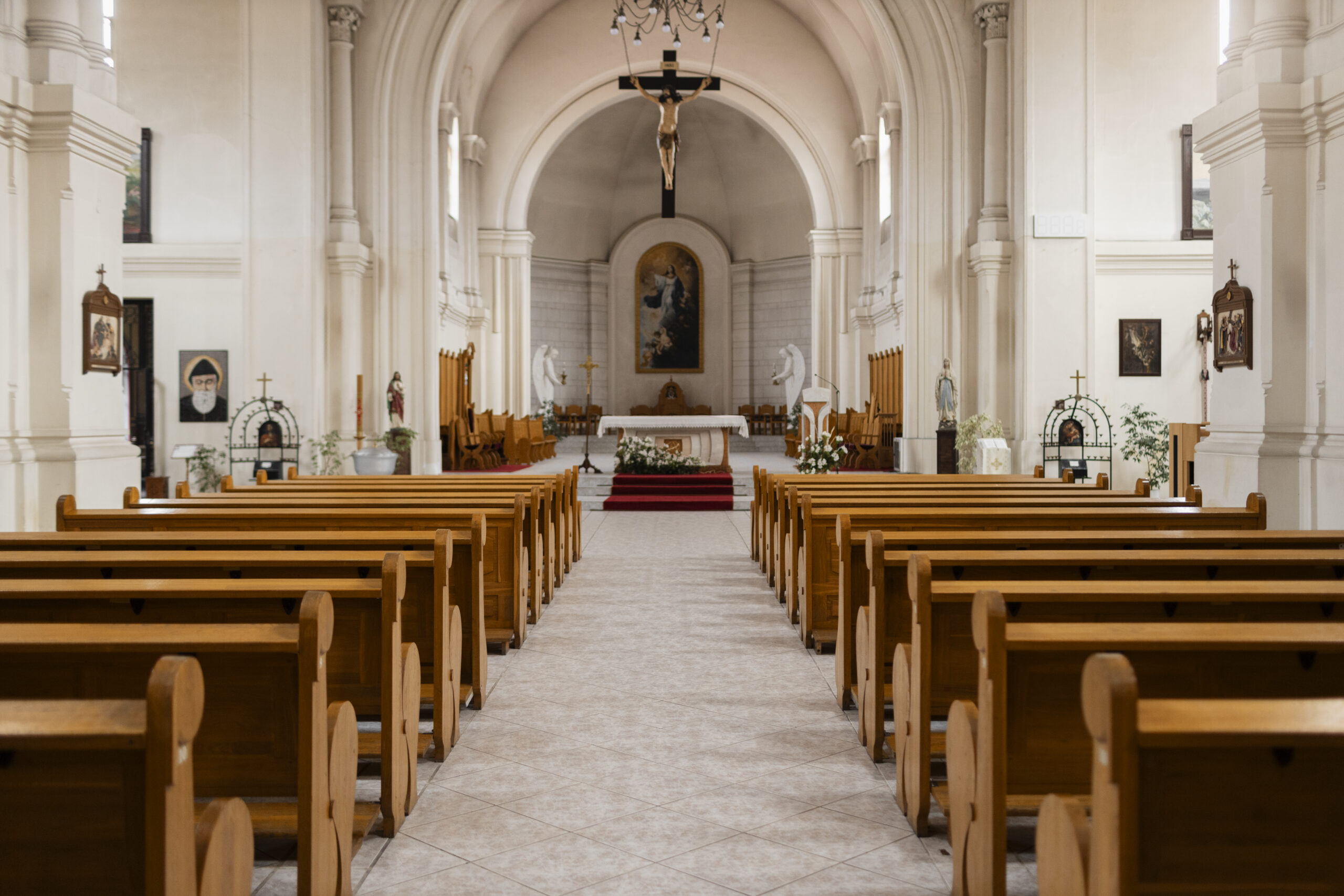
I was four years old when my mother sat me on a mahogany bench inside Saint Agnes Church and meticulously unmade my world.
The memory is not a blur, the way many childhood traumas are said to be. It is a high-definition recording, etched into my subconscious with the permanence of a fossil. I remember the way my patent leather shoes dangled several inches above the floor, kicking rhythmically against the heavy wood. I remember the scent of guttering votive candles and the dry, ancient aroma of hymn books that had absorbed a thousand desperate prayers. Most of all, I remember the yellow glow of winter light straining through the stained-glass saints, casting crimson and azure shadows across my mother’s face as she crouched before me.
Her fingers lingered on the collar of my little blue coat. Her touch was not trembling. It was steady, almost professional. She smoothed the fabric with a terrifying tenderness, as if she were preparing me for a Sunday school recital rather than erasing me from the census of her heart.
“Stay here, darling,” she murmured. “God will take care of you now.”
Then she stood. She didn’t look back with the jagged features of a woman in agony. She turned with a fluid, graceful motion and walked down the long central aisle. My father Richard waited at the vestibule, his hand extended. My older sister Rebecca, then nine years old, held their hands. They moved as a unit, a tight and calcified triad, leaving me as the discarded fourth.
I was too stunned to cry. The betrayal was so absolute that it bypassed the tear ducts and went straight to the bone. I watched the heavy oak doors open. A brief flash of blinding white snow spilled in around their silhouettes.
Then they were gone.
The silence that followed was the first true thing I ever heard.
For hours I sat there. I believed her. I believed God was a literal entity who would step down from the rafters and hold my hand. It was only when the sun dipped below the arched windows and the shadows grew long and predatory that I began to understand. God was silent, and my mother was a liar.
By the time the parish priest found me, shivering and mute on that second-row pew, my biological family was already crossing the state line. They left no note, no name, no forwarding address. They left behind unpaid rent and a disconnected life, ensuring that by the time authorities traced my identity, the trail would be cold enough to freeze my future.
I was a ghost before I had even learned to tie my own laces.
The system attempted to swallow me, as it does with children marked as disposable. I spent six months in the sterile, fluorescent-lit corridors of emergency foster care, a transient guest in houses that smelled of industrial cleaner and indifference.
Then came Evelyn Hart.
She was fifty-seven, a widow with silver-threaded hair and hands that bore the gnarled, honorable scars of a lifetime spent at the piano. She didn’t look like a savior. She looked like a woman who understood the value of a well-tended garden and the necessity of silence. Her home was a small, creaky Victorian that smelled perpetually of lavender sachets and old leather-bound books.
Evelyn did not believe in melodrama. She did not coddle the wound my parents had left behind. Instead, she taught me how to bandage it.
“Some parents leave because they are broken,” she told me one evening while we sat on her porch in the thick sweet air of blooming lilacs. Her arthritic fingers moved rhythmically as she shelled peas. “Some leave because they are fundamentally cruel. But most leave because they are small, and they cannot handle the bigness of another human being’s needs. It is always about them, Mary. It is never about you.”
She became Mom in every way that biology had failed to provide. She sat through my parent-teacher conferences with the ferocity of a lioness. She sat in the front row of every piano recital, her head nodding to the tempo she had taught me. She taught me that family was a verb, something you did, not something you were simply born into.
I built a life from the wreckage. I worked with a quiet, desperate focus, earning a scholarship to a local college and eventually returning to Saint Agnes Church as an adult. I didn’t return out of religious obligation. I returned because that church was the site of my greatest death and my most profound rebirth. I became the Parish Outreach Coordinator, managing the food banks, the immigrant advocacy programs, the Sunday youth groups.
By twenty-four I was a woman of substance, anchored by a community and the unwavering love of Evelyn. I believed I had buried the ghost of that four-year-old girl in the blue coat.
Then came a rainy Thursday in October.
I was standing near the side altar checking ledgers for the winter coat drive when the heavy front doors creaked open. The sound was a trigger I didn’t know I possessed. My heart hammered against my ribs as three figures moved down the aisle.
They were older, their faces softened by gravity and the passage of twenty years. But their gait was unmistakable. The triad had returned.
My mother Elena stopped exactly where she had crouched two decades ago. She looked at me, her eyes filling with tears that felt meticulously rehearsed.
“We’re your parents,” she said, her voice trembling with a terrifying, unearned familiarity. “We’ve come to take you home.”
The sanctuary seemed to shrink, the walls closing in until the air felt like crushed velvet.
“Home?” I repeated. The word tasted like ash. “You walked out of those doors twenty years ago and didn’t look back. You don’t get to use that word.”
Elena took a tentative step forward, her hand reaching out as if to stroke my cheek. I recoiled, sharp and instinctive. Beside her, Richard cleared his throat, his eyes scanning the opulent stained glass rather than meeting mine. He looked like a man who had spent two decades convincing himself he had done nothing wrong.
“We searched for you for years,” he said, his voice a gravelly rasp.
“That is a lie,” I said, cold and surgical. “A detective found you in Ohio a week after you left me. You told him you couldn’t cope and signed the relinquishment papers. Evelyn showed them to me when I turned eighteen. You didn’t search. You fled.”
The silence that followed was heavy, calcified by their shame.
My sister Rebecca stood behind them in a camel-colored wool coat. She was twenty-nine now, her face a mirror of my own, though her eyes were guarded. She had been old enough to understand the abandonment. She had been a participant in the silence.
“Why are you here?” I asked. “What do you want?”
Elena reached into her designer purse and produced a photograph. She held it out with trembling fingers. A little boy, perhaps six years old, his skin the color of parched parchment, lying in a hospital bed surrounded by plastic tubing and the sterile hum of monitors.
“This is your nephew, Jonah,” Elena whispered. “Rebecca’s son.”
I didn’t take the photo. I kept my hands clenched at my sides.
“He has a rare bone marrow disorder,” Rebecca said, her voice flat and brittle. It was the first time she had spoken, and the sound of her made the phantom of the four-year-old girl inside me wince. “The doctors say he needs a perfect match. A sibling or a close blood relative.”
The realization hit me with the force of a physical blow.
They hadn’t come back because of a sudden awakening of conscience. They hadn’t come back because they missed the daughter they had discarded.
They had come back for tissue.
“You want me tested,” I said, the words falling like lead weights.
“We want to be a family again,” Elena sobbed, clutching her chest in a theatrical display of maternal agony. “We want to heal the past. This is God’s way of bringing us back together.”
“Do not use the name of God in this house to justify your greed,” I said. “You didn’t come back for me. You came back for a spare part. You want my marrow, but you don’t want my soul.”
Elena flinched as if I had struck her. “How can you be so cruel? He’s an innocent child.”
“I was an innocent child,” I replied, pointing to the second-row pew. “I sat right there in my red tights and my blue coat and I watched you smile as you walked away. Where was your mercy then?”
Before they could respond, the heavy click of footsteps echoed from the side corridor. Father Michael stepped into the light. He looked at the trio with an expression of profound, weary disappointment.
“I think this conversation should continue in my office,” he said, his voice a low thunder. “Now.”
The office was small, smelling of lemon polish and old parchment. We sat in a tense circle, the atmosphere thick with unspoken accusations.
“Before we proceed,” Father Michael began, folding his hands atop his desk, “I must address the letter the parish received from a law firm on your behalf last week.”
I felt my blood turn to ice. “A law firm? You didn’t just show up. You planned this.”
Elena looked down at her lap, picking at a loose thread on her sleeve. Richard stared at the wall.
“The letter,” Father Michael continued, “described you as estranged parents seeking compassionate mediation with a daughter who had been placed outside the home during a period of economic hardship. It omitted the formal abandonment report. It omitted the fact that you refused reunification services three times over the course of two years.”
“Placed outside the home?” I rasped. “You left me on a bench like a bag of unwanted clothes.”
“We were told that language would be easier,” Rebecca muttered, her gaze fixed on the floor.
“Easier for whom?” I said. “For your reputation? For the hospital board? You wanted a church and a priest to provide a veneer of forgiveness so I wouldn’t be able to say no. You wanted the sanctity of this place to act as a cage.”
Father Michael leaned forward, his voice dropping to a dangerous quiet. “Why was this young woman contacted through her place of employment and faith rather than through private counsel? If the concern was purely medical, why the theater?”
“We thought she’d be more receptive here,” Richard admitted, his voice devoid of whatever bravado he had arrived with.
They had weaponized my faith. They had looked at my life of service and seen a weakness to exploit. They believed that because I helped the poor and the broken, I would be a soft target for their brand of emotional terrorism.
I looked at the photograph of Jonah on the desk. He was innocent. He was a victim of the same lineage of coldness that had tried to claim me. I could see my own eyes in his, that same wide, searching look of a child wondering why the world was so loud and so painful.
“I will do the test,” I said, the words feeling like a betrayal of my own survival.
Elena let out a sound of triumph, reaching across the desk to take my hand. I pulled back.
“I am doing this for the boy,” I said, my voice steady. “Not for you. There will be no family dinners. There will be no coming home. After the results are in, you will leave this parish and never speak my name again. Do you understand?”
Rebecca looked up, her eyes flashing with sharp resentment. “You’re really going to be that bitter? After all these years?”
“Bitterness is a slow poison, Rebecca,” I replied. “What I feel isn’t bitterness. It’s a boundary. I am a stranger to you. I am simply a donor you haven’t bought yet.”
The week that followed was a fever dream of sterile clinics and invasive questions. I moved through the world like a somnambulist, my body a battleground for a family I had long ago buried.
I sat in a cold examination room at Mercy General, watching the nurse draw vial after vial of my blood. The sharp sting of the needle felt honest compared to the cloying, fake sentimentality of my mother’s daily phone calls.
She didn’t ask how I was. She didn’t ask about Evelyn. She spoke of destiny and God’s plan. She spoke of the room they had always kept ready for me, another lie, as they had moved four times in the last decade.
“We’re so close, Mary,” she whispered into the phone one evening. “I can feel it. You’re going to save him, and we’re going to be whole again.”
“I am already whole, Elena,” I told her, my voice weary. “I was made whole by a woman who chose me. You are just a ghost haunting a hospital wing.”
The results arrived on a Tuesday morning. Father Michael insisted on being present. We gathered in a small consultation room, the air thick with the scent of ozone and anxiety.
The doctor looked at the chart. He looked at Rebecca, then at me.
“I’m sorry,” he said. “The markers don’t match. Not even for a secondary donation. Mary is not a compatible donor for Jonah.”
The silence that followed was absolute. The silence of a failed investment.
Elena didn’t cry out in grief for her grandson. She didn’t reach out to comfort Rebecca. She turned to me, her face contorting into a mask of pure, unadulterated fury.
“You did this on purpose,” she hissed.
I stared at her. “I gave my blood. I gave my time. You cannot bargain with biology, Elena.”
“You were always the difficult one,” she continued, her voice rising to a shriek. “You’ve held onto this bitterness for twenty years and now it’s calcified your very blood. You’re letting your nephew die because you want to punish us.”
“That is enough.” Father Michael stood so abruptly his chair struck the wall with a hollow thud. “You will leave this hospital this instant, or I will have security escort you out and personally ensure the authorities are notified of your harassment.”
Richard grabbed Elena’s arm and pulled her toward the door. She looked back at me one last time, her eyes cold and dead.
“You’re no daughter of mine,” she said.
“I know,” I replied, my voice a calm, steady anchor. “I haven’t been for twenty years.”
Three weeks later, the bells of a different church in a different town tolled for Jonah.
I stood in the very last row, hidden behind a stone pillar. I didn’t go for the adults. I went because that little boy deserved to have one person in the room who saw him as a child rather than a pawn. I watched from the shadows as my parents performed their grief, Elena draped in black lace, Richard dabbing at his eyes with a silk handkerchief. Masters of the aesthetic of loss.
After the service, I walked toward my car in the quiet of the cemetery. The air was crisp, the leaves turning the color of rust and dried blood.
“Mary.”
I turned. Rebecca was standing a few yards away. She looked hollow, her camel coat replaced by a black one that seemed to swallow her whole. She wasn’t crying. She looked like she had finally run out of script.
“He’s gone,” she said, her voice a flat, dead thing.
“I am so sorry, Rebecca. Truly.”
She looked at the grave, then back at me. “Mom sent you a voicemail, didn’t she? After the test results?”
“She did.”
“She told me it was your fault. She said if you had stayed connected to the family, the markers would have stayed aligned.” Rebecca swallowed. “She’s not well, Mary.”
“She is exactly who she has always been,” I replied. “A woman who cannot accept the consequences of her own choices, so she creates villains out of the people she hurts.”
Rebecca took a shaky breath, her eyes filling with genuine, unmanaged sorrow. “I should have taken your hand that day. In the church. I was nine. I knew what they were doing. I saw the suitcases in the trunk. I saw the way Mom didn’t look at you.” She paused. “And I just held her hand instead. I chose them.”
It was the first honest thing a biological member of my family had ever said to me.
It didn’t heal the wound. But it acknowledged the scar.
“You were a child, Rebecca. You were surviving them, just as I had to.”
“I’m still surviving them,” she whispered. “And now I have nothing left.”
“You have the truth,” I said. “It’s a cold thing to hold, but it’s the only thing that won’t lie to you.”
I turned and walked away. I didn’t look back. I didn’t wait for a plea or an apology. I had spent twenty years waiting for the doors of that church to open.
Now, I was the one closing them.
I drove back to the small Victorian house that smelled of lavender and old hymns.
Evelyn was at the piano, her stiff fingers moving through a slow, contemplative Chopin nocturne. She didn’t stop playing when I entered. She simply nodded, the music filling the spaces between us.
I sat on the bench beside her, the same way I had once sat on that church pew twenty years ago. But this time my feet reached the floor. This time I wasn’t waiting for a miracle.
I was living one.
“They are gone, Mom,” I said, the word settling into the room like something returned to its rightful place.
“I know, Mary,” she murmured, her eyes fixed on the sheet music. “They were never really here.”
People like my biological parents believe that blood creates a permanent lien on a soul. They believe that because they provided the DNA, they own the destiny. They think home is a place you can reclaim like lost luggage, that you can walk back through the same doors twenty years later and simply announce the repossession.
But they are wrong.
Home is not a bench in a church. It is not a law firm’s letter or a biological match or a room someone claims to have kept ready when they moved four times in ten years. Home is the person who stays when the lights go out. It is the woman who shells peas on a porch and tells you that you are enough, exactly as you are, and means it without calculation or condition.
When they walked into Saint Agnes and said we’ve come to take you home, they didn’t know that I had been home for twenty years already. They looked at my life of service, my faith, my community, and they saw softness they could exploit. They didn’t see what was actually there, which was a woman who had survived them.
It has been a year since the funeral. My life at the parish continues. We have expanded the food bank. We have built a sanctuary for runaway teenagers. I spend my days helping people who have been discarded find their footing, showing them that the world is bigger than the people who broke them.
I never heard from Elena or Richard again. I heard through the grapevine that Rebecca finally moved away, building a life outside the gravitational pull of our parents’ narcissism. I hope she finds her own Evelyn. I hope she finds something that stays.
Sometimes, when the church is empty and the sun is setting, I sit on that second-row pew. I look at the doors. I remember the flash of white snow and the weight of the silence, and the sound of my own small shoes kicking rhythmically against the heavy wood while I waited for a miracle that arrived twenty years later in the form of a woman with arthritic hands and a house that smelled like lavender.
I am not bitter. I am not angry. I am simply a witness to my own survival.
A family is not a bloodline. It is an architecture of choice. A house built stone by stone through the simple, radical act of staying.
I stood up from that pew, smoothed the fabric of my coat, and walked toward the altar.
I had work to do. I had a life to lead.
And for the first time in my existence, the silence wasn’t a void.
It was a peace.

Specialty: Legal & Financial Drama
Michael Carter covers stories where money, power, and personal history collide. His writing often explores courtroom battles, business conflicts, and the subtle strategies people use when pushed into a corner. He focuses on grounded, realistic storytelling with attention to detail and believable motivations.