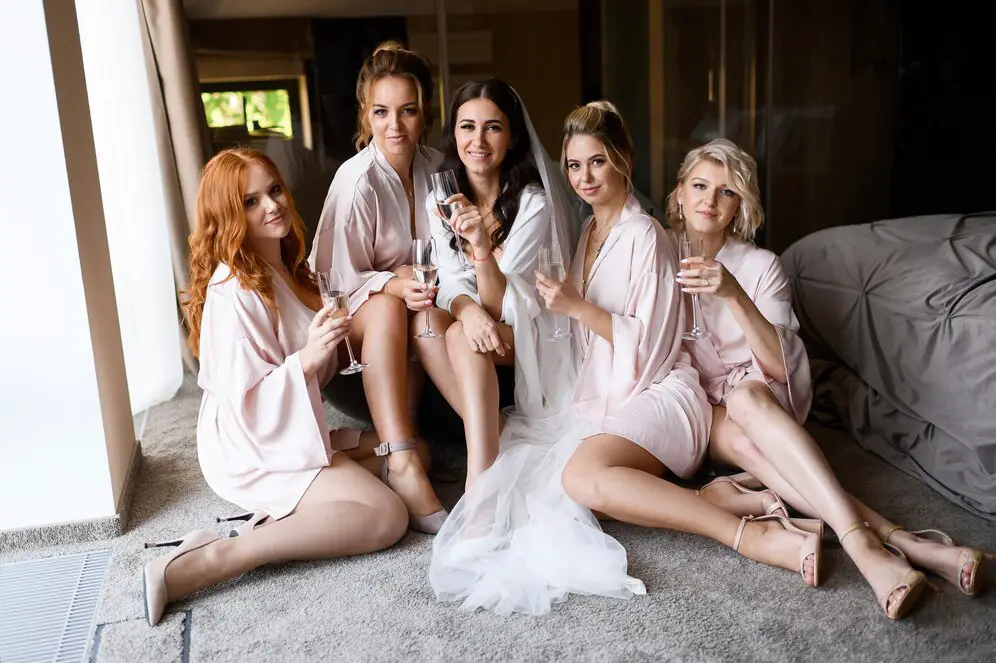
The bridal suite at the Whitlock estate smelled like expensive perfume and something artificial underneath it — synthetic vanilla pumped through the ventilation, the kind of scent designed to make you feel like money without actually having to earn it.
I stood in the doorway with my canvas duffel cutting a red line into my shoulder.
The room was a soft, curated blur of movement. Seven women in matching silk robes the color of lavender at dusk clinked crystal champagne flutes and laughed in the practiced way of people who know they’re being watched. Every robe had a name embroidered on the breast pocket.
Mine didn’t.
My sister Sloan didn’t look up from the makeup chair. She just lifted one freshly manicured finger and pointed toward the back hallway.
“Yours is in the back,” she said, checking her reflection.
I shifted my grip on the bag and walked down the hall. The heavy floral scent died the moment I turned the corner, replaced by the sharp chemical bite of industrial bleach. My staging area wasn’t a suite. It wasn’t even a room. It was a linen closet — twenty square feet of damp mops, a yellow plastic bucket of floor cleaner, and a rusted water pipe overhead.
Hanging from that pipe was my dress.
Neon orange. Size 2XL. The fabric caught the dim light like a construction zone tarp. I reached out and rubbed it between my fingers. Fine-grit sandpaper would have felt softer.
Out there, seven women were stepping into flowing lavender silk that cost more than a month’s rent.
In here, my family had left me a joke.
I’m Emma Clark. I’m thirty-three years old and I hold the rank of Captain in the United States Army Corps of Engineers. I have cleared minefields in places where the temperature swings sixty degrees between noon and midnight, where the ground itself is trying to kill you. I have written casualty reports. I have made decisions in the dark that I will carry for the rest of my life.
I stood in that closet and I did not cry.
Crying is a tactical error. It blurs your vision.
I dropped to one knee, unzipped my duffel, and reached past the combat gauze and tourniquet to the bottom pouch. Three heavy-duty steel safety pins. I stood up, grabbed the massive folds of neon fabric at the small of my back, twisted the cheap polyester brutally tight against my spine, and drove the first pin through the layers.
Snap.
Second pin at the waist.
Snap.
Third pin below the ribs.
Snap.
I turned back to the cracked mirror bolted to the closet door. The dress was still an offensive, blazing orange. It still looked like a hazard sign. But it wasn’t a garbage bag anymore. I squared my shoulders, back straight, chin parallel to the floor, and locked into the posture that had carried a sixty-pound ruck across the desert.
I pushed the closet door open and walked back into the suite.
The giggling died the moment I appeared. Seven heads snapped toward me. My mother, Diane, was standing behind Sloan pinning a diamond tiara into her blonde curls. She caught my orange reflection in the vanity mirror and froze.
I raised a steady arm and pointed at the rolling rack in the corner. Two spare lavender dresses hung in garment bags, untouched.
“Hand over one of the backups,” I said. No inflection. No negotiation.
Diane turned slowly. She looked me up and down — not with guilt, not with embarrassment. With cold, calculating annoyance, like I was a stray dog begging at the table.
“Don’t ruin your sister’s day, Emma,” she said. “Just wear it. Nobody’s going to look at you down there anyway.”
Down there. The back of the room. The designated blind spot.
I looked past her. My Uncle Rick was leaning against the mini bar with a glass of whiskey and a sick little smirk. Enjoying the show.
Then I looked at my father, Glenn. He was standing at the floor-to-ceiling window with his back to the room, staring at the cloudless Virginia sky, pretending to check the weather. His shoulders were rigid. He heard every word.
He did nothing.
I gave Diane a slow, dead-eyed nod. I turned on my heel and walked out.
In the quiet hallway, my right hand dropped to my side. My thumb found the long scar running up my left wrist — thick, uneven, a permanent physical record of what this family had already cost me. I pressed my fingernail into the raised tissue and let the dull ache ground me.
Then I straightened up and kept walking.
I had been a direct deposit to this family for years before I understood that’s what I was. At twenty-two, deployed to a forward operating base in temperatures that dropped below freezing at night, I ate tasteless MREs in a concrete bunker and slept with my muscles locked, waiting for the perimeter alarms. Every month, the Army compensated that low-grade terror with hazard pay.
I didn’t keep a dime of it.
Diane called on a scrambled satellite line, voice cracking with panic. The bank was threatening the house. Sloan’s university tuition had a gap. I authorized a transfer — fifteen thousand dollars, earned by freezing in a guard tower with a rifle in my hands — and I did it because I believed the fear in my mother’s voice.
Three semesters later, Sloan dropped out. Not failed out. Chose to leave. Diane said the academic environment was too toxic for her mental health. My parents defended her. She needs time to find herself.
She found herself in Cancún. I know because she posted the pictures. Designer sunglasses, a faux fur coat, overpriced drinks on a white sand beach — all of it funded by my hazard pay. Not once during that deployment did Sloan call to ask if I’d slept. Not once did my mother call to ask if my unit had taken casualties.
I wasn’t a daughter. I was a direct deposit.
Three years ago, Grandmother Ruth had a massive stroke. The family accounts were suddenly empty. Diane’s back was too weak to lift a grown woman. Glenn had mandatory overtime at the hardware store. So I filed for a compassionate reassignment, pulled myself off the promotion track, and came home.
For three years my life shrank to the size of a sterile back bedroom that smelled of iodine and stale antiseptic. I rolled an eighty-pound woman every two hours to prevent bed sores. I cleaned up human waste. I spoonfed pureed food while the mechanical ventilator hissed and clicked in the corner. I ran between military training drills and emergency room visits.
Sloan visited twice.
The first time she stood in the doorway holding a clipboard, refusing to step close to the bed because the room smelled like a hospital. She wanted my signature on a cosign for a new SUV. I was holding a soiled bedpan in gloved hands. I told her to get out.
The second time was the funeral. She arrived twenty minutes late in a designer black dress with a plunging neckline, took one look at the extended family gathered around the casket, and collapsed into my uncle’s arms, wailing about how close she and Grandma Ruth had always been.
She stole the grief. She hoarded the pity.
I stood in the back row in my service uniform with dry eyes. I had done my crying at three in the morning on a bathroom floor while washing out soiled sheets. There was nothing left.
The ceremony passed in a blur of rehearsed vows and manufactured tears. I stood at the far edge of the altar like a glowing hazard sign somebody forgot to remove, holding a bunch of pale, wilting hydrangeas with brown edges — Diane had made sure even the flowers assigned to my coordinates were already dying.
During the photography session, the photographer positioned the seven lavender bridesmaids, then looked at me and sighed.
“Step behind the groomsman,” he said. “You’re pulling focus.”
I stepped back. He tried again. Lowered the camera. Shook his head.
“Step out of the frame. Let’s get the core family first.”
Core family.
The words hit the humid Virginia air and just hung there. I looked at the front row. Diane adjusted the lace on Sloan’s veil and gave the photographer a tiny, satisfied nod. Mission accomplished.
I looked at Glenn. He was staring at the toe of his polished leather shoe, shifting his weight from foot to foot.
He let a hired stranger erase his eldest daughter from the bloodline, and he did it while inspecting his own shoe.
I nodded once — a sharp, mechanical movement — turned my back on the core family, and walked to the far edge of the lawn to stand in the shade of an ancient oak. The temperature dropped ten degrees. I crossed my arms and watched.
I counted thirty-two shutter clicks.
Thirty-two frames of documented history where Emma Clark did not exist.
In the military, when you’re pushed out of the primary engagement zone, you don’t sit down and cry. You shift to reconnaissance.
I began scanning the perimeter.
My eyes swept past the photographer and Diane’s triumphant smile, past the VIP seating near the cocktail patio, and stopped on a woman sitting alone in a high-backed rattan chair. Margaret Whitlock. Seventy-nine years old. Matriarch of the groom’s family. The woman who held the financial reins of the entire Whitlock dynasty. She wore a tailored charcoal suit that had nothing to prove to anyone.
She wasn’t watching her grandson. She wasn’t watching the beautiful bride.
Her head was turned completely to the side. Her eyes — sharp and predatory as a hawk’s — were locked dead onto the shade of the oak tree where I was standing.
She lifted her pearl-topped cane one inch off the ground and brought it down against the stone paver.
Clack.
Lifted it again.
Clack.
A deliberate, calculated signal.
The cocktail reception moved to the outdoor patio. I took a glass of ice water and stood behind a lattice wall covered in white roses, listening to what I couldn’t see.
Sloan’s voice carried over the soft jazz. That high, sugary register she only used when she wanted something.
“It wasn’t easy,” she was saying. “I paid my own way. Community college first, then I transferred. I worked double shifts at a diner. I never got a single handout.”
My grip tightened around the glass.
She was reciting my life. My late nights. My tables wiped down at closing. My cheap textbooks while she was in Mexico. Word for word, detail for detail, she was wearing my history like a costume.
An older Whitlock woman sounded impressed. “Daniel mentioned you run a consulting firm now. Structural engineering?”
“NC State,” Sloan said, voice dripping with fake humility. “I built the firm with a partner. We spent years over blueprints, calculating load-bearing capacities. It’s tough work for a woman in this industry, but I built it from the ground up.”
She had never touched a drafting table in her life.
I stepped around the rose partition and blocked her path.
She jumped at the flash of orange.
I kept my voice low, a flat rasp pressed through my teeth. “Structural engineering. You don’t know the difference between reinforced concrete and mud brick.”
For one fraction of a second, genuine panic crossed her face. Then it vanished, replaced by a cruel, calculated smirk.
“Look at yourself, Emma,” she sneered. “You’re standing here in a giant sweaty orange tent. You’re making up crazy stories again. This is exactly why nobody takes you seriously.”
A hand clamped down on my left arm before I could respond. Manicured fingers dug into my tricep through the cheap fabric. Diane — materializing from the crowd, dragging me backward with a wide plastic smile plastered across her face for the surrounding guests.
She threw me into a dark alcove near the kitchen service doors. Released my arm. Stepped into my personal space.
“Shut your mouth,” she hissed. The mask completely off. “Shut it right now.”
“She’s claiming my degree. My company.”
“And who’s going to believe you?” Diane leaned in closer. “I already handled it. I had a long talk with Daniel’s parents last night. I told them you came back from your deployment with severe PTSD. I told them you suffer from delusions. I told them you have a history of making things up because you’re pathologically jealous of your sister.”
The air went out of me.
Gaslighting. The ultimate psychological kill shot. She had paved the road for this exact moment. Any word from my mouth would be written off as the paranoid rambling of a broken soldier. If I screamed, I proved her right. If I caused a scene, I gave them the evidence they needed to have me removed.
“So go ahead,” Diane whispered. “Open your mouth. Let’s see who the Whitlock family believes. The beautiful successful bride, or the deranged hallucinating sister in the hideous dress.”
She smoothed down her silk dress, turned her back on me, and walked back into the sunlight.
I stood alone in the damp alcove. My chest heaved. The blood pounded in my ears.
A normal person might have run screaming into that patio. A normal person would have let the civilian rage take over.
I am not a normal person.
I am an Army captain.
Screaming is for victims. Strategy is for soldiers.
The enemy had just handed me their entire battle plan. And by stripping away my family ties, they had removed every rule of engagement I’d been operating under. I owed them absolutely nothing. No loyalty. No silence.
I walked straight back into the dining hall.
Table 14 was in the far back corner, practically pressed against the swinging kitchen doors. Every time a waiter pushed through, the rusted hinges screeched and blasted hot, greasy air that smelled like industrial dish soap and burnt fat. None of my blood relatives sat there. My family was at the head table under a crystal chandelier.
I was seated with third-tier business associates and people who had been invited out of corporate obligation. They stared at their phones and talked over my head.
I was a ghost in a neon orange hazard suit.
I sat down. Both feet flat. Shoulders squared. Hands flat on the cold tablecloth. The caterers dropped plates of filet mignon in front of everyone. I didn’t touch my fork. I wasn’t going to consume a single calorie paid for by fraud.
A shadow fell across my table.
Daniel. The groom. He had walked from the head table all the way to the kitchen doors, and he stood beside my chair with an expression that made the acid rise in my throat. Not malice. Pity. The suffocating, airless pity reserved for someone who can’t help themselves.
“Sloan told me about your mental state,” he said, keeping his voice gentle. “The trauma. The episodes. I think it’s incredibly brave that you showed up today. With the crowds and the noise, I know it must be overwhelming.”
He was being kind. He thought he was being kind.
Misguided kindness cuts deeper than an open insult.
He reached out and put a hand on my shoulder.
I rolled it back in one sharp physical jerk and threw his hand off my body. I looked up and locked eyes with him. Cold, dead, empty. Not a single word.
Daniel blinked. The pity shifted to mild alarm. He cleared his throat, patted his jacket, and retreated quickly to the safety of the head table.
I pushed my chair back.
I had reached the limit of what I could absorb without losing the strategic advantage. I needed air. I turned my back on the dining hall — the crystal glasses, the fake smiles, the smell of grease — and walked down the dim carpeted hallway toward the coat check and the parking lot.
I rounded the corner and stopped.
The coat counter was empty.
But sitting in the red velvet accent chair directly blocking the exit was a roadblock.
Margaret Whitlock.
Her back was perfectly straight. Both frail, liver-spotted hands rested on the silver handle of her cane. In the dim light of the hallway, her eyes were scanning me like a targeting system.
She had been waiting.
She didn’t offer a greeting. She didn’t ask how I was doing. She looked at me and said: “You graduated from North Carolina State University. Department of Civil, Construction, and Environmental Engineering. Class of 2017. Is that correct?”
I snapped to attention before I consciously decided to.
“Yes, ma’am.”
The corner of her mouth twitched. “I don’t sign blank checks,” she said. “And I certainly don’t approve a marriage merging with my family without reading the fine print. I run full background checks on everyone.”
She leaned forward on her cane.
“I think you should stay, Captain. You’re going to want to see what happens next.”
It wasn’t advice. It wasn’t a request.
It was a direct order from a four-star general.
I turned around and walked back into the dining hall.
The maid of honor was at the microphone, her champagne flute raised, delivering a tearful speech about Sloan’s remarkable independence, her limitless grit, the life she had built completely from scratch. I sat back down at table 14 and placed my hands flat on the tablecloth and waited.
My knuckles brushed something cold in the crease of the empty chair beside me.
A smartphone in a designer leather case.
Diane’s phone.
She had been sitting there earlier, arguing with a vendor, and she had left it behind. She never bothered with a passcode because she had spent her life believing she was completely untouchable.
A notification lit the screen. A group text titled Clark Girls.
The phone was unlocked.
I swiped it open.
The text chain loaded in a long cascade of blue and gray bubbles, and what I read hit my retinas like physical impact.
Three weeks before the wedding, my Aunt Renee — the woman who used to babysit me, who bought me ice cream when I was seven — had sent a message: What about that neon orange dress on the clearance rack? Get the plus size. It’s massive.
Diane replied within sixty seconds. Perfect. Buy it. It will make that dumpy freak look completely out of place next to the silk. I am not letting her dress better than my daughter today.
I scrolled up.
A message from Sloan: Make sure you tell the photographer to push her out of the frame early. If Daniel’s family asks why she’s hiding in the back, I’ll tell his uncle she has severe PTSD and hates having her picture taken. Let his family see how pathetic and crazy she is. They’ll never believe a word she says.
Below it, an image file. I tapped it.
My college diploma. NC State. Bachelor of Science in Civil and Environmental Engineering. But my name had been blurred out with photo editing software, and Sloan’s name had been typed directly over the university seal.
Just emailed this to Daniel’s uncle for the background check, she had written. Looks totally legit. The Whitlocks think I’m a genius.
I pressed the power button. The screen went black. I placed the phone exactly where I’d found it — back in the crease of the cushion — and sat up straight.
I looked across the dining hall and found Margaret Whitlock in her VIP corner.
I gave her one sharp nod.
She looked back at me without expression.
Then she folded her linen napkin once, twice, into perfect sharp squares. Placed it on the table. And stood up.
The shift in the room’s atmospheric pressure was instantaneous. Every eye broke away from the glowing bride. The event manager near the wall threw a panicked hand signal at the string quartet. The cellist froze. The violinist dragged her bow off the strings with a dying screech.
The music died.
Two hundred people went silent.
The only sound left in that cavernous hall was the rhythmic, deliberate strike of Margaret’s cane against the hardwood floor.
Thump. A step.
Thump. Another step.
She walked with the unhurried pace of someone who has never once needed to rush. No hesitation, no performance. She passed the tables of cousins and college friends and moved toward the kitchen doors — toward the neon orange target in the back corner — like a heat-seeking missile.
Diane saw it happening in real time. Her carefully constructed narrative was unraveling, and she moved to intercept.
She shoved back her chair, practically sprinting around the head table, her silk dress catching on a chair leg, and threw herself into Margaret’s path ten feet from where I sat.
“Mother Whitlock!” Her voice was breathless and shrill in the total vacuum of sound. A wide, desperate smile. “What an honor. Are you coming back to say hello to Emma? I should warn you —” she lowered her voice, but the acoustic bounce of that silent hall carried every syllable to every corner, “she’s a little shy. Her nerves are shot. Her mental state has been incredibly fragile since she discharged. The loud noises here, you know, it triggers her.”
I sat perfectly still. Back rigid against the cheap banquet chair. Hands flat on the tablecloth. I let the lie hang in the air.
Diane reached out a manicured hand to grab Margaret’s forearm. A fake show of familial intimacy, trying to herd the old woman back to the VIP section.
Margaret stopped.
She looked down at the hand hovering near her charcoal sleeve with an expression of such unfiltered, absolute disgust that Diane’s arm stopped moving mid-reach, suspended in the air like she’d hit an invisible wall.
“I am not finished, dear.”
Five words. Low volume. Absolute zero temperature.
Diane physically recoiled. She yanked her hand back and pressed it against her chest. Her mouth opened, but nothing came out. She stood frozen in the middle of the aisle, stripped of every weapon she’d brought to that room, in front of two hundred people.
Margaret stepped around her like she was stepping around debris on a sidewalk.
Thump. Thump.
She stopped at the edge of table 14. Pulled back the empty chair beside me — the chair where Diane’s phone sat wedged in the cushion — and sat down with both hands resting on her cane.
She ignored the crowd. She ignored the sweating event manager. She ignored Diane, who was still standing paralyzed in the aisle.
She looked at me.
“Emma,” she said, her voice carrying the cold, clear weight of a military tribunal. “Sitrep. Right now. Who took care of your grandmother?”
The room held its breath.
I looked at the commander. “I did,” I said. My voice carried clean and clear through the dead silence. “Three years on duty. I pulled a compassionate reassignment. I changed her bedpans. I pureed her food. I monitored the ventilator until the day her heart stopped.”
Margaret nodded once. “The civil engineering degree from NC State. The structural firm in Raleigh.”
“Mine,” I said. No hesitation. “Class of 2017. I co-founded the firm six years ago. We handle commercial steel framing. Current annual revenue is over one point two million.”
The gasp that moved through two hundred people sounded like a vacuum sucking the oxygen out of the room.
At the head table, the microphone slipped out of the maid of honor’s hand and hit the stage with a dull thud.
Daniel stepped away from his bride. His face had gone the color of wet cement. He looked from Margaret’s table to Sloan and said her name — just her name, quietly, the way you say someone’s name when you need the world to stop for a second.
“You told my aunt that firm was yours,” he said. “You told her you pulled the all-nighters.”
The expensive foundation and contouring couldn’t hide the panic flooding Sloan’s face. She gripped the layers of her twenty-thousand-dollar gown, knuckles going white, and when parasites panic, they swing wild and they swing at everything.
“She’s lying, Daniel. Look at her. She’s crazy. She’s been jealous of me her entire life.” Her voice cracked, the sugary register breaking into something high and grating. Then she pointed past me, directly at Margaret. “Your grandmother is senile. She’s seventy-nine years old. She’s confused.”
You do not call the woman who controls a nine-figure trust fund senile.
You do not insult the apex predator in her own territory.
Margaret Whitlock did not look offended. She didn’t gasp or recoil. She smiled — a thin, bloodless smile that made the hair on my neck stand up — and reached a steady hand into the inner pocket of her charcoal jacket.
She pulled out a thick stack of papers, folded in neat fourths, and placed them on the table with a single heavy smack.
“I called the nursing facility,” Margaret said, her voice projecting effortlessly without being raised. “I checked the alumni registry at NC State. And most importantly, I ran a comprehensive credit check.” She didn’t look at the papers. “Nine credit cards. Every single one maxed out. A forty-thousand-dollar payday loan currently ninety days past due.” She paused. “This marriage is not a romance. It is a bankruptcy bailout.”
The room exploded.
Two hundred people talking at once. Crystal hitting the floor as someone at the head table knocked over a water pitcher. Whitlock family members rising from their seats, faces tight with fury.
Diane lunged forward and grabbed the edge of my table, reaching for the papers, her spray-tanned face dripping with cold sweat. “Stop it! Please, everyone, my oldest daughter is deeply unwell. Emma ruins everything. She always ruins everything for her sister.”
Nobody was listening to Diane.
Up on the stage, Sloan reached up with both hands, grabbed the diamond tiara pinned into her hair, and ripped it out. Several blonde extensions came with it. She threw the tiara onto the wooden stage. The metal bent. The stones scattered across the floor.
“You always had to be better,” she screamed across the room at me, mascara running in black streaks down her face. “You had the degree, the money, everything. Today was supposed to be mine.”
The careful architecture of her entire life — the fake credentials, the stolen narrative, the manufactured grief — had collapsed in the span of three minutes, and what stood in the rubble was a broke, bitter adult throwing a tantrum in a wedding dress.
I did not stand up.
I did not shout back.
I reached out, picked up my glass of tap water, and took a slow, deliberate sip.
Sloan grabbed fistfuls of her gown, hiked the fabric to her knees, and ran — not toward Daniel, not toward her mother, but straight for the swinging metal doors of the catering kitchen. The doors slapped back and forth on their rusted hinges.
A shadow detached itself from the far wall.
Glenn. My father.
For three hours he had watched from a safe distance, staring at his own shoes while his wife and youngest daughter dismantled me piece by piece. Now that the ambush had failed and the smoke had cleared, the man who taught me to ride a bike finally stepped into the light.
He walked toward table 14 with his shoulders slumped and his arms hanging at his sides. He stopped three feet away. He couldn’t meet my eyes. He aimed his gaze somewhere near my left collarbone.
“Emma,” he mumbled. His voice cracked. “I should have said something.”
In a combat zone, an enemy firing at you is expected. The teammate who watches a sniper line up the shot and stays quiet is the real executioner. Silence is its own kind of death sentence.
“Yes,” I said. Flat. Zero anger, zero warmth. “You should have.”
His hand came up, trembling. “I just wanted to keep the peace. You know how your mother gets. I didn’t want to ruin the day for everyone.”
“You chose to protect their lies over my actual life,” I said. I raised one hand — a flat, sharp palm — and he closed his mouth.
I turned away from him.
Margaret Whitlock was still sitting in the cheap banquet chair beside me, both hands resting on her cane, watching the entire exchange with the cold, evaluative approval of someone confirming a conclusion they’d already drawn.
I stood up straight, raised my right hand to my brow, and held a crisp military salute.
Margaret lowered her head in one slow, deliberate nod. The faint trace of a smile at the corners of her mouth.
“You can stay, Captain,” she said. “The Whitlock family welcomes the truth. We have an open seat at the head table.”
I looked at the crystal chandeliers. I smelled the kitchen grease and the expensive perfume of a panicked crowd.
“Thank you, ma’am,” I said. “But my mission here is done.”
I pushed my chair under the table.
I did not smooth down the hideous neon orange fabric. I did not unfasten the three steel safety pins still biting into my ribs. I let the ugly, glowing polyester remain exactly as they had intended it.
Let them look at the hazard sign they created.
I turned toward the main aisle, and two hundred people parted to let me through. I kept my eyes straight ahead, my combat boots striking the marble floor at a steady one-twenty beats per minute.
Past the shattered water pitcher. Past the broken tiara on the wooden stage. Through the heavy double doors and into the cold night air of the Shenandoah Valley.
It hit my face like a remedy. Pine needles and damp earth. It flushed the champagne and the lies and the synthetic vanilla completely out of my lungs.
Ten miles outside the estate, the highway was black and empty. I hit the brakes and pulled onto the gravel shoulder in a cloud of dust. I got out of the truck, reached around to my lower back, and ripped the three steel safety pins out one by one.
The metal scratched my skin. I didn’t care.
I grabbed the neon orange hem and pulled the whole suffocating mass over my head. The synthetic fibers scraped my shoulders one last time. Then it was off.
The cold wind hit my bare skin, and the relief was immediate and absolute. I balled the dress into a tight fist, wound my arm back, and threw it as hard as I could into the dark. The orange fabric sailed through the night and landed in the muddy ditch at the tree line.
I reached into the back seat, pulled out an old gray t-shirt, and pulled it over my head.
Soft cotton. Freedom.
I climbed back in, put the truck in gear, and pointed the headlights south toward Raleigh.
The wedding never happened. Daniel refused to sign the marriage license. The Whitlock family deployed their corporate lawyers within forty-eight hours. The trust fund vanished. Nine credit cards, a forty-thousand-dollar payday loan compounding at four hundred percent interest, and a fake engineering degree — the entire empire Sloan had built on my name collapsed before the week was out.
Six weeks later, I was sitting in my corner office in downtown Raleigh when the intercom buzzed.
“Captain Clark. Two walk-ins at the front desk. No appointment. They say they’re family.”
I didn’t answer immediately. I leaned back in my chair and looked through the glass wall.
Diane and Sloan stood near the elevator banks. The designer bags were gone — replaced by stiff, plastic-looking faux leather. Sloan had lost weight and the expensive extensions, leaving her hair thin and flat. Diane’s spray tan had faded to a sickly, uneven yellow. They looked like refugees from a war they had started and lost.
“Send them back.”
Diane came in first, trailing Sloan by the wrist. The moment she saw me behind the desk, she launched the routine — theatrical tears welling up, lower lip quivering, rushing forward to grab my hand across the oak surface, her palms cold and shaking.
“Emma. Please. You have to help us.”
I looked down at her fingers on my skin.
“The creditors call every day,” she said, voice breaking in that precise, practiced way. “Sloan can’t find work. Daniel won’t return our calls. But Margaret Whitlock respects you. We all saw it. She called you Captain. If you vouch for your sister, use your military record to show them we’re a good family — they might drop the fraud charges.”
They dragged my name through the mud, labeled me a hallucinating crazy veteran, tried to erase my existence from the record — and now they wanted me to use my uniform to clean the blood off their knife.
I pulled my hand back. Not gently. I ripped it out of her grip and wiped my palm firmly down the side of my jeans — a slow, deliberate motion to scrub the feeling of her skin from mine.
Diane stared at my jeans, visibly insulted.
I looked at both of them with the same dead stare I used on insubordinate recruits.
“I will not call anyone,” I said. “I will not clean up this garbage.”
Sloan stepped forward, hands trembling. “Emma, please. I have nothing. My car was repossessed. Do you want to see me starve?”
I leaned forward, knuckles on the oak desk. “You took my hazard pay. You took my sleep. You took three years of my life caring for someone you visited twice. You took my degree, my company, my name — and you used all of it to build a fake life and erase my existence. You played a stupid game.” I held her gaze. “You lost. The game is over.”
Diane’s mask came off completely. The narcissistic abuser had run out of angles and what was left was pure, ugly rage.
“You are my daughter,” she snarled. “You will not speak to us this way. Stop overreacting and pick up that phone right now.”
“I am not overreacting,” I said. My voice didn’t rise. “I am refusing to be your stray dog. I am refusing to be your ATM. You are not my family. You are a financial liability.”
I stood to my full height and pointed at the glass door.
“Get out of my office.”
Diane looked at my face. She saw the absolute zero in my eyes — no guilt, no fear, no obligation left for her to leverage. The structural integrity of her control had been completely demolished.
She snapped her mouth shut. Grabbed Sloan by the arm. Walked out in total silence.
The hydraulic hinge pulled the heavy glass door shut behind them with a clean, quiet click.
The sound of the latch dropping into place was absolute. It severed the crying. It severed the manipulation. It severed the bloodline for good.
I stood in the quiet of my office. Dark roast coffee. Fresh plotter paper. Sunlight through floor-to-ceiling glass warming my shoulders. Below the windows, the Raleigh skyline held itself up in the clear North Carolina morning.
I sat back down, pulled a fresh set of structural blueprints across the desk, picked up my steel pen, and got back to work building something real.

Ethan Blake is a skilled Creative Content Specialist with a talent for crafting engaging and thought-provoking narratives. With a strong background in storytelling and digital content creation, Ethan brings a unique perspective to his role at TheArchivists, where he curates and produces captivating content for a global audience.
Ethan holds a degree in Communications from Zurich University, where he developed his expertise in storytelling, media strategy, and audience engagement. Known for his ability to blend creativity with analytical precision, he excels at creating content that not only entertains but also connects deeply with readers.
At TheArchivists, Ethan specializes in uncovering compelling stories that reflect a wide range of human experiences. His work is celebrated for its authenticity, creativity, and ability to spark meaningful conversations, earning him recognition among peers and readers alike.
Passionate about the art of storytelling, Ethan enjoys exploring themes of culture, history, and personal growth, aiming to inspire and inform with every piece he creates. Dedicated to making a lasting impact, Ethan continues to push boundaries in the ever-evolving world of digital content.