The baby was still crying when Michael first heard him from the rented field.
At first he thought it was a bird caught in the ditch grass. The sound was too small to belong to anything strong enough to survive the evening. The field smelled of diesel, wet dirt, and summer rain hanging low over the rows. Michael had been working since before sunrise, bent over the muddy earth with clay on his boots and his shirt stiff with dried sweat.
He owned almost nothing worth bragging about. Not the land. Not the tractor. Not even the little house at the edge of the road, not in any way that made him feel safe. Every month, rent came first. Then feed. Then gas. Then groceries, if there was enough left to call groceries anything more than bread, beans, and whatever was marked down at the corner store.
The cry came again. This time it was human.
Michael dropped the hoe and followed the sound toward the ditch, his heart moving faster with every step. He found the newborn near the muddy rows, wrapped in a faded blue blanket that smelled like rain, dirt, and old cloth. The cord was still fresh at his belly. His little fists opened and closed against the air as if he were trying to grab onto the world before it left him behind completely.
Michael stood over him for one second and did the math poverty had trained into his bones.
Formula. Diapers. Heat in January. Doctor visits. School clothes.
A man who sometimes ate crackers for dinner had no business picking up a baby the world had already put down.
Then the baby cried again, thin and broken, and something in Michael broke with it.
He knelt in the mud and lifted him with both shaking hands.
“You’re not alone now, little man,” he whispered.
The baby quieted against his chest. That was the first miracle Michael ever believed in.
By 7:18 p.m. he was standing at the hospital intake desk with mud on his jeans and panic in his eyes. The nurse looked from him to the baby and then back again. “Is this your child?” she asked.
Michael opened his mouth. For the first time in his life, he understood how a lie could be more honorable than the truth. “I found him,” he said.
The nurse wrote unknown male infant on the intake form. A deputy came and took a short police report. Michael answered every question as plainly as he could. Where exactly did you find him? Near the lower field, by the ditch. What time? Around sunset. Did you see anyone leaving? No. Did you touch anything besides the baby and the blanket? No.
The deputy looked at Michael’s boots, his worn shirt, the old cap crushed in his hands. “You understand child services will have to be involved,” he said.
Michael nodded. He did not argue. He did not beg.
But when the nurse tried to take the baby from his arms, the newborn let out a cry so sharp that Michael’s body moved before his mind did. He held him closer. The nurse softened. “Just a minute,” she said.
Michael sat in the hospital waiting room until after midnight, holding a paper cup of coffee that went cold before he drank it. A television played in the corner with the volume too low to understand. The floor smelled like bleach. Every time someone walked past with a clipboard, he looked up.
The next morning, county child services opened a file.
By noon, the town had opened its mouth.
Small towns do not need facts when they already have opinions. At the corner store, while Michael bought cloth diapers on credit, the men by the coffee machine lowered their voices just enough to make sure he heard. Michael’s lost his mind. He can’t keep his own roof from leaking. Kids with no father or mother grow up wrong. Remember I said that.
Michael laid the diapers on the counter. The cashier, who knew exactly how little money he had, did not ask if he wanted anything else. She just wrote the amount in the little notebook where she kept track of people trying to make it to Friday. Michael thanked her and left without turning around. People who have never counted change for bread always have advice for the hungry.
That evening he sat at his kitchen table with the baby asleep in a laundry basket lined with clean towels. The faded blue blanket lay across the back of the chair, freshly washed and still damp at one corner. Michael had no crib. No nursery. No plan that would impress anyone with a desk.
But when the baby stirred, Michael reached down and laid one finger in that tiny palm. The baby gripped him.
Michael named him Noah. He chose the name because it sounded steady. Like something built for bad weather.
His sister Sarah came over the next week. She stood on his front porch with her arms crossed while the small American flag tied to the railing tapped against the wood in the wind. She had always believed she was the practical one in the family. Practical, in Sarah’s mouth, usually meant cruel with a clean conscience.
“You’re still in time to give him up,” she said.
Michael stood in the doorway with Noah against his shoulder. The baby had milk on his cheek. Michael had not slept more than two hours at a time in seven days.
“Give him up to who?” he asked.
“To the people whose job it is. Child services. A proper home. Somebody with money. Somebody younger. Michael, he’s not yours. You don’t know where that baby came from.”
Michael looked past her at the dusty driveway, the mailbox leaning a little to one side, the field beyond the road. He had grown up with Sarah. He knew the sound she made when she was worried. This was not worry. This was embarrassment.
“He came from the mud,” Michael said. “And I found him.”
Sarah’s face hardened. “You are going to ruin your life for a child who may never thank you.”
Michael looked down at Noah. The baby blinked up at him with unfocused eyes.
“Then I guess that is between me and my life,” he said.
That was the beginning of twenty-five years of quiet war. Not the kind with shouting every day. The worse kind. The kind made of comments in kitchens, looks at school events, and sentences spoken just loudly enough to land.
Sarah never said Noah’s name when she could say that boy instead. At family cookouts, she asked whether Michael had heard anything about his real people. At Christmas, she gave Noah socks one year and told Michael not to get too attached to blood that was not his.
Michael never threw her out. He never raised his hand. He never gave her the satisfaction of seeing the anger she kept trying to buy from him. He just carried Noah into the kitchen, warmed a bottle in a saucepan, and kept going.
Love is not always soft. Sometimes love is waking up at 4:30 in the morning to fix fences with a baby tied against your chest. Sometimes it is wearing split boots in winter so a kid can have lunch money. Sometimes it is signing parent/guardian on a school form with a hand that shakes, then sending the paper back anyway.
Noah grew up with the truth close enough to touch. He knew he had been found. Michael never turned it into a fairy tale.
“You were left,” he told him when Noah was old enough to ask. “And then you were kept. Those are both true. Only one of them gets to decide who we are.”
Noah carried that sentence for years.
At six, he drew a picture of Michael standing beside a tractor and wrote Dad in crooked letters above his head.
At nine, he got into a fight at school because another boy said he was a ditch baby. Michael sat with him in the principal’s office, cap in his hands, while the school secretary clicked her pen and a flag stood in the corner.
“He should not have hit,” the principal said.
“No,” Michael replied. “He shouldn’t have.” Then he looked at Noah. “But he also shouldn’t have had to hear that.”
The principal had no neat answer for that.
By high school, Noah understood more than Michael wanted him to. He noticed when the fridge was nearly empty. He noticed when Michael said I ate at work even though his lunch pail came home untouched. He noticed the winter Michael patched his own coat with duct tape but somehow found money for Noah’s basketball shoes.
He noticed Sarah at his graduation party standing near the porch with two neighbors, saying, “He turned out fine, I suppose, but Michael still wasted the best years of his life.”
Noah had been holding a paper plate with grocery-store cake on it. He stopped moving.
Michael touched his elbow before he could speak. “Not today,” he said quietly.
Noah swallowed the words.
That was something else Michael taught him. Not every insult deserves your finest anger. Some people want proof they can still reach you.
When Noah was eighteen, he left with one duffel bag, a folder of school transcripts, and Michael’s last forty dollars folded into his palm. The bus station smelled like exhaust and hot pavement. Michael stood beside him with both hands in his pockets.
“Call when you get there,” he said.
“I will.”
“Eat something real.”
“I will.”
“Don’t spend that money unless you need it.”
Noah looked at the folded bills. He knew Michael needed them more. “Dad,” he said, “I can’t take this.”
Michael closed Noah’s fingers around the money. “A father gets to send his son off with something in his hand,” he said. “Don’t take that from me.”
Noah hugged him then, hard enough that Michael had to blink several times at the gray sky.
Sarah heard about it before dinner. She came by that evening and found Michael in the driveway, still watching the road long after the bus was gone. “He’ll forget you by Christmas,” she said.
Michael did not answer. He just kept looking down the road.
Christmas came. Noah called.
Then spring came. Noah called again.
Life, however, has a way of stretching distance without asking permission. Some years, calls came often. Some years, work swallowed Noah whole. He sent money once, and Michael mailed it back with a note that said, Save this for your future. Noah sent it again. Michael mailed half back. That was their argument for years. A quiet exchange of checks, notes, pride, and love neither of them knew how to say without turning it into chores.
Michael grew thinner. His knees stiffened. The porch sagged more every season. The same little house held on the way old houses do, not because they are strong, but because nobody has given them permission to fall.
Sarah grew older too, but age did not soften her. It sharpened her. She spoke of Michael’s life as if it were a cautionary tale she had personally survived. He could have had more. He could have sold that place. He could have remarried. He could have done anything except raise a child who was never his.
Michael heard it more than once. He never corrected her. Maybe because he was tired. Maybe because he had learned that some people confuse silence with surrender.
Twenty-five years after that muddy evening, Michael sat on the porch holding a paper coffee cup in both hands. The morning had been cool, but the afternoon had warmed the boards under his boots. A small American flag still hung from the porch railing, faded now at the edges.
Sarah stood near the steps with two neighbors, talking as if he were no longer fully present.
“He wasted his whole life,” she said. “On a child who never even belonged to him.”
Michael looked down into his coffee. His hands were not as steady as they used to be. He thought of the hospital waiting room. He thought of the laundry basket lined with towels. He thought of Noah at six, holding up that drawing with Dad written above his head.
He did not think of it as waste. He thought of it as the only thing he had ever done that made the rest of his life make sense.
Then tires crunched on the gravel drive.
Sarah turned first. A dark SUV rolled slowly toward the house, clean but not flashy, the kind of vehicle that said someone had worked hard enough to stop apologizing for needing reliability. The engine went quiet. The driver’s door opened.
Noah stepped out in work boots and a clean jacket.
For a second, nobody spoke.
Michael’s face changed before the rest of him did. Age seemed to loosen its grip on him for one breath. His mouth opened. The paper coffee cup slipped from his hand and cracked against the porch step. Coffee spread across the wood and dripped through the gap between the boards.
Sarah gave a small laugh. “Well,” she said, “look who finally remembered where he came from.”
Noah did not look at her. That was the first thing everyone noticed. He looked only at Michael.
Then he walked around to the passenger side of the SUV and opened the door.
Sarah’s smile stayed in place, but it had begun to work too hard.
Noah reached inside. His hand came out holding something folded. At first it looked like nothing. Just cloth. Old cloth. Blue cloth.
Michael’s hand went to the porch rail.
Noah held the blanket under one arm carefully, almost protectively. The faded edge showed first. Then the frayed corner stitching. Then the small patch near the fold where Michael had once sewn it by hand after Noah dragged it through the yard at three years old.
Sarah saw it. Every bit of color drained from her face.
“No,” she whispered.
Noah finally turned toward her. “Yes,” he said.
The neighbors stood completely still. One of them covered her mouth. The other stared down at the broken coffee cup as if looking anywhere else would make her responsible for what she was witnessing.
Noah walked to the porch steps and stopped below Michael. For a moment he was the newborn in the blue blanket and the boy with a lunchbox and the teenager on the bus platform and the man standing in the driveway all at once.
Michael could not speak.
Noah lifted the blanket toward him. “I kept it,” he said. “You thought I forgot where I came from. I didn’t. I knew exactly where I came from.”
Sarah found her voice, but it came out brittle. “A blanket does not change blood.”
Noah reached back into the SUV and took out a brown envelope. “No,” he said. “But records do.”
The envelope had been handled many times. The corners were soft. Across the front, in black marker, were the words COUNTY FINAL ORDER.
Michael sank slowly onto the porch chair.
Noah opened the envelope and pulled out a stack of copies. Hospital intake form. Police report. Child services placement notes. A final order signed years earlier, confirming what Michael had lived every day without needing paper to prove.
Sarah stared at the documents. Her mouth opened, closed, opened again.
“He never told me,” she said.
Noah’s eyes did not leave hers. “Because you never asked what was true,” he said. “You only repeated what made you feel right.”
The words landed harder than shouting would have.
Michael put one hand over his eyes. He was not hiding tears. He was trying to hold himself together in front of a life that had finally come back and spoken plainly.
Noah climbed the steps and knelt in front of him. The blanket lay across both their knees.
“Dad,” he said, and the word made Michael’s shoulders shake. “I came home because I bought the house.”
Michael froze. Sarah’s head snapped up.
Noah pulled another document from the envelope. Plain paper has a way of humiliating people who built their cruelty on rumors.
“The rent note, the back taxes, the repairs,” Noah said. “All of it. I took care of it through the county clerk’s office and the bank. You don’t owe anyone on this porch another apology.”
Michael stared at him. “Noah,” he whispered, “you shouldn’t have done that.”
Noah smiled through wet eyes. “A son gets to send his father into old age with something under his feet,” he said. “Don’t take that from me.”
It was the same sentence, turned around by time.
Michael broke then. Not loudly. Not in a way that made anyone uncomfortable. He leaned forward and put his forehead against Noah’s shoulder, and the man who had once lifted an abandoned baby from the mud finally let himself be held.
Sarah sat down on the porch step because her legs seemed to forget what pride required from them. “I didn’t know,” she said.
Noah looked at her for a long moment. “You knew enough to be cruel,” he said.
She flinched. No one comforted her.
The little flag on the porch rail moved softly in the afternoon air. Coffee continued dripping through the boards. The neighbors stayed silent. For once, the whole town had nothing helpful to say.
Later, people would tell the story differently depending on what they needed to believe. Some would say Noah had made something of himself despite where he came from. Some would say Michael had been lucky. Some would say Sarah had only been worried all along.
But Michael knew the truth.
Noah did not become his son because a form said so. And he did not become less his son because people refused to see it. He became his son on a muddy evening when a poor farmer heard a cry, did the math, understood the cost, and picked him up anyway.
Love is not always soft. Sometimes love is split boots in winter so a kid can have lunch money. Sometimes it is a faded blue blanket kept for twenty-five years. Sometimes it comes back up the gravel driveway in a dark SUV, carrying proof in one hand and the past in the other.
That afternoon, Noah helped Michael fold the blanket and carry it inside. He placed it on the kitchen table, beside the old school photo Michael still kept in a frame. Then he fixed the loose porch step before supper, because some sons say I love you with words, and some say it with a hammer, a deed, and both feet planted firmly at home.
There is something more I want to say about Michael, because the story as it stands makes him sound like a simple man, and he was, but simple is not the same as uncomplicated.
The thing about Michael is that he never seemed to regard what he did as remarkable. He picked up a baby. He fed it. He named it. He raised it. That was the whole of the story, in his accounting. The part where he ate crackers for dinner so there would be formula in the cabinet, the part where he signed school forms with a hand that shook, the part where he wore split boots in February because Noah needed new shoes for basketball, those parts Michael would not have listed as sacrifices. They were just what the day required.
That is the thing that is hardest to explain to people who have not seen it.
The Sarahs of the world believe they understand sacrifice. They have opinions about it. They track it. They measure it against outcome and announce the verdict. They say Michael wasted his life and mean it as analysis, as if life is a resource that can be conserved by keeping it for yourself.
Michael never tracked it that way. He could not have told you, if you asked, what he had given up. He would have looked at you without quite understanding the question, the same way you look at someone who has asked you to explain why you breathe. Because the baby was in the mud. Because the baby stopped crying when he picked it up. Because a name is a beginning, and a boy needs a beginning.
That is all. That was always all.
Noah understood this about his father long before he was old enough to articulate it. Children who grow up with people like Michael understand something that most people learn much later, if they learn it at all. That love is not declared. It is enacted. It is the lunch pail and the cold coffee and the split boot and the forty dollars at the bus station. It is the form signed with a shaking hand. It is the sentence said quietly in a principal’s office that does not excuse the action but refuses to abandon the person.
Noah kept the blanket for twenty-five years. That is the part that stays with me.
He had every reason to let it go. The years between him leaving and coming back were long enough for most things to become abstract. All of it could have softened into something that sounded like backstory, like the place you came from rather than the place you still were.
He kept the blanket anyway. Not as proof of anything. Not to take out and explain. Just because it was the first thing that covered him, the first thing someone washed and folded and kept and handed down, the first material evidence of the decision that Michael had made in the mud when he could have walked away and nobody would have blamed him.
The blanket is what it means to be held. And Noah carried it with him for twenty-five years through whatever came, because the holding had been real, and he was not willing to pretend otherwise just because he had grown large enough to stand on his own.
Michael, for his part, had spent twenty-five years accepting that this was something he might never see clearly. He had not done what he did for gratitude. He had done it because the baby cried and he had hands. That was the whole of his theology.
But there is a thing that happens to people who give without keeping score, a quiet erosion that they do not notice while it is happening. The years of Sarah’s comments. The years of the town’s opinions. The years of doing the math in his own head late at night when the porch was quiet and the bills were stacked on the table and nobody was there to say, yes, but look what you built.
Michael had lived inside the doubt without showing it. But it was there. Was it enough? Was any of it worth it? Was the life I chose the right one?
Noah answered that question by driving up a gravel driveway with a blanket in one hand and a deed in the other. He answered it by kneeling on a porch step and using the same sentence his father had used at a bus station twenty-five years earlier, turned around by time and offered back.
A son gets to send his father into old age with something under his feet. Don’t take that from me.
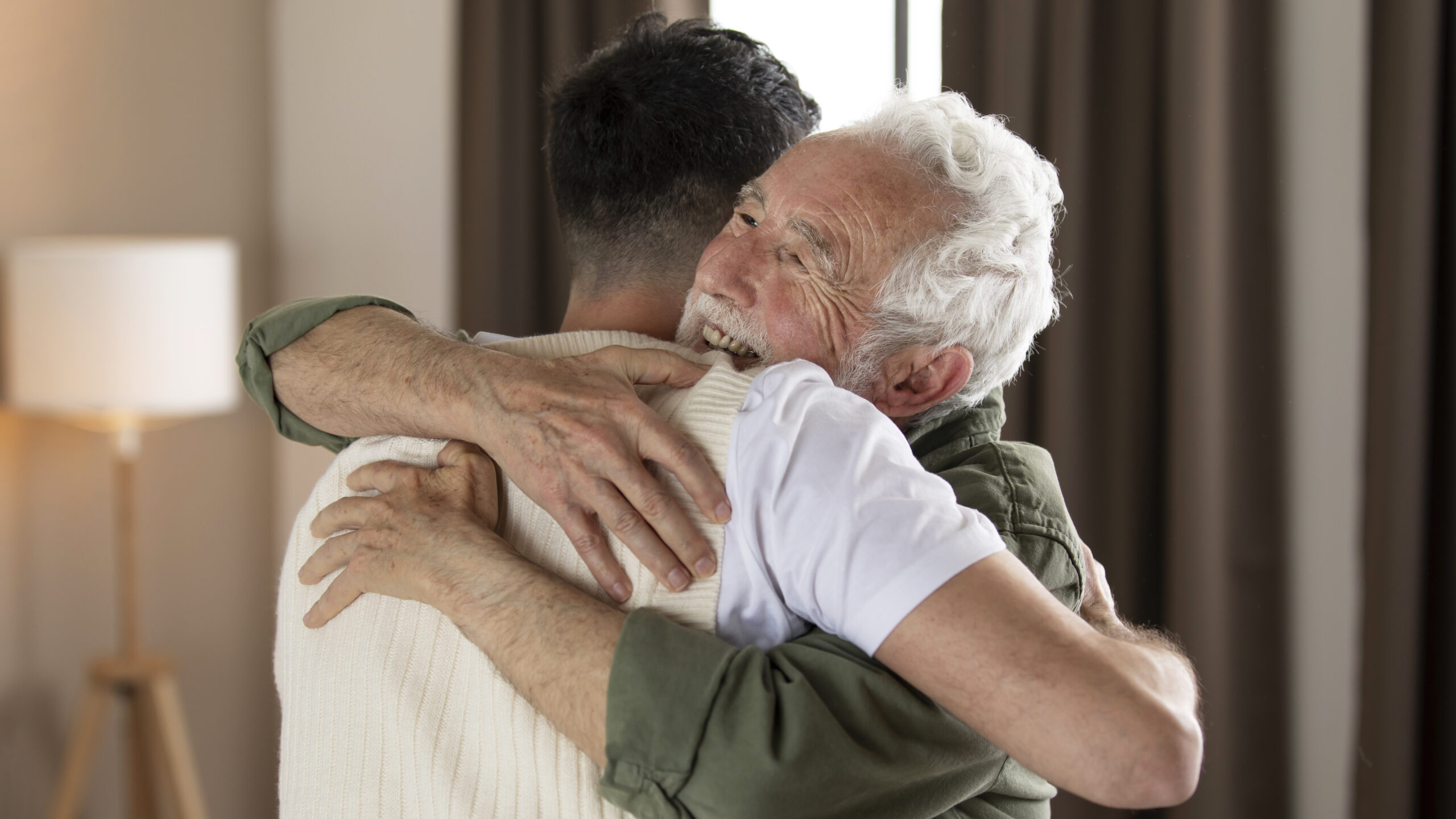
Michael wept. Quietly. Against his son’s shoulder. The man who had lifted an abandoned baby from the mud on a summer evening, who had named him Noah because it sounded steady and built for bad weather, finally let himself be held by the life he had chosen.
That is what twenty-five years of love looks like when it comes home. Not loud. Not spectacular. Just two people on an old porch, holding the proof of something that the world had spent a long time trying to tell them was not real.
After supper, Noah fixed the loose porch step. Michael watched from the chair, holding a cup of coffee he actually drank while it was warm. The neighbors were long gone. Sarah’s car was gone from the road.
The little flag moved in the evening air.
Inside, on the kitchen table, the blue blanket lay folded beside the old school photo in its frame.
Outside, Noah set down the hammer and looked at his work and then back at Michael.
“That’ll hold,” he said.
Michael looked at the step. Then at his son.
“Yeah,” he said. “It will.”
Some things do not need more words than that.

Specialty: Emotional Turning Points
Rachel Monroe writes character-driven stories about betrayal, second chances, and unexpected resilience. Her work highlights the emotional side of family conflict — the silences, the misunderstandings, and the moments when someone quietly decides they’ve had enough.