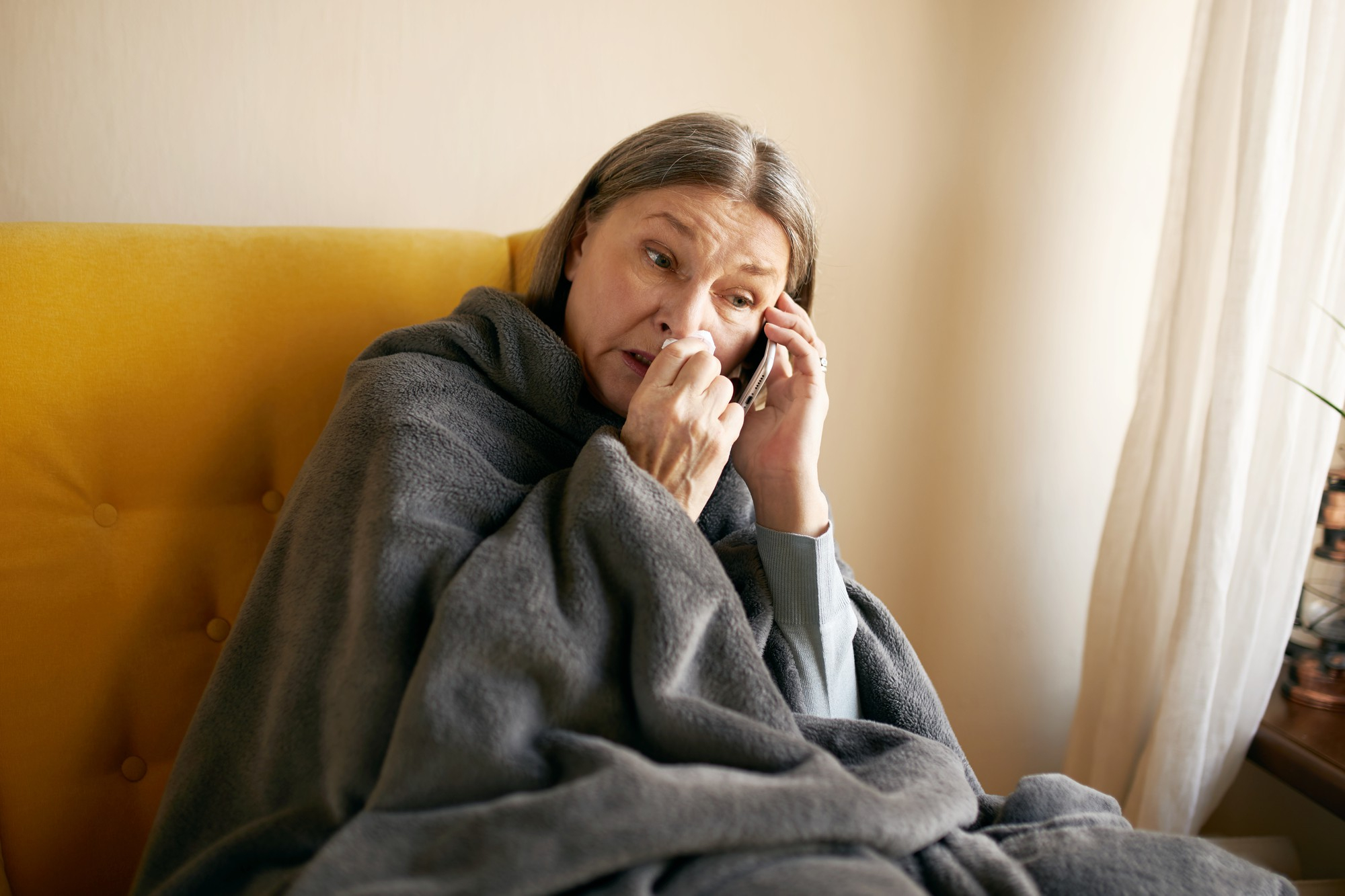
Real Love Answers the Phone
The flight from Cleveland landed at one in the afternoon, and I sent the text from the hard airport chair with my purse clutched in my lap and my small suitcase standing beside my knee.
Can someone pick me up? My flight lands at 1 p.m.
I watched the little message sit in the family group chat while the airport moved around me the way airports do, indifferent and continuous, full of families reuniting near baggage claim and businessmen rolling carry-ons and a young mother laughing as her toddler kicked both shoes loose in midair. Three weeks in Cleveland had made me see ordinary things differently. The way a mother just picked up those small shoes without a second thought. The way a man held the door for someone he did not know.
My hand trembled slightly. Whether from the medication, the exhaustion, or something more basic than either, I could not tell anymore.
Twenty-three days earlier I had boarded a flight to Ohio alone and checked into a hospital bed in a city where I did not know a single street name. I had signed waivers acknowledging that I might bleed out, stroke out, or simply not wake up from the anesthesia. I had listened through the night to the woman behind the curtain in the next bed crying softly while nurses moved in and out on soft shoes. I had faced the real possibility of dying in a strange city without a familiar hand to hold.
I had told my family it was a minor procedure because I did not want to worry them. That was what I had always done, for as long as I could remember. I softened the edges of my own pain so other people would not have to rearrange their lives around it.
My phone finally vibrated.
We’re too busy today. Just call an Uber.
Diana. My daughter-in-law of fifteen years, the woman whose children I had watched four days a week while she built her career at Meridian Pharmaceuticals.
A second message appeared from Phillip.
Why don’t you ever plan anything in advance, Mom?
I sat very still and looked at those words until the letters blurred at the edges.
The surgery I had just survived was not a minor procedure. It was an experimental valve reinforcement involving titanium mesh, performed by specialists who operated on perhaps forty patients a year. The procedure carried a forty percent chance of not surviving it. I had known this. I had chosen not to burden my family with it. And now here was the result of that choice, my son asking why I had not planned better, my daughter-in-law directing me to a rideshare app.
My thumb hovered over the keyboard.
I thought about telling them the full truth. About the titanium mesh now holding my heart chambers from collapsing. About the blood pressure crash in recovery that had kept me in the ICU for two extra days. About the surgeon’s face when he came to tell me they had almost lost me on the table, the particular way a person’s expression looks when they are relieved and still frightened at the same time.
I typed one word.
Okay.
There was nothing cheerful about that word, despite what the autocorrect period implied. Something was forming inside me as I sat in that hard chair, something I had been years in the making of and had not quite completed until that moment.
I opened a different text thread.
Dr. Harrison Wells had been the cardiologist who first identified my condition and referred me to the Cleveland surgical team. He was the kind of physician whose name appeared in medical journals and conference programs, the kind that had a six-month waiting list for private consultations. He was also, through the strange alchemy of months of appointments and conversations that had drifted far beyond medical protocols, something that felt very much like a friend. We had talked about Italian opera and grief and the best peach cobbler in Georgia. He had insisted I call him Harrison. I still could not quite manage it without feeling presumptuous.
He was currently in Switzerland for his son’s birthday.
Harrison, I typed, I know you’re in Zurich, but I just landed in Atlanta after the Cleveland surgery. Having some transportation issues. Don’t worry. I hope the celebration was wonderful.
I sent it without expecting anything. He was overseas with his family. He had no reason to see it quickly.
My phone rang almost immediately.
“Pamela?” The voice was unmistakable, that slight Boston accent under the warm authority of it.
“Harrison? I didn’t expect you to call.”
“Where are you in the airport?”
“Terminal B. But please don’t worry about this, I only meant to say hello.”
“Stay there,” he said. “I’m at Terminal C right now. I caught the overnight flight from Zurich. I’m waiting for my driver. Samuel and I can collect you on the way out. Do you have checked luggage?”
“Just this carry-on. But Harrison, I can’t impose. You’ve just flown from Europe.”
“Pamela,” he said, and his voice had the particular quality of a man who does not argue when he has made a decision, “you have just had major cardiac surgery. The last thing you need is a rideshare app and a strange driver. Text me your exact location.”
After we hung up I sat in stunned quiet for a moment. Then I opened my compact mirror and winced at what I found there. Three weeks in a hospital had left me pale and hollow-eyed and twelve pounds lighter than I had any right to be. My silver hair hung limp. My good blouse sagged from my shoulders like something borrowed from a larger woman.
There was nothing to be done about any of it.
I applied lipstick anyway, a small act of self-regard that I could not fully explain but felt suddenly necessary.
Fifteen minutes later, Samuel helped me with my suitcase and Harrison appeared beside the car in a casual jacket that probably cost more than my monthly pension, his silver hair slightly rumpled from the transatlantic flight, his eyes immediately assessing me with the focused attention of a cardiologist who is also a friend and finding both roles relevant.
“Pamela,” he said, taking my hand in both of his. “I’ve been wondering how the surgery went. I’ve been concerned.”
The genuine care in his voice, arriving as it did after the coldness of my family’s texts, nearly undid me. I blinked hard and manufactured a smile.
“I’m still here,” I said.
His eyes did not miss anything. They never did.
“Yes,” he said quietly. “And I am very glad of that fact.”
He offered me his arm as Samuel handled the suitcase, and the gesture was so unexpectedly courteous that I hesitated before taking it. As we walked to the car he leaned closer.
“You can tell me on the way why your family wasn’t here to meet you.”
The Bentley glided through Atlanta traffic with the insulation of a different world, quiet and steady. I looked out at the familiar city moving past and wondered how to explain a dynamic that I had spent years refusing to examine too closely.
“They’re very busy,” I said, aware of how it sounded.
“I see,” Harrison replied, with the patience of a man who has learned not to rush toward conclusions but not to pretend they aren’t visible either. “And they couldn’t spare half an hour after cardiac surgery.”
“I didn’t tell them it was cardiac surgery,” I admitted. “I said it was a minor procedure.”
“Pamela. The experimental valve reinforcement you underwent is not remotely minor.”
“I know that,” I said quietly. “But telling them the truth would have meant asking for things I wasn’t certain they wanted to give.”
He was quiet for a moment, watching the highway.
“And so you protected them from worrying about you,” he said, “and they protected their Saturday from inconvenience.”
The accuracy of it was stark enough that I couldn’t answer.
Samuel helped me into the house while Harrison insisted on reviewing my medications and what was in the refrigerator, which he found inadequate in ways he described with the particular directness of a doctor who has decided to apply his expertise to a situation beyond his official mandate. He sent Samuel to the grocery store with a detailed list. He made tea while I sat at the kitchen table feeling simultaneously grateful and absurd.
He set a cup in front of me.
“My mother believed tea could cure most things short of structural failure,” he said. “In your case, the structural issues have already been addressed by better surgeons than either of us. The tea is for the rest of it.”
That made me smile. A genuine one, the first in days.
My phone began vibrating on the counter.
I ignored it at first. Then I looked, and went still.
Forty-eight missed calls.
Thirty-two texts. All from Phillip and Diana. Sent over the past two hours, beginning when Harrison had posted a photograph.
I opened his social media page and found it: the two of us near the Bentley, his hand steadying my elbow, my face turned slightly from the camera. The caption read: Honored to assist my friend Pamela Hayes home after her courageous journey through pioneering cardiac surgery. A remarkable woman with extraordinary resilience.
The post had thousands of likes.
One comment stood out immediately.
Dr. Wells, that’s my mother-in-law. We’ve been hoping to speak with you for months regarding Meridian’s Cardio Restore project.
Diana.
I looked up at Harrison.
His expression told me he had already seen it.
“You knew,” I said quietly. “About Diana trying to reach you professionally.”
He sat across from me and folded his hands around his teacup.
“Your daughter-in-law has attempted contact with my office seventeen times in four months,” he said. “Six approaches at conferences. Two invitations to speak at Meridian events. All declined.”
“And when I mentioned my family during our consultations, you connected it.”
“Yes. Though I should clarify: my interest in your well-being preceded that connection entirely and remains entirely separate from it.”
I looked at him for a long moment, this distinguished man sitting in my modest kitchen with the practiced ease of someone who is entirely comfortable wherever he is.
“Pamela,” he said, reading the question I had not spoken, “I came to Terminal C because you needed assistance and no one else came. That is the whole of it.”
The texts from Phillip and Diana were already escalating, moving from confusion to urgency to a particular breathless calculation I recognized from years of watching Diana approach situations that could be leveraged.
I turned the phone face down.
“Shall we finish our tea?” I asked.
Harrison smiled.
The calls continued through the afternoon. By the time Harrison and Samuel left, after ensuring my medications were organized and my refrigerator no longer constituted a cardiac risk, my phone showed sixty-four missed calls and a text from Diana asking how well I knew Dr. Wells exactly and whether I might arrange an introduction.
Not one message asked how the surgery had gone.
Not one asked if I was frightened.
Not one said they were glad I was home.
The doorbell rang at seven that evening.
Phillip and Diana stood on the porch in work clothes, their expressions carefully assembled into something that looked like concern from a distance but had calculation in the details.
I let them in.
Diana’s eyes went immediately to the pill organizer on the coffee table, then to the medical documents, then to the private number written on the back of Harrison’s business card on the side table. Phillip looked at the card with an attorney’s eye for detail.
“Mom,” he said, “we’ve been trying to reach you all afternoon. Why didn’t you call back?”
“I was resting,” I said. “Doctor’s orders.”
“Cardiac surgery?” Diana said. “You told us it was minor.”
“I didn’t want to worry you.”
She sat down on my sofa and attempted the gentle tone she used when she needed something and believed softness was the most efficient route to it.
“How well do you know Dr. Wells?” she asked. “We had no idea you were close. It’s such a small world.”
“He was my consulting cardiologist before I was referred to Cleveland,” I said. “Over the months of appointments, we became friends.”
“Friends,” Diana repeated, finding the texture of the word. “He seems quite invested in your welfare. Picking you up from the airport personally.”
“When my family wasn’t available,” I said, allowing the words to settle where they would.
Phillip had the grace to look ashamed. Diana moved past it.
“It’s just that his connection to our family could have real professional implications. Meridian’s Cardio Restore program needs his endorsement. I’ve been trying to reach him for months. You must understand how significant this could be.”
There it was.
Not my surgery. Not my fear. Not the forty percent chance that had sent me to Cleveland without a hand to hold. What I could provide. What connection I represented.
I looked at my son. He looked at the carpet.
“I understand perfectly,” I said. “You are here because Harrison appeared on social media with me, not because I had cardiac surgery and came home alone.”
“That’s not fair,” Phillip said.
“You asked why I don’t plan ahead,” I said. “I had surgery and texted from the airport. Diana told me to call an Uber. That was the planning.”
My son closed his eyes briefly.
“Mom. I’m sorry. We should have been there.”
“Yes,” I said. “You should have.”
The honesty of it sat between us without decoration.
Diana tried once more. She explained that Phillip’s firm handled Meridian’s legal work, that the family’s financial stability was tied to her professional success, that one introduction would open a door that had been closed for months.
I thought about what Harrison had said in the car. That Cardio Restore’s clinical trials had shown mixed results. That it needed more research, not better marketing. That Diana Reynolds’s approach to physician endorsements had given her a specific kind of reputation in medical circles.
“My relationship with Harrison is personal,” I said. “Not a professional resource.”
Diana’s composed expression cracked slightly.
“So you won’t help us.”
“I won’t use a friendship to advance a pharmaceutical campaign for a drug Harrison has concerns about,” I said. “No.”
After they left, with promises to check in that I understood would be conditional on what happened next, I sat in the quiet house and felt something I had not felt in years. Not happiness exactly. Something steadier. The particular relief of having said a true thing without softening it.
Harrison called the following morning.
He asked how I was feeling and whether I had slept. Then, with the directness I had come to appreciate about him, he acknowledged that his social media post had been at least partly intentional.
“Some situations benefit from clarity,” he said. “Diana Reynolds has built a strategy around persistent access. A public connection sometimes communicates what professional refusals cannot.”
“And I was the mechanism for that clarity,” I said.
“You were the reason I came to the airport,” he corrected. “The clarity was a secondary benefit. Pamela, would you be willing to accompany me to the symphony gala this Saturday? It benefits cardiac research, and I find I’m not interested in attending alone.”
I looked at the living room where my daughter-in-law had sat an hour ago asking what she could extract from this friendship.
“Yes,” I said. “I would like that.”
“Good. Samuel will help with arrangements.”
When I arrived at the gala in the emerald dress that Samuel’s team had arranged, feeling more like myself than I had in years, Harrison met me at the door with the unhurried warmth of a man who is not performing attentiveness but simply feels it. He offered me his arm. He introduced me as his guest, without title or explanation, and let the ambiguity do what ambiguity does.
When Diana and Phillip appeared, impeccably dressed, Diana’s professional smile fully deployed, Harrison greeted them with perfect courtesy and then deflected her pivot toward Meridian with the ease of someone who has been navigating that kind of approach for decades.
“I don’t discuss business at charitable events,” he said pleasantly. “I’m sure you understand.”
“Of course,” Diana said quickly. “Though as family now—”
“We are not family, Mrs. Reynolds,” Harrison said, still pleasant. “I am enjoying a personal friendship with Pamela. That doesn’t extend to professional introductions for her relatives.”
The boundary was so clean and so clearly stated that Diana had nothing to find purchase on.
Phillip looked at me, and I saw in his face the beginning of something more honest than what he had brought to my porch the evening before. Not yet an apology. But the recognition that one was owed.
Later, seated at a table where the city’s philanthropic community discussed cardiac research funding, Harrison held my hand briefly and asked how I was managing.
“Better than I expected,” I said.
“You look it.”
“I feel it,” I said, and meant it in ways that went beyond the healing of my repaired heart.
What I had learned in the months since coming home from Cleveland, in the difficult conversations and the new ones, was that I had been the architect of my own diminishment for a very long time. Not because my family forced it upon me but because I had offered myself as something to be used before they had a chance to see me as something to be loved. I had softened every truth and reduced every need and made myself so small and so convenient that they had simply accepted the version I presented.
The forty percent chance of not surviving surgery had given me something unexpected alongside the titanium mesh and the repaired valve. It had given me a very clear view of what I had been doing and what it had cost.
I was sixty-seven years old with a surgically reinforced heart and a friendship that had arrived from a direction I had not anticipated, offered by a man who had come to Terminal C because he said he valued my company and had meant it simply, without agenda.
I could spend what time remained managing other people’s comfort.
Or I could do something else.
When Harrison brought me home that night and stood at my door with his coat collar up against the October air, he said that he hoped I would consider accompanying him to the conference in Boston in two weeks.
“As your companion?” I asked.
“As my friend,” he said. “And perhaps as something more, if you are willing to see where that goes.”
I looked at this distinguished, complicated, genuinely kind man standing on my porch and thought about all the years I had spent making myself smaller to avoid the risk of asking for anything.
“I am willing,” I said.
He smiled, and it reached his eyes.
“Good,” he said. “Then I will have Samuel arrange the details. Good night, Pamela.”
After the car disappeared, I stood in my quiet house and listened to the ordinary sounds of it. The refrigerator. The clock. The settling of walls that had held me through decades of giving.
I had survived a surgery with a forty percent mortality rate.
I had come home alone to an empty house and found, unexpectedly, that the emptiness had room in it for something new.
My phone had one new message. Phillip.
Mom. I want to come by this week. Not about Dr. Wells. Just to see you. If that’s alright.
I read it twice. It was not everything. It was something real.
I typed back.
Come Thursday. I’ll make dinner.

Specialty: Quiet Comebacks & Personal Justice
David Reynolds focuses on stories where underestimated individuals regain control of their lives. His writing centers on measured decisions rather than dramatic outbursts — emphasizing preparation, patience, and the long game. His characters don’t shout; they act.