Vanessa went behind the screen.
When she came out, she was wearing the pale pink dress again. Her face was scrubbed clean. Her eyes were swollen. She held the emerald dress out to me, folded over her arm.
I took it.
She didn’t say anything. She couldn’t. She just looked at me for a long moment. Then she walked out of the room with Dad’s hand on her shoulder.
Mom stood in the middle of the dressing room. She looked lost. Like someone who’d been walking the same road for thirty years and had just reached the place where it ended.
“I didn’t know what else to do,” she said quietly. “She was always so much. So loud. So hungry. And you were always so easy. You never needed anything. You were always fine.”
“I wasn’t always fine, Mom.”
“I know that now.” She pressed her hands against her mouth. “I think I knew it before. I just didn’t want to.”
I didn’t know what to say to her. So I didn’t say anything.
After a while, she left too.
The reception was in a ballroom on the second floor. Crystal chandeliers. Waiters with silver trays of champagne. A string quartet playing in the corner. All the donors and critics and conservatory directors milling around in tuxedos and gowns.
I changed into the emerald dress before I went up. I wasn’t sure I should. It felt strange. Like wearing something from a crime scene.
But it was mine. I’d bought it for tonight. And I wasn’t going to let Vanessa take that from me too.
When I walked into the ballroom, the room turned and started clapping again.
Eleanor Whitmore found me in the crowd. She took both of my hands.
“That green suits you,” she said. “Much better than it suited her.”
I laughed. I couldn’t help it.
“Thank you,” I said. “For the Gagliano. For everything.”
“No. Thank you.” Her gray eyes were very bright. “I haven’t heard the Sibelius played like that since I was a young woman in Vienna. You played it like it was the last thing you’d ever get to say to someone.”
“It was,” I said. “Sort of.”
She nodded slowly. She understood.
“Your sister is in the library downstairs,” she said. “With my son. And your father.” She paused. “She found Ethan before I did. She told him herself. Your father told me.”
I didn’t say anything.
“I want you to know,” Eleanor said, “that I never would have shown my son that video to hurt him. Or her. I would have shown it to him because a person deserves to know who they’re building a life with.” She sighed. “But I’m glad she told him first. It’s the first thing she’s done that made me think there might be something more in her than wanting.”
I found out later what happened in that library.
Vanessa told Ethan everything. The dress. The violin. What she said. What she did. All of it.
Dad said she didn’t make excuses. Not one. She didn’t say she was emotional. She didn’t say it got out of hand. She told the truth, start to finish. She cried through the whole thing. Ethan didn’t say a word until she was done.
Then he asked to see the video.
Dad said he watched it twice. His face never moved.
When it was over, he closed the laptop and took off his glasses and rubbed his eyes for a long time.
“I need some time,” he said finally. “I’m not saying it’s over. I’m not saying anything. I just need time.”
Vanessa nodded. She took off her engagement ring and held it out to him.
Ethan looked at it for a long time.
“Keep it for now,” he said quietly. “Just—keep it. For now.”
He walked out.
They postponed the wedding. They’re still together. I don’t know if they’ll get married. Ethan goes to therapy with her every Tuesday. He told me once, at a family dinner, that he decided to stay because she told him the truth when she didn’t have to.
“That’s the first time she ever did something hard,” he said. “I wanted to see what would happen if she kept doing it.”
I filed the insurance claim on Monday morning.
I told them exactly what happened. I gave them Jonah’s footage. The insurance company paid for the restoration in full. Then their lawyers sent Vanessa a letter. They were going to recover the cost from her. Twenty-six thousand, four hundred dollars.
Mom called me crying.
“They’re going to ruin her, Claire. She doesn’t have that kind of money.”
“She’ll figure it out, Mom.”
“How?”
“The same way I figured out how to pay four hundred and twenty dollars for a dress,” I said. “One lesson at a time.”
Vanessa set up a payment plan. Four hundred and forty dollars a month for five years. She took a second job on weekends, working the front desk at a hotel. She sold her car and started taking the subway.
She didn’t ask Mom and Dad for help. Dad told her not to. And for the first time in her life, Mom didn’t argue.
The man who restored Grandpa’s violin was named Mr. Tavares. He was eighty-one years old. He had a tiny workshop on the fourth floor of a building in Midtown, filled with hanging instrument bodies and the smell of glue and spruce.
When I opened the case and showed him the pieces, he didn’t say anything for a long time. He picked up each piece one at a time and held it under his magnifying lamp.
“Who did this?” he finally asked.
“My sister.”
He shook his head slowly. “Terrible. Terrible. But not impossible.”
“Can you fix it?”
“I’ve fixed worse.” He held up the broken rib to the light. “The top is cracked in two places. The rib is split. The neck is broken at the heel. The back is mostly fine, thank God.” He looked at me over his glasses. “It will take a year. Maybe more. And it will never be exactly the same. You’ll always be able to see where it broke, if you know where to look.”
“That’s okay,” I said. “He’d want people to see.”
Mr. Tavares raised an eyebrow. So I told him about the scratch. About Grandpa’s father dropping his wedding ring at a birthday party in 1952. About every instrument deserves to show that it has lived.
Mr. Tavares smiled for the first time.
“Your grandfather understood instruments,” he said. “Most people don’t.”
Seven months later, he called me.
“Claire? You should come in. I found something.”
I took the train into the city that afternoon. Mr. Tavares was waiting for me at his workbench. The violin was lying there with its top removed. The inside was exposed, pale and bare, like an open chest.
He handed me a magnifying glass.
“Look,” he said. “There. On the inside of the back. Near the bottom.”
I leaned close.
There was writing. Faded pencil, in a slanted, careful hand. I’d recognize that handwriting anywhere. I’d seen it on a thousand birthday cards. On the margins of my sheet music. On the note pinned to my violin case every time I left his house on a Saturday. Practice slow. Love, Grandpa.
For Claire, it said. When you open this one day for repairs (and you will, because instruments that get played always need repairs), know that I’m proud of you. Don’t rush the second movement. Love, W.H. 2014.
The year I turned twelve. The year he told me the Sibelius was the one.
He must have had the top removed by a luthier for some repair. And while it was open, he’d written a note to me. Inside the violin. Where no one would ever see it unless the instrument was opened again.
Where he knew I’d find it someday.
I sat down on Mr. Tavares’s little wooden stool and cried for a long time. Mr. Tavares made me a cup of tea and didn’t say anything. He just patted my shoulder occasionally, the way old men do.
“I’ll seal it back up,” he said finally. “Exactly as it was. The note stays inside. Where he put it.”
“Thank you.”
“Every instrument deserves to show that it has lived,” Mr. Tavares said quietly. “Your grandfather was right. But some of them have secrets, too.”
I started at Curtis that fall. Full scholarship.
Eleanor Whitmore wrote one of my recommendation letters. She also sent me a check, on my first day of classes, for exactly four hundred and twenty dollars.
The note with it said: For the dress. You shouldn’t have had to pay for it twice.
I gave the money back. She sent it again. I gave it back again. On the third try, she sent it to the youth orchestra’s scholarship fund in my name, with a note that said, You’re as stubborn as I was. Good. You’ll need it.
Grandpa’s violin came home to me a year and two months after the night of the gala.
Mr. Tavares did a beautiful job. The cracks in the top were sealed so carefully you could only see them when the light hit the wood at a certain angle. Thin, pale lines, like veins of silver in dark stone. The neck was solid again. The rib was whole.
And the little scratch beside the chin rest was still there. Exactly where it had always been.
The first person I played it for was my sister.
I didn’t plan that. It just happened. She came over to my apartment in Philadelphia one Sunday in July. Her first visit. She’d taken a Greyhound bus from New York. She stood awkwardly in my doorway holding a bag from a bakery.
“I brought cannoli,” she said. “Grandpa’s favorite.”
We sat on my couch and ate them. We didn’t talk about the violin. We didn’t talk about the dress. We talked about her new job. She’d left the hotel and started working at a nonprofit that helps kids from the Bronx get music lessons. Eleanor had made a phone call. Vanessa started at the bottom. Answering phones. Filing paperwork.
“It’s the most boring job I’ve ever had,” she said. “I love it.”
After a while, she looked at the case sitting on my music stand.
“Is that—?”
“Yes.”
“Can I see it?”
I hesitated. Just for a second.
Then I opened the case.
She looked at it for a long time. She didn’t touch it. She looked at the silver lines in the wood. The places where it had broken in her hands.
Her eyes filled up.
“You can see it,” she whispered. “Where I—”
“I know,” I said. “Mr. Tavares said you always would. If you know where to look.”
She covered her mouth with her hand.
“I’m sorry, Claire,” she said. “I’m so sorry. I’ve said it a hundred times. I’ll say it a thousand more. I don’t know how to make it right.”
“You’re paying for it,” I said. “Every month. That’s how.”
“That’s money. That’s not making it right.”
“It’s a start.”
She wiped her eyes.
“Will you play something?” she asked. “On it? I never—” She stopped. “I never once listened to you play. Not really. In twenty-two years. I was always too busy being bored.”
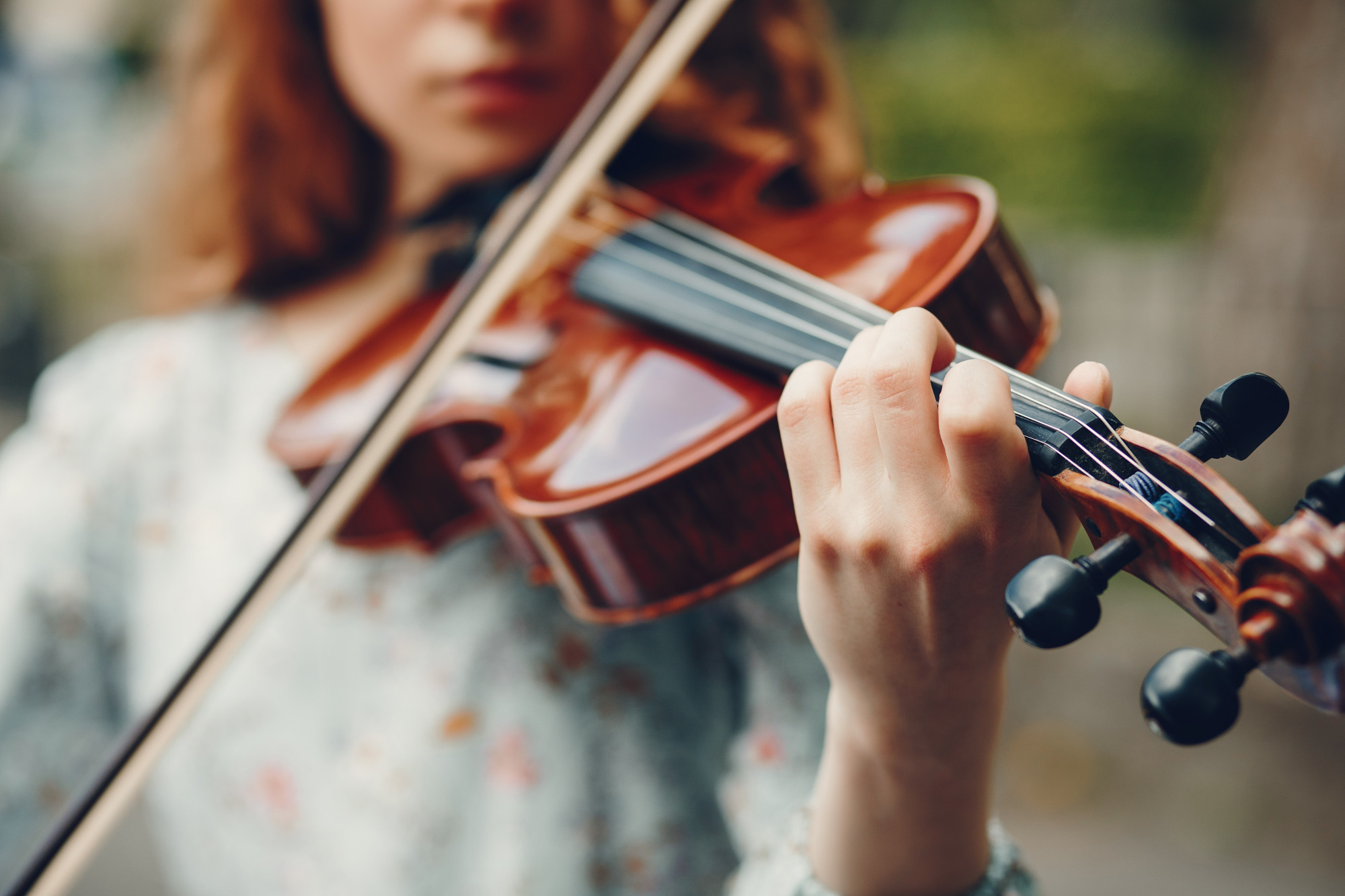
I took the violin out of the case. I tuned it. I put it under my chin.
It felt like coming home.
“What do you want to hear?”
“Whatever he would have wanted.”
I thought about it. Then I played the second movement of the Sibelius. The slow one. The one I always rushed.
I played it slowly. Very slowly. I let it breathe.
When I finished, my sister was crying on my couch with a half-eaten cannoli in her hand.
“That’s what he meant,” she said. “Isn’t it? When he told you not to rush.”
“Yeah,” I said. “That’s what he meant.”
I’ve performed on that violin in some beautiful halls since then. In Philadelphia. In Boston. Once in Vienna, in the city where Eleanor Whitmore’s father taught her on Saturdays. Eleanor came. She sat in the front row and cried again. She says she’s too old to stop crying at concerts now.
People sometimes notice the lines in the wood. The silver veins across the top. Collectors ask me why I didn’t have them made invisible. They say it would be worth more if you couldn’t see the damage.
I tell them what my grandfather told me.
Every instrument deserves to show that it has lived.
My family broke on the night of that gala. Not just the violin. All of us. Every unspoken rule we’d lived by for twenty-two years. Every time someone gave in so Vanessa wouldn’t have to face anything. Every time someone told me not to make a scene.
It broke in a dressing room on the Upper West Side, and nobody could put it back together exactly the way it was.
But some things aren’t meant to go back the way they were.
Some things have to break before they can be fixed right.
My father stands next to my sister now instead of in front of her. My mother calls me on Sundays and asks how I am, and then she actually waits for the answer. My sister pays four hundred and forty dollars every month for an instrument she’ll never play, and she’s never once missed a payment.
And me?
I learned that “no” is a complete sentence. I learned that being the strong one doesn’t mean being the one who always gives things up. I learned that sometimes the kindest thing you can do for someone you love is refuse to protect them from what they did.
And I learned that a little girl who finishes the piece, even after the goose, grows up into a woman who finishes it even after the violin breaks.
Somewhere inside the instrument under my chin, in faded pencil, there’s a note from a man with big square hands who smelled like rosin and peppermint candies.
I can’t see it anymore. It’s sealed back inside, right where he put it.
But I know it’s there.
And every time I play the second movement, I don’t rush.

Adrian Hawthorne is a celebrated author and dedicated archivist who finds inspiration in the hidden stories of the past. Educated at Oxford, he now works at the National Archives, where preserving history fuels his evocative writing. Balancing archival precision with creative storytelling, Adrian founded the Hawthorne Institute of Literary Arts to mentor emerging writers and honor the timeless art of narrative.