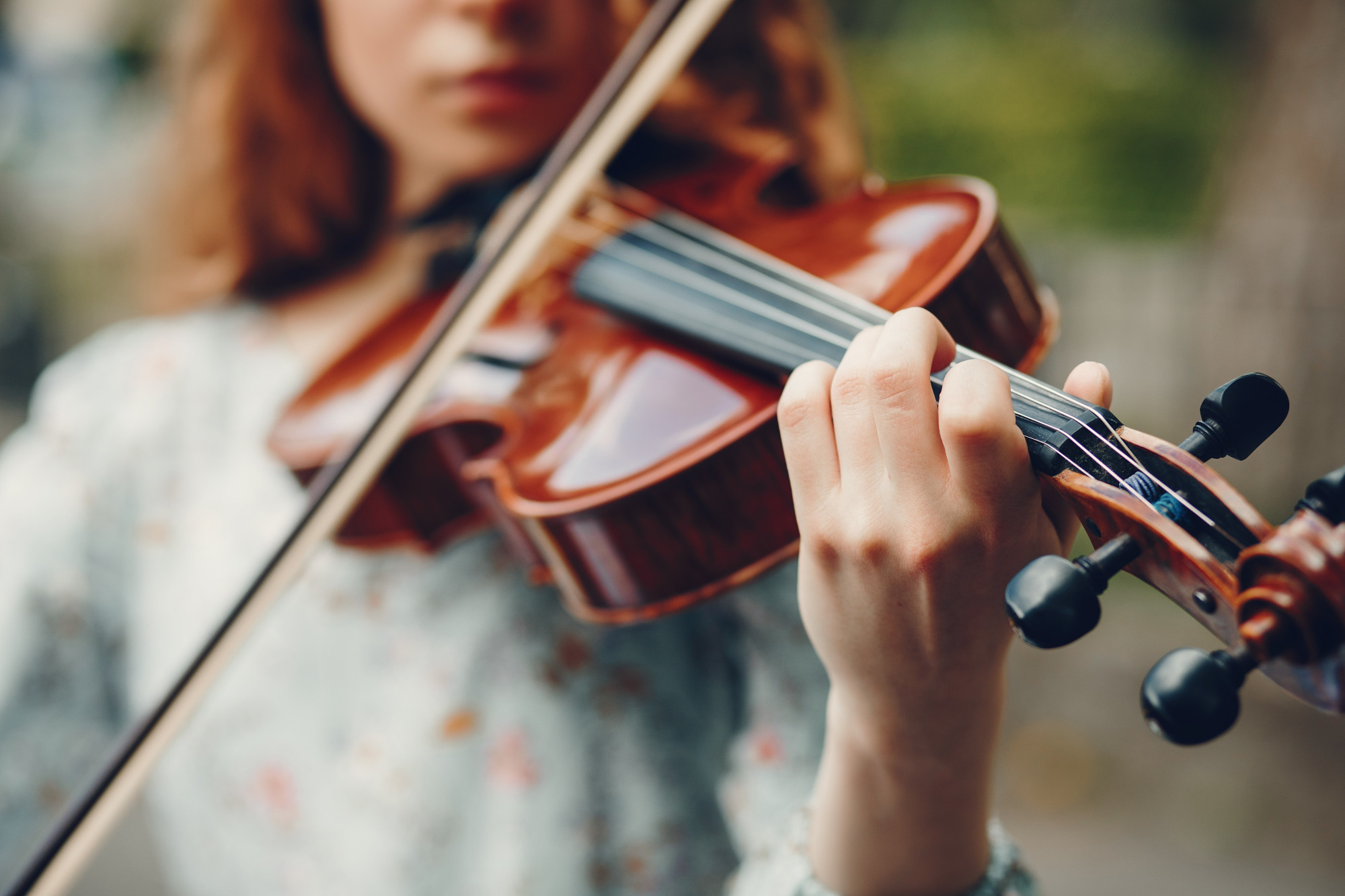
My sister broke my violin in half less than twenty minutes before the most important performance of my life, all because I refused to give her my new dress.
She looked at the broken pieces and said, “Guess your big night is over.”
She thought she had destroyed my future.
But twenty minutes later, she was standing backstage in tears, begging me to save hers.
To understand why that violin mattered so much, you have to understand my grandfather.
His name was Walter Hale. He was a high school music teacher in Queens for thirty-eight years. He had big, square hands that looked like they belonged to a carpenter, not a violinist. He smelled like rosin and peppermint candies. He wore cardigans with leather patches on the elbows, and he hummed constantly, under his breath, even when he didn’t know he was doing it.
When I was four years old, he sat me down on the piano bench in his living room and placed a tiny violin beneath my chin.
It was a sixteenth-size instrument. It looked like a toy. I remember how cold the chin rest felt against my neck, and how enormous his hands looked guiding my fingers onto the strings.
“Gently, Clairebear,” he said. “You don’t fight it. You ask it.”
“Ask it what?”
“To sing for you.”
I drew the bow across the A string. It made a sound like a cat stepping on a squeaky toy.
My grandfather laughed so hard he had to sit down.
“Beautiful,” he said, wiping his eyes. “Absolutely beautiful. Again.”
That was my first scale. Four notes. It took me an entire afternoon to get them right. He never once got tired of listening.
When I was eight, I started going to his house every Saturday. My parents dropped me off at nine in the morning and picked me up at four. My older sister, Vanessa, was supposed to come too. She came twice. Then she said violin was boring and she’d rather go to the mall with Mom.
Nobody argued with her. Nobody ever argued with Vanessa.
So it was just Grandpa and me.
He spent entire afternoons correcting the angle of my bow. He’d stand behind me and put his hand over mine, tilting my wrist a few degrees at a time.
“There. Feel that? Now your arm is doing the work instead of your fingers. The sound comes from your shoulder, not your hand.”
“My shoulder hurts.”
“That’s how you know it’s working.”
He’d make me play the same eight bars fifty times. A hundred. When I got frustrated and wanted to quit, he’d make me a cup of hot chocolate with too many marshmallows and tell me stories about the great violinists. Heifetz, who practiced so much his fingers bled. Paganini, who people said had sold his soul to the devil because nobody human could play that fast.
“Did he?” I asked once. “Did he really sell his soul?”
“No,” Grandpa said. “He just practiced more than anyone else. People always think talent is magic. It’s not. It’s just a thousand boring Saturdays that nobody sees.”
He attended every recital he could. Even the terrible early ones.
When I was nine, I played “Twinkle, Twinkle, Little Star” with variations at a student recital in a church basement. I was so nervous that I squeaked through half the notes. In the middle of the third variation, my bow slipped and made a sound like a goose being stepped on. A boy in the second row laughed out loud.
I stopped playing. I stood frozen in front of fifty people with my face burning.
Then, from the back row, I heard someone clapping.
Slow. Steady. One person.
It was Grandpa. He was standing up, clapping, with a huge grin on his face.
“Keep going, Clairebear!” he called. “That was the best goose I’ve ever heard!”
Everyone laughed. But it wasn’t mean laughter anymore. It was warm. I started laughing too.
And then I finished the piece.
Afterward, he gave me a peppermint candy and said, “You know what separates a real musician from everybody else?”
“What?”
“Real musicians finish the piece. Even after the goose.”
My grandfather had his own violin.
He kept it in a battered brown case in the corner of his living room. He played it in the evenings, after dinner, sitting in his armchair by the window. Mostly old folk songs. Sometimes Bach. And sometimes, when he thought nobody was listening, Sibelius.
The Sibelius Violin Concerto in D minor. The hardest piece I’d ever heard. Haunting and wild and cold, like wind across a frozen lake.
“This is the one,” he told me when I was twelve. “If you can play the Sibelius, you can play anything.”
“Will you teach me?”
He looked at me for a long time.
“When you’re ready,” he said. “Not before.”
The violin had a tiny scratch beside the chin rest. A little pale line in the dark varnish. I asked him once why he’d never had it fixed.
He ran his thumb over it gently.
“My father put that there,” he said. “In 1952. He dropped his wedding ring while he was playing at my mother’s birthday party. It bounced off the wood.” He smiled. “I could have had it repaired a hundred times. But every instrument deserves to show that it has lived, Clairebear. Scars mean somebody loved it enough to use it.”
When I was sixteen, Grandpa got sick.
Pancreatic cancer. By the time they found it, it was everywhere. The doctors gave him three months. He lived five.
I visited him every single day. After school. On weekends. I brought my violin to the hospice and played for him. Bach partitas. Folk songs. The beginning of the Sibelius, which I’d finally started learning on my own.
“You’re rushing the second movement,” he said from his bed, his voice paper thin. “It’s not a race. Let it breathe.”
“Sorry.”
“Don’t be sorry. Be slower.”
Three days before he died, he asked my mother to bring him the battered brown case from his living room.
He opened it on the bed. He took out his violin and held it for a long time, running his fingers over the wood. Over the scratch beside the chin rest.
Then he held it out to me.
“This is yours now,” he said.
“Grandpa, no. You should keep it. You’ll get better and—”
“Clairebear.” He took my hand and placed it on the neck of the violin. His fingers were so thin. “Promise me something.”
“Anything.”
“Play the Sibelius on it someday. On a real stage. In front of people who matter.” He squeezed my hand. “And slow down in the second movement.”
I was crying too hard to answer. I just nodded.
He died on a Tuesday morning in April. I was holding his hand.
He left his violin to me in his will. Just me. One line. My violin goes to my granddaughter Claire, who will know what to do with it.
Years later, when I brought it to a specialist for its first proper cleaning, the man went very quiet. He took it to a back room. He called two colleagues.
He authenticated it as an instrument from a respected nineteenth-century Italian workshop in Milan. Nobody in my family had known. Grandpa had bought it from a widow at an estate sale in 1968 for three hundred dollars, thinking it was just a nice old fiddle.
It was insured for around eighty thousand dollars.
Still, I would have traded every dollar of that value just to hear Grandpa tell me one more time that I was rushing the second movement.

Adrian Hawthorne is a celebrated author and dedicated archivist who finds inspiration in the hidden stories of the past. Educated at Oxford, he now works at the National Archives, where preserving history fuels his evocative writing. Balancing archival precision with creative storytelling, Adrian founded the Hawthorne Institute of Literary Arts to mentor emerging writers and honor the timeless art of narrative.