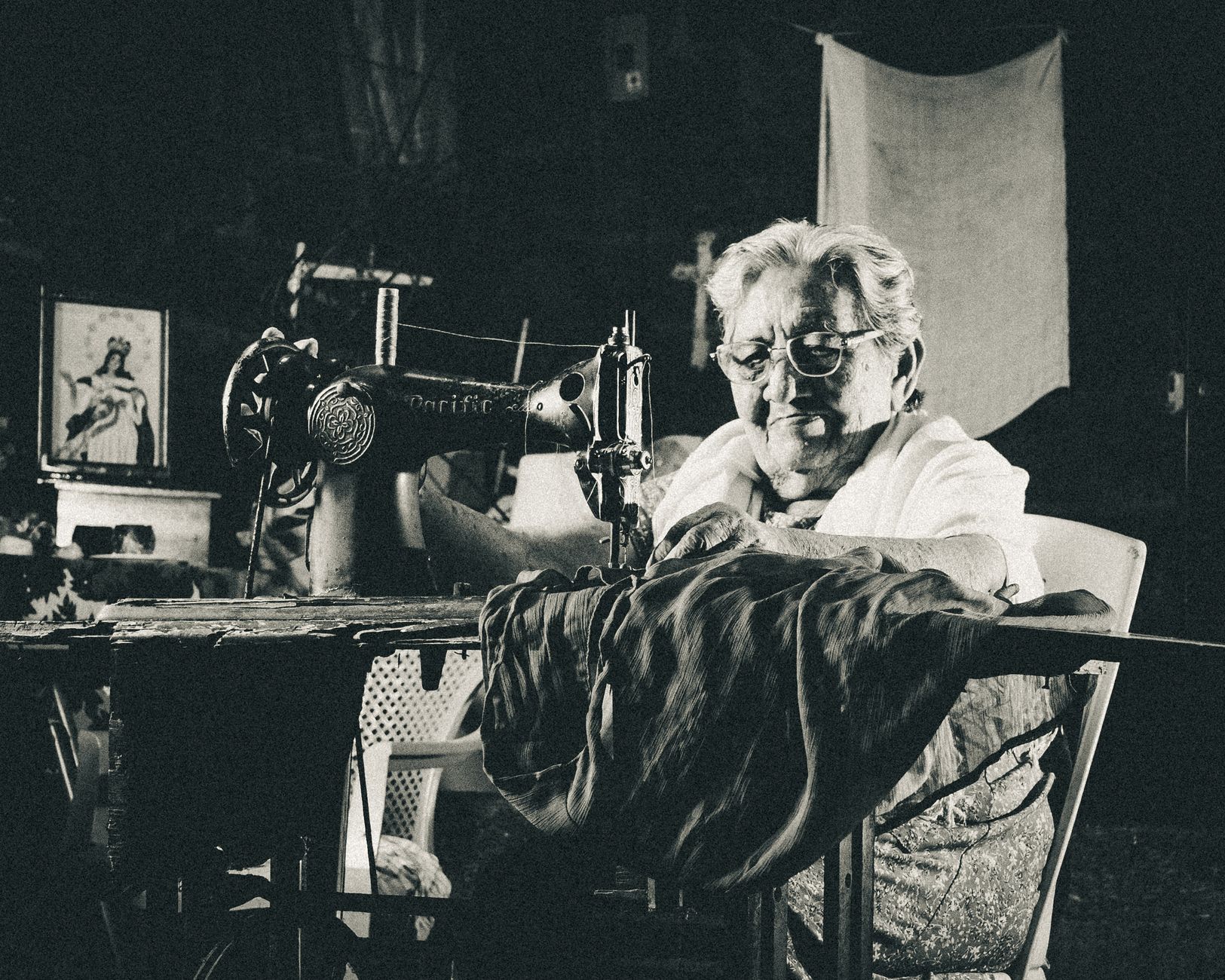
There were four dents in the carpet where the cabinet had stood.
That’s what I saw first. Four little square dents, each one about the size of a postage stamp, pressed into the carpet of Mama’s sewing room by fourteen years of a Singer sitting in the same spot.
My daughter Hannah was standing right behind me. I heard her breathe in.
“Mom,” she said. “Where is it?”
I didn’t answer her, because I didn’t know, and because my eyes had already gone to the other side of the room. The cutting table was still there. It was only an old door laid across two sawhorses, with a bedsheet thrown over it the way Mama always did when she quit for the night, to keep the dust and the cat hair off her work.
I lifted the corner of the sheet.
Pale blue dotted swiss. Four yards of it, cut into pieces, every piece still wearing its brown tissue pattern, pinned in Mama’s way with the pins all pointing the same direction. The bodice front. Two bodice backs. The skirt panels folded once down the middle. Two little cap sleeves, laid side by side like a pair of hands.
Hannah’s graduation dress. Mama had cut it out on a Tuesday. She died that Thursday, in her chair, with the weather on.
“It’s all still here,” Hannah said, and her voice went thin. “Grandma’s dress is still here. So where’s the machine?”
I laid the sheet back down, gentle, the way you’d cover somebody up.
“Stay with it,” I told her. “Don’t let anybody put it in a box.”
My sister Karen was in the kitchen wrapping Mama’s juice glasses in newspaper. Karen is fifty-three, six years older than me, and that Saturday she looked seventy. She had a roll of packing tape around her wrist like a bracelet and her reading glasses pushed up in her hair. The boxes were stacked to the windowsill, labeled in black marker in her square hand. Kitchen. Linens. Give away. Give away. Give away.
“Karen. Where’s Mama’s sewing machine?”
She didn’t look up. She folded the paper over a glass and tucked the ends in.
“I took it to the consignment shop on the square Tuesday. They sold it Thursday.”
“You sold it.”
“It’s a consignment shop, Denise. That’s what they do.” She reached for another glass. “Forty dollars. The shop keeps forty percent, so I’ve got a check for twenty-four. You can have half if that’s what this is about.”
“That is not what this is about.”
“Then I don’t know what it’s about.” Now she looked at me, and her eyes were flat and dry and so tired. “It was an old machine in an old cabinet and it weighed as much as a calf. Jeff and I about put our backs out getting it in the truck. Nobody sews anymore. I have to have this house empty by the thirty-first or Mr. Garrison bills us four hundred and fifty dollars for June, and I didn’t see anybody else here on a Tuesday to carry things.”
That one landed where she aimed it.
“Did you lift the sheet on the cutting table?” I asked.
“What sheet?”
“Hannah’s graduation dress is under it. Mama had it cut out and pinned. All of it.”
Karen’s hands stopped. Just for a second, the newspaper half folded. I watched her decide something. Then she finished the fold, and set the glass in the box with the others, and tore off a strip of tape with her teeth.

Specialty: Emotional Turning Points
Rachel Monroe writes character-driven stories about betrayal, second chances, and unexpected resilience. Her work highlights the emotional side of family conflict — the silences, the misunderstandings, and the moments when someone quietly decides they’ve had enough.