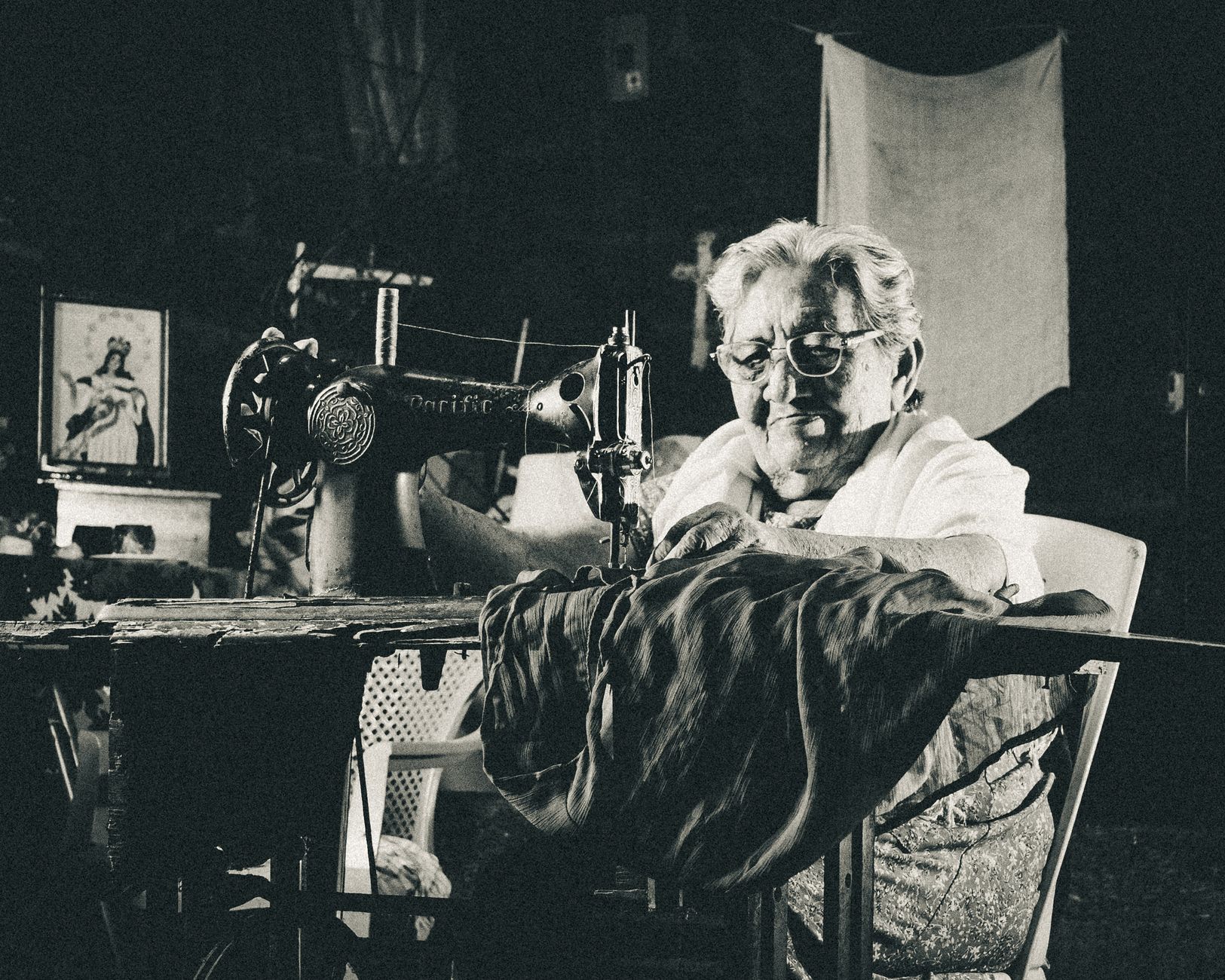
“Well, I can’t unsell it,” she said. “It’s a machine, Denise. Mama’s gone. I’m not running a museum.”
I stood there in my mother’s kitchen with a whole speech lined up behind my teeth.
I didn’t give it. I’d like to say that was grace, but it was mostly arithmetic. Karen lived four blocks from Mama. I lived fourteen miles out and cooked full time in the school cafeteria in Fordland. For three years Karen had done the Tuesdays and the Thursdays. She filled the pill box. She drove Mama to the heart doctor in Springfield, an hour each way. I came on Sunday afternoons with a casserole and sewed with Mama for two hours and went home feeling like a good daughter.
A woman who came on Sundays does not get to give a speech to the woman who came on Tuesdays.
And a speech wouldn’t put one stitch in that dress. Graduation was thirteen days off.
So I went back down the hall. Hannah was standing guard at the cutting table with her arms crossed, seventeen years old and five foot nine and trying hard not to cry in front of me.
“Get me that long flat box off the closet shelf,” I said. “The one the Christmas tablecloth lives in.”
We laid the pieces in it one at a time, tissue and pins and all, flat as we could get them. I put Mama’s sewing basket on top: her bent-handled shears, her pin cushion, the stub of pink tailor’s chalk, the little round tin of bobbins, her seam gauge, her oil can. I took the pattern envelope too. The receipt was still inside, from the Amish dry goods store out past the bulk food place. Four yards at five ninety-nine. Twenty-three dollars and ninety-six cents.
Karen had a check for twenty-four. Mama’s machine had come out four cents ahead of the cloth.
I carried the box out the front door past my sister without another word. She didn’t say one either. I heard the tape gun start up again before I got to the car.
The consignment shop sits on the north side of the square in Seymour, between the insurance office and the place that used to be the dime store. A woman named Linda runs it. She was pricing a rack of children’s coats when Hannah and I came in, me carrying that box like a sheet cake.
“The black Singer in the walnut cabinet,” I said. “It sold Thursday.”
“It did.” She smiled. “Went quick. Those old ones are heavy as sin but they don’t die.”
“It was my mother’s. Opal’s. My sister brought it in.”
Linda’s smile came down some.
“I’m not here to make trouble,” I said. “It was sold fair. I only need to know who’s got it.”
She looked at the box in my arms, and then at Hannah.
“I really shouldn’t,” she said. “But it was the Fry girl. Megan. Lives out on Finley Road with the two little ones. She paid in fives and ones and asked me if the price was firm.” She shook her head. “It was. I felt bad about that after.”
My husband Bill got home from his route a little past four. Rural carriers work Saturdays, which is why he hadn’t been at Mama’s with me that morning, and I could tell from his face when I told him that he wished he had been. Bill has carried the mail out of the Seymour post office for nineteen years. He loved my mother. She hemmed every pair of work pants he ever wore on that route.
Specialty: Emotional Turning Points
Rachel Monroe writes character-driven stories about betrayal, second chances, and unexpected resilience. Her work highlights the emotional side of family conflict — the silences, the misunderstandings, and the moments when someone quietly decides they’ve had enough.