He squared the corners with nothing but the tape. Thirty feet down one side, forty down the other, and if the line between them measures fifty you’ve got a true corner. Carl laid out the machine shed the same way in 1981. I held the dumb end of the tape, and I stood there in my straw hat with the bundle of stakes on my arm, handing them over one at a time like a nurse.
By noon there was a line of orange running north from the slab, and another running east, and another south. A box around three sides of Brian’s pad, with the pad sitting in the open mouth of it.
Two acres, less the slab and less sixty feet on the west I had told him to leave clear.
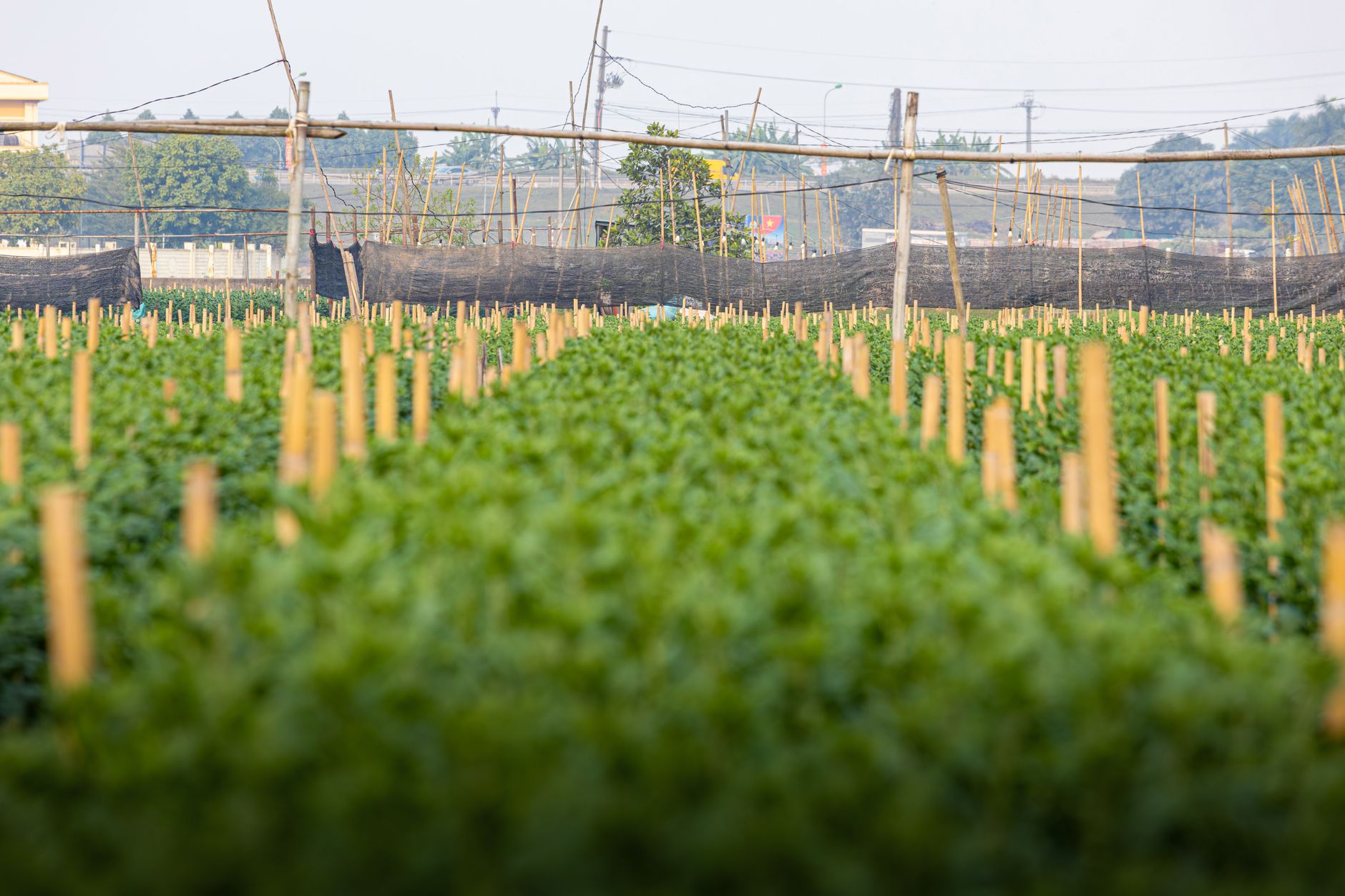
“Corn on the north,” Mr. Pruitt said, “so it doesn’t shade your flowers. Flowers on the south, where you can see them from the house. Orchard on the east, where the ground rises. Cold air runs downhill. A late frost will settle in the low spots and take your bloom.”
He was winding the tape when Brian’s truck came through the gate.
My son got out slowly. He stood with the truck door open and looked at the stakes, turning his head to follow the line of them all the way around.
“Mr. Pruitt,” he said.
“Brian.”
“Mom. What is all this?”
“A garden.”
“A garden.” He walked to the corner stake, the one six inches off his concrete, and looked down at it. The orange tape flapped against his knee. “Right up against my pad.”
“Right up against your pad,” I said. “In my field.”
Mr. Pruitt had become very interested in the crank on his tape reel.
“I can’t get around the building with that there. I can’t get a ladder up. I can’t…” Brian pushed his cap back. “You’re doing this to spite me.”
“No.”
“Then what do you call it?”
“I’ve wanted an orchard on this ground since before you could ride a bicycle,” I said. “Your father always said we’d get to it. I quit waiting Monday night. Somebody reminded me I may be running short on soon enough.”
It went into him. I watched it go. His face did what it used to do when he was ten and I had caught him at something, a kind of flinch around the eyes, and then it closed over.
“I didn’t mean it like that.”
“How did you mean it?”
He opened his mouth and nothing came.
“You’ve got the whole west side,” I said. “Sixty feet. Mr. Pruitt says that will turn a pickup and a twenty-foot trailer, and if it won’t, you tell me and I’ll move a stake. I’m not stopping your shop, Brian. I’m planting mine.”
He stood a while longer. Then he got back in his truck and backed all the way out to the gate, careful, without touching one stake.
Mr. Pruitt hung the tape reel on his shoulder.
“Enterprise and GoldRush,” he said, as though nothing had happened. “For your apples. Both of them bred up at Purdue. You won’t have to spray for scab, and they bloom near enough together to set each other. I’d put a Liberty in for a third. There’s a nursery over by Salem that might still have bare-root stock in the cooler, if you call today.”
“I’ll call today.”
“I thought you might.”
Dale plowed the corn and flower ground for me on Saturday. When I asked what I owed him for turning an acre of old sod, he said, “A dozen ears a week, once it’s on,” and would not hear anything else.

Laura Bennett writes about complicated family dynamics, difficult conversations, and the quiet moments that change everything. Her stories focus on real-life tensions — inheritance disputes, strained marriages, loyalty tests — and the strength people find when they finally speak up. She believes the smallest decisions often carry the biggest consequences.