At home I changed my shoes, pulled my barn coat on over my church dress, and dropped a stick of white chalk from the kitchen drawer into the pocket.
“Mason. Lily. Come walk with Grandma.”
Mason is eleven, a serious boy, a noticer. Lily is eight and wears two braids her mother does every morning, and she has never walked anywhere she could skip.
They had seen the stumps already, of course. The school bus goes right past them. But children take a thing the way they find it.
“Daddy said they had to come down,” Lily told me.
“Did he?”
“Were they sick?” Mason said.
“No, honey. They weren’t sick.”
I left it there.
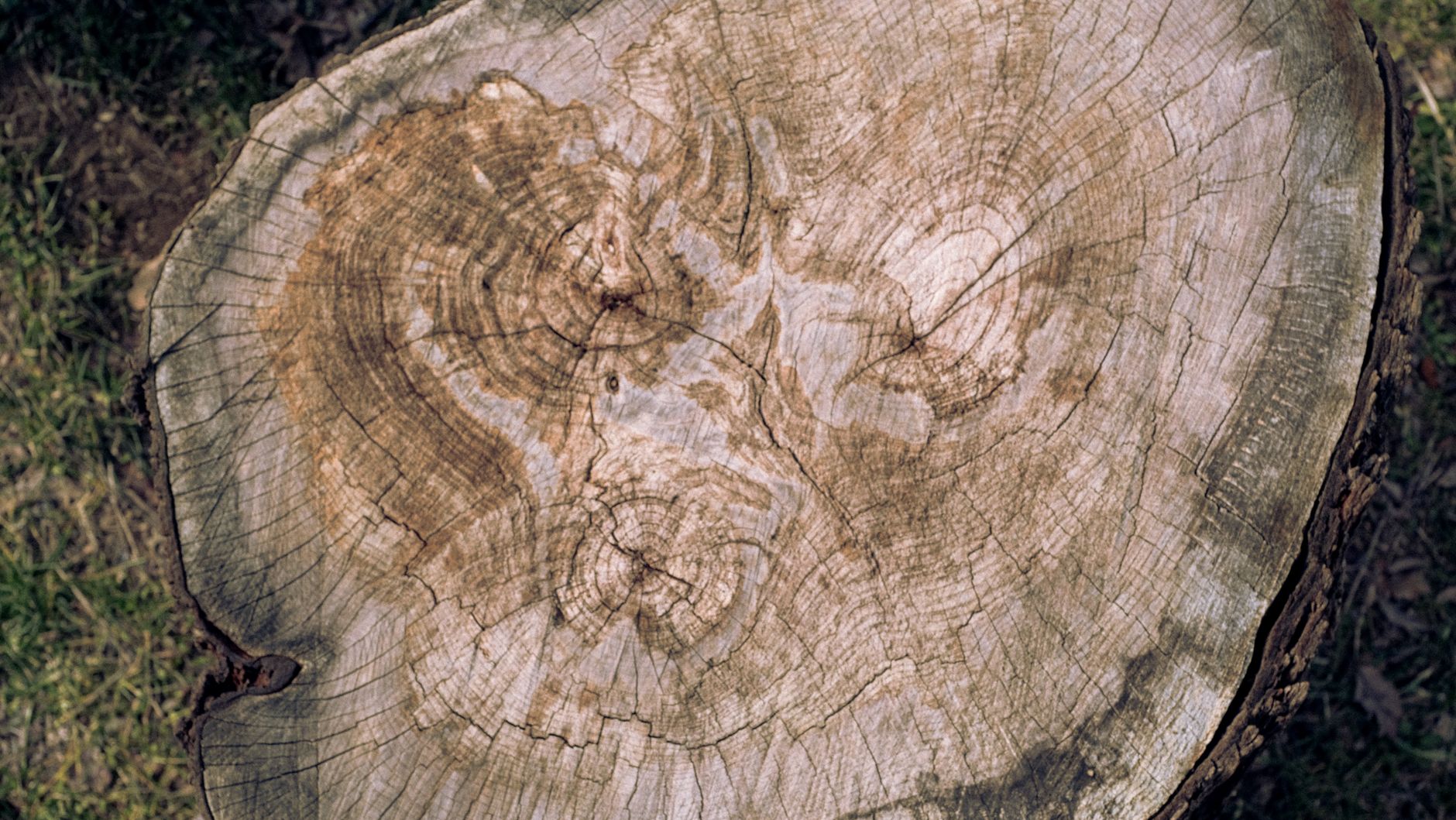
I sat them both on the middle stump, with room to spare, and I knelt in the sawdust beside Ray’s sanded strip.
“A tree keeps a diary,” I told them. “Every year it grows it puts on one ring. Pale wood in the spring when it’s growing fast, and a thin dark line in late summer when it slows down. One light and one dark is one year. We’ll start here at the bark, which is this year, and go to the middle. Mason, you count out loud. Lily, every time he gets to ten I’ll make a chalk mark and you put up a finger.”
Mason bent over and put his fingertip on the wood.
“One. Two. Three.”
I followed his finger with the chalk. It made a dry little scrape on the wood, like a teacher at a blackboard.
At eight I stopped him.
“Lily, that one is you. The summer you were born, this tree made that ring.”
She leaned down until one braid touched the stump. “It’s so little.”
“So were you.”
Mason found his own a few rings on without being told, and he tapped it twice and kept going.
“Seventeen.”
“Wait there.” I drew a small cross. “That’s the year your great-grandpa Emil died. He was seventy-nine. The week before, he was standing right where you’re sitting, leaning on a stick and looking up into these limbs.”
“What was he looking for?” Lily said.
“I don’t think he was looking for anything. I think he was just glad of them.”
They counted on. Twenty. Thirty. Somewhere in the thirties Mason’s finger stopped by itself.
“Grandma, why’s this one so skinny?”
It was no wider than a pencil line.
“That’s 1988,” I said. “It didn’t rain. The corn burned up in the field and the creek quit running in July, and your great-grandpa sold eleven cows he’d raised from calves because there wasn’t hay to feed them. The tree remembers. It hardly grew at all that year. Now look at the one beside it.”
“It’s fat.”
“It rained in eighty-nine.”
A few rings past that I made another mark.
“Right about here is the year your daddy was born.”
Mason’s head came up. “Dad’s in here?”
“Everybody’s in here.”
At sixty-four I wrote a small letter B, and Lily wanted to know if I had been little too, and I said I had been littler than her and twice as stubborn.
The rings ran tighter toward the heart and harder to see. Mason slowed down. He had his lip between his teeth.
“Seventy-two. Seventy-three. Seventy-four.”
His finger rested on a dark dot at the very center, no bigger than a pencil eraser.
“Seventy-four,” Lily announced to the whole yard, with seven fingers up and then four.

Lila Hart is a dedicated Digital Archivist and Research Specialist with a keen eye for preserving and curating meaningful content. At TheArchivists, she specializes in organizing and managing digital archives, ensuring that valuable stories and historical moments are accessible for generations to come.
Lila earned her degree in History and Archival Studies from the University of Edinburgh, where she cultivated her passion for documenting the past and preserving cultural heritage. Her expertise lies in combining traditional archival techniques with modern digital tools, allowing her to create comprehensive and engaging collections that resonate with audiences worldwide.
At TheArchivists, Lila is known for her meticulous attention to detail and her ability to uncover hidden gems within extensive archives. Her work is praised for its depth, authenticity, and contribution to the preservation of knowledge in the digital age.
Driven by a commitment to preserving stories that matter, Lila is passionate about exploring the intersection of history and technology. Her goal is to ensure that every piece of content she handles reflects the richness of human experiences and remains a source of inspiration for years to come.