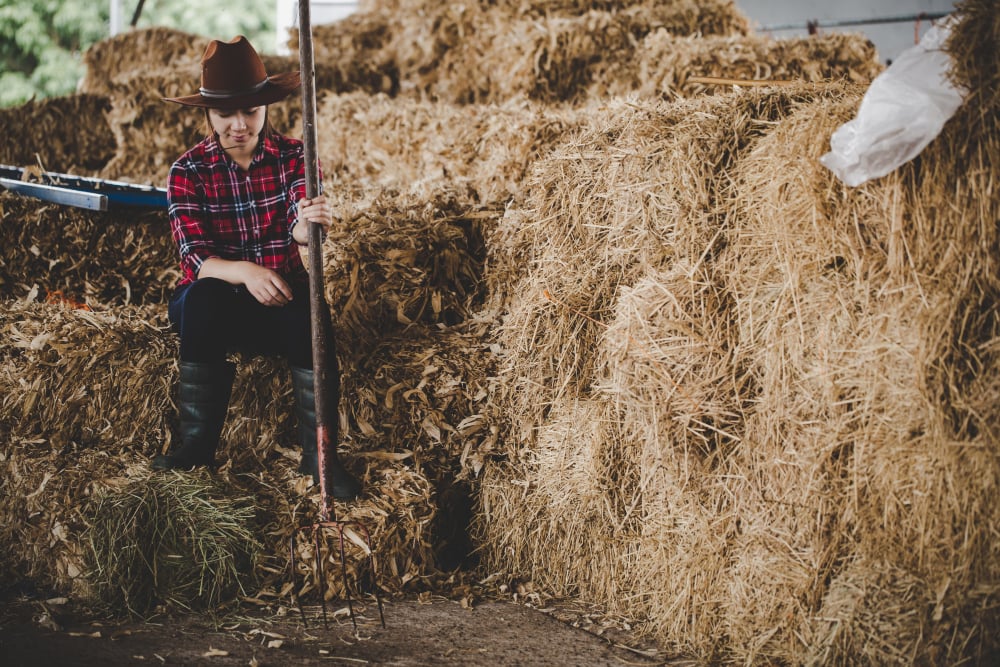
Lyle was standing at the end of my stackyard on a Tuesday afternoon with a can of orange marking paint.
He’d sprayed a stripe across the ends of three of my lots.
Lot one. Lot two. Lot three.
The paint was still wet. I could smell it over the hay. That sharp, chemical smell, sitting on top of the green, sweet smell of good alfalfa cured right.
I’d just come up from the pivot on the four-wheeler. I shut it off and sat there a second, looking at those orange stripes.
Lyle didn’t turn around. He knew I was there. He shook the can, the little ball inside rattling, and sprayed one more line across the end of lot three, slow and careful, like he was signing something.
“Thirty-four ton,” he said. “Two-eighty a ton. Ninety-five twenty.”
I got off the four-wheeler.
“What are you talking about, Lyle?”
“It cleared Monday.”
He turned around then. He’s sixty-six. Tall, a little stooped now, with a sunburned neck and a sweat-stained feed-store cap he’s been wearing since I was in college. He had a folded piece of paper in his shirt pocket. I could see the edge of it. A check stub.
“The Arneson dairy,” he said. “Down by Wendell. Their buyer’s sending two trucks Thursday.”
I looked at the stripes. At the stub in his pocket. At him.
“That’s my hay,” I said.
“Your mother’s hay was my hay for twenty-two years,” Lyle said. “Nobody ever wrote me a check for it.”
“Now somebody did.”
He said it flat. Not mean. Not proud. Just flat, the way you’d tell somebody the price of diesel.
Then he put the cap back on the paint can.
“Don’t make a scene when the dairy’s trucks come Thursday,” he said. “You’ll embarrass us both.”
He walked off toward the house. His boots kicked up little puffs of dust on the lane.
I stood in my stackyard with the smell of wet paint and good hay and watched him go.
I’m forty-one. I grow alfalfa on the forty acres my mother left me in Idaho’s Magic Valley, out past Jerome where the canal water runs and the wind never quits.
Lyle is my stepfather. He married my mother when I was nineteen. When she died three years ago, she left me the forty. She left Lyle the house on the home place and the right to live in it for as long as he wanted.
That’s how it’s been. My hay ground runs right up against his back fence. My stackyard is a hundred yards from his kitchen window. I can see his porch light from my shop.
In twenty-two years on this farm, every hay check had gone out in my mother’s name.
Never once in his.
I need you to understand about that hay.
It wasn’t just hay. Not to me.
I cut it at early bud, before the purple flowers come on, when the protein is highest and the stems are still fine. Some years that means cutting three or four days before everybody else up and down the road. My neighbors used to drive by and shake their heads.
I raked it at night with the dew on, so the leaves would stay stuck to the stems instead of shattering off in the dry wind. Leaves are where the feed is. You lose your leaves, you’ve got sticks.
Rosa baled it at sixteen percent moisture. Not eighteen. Not twenty. Sixteen. She checks it with a probe every few rows, and if it’s too wet, she shuts down and waits, even if a storm is building over the Sawtooths.
And I stacked every single lot separate. Labeled. Numbered. Lot one from the north quarter of the field. Lot two from the middle. Lot three from the south end, down by the ditch where the ground is best.
Every lot got cored. Twenty bales a lot, at least. I drill a sample out of each bale with my hay probe, mix the cores in a bag, seal it, and send it to the forage lab in Twin Falls.
Under my own sampler number.
People have asked me since why I didn’t just call the sheriff. Or the dairy. Or a lawyer.
I’ll tell you why.
Because a big dairy doesn’t buy hay on whose name is on the mailbox.
It buys on lab numbers.
And if I’d called the dairy and said, “My stepfather’s selling my hay,” that would have been my word against his. A forty-one-year-old woman against a sixty-six-year-old man who’d farmed that ground with her mother for twenty-two years. Who’d shaken hands with every buyer in the county. Who lived on the home place.
Who do you think they’d believe?
A phone call is somebody’s word.
A lab sheet is the lab’s word.
That night, I sat in my shop at the old steel desk.
The binder was on the shelf above it. Three inches thick. Green, with a cracked spine and duct tape on the corners.
My mother started that binder the year I turned fourteen.
Her handwriting was on the first tab. Big, loopy, a little slanted. JUNE HOLLOWAY — HAY TESTS — 1997.
Mine was on every tab after.
I pulled it down and set it on the desk and just looked at it for a while.
My mother bought me my first hay probe when I was fourteen. A Penn State forage sampler with a T-handle, from the co-op in Jerome. It cost her forty-two dollars, which was a lot of money for us that year.
My father had left when I was six. Just drove off one morning to “see about a job in Nevada” and never came back. My mother farmed this place by herself after that. Forty acres of hay and a milk cow and a big garden. She did the books at the kitchen table at night.
She handed me the probe in a paper bag on my fourteenth birthday.
“What’s this for?” I said.
“So you can stop guessing,” she said.
She took me out to the stack that afternoon and showed me how to drill a core. Straight in from the end of the bale. Not the side. Twelve to eighteen inches deep. Twenty bales, all from different spots in the lot. Mix them up. Seal the bag.
“People will tell you your hay is good,” she said. “People will tell you it’s bad. People will lie to you either way, depending on whether they’re buying or selling.”
She held up the sealed bag.
“This doesn’t lie,” she said.
I sent off my first sample that week. Two weeks later, the lab sheet came back in the mail.
Relative feed value 168.
I didn’t even know what that meant yet. My mother sat me down and explained it. Protein. Fiber. How digestible it was. How much a cow would eat of it.
“Anything over 150 is good,” she said. “Anything over 180, the dairies will fight over.”
I was fourteen, and I wanted to grow hay that dairies would fight over.
I’ve been chasing that number ever since.
I opened the binder to this year’s tab.
I pulled out lots one, two, and three.
Three lab sheets. Each one stamped with the Snake River Forage Lab logo at the top. Each one with the date sampled, the date received, the date tested.
And on every page, in the box that says Sampler ID, printed in clean black type:
417 — HOLLOWAY, MARA.
Lot one: Relative feed value 186.
Lot two: 189.
Lot three: 192.
Best hay I’d ever grown. Best hay my mother ever grew too, if I’m honest. She topped out at 184 in a good year.
I set the three sheets side by side on the desk.
Then I noticed something.
There was a little gap in the binder. Between lot three and lot four. A gap where there shouldn’t have been one. I flipped back. The sheets were all there. But they were out of order. Lot two had been put in upside down.
Somebody had pulled them out.
Somebody had taken them out of the binder, and then put them back. Not quite right.
My phone rang around nine. It was Eldon.
My husband was on a custom harvest crew in Montana, running a combine for an outfit out of Kansas. Wheat. They’d started in Texas in May and worked their way north. He’d be home Labor Day.
“Hey, Mare,” he said. I could hear wind and an engine running somewhere behind him. “How’s the third cutting looking?”
“Lyle sold my hay,” I said.
There was a long silence.
“He what?”
I told him. The paint. The thirty-four ton. The two-eighty. The check that cleared Monday. Don’t make a scene.
“That son of a—” Eldon stopped himself. He knows how I feel about people cussing Lyle, even when I’m the one who’s mad at him.
“I know,” I said.
“You want me home?” he said. “I can be there by tomorrow night. I’ll drive straight through.”
I looked at the three lab sheets on the desk.
“No,” I said. “Finish your run. You’ve got two more weeks. They need you.”
“Mara.”
“I’ve got paper,” I said.
He was quiet for a while.
“You’ve always got paper,” he said. And I could hear him smiling a little.
“Mom’s binder,” I said.
“Then you’ve got her too,” Eldon said.
After we hung up, I sat in the shop for a long time.
The light over the desk buzzed. Outside, a coyote was yipping somewhere down by the canal. The pivot on the neighbor’s ground was ticking its slow way around in the dark.
I thought about Lyle.
I want to be fair. Because a lot of people, if they told this story, would make Lyle sound like a crook. And he’s not. Not really. Not usually.
He came to us when I was nineteen. My mother was forty-four. She’d been alone thirteen years, raising me and farming forty acres by herself.
Lyle was a widower who drove a feed truck for the co-op. He delivered to us every two weeks. He started staying for coffee. Then for supper. Then he was just there.
And he worked. He worked hard. He changed sprinkler pipe at five in the morning. He fixed the swather when it broke. He sat on the tractor for twelve hours at a stretch when Mom’s back went out. He never once complained that the land wasn’t his.
But it wasn’t.
My mother kept every acre in her name. She kept the farm account in her name. When the hay buyers wrote checks, they wrote them to June Holloway.
I asked her once why she didn’t put Lyle on the account.
She was quiet a long time.
“Because your father took everything when he left,” she said. “The truck. The savings. Half the cattle. I promised myself that whatever I built after that, I’d build in a way nobody could carry off.”
“Lyle wouldn’t carry anything off.”
“I know he wouldn’t,” she said. “But I made a promise. And this land is going to you, Mara. All of it. I never want there to be a question.”
I’d always thought Lyle understood that.
I’d always thought he was fine with it.
I’d never once asked him.
Wednesday morning, I walked up to the house.
I hadn’t been in that kitchen much since Mom died. It still smelled the same. Coffee and bacon grease and the lemon furniture polish she used on the table. Her blue mixing bowls were still on the shelf over the stove. Her apron still hung on the hook by the back door.
Lyle was sitting at the table with a cup of coffee and the Times-News.
He didn’t look up when I came in.
“There’s coffee,” he said.
I didn’t pour any.
I stood across the table from him.
“You took my lab sheets out of the binder,” I said.
He turned a page of the newspaper.
“I took pictures of them,” he said. “For the buyer. He wanted to see test results. I put them back.”
“You put lot two in upside down.”
He didn’t say anything.
“Did you cut off my name?” I said. “When you sent him the pictures?”
He folded the newspaper. He set it down very carefully on the table.
“I sent him the numbers,” he said. “That’s what he wanted. The numbers.”
“So you cut off my name.”
He looked at me then.
“I grew that hay too, Mara.”
“No, you didn’t.”
“I changed that pipe every morning in June. I fixed the swather when the knife broke. I—”
“You changed the pipe,” I said. “Yes. And I paid you for it. Fifteen hundred a month, all summer, every summer since Mom died. Because you asked me to. Because you wanted to keep busy. Did you forget that?”
He looked away. Out the window. At the stackyard.
“Here’s what I’ll do,” I said.
I’d thought about this all night. I’d practiced it in the shop.
“Call Seth Arneson today. Tell him the truth. Tell him the hay’s mine. Give me the money. And I’ll let them load Thursday. I’ll sell him the hay. Same price. Nobody has to know anything else. I’ll tell him it was a misunderstanding. Paperwork mix-up. Whatever you want.”
Lyle didn’t say anything.
He looked at the stack out the window for a long time.
The orange stripes were bright in the morning sun.
“One check, Mara,” he said finally. His voice was very quiet. “Just one. With my name on it.”
I stood there in my mother’s kitchen and waited for him to say something else.
To say okay. To say you’re right. To say I’m sorry.
He didn’t.
He picked the newspaper back up and opened it.
I walked out the back door.
My mother’s apron swung a little on its hook as the door closed.
Rosa came by that afternoon.
Rosa Delgado is fifty-eight. She’s been custom baling for us since I was in high school. She has her own baler, her own tractor, and her own telehandler for stacking. She’s five foot one and swears in two languages and can back a sixty-foot hay trailer into a slot with six inches on either side.
She pulled into the stackyard in her white Ford and got out and looked at the orange stripes.
“What the hell is that?”
I told her.
She listened with her arms crossed. When I got to Don’t make a scene, she spat in the dirt.
“Your mother would’ve taken that paint can and sprayed his truck,” Rosa said.
“I know.”
“So what are you going to do?”
“Let them load,” I said.
Rosa stared at me.
“You’re going to let them load?”
“Seth Arneson’s coming Thursday at noon. Lyle’s going to stand there and shake his hand and tell him what good hay it is. And then Seth’s going to ask him a question.”
“What question?”
“I don’t know yet,” I said. “But he’ll ask one. Dairy buyers always do. Nobody spends nine thousand dollars on hay without asking a question.”
Rosa looked at me for a long moment.
Then she grinned. Slowly.
“You want me to run the handler?”
“Will you?”
“Mija,” Rosa said. “I wouldn’t miss it for a thousand dollars.”
That night I couldn’t sleep.
I lay in bed in the little house Eldon and I built on the forty, twelve years ago. I listened to the sprinklers. I listened to the wind against the window.
I kept thinking about that kitchen. About Lyle at the table with the newspaper.
One check. Just one. With my name on it.
And I kept thinking about something that happened at my mother’s funeral.
After the service, people came back to the house. They brought casseroles and Jell-O salad and stood around in the kitchen talking in low voices. The pastor. The neighbors. Some old men from the co-op who’d known Mom forever.
I was standing by the sink when I heard one of them say to Lyle:
“Well, at least June left you the house. That was decent of her.”
And another one said, “Heck of a thing. Twenty years of work and the hired man gets a room.”
They laughed. Not meanly. Just the way old farmers laugh at things that aren’t funny.
Lyle laughed too.
Then he went out on the back porch and didn’t come back in for an hour.
I’d forgotten about that.
Until Wednesday night, lying in the dark.
Thursday came hot and bright.
By ten in the morning it was already eighty-five degrees. By noon it would be ninety-five. The wind was out of the west, steady, the way it always is in August. Dust devils were spinning up off the fallow ground across the road.
Rosa was there at nine. She fired up the telehandler and parked it by the stack.
At eleven-thirty, the first semi pulled in. A red Peterbilt pulling a flatbed, long and empty, with straps hanging off the side. The driver was a young guy with a beard and a Boise State cap. He swung the truck around in the stackyard and backed it up alongside lot one.
A second flatbed pulled in behind it. A blue Kenworth. Older driver. He got out and stretched and lit a cigarette and leaned against his fender.
Rosa started loading.
She lifted three bales at a time with the forks, big three-by-four square bales, eight hundred pounds each, and set them on the flatbed neat as books on a shelf. The bales were green. Real green, the way good alfalfa is when it’s been cured right and kept out of the rain. Every time she set a stack down, chaff blew off in the wind and went sparkling across the yard.
Past the stackyard, the irrigated fields were green as June. Mine and the neighbors’, all the way out to the canal. The sky was that hard, deep blue you only get out here, with not a single cloud in it.
I climbed up on top of lot three.
I was wearing my yellow work shirt and my leather gloves. My boots were dusty. My hat was pulled down low against the sun.
I had three lab sheets folded in my hand.
Lyle came out of the house at quarter to twelve.
He’d changed his shirt. He was wearing a clean blue pearl-snap and his good jeans. He’d put on his newer cap. The one from the co-op, without the sweat stains.
He walked out to the stackyard slow, with his hands in his pockets. He stopped by the first semi and looked up at the bales Rosa was loading.
Then he looked up at me on top of lot three.
He didn’t say anything.
He just looked at me for a long moment.
Then he turned and faced the lane.
At noon exactly, a white Ram pickup came down the lane in a cloud of dust.
Seth Arneson got out.
He was younger than I expected. Maybe forty-five. Lean. Sunglasses, a gray polo with the dairy’s logo on the chest, and a clipboard under his arm. He buys feed for three thousand cows. Arneson Dairy is one of the biggest outfits in Gooding County. He buys more hay in a week than I grow in a year.
Lyle walked over to meet him.
He held out his hand. Seth shook it.
Lyle shook it like a man who’d grown every single bale.
“Good stand this year,” Lyle said. “Real good stand. Third cutting’s the best we’ve had.”
We.
Seth nodded. He looked at the bales on the flatbed. He walked over and pulled a handful of hay out of the end of one and looked at it close. He rubbed it between his fingers. He smelled it.
He nodded again.
Then he looked down at his clipboard.
“What did your third lot test for relative feed value?” he asked.
Lyle smiled.
“It’s good hay,” he said.
Seth waited.
He didn’t say anything. He just stood there with his clipboard and waited, the way buyers do.
The truckers waited. The young one had stopped tightening his straps. The older one dropped his cigarette in the dirt and stepped on it.
Rosa stopped the forks halfway up. Three bales hung in the air, swaying a little.
The wind blew. Chaff drifted across the yard.
Lyle opened his mouth.
He closed it.
He’d sent Seth pictures. Pictures with the numbers on them. He’d cut off my name. But he hadn’t memorized the numbers.
He’d never once in his life looked at a lab sheet long enough to remember it.
I stepped to the edge of the stack.
I unfolded the third sheet.
“Lot three,” I said. My voice carried farther than I expected in the quiet. “Relative feed value 192. Sampler number 417.”
Seth looked up at me.
He took off his sunglasses.
Then he looked at Lyle.
Then he took out his phone and started scrolling.
Nobody moved.
The Peterbilt’s engine idled. A meadowlark sang somewhere out in the field. The wind flapped the loose end of a strap against the flatbed. Tap. Tap. Tap.
Seth scrolled for a long time.
I knew what he was doing. Snake River Forage Lab has an online portal. Any buyer with an account can type in a sampler number and pull up the results. Date. Lot. Numbers.
And name.
Seth stopped scrolling.
He looked at his screen for a while. Then he held his phone up next to his clipboard. He looked from one to the other.
Then he looked up at me.
“You’re Mara Holloway,” he said.
“Yes.”
“Sampler 417.”
“Yes.”
“These are your tests.”
“Every one of them,” I said. “Lots one through six. All this year. And every year back to when I was fourteen. If you want to see those too, I’ve got the binder in the shop.”
Seth turned slowly to Lyle.
Lyle was standing very still. His hands were at his sides. His face had gone a strange color. Not red. Not white. Sort of gray, under the sunburn.
“Mr. Gentry,” Seth said. “You told me this was your hay.”
Lyle didn’t say anything.
“You sent me pictures of these test results,” Seth said. “With the top cut off. I asked you about that. You said the scanner at the co-op cut it off.”
Lyle looked at the ground.
“You told me this was your ground,” Seth said. “You told me you’d been growing on it twenty years.”
“I have been,” Lyle said quietly.
“Whose name is on the deed?”
Lyle didn’t answer.
Seth looked up at me.
“Mine,” I said. “My mother left it to me. Three years ago.”
Seth let out a long breath.
He put his phone in his pocket. He put his sunglasses back on. He looked out at the green fields for a while, like he was doing math.
Then he turned to the truckers.
“Hold up, guys,” he said. “Don’t strap anything yet.”
The young driver nodded. He took his hands off the ratchet.
Seth walked over to the edge of the stack and looked up at me.
“Ms. Holloway,” he said. “Can you come down here? I’d rather not have this conversation shouting.”
I climbed down.
My knees were shaking a little. I hadn’t noticed until my boots hit the ground.
Seth held out his hand. I shook it.
“Seth Arneson,” he said.
“Mara.”
“I’m going to be honest with you, Mara,” he said. “I’ve been buying hay in this valley for nineteen years. I’ve had guys sell me wet hay. Moldy hay. Hay with rocks in it. I had a guy once put a dead badger in the middle of a stack.” He shook his head. “But I’ve never had a guy sell me somebody else’s hay.”
“I’m sorry,” I said. I don’t know why I said it.
“You don’t need to be sorry,” Seth said. “You’re the one who’s got the paper.”
He looked over at Lyle, who was still standing by the Peterbilt, not moving.
“Here’s my problem,” Seth said, lower. “I wrote him a check for ninety-five twenty. It cleared Monday. I’ve got three thousand cows that need this hay. Our nutritionist built the whole fall ration around a 190 RFV. I can’t find thirty-four ton of this quality anywhere else in this valley this week. I already looked.”
“I know,” I said.
“So what do you want to do?”
I’d thought about this for two days.
I’d thought about calling the sheriff. About charges. About lawyers. About making Lyle stand in front of a judge in Jerome and explain himself.
I’d thought about telling Seth to drive off empty, and letting Lyle figure out how to give back nine thousand dollars he’d already spent half of.
But standing there in that stackyard, with the wind blowing and the meadowlark singing and Lyle’s face gone gray, I knew what I wanted.
“I want to sell you my hay,” I said.
Seth raised his eyebrows.
“Same price,” I said. “Two-eighty a ton. Thirty-four ton. You write the check to me. Mara Holloway.”
“And the ninety-five twenty I already paid him?”
“That’s between you and him,” I said. “I’m not going to tell you how to get your money back. That’s not mine to say. But I’m not going to let you drive off with my hay and leave me with nothing either.”
Seth looked at me for a long time.
Then he nodded.
“That’s fair,” he said. “That’s more than fair, honestly.”
He took out his checkbook. He wrote it on the hood of his pickup. He tore it out and handed it to me.
Pay to the order of Mara Holloway. Nine thousand five hundred twenty and 00/100.
Then he walked over to Lyle.
I didn’t follow. I stayed by the pickup. But the wind was blowing my way, and I heard most of it.
“Mr. Gentry,” Seth said. “I need my money back.”
Lyle didn’t look at him.
“I spent some of it,” he said.
“How much?”
“Thirty-two hundred. I paid off my fuel bill at the co-op.”
Seth was quiet.
“I can give you the rest today,” Lyle said. “It’s in the bank. I can drive to Jerome right now.”
“And the thirty-two hundred?”
Lyle swallowed.
“I’ll get it,” he said. “I’ve got a trailer I can sell. And my roping saddle.”
Seth looked at him for a long moment.
“You’ve got thirty days,” Seth said. “I’d rather not call the sheriff over this. I’ve got enough on my plate. But I will if I have to.”
“You won’t have to,” Lyle said.
His voice cracked a little on the last word.
Seth came back over to me.
“I’m going to have them load,” he said. “If that’s still okay with you.”
“It’s okay.”
“And Mara?”
“Yeah?”
“Your third cutting next year,” he said. “If it tests like this. I want it. All of it. Call me direct.” He handed me a card. “I’ll pay you two-ninety if it’s over 185.”
I looked at the card.
“Okay,” I said.
He smiled.
“Your mom must’ve taught you right,” he said.
Rosa started the handler again. The forks came up. The three bales that had been hanging in the air for twenty minutes went down onto the flatbed.
The young trucker started ratcheting his straps.
I looked around for Lyle.
He was gone.
I found him an hour later.
Not in the house. Not in the shop.
He was down at the little cemetery behind the Methodist church, on the edge of town. Standing by my mother’s grave.
I almost didn’t go down there. I almost turned around in the parking lot.
But I’d seen his truck. And I thought about him on the back porch at her funeral, alone for an hour, while the old men laughed in the kitchen.
So I got out.
He heard my boots on the gravel. He didn’t turn around.
I stopped beside him.
My mother’s stone is gray granite. Simple. JUNE ELLEN HOLLOWAY. 1955 – 2023. She grew good things.
Lyle picked that line. I’d forgotten that too. He picked it, and I said it was perfect, and he looked so relieved.
We stood there a long time.
“I’m sorry, Mara,” he said finally.
I didn’t say anything.
“I don’t know why I did it,” he said. “That’s a lie. I know why. I just don’t know how to say it so it doesn’t sound stupid.”
“Try,” I said.
He took off his cap. He turned it around and around in his hands.
“You know how many hay checks came to this place in twenty-two years?” he said.
“No.”
“I counted,” Lyle said. “After she died. I went through the books. Sixty-one. Sixty-one checks. Every one of them made out to June Holloway.”
He looked at the stone.
“I’m not saying she was wrong,” he said. “I’m not. She had her reasons. Your daddy took everything she had and she promised herself it’d never happen again. I understood that. I always understood it.”
He swallowed.
“But I was there for every one of those checks, Mara. I was there at five in the morning changing pipe. I was there when the swather broke in the middle of second cutting and I drove to Twin Falls at midnight for a part. I was there when she couldn’t get out of bed that last year. I raked the hay. I drove the truck. I sat with her at the end.”
His voice was very quiet.
“And at the funeral, I heard Carl Peterson say I was the hired man who got a room.”
I didn’t say anything.
I couldn’t.
“I’m sixty-six,” Lyle said. “And I’m going to die in a house that isn’t mine, on a farm that isn’t mine, and nobody will ever know I did anything on it. Not one piece of paper with my name. Not one.”
He laughed. It came out broken.
“So I thought, one check. Just one. Just so there’s a piece of paper somewhere that says Lyle Gentry grew good hay.”
He wiped his face with the back of his hand.
“But I didn’t grow it,” he said. “You did. I knew that. I knew it the whole time I was spraying that paint. That’s the stupid part. I knew it was yours, and I did it anyway.”
I stood there beside him for a long time.
Then I said, “You raked it.”
He looked at me.
“Third cutting,” I said. “The night of the twenty-first. I was supposed to rake the south end, but my back went out. You did it. I didn’t even ask. I came out the next morning and it was done. Raked with the dew on. Perfect windrows. Not a leaf on the ground.”
He didn’t say anything.
“That’s lot three,” I said. “The south end. The 192.”
Lyle stared at me.
“You never said anything,” he said.
“I know,” I said. “I should have.”
We drove back to the farm in separate trucks.
When we got there, the semis were gone. The stackyard was half empty. Lots one, two, and three were nothing but flat, pale rectangles of ground with chaff scattered around the edges.
The orange paint stripes were gone too. They’d left with the hay.
Rosa was sitting on the tailgate of her pickup with a can of Coke, waiting.
She looked at Lyle. Then at me.
“Everybody still alive?” she said.
“Everybody’s still alive,” I said.
“Good,” Rosa said. “Because I’m starving. Somebody better feed me.”
I made supper that night in my mother’s kitchen.
I hadn’t cooked in there since she died. I made her pot roast. The way she made it, with the onions and the carrots and a can of mushroom soup poured over the top. I found the recipe card in her blue tin box, in her loopy handwriting.
Rosa stayed. Lyle sat at the head of the table, where he always sat. Nobody said much.
At one point, Rosa put her fork down and looked at Lyle.
“For the record,” she said, “you’re an idiot.”
“I know,” Lyle said.
“But June would’ve forgiven you,” Rosa said. “She’d have been madder than a wet cat for about a week. And then she would’ve forgiven you.”
Lyle didn’t look up from his plate.
“Probably would’ve,” he said.
Eldon called that night.
I told him everything. The paint. The phone. Sampler 417. Seth’s check. The cemetery.
When I got to the part about Lyle counting sixty-one checks, Eldon was quiet for a long time.
“Huh,” he said finally.
“Yeah.”
“You okay?”
“I think so.”
“You still want me home early?”
“No,” I said. “But I want you home.”
“Ten more days,” Eldon said.
“I know.”
“Mare?”
“Yeah?”
“I’m proud of you,” he said. “You didn’t yell. You didn’t call anybody. You just stood up there with your paper.”
“Mom’s paper,” I said.
“Your paper,” Eldon said. “Your number’s on it.”
The next morning, Lyle drove to the bank in Jerome.
He came back at noon. He came down to my shop and stood in the doorway.
“I sent Arneson sixty-three hundred,” he said. “Wire transfer. What I had left.”
“Okay.”
“I put an ad in the paper for the stock trailer. Twenty-four foot. Should get thirty-five hundred for it.”
“That’s a good trailer,” I said. “You loved that trailer.”
“I haven’t hauled a cow in it in four years,” Lyle said. “It’s just sitting there.”
He stood in the doorway a little longer.
“I’m going to keep the saddle,” he said. “If the trailer covers it.”
“Keep the saddle, Lyle.”
He nodded.
He turned to go. Then he turned back.
“I’ll change your pipe tomorrow,” he said. “If you still want me to.”
I looked at him.
“I still want you to,” I said.
The trailer sold in nine days. A young couple from Shoshone with three little kids and a bunch of 4-H steers. They paid thirty-six hundred cash. Lyle drove down to Wendell himself and handed Seth Arneson an envelope with thirty-two hundred dollars in it.
He told me Seth shook his hand.
“He said, ‘You did the right thing, Mr. Gentry.’” Lyle looked at the floor of my shop. “I told him, ‘Took me long enough.’”
Eldon came home on Labor Day.
He pulled into the driveway at six in the evening, sunburned and thin and grinning, with a bag of Montana huckleberry taffy for me and a cap from a grain elevator in Havre for Lyle.
He walked up to the house first. Before he even came in to see me.
I watched from the kitchen window.
He stood on Lyle’s porch and talked to him for maybe ten minutes. I couldn’t hear what they said. At one point, Lyle laughed. At another point, Eldon put his hand on Lyle’s shoulder.
Then he handed him the cap.
Lyle put it on right there.
“What did you say to him?” I asked Eldon that night.
“I told him he’s an idiot,” Eldon said.
“Rosa already told him that.”
“I know. He said she beat me to it.” Eldon grinned. “Then I told him I’ve got a fourth cutting coming up on the north quarter and I can’t rake it by myself with my shoulder. And I asked if he’d be willing to rake at night. With the dew on. The way he does it.”
I looked at him.
“What’d he say?”
“He said yes,” Eldon said. “Before I even finished asking.”
We cut the fourth crop in late September.
Lyle raked it. Two nights in a row, eleven at night until three in the morning, under a big orange harvest moon. The dew came up thick off the canal. The windrows lay out green and fluffy and perfect.
Rosa baled it at sixteen percent.
I stacked every lot separate. Lot seven. Lot eight.
And I cored them. Twenty bales a lot. Sealed the bags. Sent them to Twin Falls under sampler 417.
Lot seven came back at 178. Lot eight at 181.
Not as good as the third cutting. Fourth cuttings never are. But good. Good enough to sell.
I called a feedlot near Hagerman. They took both lots. Twenty-six ton, two-twenty a ton.
When the check came, it was made out to me. Mara Holloway.
I deposited it.
Then I sat down at my mother’s old desk in the shop, with her green binder on the shelf above me, and I opened my checkbook.
I’d been thinking about it for weeks.
I wrote out a check.
Pay to the order of Lyle Gentry.
One thousand two hundred and 00/100.
In the memo line, I wrote: Raking — Lots 3, 7, 8.
I walked up to the house that evening.
Lyle was on the porch in his chair, watching the sunset over the stackyard. He had the Havre cap on. He’d been wearing it every day since Labor Day.
I handed him the envelope.
He looked at it.
“What’s this?”
“Open it.”
He opened it.
He took out the check and looked at it for a long time. He read it twice. I watched his lips move on the memo line.
Raking — Lots 3, 7, 8.
He didn’t say anything.
His hand was shaking a little.
“That’s custom raking rate,” I said. “Night rate. I looked it up. It’s what I’d pay anybody.”
“You don’t have to—”
“I know I don’t,” I said. “That’s why it counts.”
He held the check in both hands for a long time.
Then he folded it carefully. Once. Twice. And put it in his shirt pocket. The same pocket where he’d had the stub from Seth’s check that Tuesday, back in August.
“You’re going to cash it, right?” I said.
“I’ll cash it,” Lyle said.
“When?”
He looked out at the stackyard. At lots seven and eight, waiting for the feedlot trucks. At the pale empty rectangles where lots one, two, and three used to be. At the green fields running out to the canal under the orange sky.
“Later,” he said.
He never cashed it.
I know because I balance my checkbook every month, the way my mother taught me. And every month, that check is still outstanding. Twelve hundred dollars. Number 4417.
I didn’t plan that. The number. It just came up that way.
He keeps it in the top drawer of my mother’s old dresser, in the bedroom he still sleeps in. Next to her wedding ring and her reading glasses. I saw it there once, when I was helping him look for his blood pressure pills.
I didn’t say anything. I just closed the drawer.
In the spring, I added a new tab to the binder.
I’d been thinking about it all winter.
I took a blank divider out of the box in the shop desk and wrote on the tab in black marker. Then I put it right behind my mother’s first one. Ahead of all of mine.
It says: RAKED BY L. GENTRY.
Behind it, I put a copy of the lab sheet for lot three.
Relative feed value 192. Sampler number 417.
And a photocopy of check 4417.
Lyle doesn’t know it’s there. He’s never once in his life opened that binder unless he was trying to steal something out of it.
But someday, when I’m gone and somebody else is sitting at this desk, they’ll open it up. Maybe it’ll be a niece or a nephew. Maybe somebody I’ll never meet, who buys this ground and wants to know what it can grow.
And they’ll see my mother’s handwriting on the first tab.
And right behind it, they’ll see his name.
On a piece of paper.
That says he was here.
That says he grew good hay.

Laura Bennett writes about complicated family dynamics, difficult conversations, and the quiet moments that change everything. Her stories focus on real-life tensions — inheritance disputes, strained marriages, loyalty tests — and the strength people find when they finally speak up. She believes the smallest decisions often carry the biggest consequences.