Three days before my wedding, my father called to tell me he would not be walking me down the aisle.
I was in my kitchen at the time, making tea, the ordinary kind of Tuesday evening where nothing is supposed to happen. The kettle was just coming to a boil. His number appeared on my phone and I picked up the way you pick up when it is your father, without thinking about it, already half-gone into whatever he was about to say.
“Meredith, I need to talk to you about Saturday.”
His voice had a specific quality I recognized from childhood. Measured. The tone he used when delivering a decision that had already been made and could not be unmade but still required the pretense of a conversation.
“Dad, the wedding is in three days. Whatever it is, now is really, ”
“I’m not going to be the one to walk you in.”
The kettle finished boiling. I turned it off. I sat down at the kitchen table and looked at the window above the sink, at the dark glass reflecting my own face back at me.
“I don’t understand,” I said, which was not true. I understood immediately. I just needed him to say it.
“Your sister. She called me this morning.” He paused. “She says it would be too hard for her. Watching me walk you in. After everything she’s been through this year.”
My sister Claire is two years older than me. She is also getting divorced, slowly and painfully, from a man named Todd who is the kind of person who makes every room he enters slightly colder. The divorce has been ongoing for eleven months. During those eleven months, Claire has required a great deal from our parents: financial support, emotional support, the cancellation of two planned trips so they could be available to her, and apparently now, the reallocation of my wedding day.
“She’s upset,” my father said. “You know how she is when she’s upset.”
“Dad.” I pressed my fingertips to the table. “I asked you to walk me down the aisle eight months ago. You said yes.”
“I know.”
“I planned the whole ceremony around it.”
“I know, Meredith.”
“And you’re telling me three days before.”
“Your mother thinks you’ll be fine going solo. Lots of brides, ”
“Please don’t finish that sentence.”
He didn’t finish it. We sat in silence for a moment, my father in his house on Elm Street and me in my kitchen with the cold kettle and my own face in the dark window.
“I’m sorry,” he said, and he meant it in the way people mean things when they are sorry but not sorry enough to change course.
“Okay,” I said.
“Meredith, ”
“I said okay, Dad.”
I hung up and sat at the table for a while. I didn’t cry. The situation was too familiar for tears. Tears are for surprises.
My parents have two daughters. Claire, who is loud and present and fills every room with her needs, and me, who grew up in the margins of her noise and learned early that the margins were a fine place to build a life. I became a structural engineer partly because I liked the work and partly because I was drawn to the idea of things that hold up quietly, without drama, doing the essential work without being the thing anyone notices first.
My mother called twelve minutes after my father did. Efficient, the two of them.
“Your father explained the situation.”
“He did.”
“I just want you to know that Claire is really struggling. This time of year is especially hard for her. The anniversary of when they got together is next month and she, ”
“Mom.”
“What?”
“My wedding is in three days.”
“I know that, sweetheart. That’s why I’m calling. To make sure you’re not going to make this difficult.”
Make this difficult. I have been not making things difficult for thirty-four years. I am expert at it. I have declined to make things difficult at Claire’s college graduation, which my parents attended, and my own, which they almost missed because Claire had a crisis that afternoon involving a parking ticket and a boy she had been seeing for three weeks. I did not make things difficult when our family vacation the summer I was sixteen was relocated from the beach to a city two hours closer to home because Claire was anxious about the drive. I did not make things difficult when my parents gave Claire the money they had set aside for both of us because she needed it and I, apparently, did not.
“I’m not going to make anything difficult,” I said. “I need to go.”
After I hung up, I sat for another ten minutes, then I got up, washed my mug, and went to the spare bedroom that serves as my home office. I pulled up the wedding timeline on my computer and looked at the line that read Father-daughter processional, 3:12 p.m.
Then I thought about Leonard.
Leonard Marsh is sixty-seven years old and has been my neighbor for the past six years. He moved in next door the summer I bought my house, arriving with a pickup truck, a dog named Pepper who has since died peacefully of old age, and almost no furniture. He told me he had sold most of what he owned after his wife passed and was starting over. I helped him carry a bookcase up his porch steps that first afternoon and he made me coffee afterward in a kitchen with nothing in it except a coffee maker and two mugs.
We have been neighbors ever since, in the way that real neighboring works, which is different from simply living beside someone. Leonard knows when my car is in the driveway and when it isn’t. He has shoveled my walk in snowstorms without asking. I have brought him meals when he had his knee replaced and driven him to physical therapy when he could not drive himself. He comes to my back porch on Sunday mornings and we drink coffee and argue about the city council and the best way to prune a fruit tree, a subject on which we have never agreed.
When I got engaged to Owen eighteen months ago, Leonard opened a bottle of wine he had been saving for a significant occasion. He stood in my kitchen and raised his glass and said, “To people who deserve it,” which made me cry a little, which I blamed on the wine.
At Thanksgiving, he came to my table. At Christmas, I came to his. When my niece and nephew visit, they go next door to see Leonard and report back to me on the condition of his garden as if this is a vital diplomatic mission.
I have never thought of Leonard as a replacement for anything. He is himself, entirely, without needing to fill a category. But sitting at my desk on that Tuesday night, looking at the line in the timeline, I thought: if there is one person in my life who has consistently, quietly, without drama or condition, shown up for me, it is the man next door.
I closed the laptop and went to bed. I did not sleep very well.
Wednesday morning, Owen brought me coffee and sat across from me at the breakfast table and watched my face while I was quiet.
“Tell me,” he said.
I told him.
Owen is the kind of man who processes things before he speaks, which I love about him and which occasionally makes me want to shake him because the processing can take a while. He was quiet for nearly a minute after I finished.
“What do you want to do?” he asked.
“I don’t want to walk in alone.”
“Then you won’t.”
“Owen, we can’t just, ”
“Is there someone you want to walk you in?”
I looked at my coffee. “I was thinking about Leonard.”
Owen set his mug down and the expression on his face was the one I love best, the one that is just straightforward warmth, nothing complicated, nothing conditional. “I was going to suggest the same thing,” he said. “He’s been waiting for you to ask him something like this for years.”
“You don’t know that.”
“Meredith. The man cried at our engagement dinner.”
“He said it was the pepper.”
“There was no pepper in the pasta.”
I went next door at nine in the morning. Leonard was in his garden, which he always is in good weather, wearing the canvas work jacket he has owned since roughly the beginning of time. He looked up when I came through the gate.
“You look like you didn’t sleep,” he said.
“I didn’t sleep.”
He pulled off his gloves. “Come inside.”
We sat at his kitchen table, which now has considerably more furniture than it did six years ago, and I told him about my father’s call. Leonard listened without interrupting, which is one of his best qualities. When I finished, he was quiet for a moment, turning his coffee mug in a slow circle on the table.
“Leonard, I want to ask you something.”
“Ask.”
“Will you walk me down the aisle on Saturday?”
He looked at me. His eyes went bright and he looked away quickly, out the window at the garden, in the practiced way of a man who has had to manage his emotions in front of other people and has developed methods. He cleared his throat.
“I was wondering,” he said, “when someone was going to ask me something worthwhile.”
I reached across the table and put my hand over his. His hands are large and weathered from decades of outdoor work, the kind of hands that have built and fixed and carried more things than they could name.
“Is that a yes?” I asked.
“Meredith.” He looked back at me. “I have been next door for six years. I have watched you shovel your walk in a blizzard at six in the morning rather than ask anyone for help. I have watched you design a pedestrian bridge that won a state engineering award and then not mention it to anyone. I have watched you grow into one of the finest people I have ever known.” He stopped, cleared his throat again. “Yes. That is a yes.”
I did cry then, a little. Leonard pretended not to notice by getting up to refill his mug, which was already full.
The next two days moved with the strange double speed of the time before a wedding, simultaneously too fast and not fast enough. I updated the ceremony notes and sent them to the officiant. I called my friend Priya, my maid of honor, and told her what had happened. Priya said a number of things about my father and my sister that I will not record here but that made me feel considerably better. She also said, “Leonard is perfect, Meri. He’s been your person for years,” and then cried briefly before collecting herself and asking about corsage logistics.
My parents called once, on Friday afternoon, to confirm they were coming. My mother sounded cautious, the way she sounds when she is not sure how I have received a situation. I told her I would see them tomorrow. She said she was looking forward to it.
Claire did not call at all.
Friday evening, Owen and I had dinner with Leonard and Priya and a few of Owen’s family members who had come in from out of town. Leonard wore a collared shirt, which for Leonard is formal, and he brought a bottle of wine and a handmade card in an envelope addressed to both of us in his careful, slanted handwriting. Inside the card was a short note. Two sentences. “You built something real. Take care of it.”
I put the card in my bag to keep.
I did not sleep well on Friday either, but for better reasons.
Saturday.
Owen’s family had rented a house nearby so we had kept to the tradition of not seeing each other the night before, which meant I woke up alone on my wedding morning in my own house with the light coming through the bedroom curtains and the particular silence of a day that is waiting. I lay still for a few minutes and listened to it.
Priya arrived at eight with coffee and a bag of things she had packed with the thoroughness of someone preparing for a minor expedition. We got ready in my bedroom, the two of us talking the way we have talked since we were assigned to the same study group in graduate school, the kind of talking that goes around corners and doubles back and doesn’t need to be linear because we have been having the same conversation for eleven years.
“How are you feeling about your parents being there?” she asked, pinning a section of my hair with the focused expression she uses for precision work.
“Fine,” I said.
She looked at me in the mirror.
“Complicated fine,” I amended.
“That’s honest.”
“I don’t want to spend the day managing how I feel about them. I want to be present.”
“Then be present. You’ve got people around you today who are there for the right reasons.”
Leonard knocked at ten-thirty. He was wearing a suit. Navy, well-cut, clearly new. When I opened the door, he looked at me the way people look when they are trying to hold an expression steady against some internal weather.
“You look beautiful,” he said.
“You bought a new suit.”
“Owen took me shopping. He said I wasn’t allowed to wear the gray one from my son’s college graduation.”
“That suit is twenty years old.”
“It still fits.”
“Leonard.”
“It fits in the shoulders.” He held out his arm. “Ready when you are.”
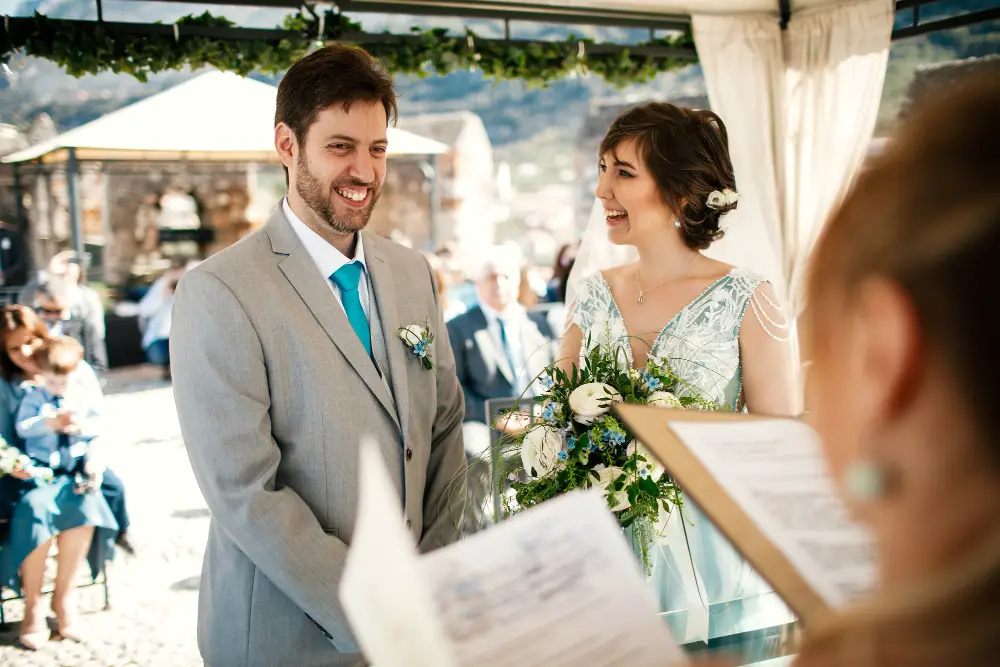
The ceremony was at a small venue outside the city, a converted farmhouse with a garden that had been lovingly tended for decades. I had chosen it partly for the garden, partly for the light, partly because it felt like a place where things grew slowly and lasted. The chairs were set up on the lawn in two sections with an aisle of grass between them, the kind of aisle that sounds simple but is actually exactly right.
We arrived to find everything already in motion: Priya directing the placement of flowers with the authority of a general, Owen’s aunt crying quietly and happily near the entrance, his cousin chasing a toddler across the garden. The day was October, which in this part of the world means a certain slanted gold light that makes everything look considered, like someone arranged it.
Leonard and I waited just inside the garden gate while Priya and the other bridesmaids walked in ahead of us. I could hear the music, something quiet and string-heavy that Owen had spent three weeks selecting.
“You know,” Leonard said, looking out at the rows of people, “I built my first house with my own hands when I was twenty-six. I thought that was the most nervous I would ever be.”
“And?”
“I was wrong.” He looked at me. “This is worse.”
“You’re not the one getting married.”
“No, but I have to walk in a straight line in front of eighty people, and my depth perception has never been what it was.”
I laughed. For a man who did not say he was trying to make me less nervous, he had done it effectively.
The gate opened. The music shifted. People turned.
I felt Leonard’s arm steady under my hand, the same solid steadiness of every conversation on his porch, every Sunday morning coffee, every small good thing he had done over six years without being asked or waiting for acknowledgment. We started walking.
I had told myself I would not look for my parents immediately. I told myself I would look at Owen, at Priya, at the familiar faces of friends. But I am human, and so my eyes moved briefly to the left side of the rows, near the back, where I had been told my family was sitting.
My father was on the aisle seat. He was watching. When he saw Leonard beside me, his face moved through several things in quick succession: confusion, recognition, something I can only describe as impact, the way a person looks when something lands. He did not stand. He did not make a scene. He simply sat very still, and for the first time in my memory, he looked genuinely small.
My mother had her hand pressed to her mouth.
Claire was next to her. She was looking at Leonard with an expression I recognized too. Not grief. Not guilt. Something closer to the expression of a person who has just understood the cost of a decision they made lightly.
I looked away. I looked at Owen.
He was standing at the end of the aisle with wet eyes and a smile that was not performing anything, not managing anything, just exactly what it was. He watched Leonard bring me to him, and when we reached the altar, he reached out and shook Leonard’s hand with both of his, the way you shake hands when a handshake has to carry more than a handshake usually does.
Leonard stepped back. He found his seat in the front row, the seat Priya had labeled with his name in her careful handwriting, and he sat down with the self-contained dignity of a man who knows he has done the right thing and does not need anyone to confirm it.
The officiant began.
I do not remember the ceremony the way I expected to remember it, in a linear way. I remember it in images. Owen’s hands around mine. Priya crying during my vows and trying not to. The sound of children somewhere in the back. The light on the garden. A monarch butterfly that appeared during the exchange of rings and landed on the altar arrangement and sat there for the entire duration, which nobody planned and everyone noticed.
When the officiant pronounced us married and Owen and I turned to face the assembled guests, I heard applause and some crying and then, from the front row, an enthusiastic single clap from Leonard that he quickly turned into proper applause when Priya leaned over and looked at him. I saw him mouth, “Sorry,” and then smile without being sorry at all.
The reception was on the lawn, tables set among the garden beds, string lights strung between the old maples at the edge of the property. People ate and talked and danced badly and well depending on their relationship with rhythm.
Leonard sat at the table I had placed him at, between Owen’s aunt who had been crying with happiness since arrival and my friend David from work, and the three of them appeared to become immediate friends on the basis of Leonard’s inexhaustible fund of moderately improbable stories from his career as a civil engineer and David’s genuine fascination with all of them.
My father came to find me during the cocktail hour. I was standing near the garden wall talking to Priya’s mother when I saw him approaching. Priya’s mother excused herself with the graceful social awareness she has always had.
My father looked older than I thought of him as being. He was sixty-two, healthy, not old in any practical sense, but he looked in that moment like a man who had been made aware of his own age. He held a glass of sparkling water and he did not quite know what to do with his free hand.
“The ceremony was beautiful,” he said.
“Thank you for coming.”
He looked past me at the garden, at the light. “That man,” he said. “Leonard. He’s your neighbor?”
“Six years.”
“He did a good job.” He paused. “He did the job I should have done.”
I did not help him with that sentence. I did not soften it or redirect it or absorb it on his behalf. I let it sit where he had placed it.
“I made the wrong choice,” he said. “I’ve been making the wrong choice with you for a long time, and I think some part of me has known it and done it anyway.”
“Why are you telling me this today?”
He looked at me. “Because I’m not sure you’ll give me many more chances to say it.”
I thought about that. “I don’t know if I will either,” I said. “But I hear you, Dad.”
He nodded. He put his hand briefly on my arm, the gesture of someone reaching across a distance they are not sure how to close, and then he walked back toward where my mother was sitting.
Claire did not come to find me. I saw her once during the reception, standing at the edge of the dancing with her arms crossed, watching. She looked neither happy nor particularly unhappy. She looked like someone who had expected to feel triumphant and found the feeling was unavailable. I did not go to her. There would be time for that conversation, or there would not, and today was not the day for it either way.
At seven o’clock, after dinner and the first dances, Leonard stood up for a toast.
He was not a natural public speaker. He held his glass too tightly and looked down at it while he found his words. But when he found them, they were his own.
“I moved into this neighborhood six years ago with most of my furniture sold and very few plans,” he said. “My wife had died. I didn’t know what to do next. And within about twenty minutes of arriving, my new neighbor was helping me carry a bookcase up my porch steps.” He glanced at me. “I did not ask her to do this. She just did it. That’s how she is.”
He was quiet for a moment.
“I have watched this woman work and build and grow for six years. I have watched her do it without needing acknowledgment or applause. I have watched her be the kind of person that makes the people around her better without realizing that’s what she’s doing.” He raised his glass. “Owen, you are a very lucky man. And Meredith, ” He stopped. Cleared his throat. “You deserve everything today. Every single part of it.”
He sat down quickly, the way people do when they are not sure they can maintain composure for another moment.
Priya was crying. Owen’s aunt was crying. David from work, who describes himself as not an emotional person, was pressing two fingers to his eyes and looking at the sky.
Owen leaned over and said something to Leonard quietly and Leonard nodded, and then Owen stood and shook his hand again, which was the second time in one day that a handshake was doing more than a handshake usually does.
At nine, after the dancing had wound down and the caterers were beginning their quiet industry of clearing plates and folding linens, I found a moment to stand alone at the edge of the garden. The lights were still strung in the maples. The air smelled of October and cut grass and the faint residue of the flower arrangements.
Leonard appeared beside me.
“You should be with your husband,” he said.
“I will be in a minute.” I looked out at the garden. “I just wanted to say thank you. Properly.”
“You don’t have to thank me.”
“I know I don’t have to. That’s why I’m doing it.”
He was quiet for a moment. The light caught the silver in his hair. “I didn’t have a daughter,” he said. “My wife and I, we tried. It didn’t happen. It was something we carried for a long time.” He glanced at me. “I’m not saying you’re a replacement for that. I’m not that sentimental or that confused. But I will say that this, ” He gestured vaguely at the whole evening, at the maples and the lights and the diminishing noise of a good day winding down. “This has been one of the finest things I’ve been part of in a long time.”
I put my arm around him the way you put your arm around someone who is family, not the arm around a shoulder kind but the side-by-side kind, both of you looking at the same thing.
“Me too,” I said.
We stood there for a minute in the comfortable silence of people who have been next-door neighbors for six years and know how to be quiet together.
Then Owen appeared at the edge of the light, looking for me, and I went to him.
A week after the wedding, I received a letter from my father. Handwritten, which surprised me. He is not a man who handwrites things. The letter was three paragraphs, and I will not reproduce it here because it belongs to him and to me and not to anyone else, but I will say that it contained the word sorry more times than I had ever heard from him in the preceding thirty-four years. It also contained a sentence that I have thought about since: “I have confused keeping the peace with being a good father, and they are not the same thing.”
I did not call him immediately. I left the letter on my desk and looked at it for several days and considered what I wanted from the future. The answer was not nothing. The answer was complicated, the way families are complicated, but it was not nothing.
I called him on a Wednesday evening, eleven days after the wedding. He picked up on the second ring.
The conversation was careful and not entirely comfortable and also, I thought, real in a way that our conversations had not often been.
It was a beginning.
Claire called two weeks after that. I was not ready for the conversation to go the way it needed to go, and I told her so, and she was quiet for a moment and then said, “Okay. When you’re ready.” It was, I thought, the most gracious thing she had said to me in years. Perhaps things break down before they improve, the way you sometimes have to strip a surface entirely before you can build it back right.
What I know is this: on the Saturday of my wedding, eighty people watched me walk down an aisle of grass in October sunlight on the arm of a man who had built his way into my life one genuine act at a time. He was not my father by birth. He was my family by the accumulation of six years of choosing to show up.
That is not a replacement. It is something different. Something you have to grow rather than inherit.
Leonard came for coffee the Sunday after we returned from our honeymoon, the first Sunday back, as if no time had passed. He sat on my porch in his usual chair and told me that the maple in his back garden had dropped most of its leaves while we were away and that he had raked them before they could blow onto my side, which he said in a practical tone but which I understood.
We drank our coffee. We argued about pruning. He was wrong and did not admit it. I was right and let it go.
Same as always. Same as ever.
The finest kind of ordinary there is.

Laura Bennett writes about complicated family dynamics, difficult conversations, and the quiet moments that change everything. Her stories focus on real-life tensions — inheritance disputes, strained marriages, loyalty tests — and the strength people find when they finally speak up. She believes the smallest decisions often carry the biggest consequences.